Best Alternatives to Kompass for B2B Prospecting & Global Trade
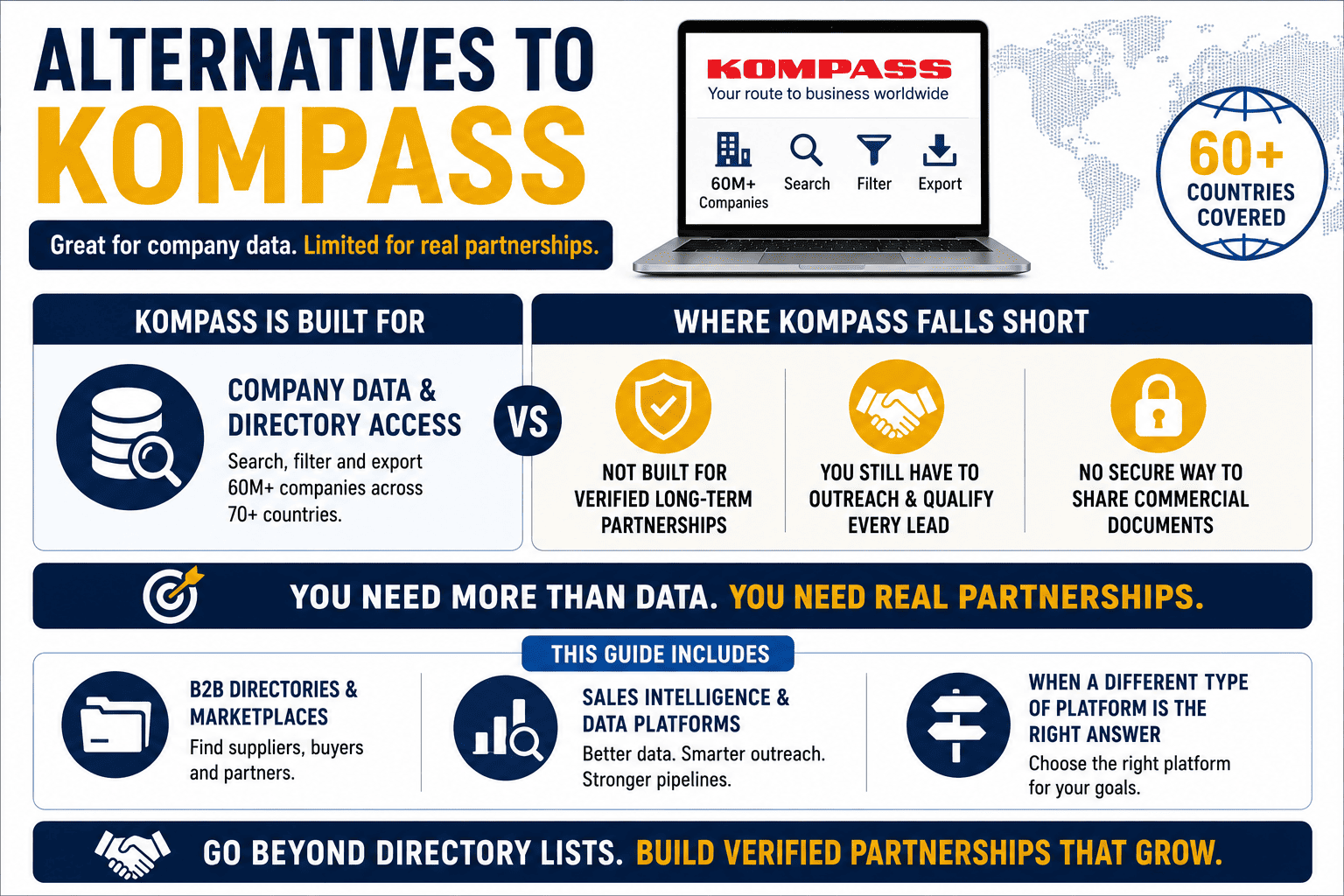
Kompass is one of the world’s oldest B2B company directories, with EasyBusiness giving sales and marketing teams a database of 60+ million companies across 70+ countries to search, filter, and export into a CRM. It does that job well. But if you are a manufacturer or distributor looking to find a verified long-term partner, rather than a list of company records to cold-contact yourself, Kompass’s directory-and-data model has real limits. This guide covers the best alternatives, broken into B2B directories and marketplaces, and sales intelligence and data platforms, and separately explains when a different type of platform altogether is the right answer.
📅 Published August 31, 2026⏱ 13 min read✍️ GTsetu Editorial🔄 Updated August 31, 2026
Kompass has been part of the B2B information landscape since 1947, and its EasyBusiness product remains a widely used tool for building prospect lists, researching suppliers, and enriching CRM data across more than 70 countries. But scale in a database creates its own limits. Records are self-reported or bulk-sourced rather than individually verified, outreach still has to be done manually once you’ve exported a list, and the platform’s architecture is built for search-and-export prospecting, not for the kind of structured, confidential engagement that long-term distributor and supply partnerships require.
This guide is organised around two separate needs: finding a Kompass alternative for B2B directory or marketplace-style discovery, and finding one for contact-level sales intelligence and data enrichment. We also explain, separately, why some manufacturers and distributors are not looking for another company database at all, but for a different type of commercial platform entirely, one built around B2B networking and verified leads rather than raw records.
💡 How to read this guide
Sections 2 and 3 cover direct Kompass alternatives, other directories, marketplaces, and sales intelligence tools. Section 5 explains the difference between company data platforms and long-term collaboration platforms, and is worth reading if you are finding that every directory gives you the same list-building experience.
Section 1
Why Businesses Look for Kompass Alternatives
The frustrations are consistent across industries and company sizes. Understanding them helps you pick the right alternative, because different alternatives solve different problems.
Data, not relationships. Kompass and comparable directories hand you a list of company records. Turning that list into an actual distributor or supply relationship still requires manual outreach, vetting, and negotiation entirely outside the platform.
Uneven data freshness. Company records at this scale are not individually re-verified on every visit. Contact details, ownership, and status can lag behind the real-world situation, particularly for smaller or overseas entities.
Rising subscription costs. Meaningful access to EasyBusiness-style search filters and export volumes sits behind paid tiers, and per-seat or per-export pricing can grow quickly for teams doing sustained international outreach.
Limited depth for long-term partner discovery. Kompass’s classification system is strong for finding who exists in a category and country, but it was not built to help you evaluate partnership fit or manage due diligence before you commit to a relationship.
No confidentiality infrastructure. There is no NDA workflow, no encrypted document sharing, and no way to protect pricing, formulations, or product specs when you move from a directory listing into real commercial conversations.
Self-reported or bulk-sourced profiles. Company identities are drawn from public filings and self-submitted data rather than being verified against government registries at the point of engagement, which matters for high-value or cross-border transactions.
📌 Key question before choosing an alternative
Are you looking for a bigger or cheaper company database (more of what Kompass does), or a different kind of commercial relationship, verified, structured, and built for the long term? The answer changes which platform is right for you. If you are looking for the former, Sections 2 and 3 cover the best alternatives. If the latter, go directly to Section 5.
Section 2
B2B Directory & Marketplace Alternatives
Company Discovery Platforms
The following platforms serve the discovery function Kompass performs, letting you search, filter, and find companies by category, geography, and product line, either as a pure directory or as a transactional marketplace layered on top.
1
Europages
Leading European B2B directory · manufacturer and distributor focus
Europe FocusDirectory
Europages is consistently cited alongside Kompass as one of the closest like-for-like competitors, particularly for European trade. It offers a searchable directory of manufacturers, distributors, wholesalers, and service providers across dozens of European countries, with multilingual listings and category-based browsing similar in spirit to Kompass’s product classification system.
Strengths
Deep European company coverage across most industry categories
Multilingual listings, useful for cross-border EU trade
Free basic listing tier for company visibility
Established brand recognition among European B2B buyers
Limitations
Weaker coverage outside Europe compared to Kompass’s 70+ countries
Self-reported profiles, no systematic verification
No contact-level data enrichment or CRM integration tools
No NDA or confidential document-sharing infrastructure
🎯
Best for: Businesses focused specifically on European manufacturer and distributor discovery who want a directory-style alternative without Kompass’s broader global data-licensing costs.
2
Alibaba.com
World’s largest B2B marketplace · maximum international buyer reach
Global ReachHigher Cost
Where Kompass is a searchable data directory, Alibaba is a transactional marketplace, buyers and suppliers can message, negotiate, and pay through the platform itself. For businesses that want to go beyond finding a company record to actually transacting, Alibaba’s Trade Assurance and integrated logistics offer a more complete workflow, at the cost of intense supplier competition and higher platform fees.
Strengths
Largest international buyer traffic of any B2B platform globally
Built-in messaging, negotiation, and Trade Assurance payment protection
Verified supplier badge options for premium members
Strong for consumer goods, industrial components, and raw materials
Limitations
High cost, premium plans and commissions significant for SMEs
Shared-lead model, buyers contact multiple suppliers at once
Transactional focus, not designed for distributor partnership engagement
No NDA or confidential document-sharing framework
🎯
Best for: Businesses that want to move past company discovery into direct transactions and can absorb Alibaba’s platform costs and competitive category pressure.
3
Global Sources
Premium Asia-Pacific B2B · trade-show verified, US and EU buyer focus
Premium QualityHigh Entry Cost
Global Sources connects Asian suppliers with buyers in North America and Europe, with trade show integration and verified supplier standards that give it a credibility edge over a general-purpose directory. It is particularly strong for industrial goods, electronics, and OEM manufacturing categories, where buyer quality and intent matter more than raw record volume.
Strengths
High-quality buyer profiles, US, EU, and Middle East focused
Trade show integration with physical and virtual events
Strong for electronics, industrial, OEM and ODM categories
Private messaging, shortlisting, and buyer alert tools
Limitations
Higher entry cost than most general company directories
Primarily Asia-sourcing focus, less useful for other regions
No partnership engagement framework or NDA tools
🎯
Best for: Businesses in electronics, OEM, and industrial goods targeting quality-screened buyers in North America and Europe, worth the premium over a general directory when buyer quality matters more than volume.
4
ExportersIndia
India-origin export directory and marketplace
India OriginExport-Ready
ExportersIndia is frequently listed as a Kompass alternative for businesses sourcing from or selling into India. It connects manufacturers, suppliers, and exporters with global buyers, generating a large volume of monthly business enquiries, at a more accessible price point than a global data-licensing platform, while covering categories like engineering, chemicals, agriculture, and handicrafts particularly well.
Strengths
India-specific export orientation with strong monthly enquiry volume
More affordable than premium global data platforms
Free company registration and responsive website creation
Multiple-language support for international buyers
Limitations
Narrower country coverage than Kompass’s 70+ country database
Self-reported profiles, no systematic buyer or seller verification
No contact-level data enrichment or CRM sync tools
🎯
Best for: Businesses sourcing from or exporting out of India who want an affordable directory-style channel alongside broader global data tools.
Wonnda takes a narrower, category-specific approach than Kompass’s broad company database. It is digital infrastructure connecting brands, manufacturers, and suppliers specifically around building consumer products, private-label and white-label sourcing for food and beverage, cosmetics, and household goods, rather than general-purpose B2B discovery.
Strengths
Purpose-built for private-label and white-label product sourcing
Curated manufacturer network rather than an open-ended directory
Strong fit for consumer brands seeking production partners
Limitations
Narrow category focus, not suited to industrial or raw material sourcing
Far smaller company base than a general directory like Kompass
No NDA or encrypted document-sharing infrastructure
🎯
Best for: Consumer brands specifically looking for private-label manufacturing partners, not a general Kompass replacement for other B2B categories.
Section 3
Sales Intelligence & Data Platform Alternatives
Prospecting & Data Enrichment Tools
These platforms compete most directly with Kompass’s EasyBusiness product, contact-level and company-level data for sales, marketing, and market research teams building outbound pipelines.
1
ZoomInfo
Leading go-to-market data and sales intelligence platform
Contact DataEnterprise Pricing
ZoomInfo is one of the most commonly cited direct Kompass competitors, offering detailed business information on people and companies, with intent data, technographic filters, and native integrations into major CRM and sales engagement tools. It generally leads on contact-level accuracy and North American coverage.
Strengths
Strong contact-level accuracy, especially in North America
Intent data and technographic filtering for targeted outreach
Deep CRM and sales engagement platform integrations
Limitations
Premium enterprise pricing, often costlier than Kompass
Weaker relative coverage outside North America and Western Europe
Still a data export tool, outreach and vetting remain manual
🎯
Best for: North America-focused sales and marketing teams who prioritise contact-level accuracy and CRM integration over Kompass’s broader international country count.
2
D&B Hoovers (Dun & Bradstreet)
Sales acceleration platform built on Dun & Bradstreet company data
Company RecordsGlobal Registry Data
D&B Hoovers draws on Dun & Bradstreet’s long-standing global business registry, giving it access to more than 120 million business records with financial and firmographic depth that Kompass’s directory model does not match. It is well suited to teams that need credit and risk context alongside contact discovery.
Strengths
Access to over 120 million business records globally
Strong financial and firmographic data depth via D&B’s registry
Enterprise-oriented pricing, less accessible for small teams
Steeper learning curve than a simple directory search
Still a data-export tool, not a partnership engagement platform
🎯
Best for: Mid-market and enterprise teams that want financial and credit-risk context alongside company discovery, not just a contact list.
3
Apollo.io
All-in-one sales intelligence and engagement platform
Sales EngagementLarge Database
Apollo.io pairs a B2B database of over 210 million contacts and 35 million companies with an outbound engagement suite, sequencing, dialling, and CRM sync in one product. Compared to Kompass’s search-and-export model, Apollo bundles the outreach step directly into the platform, which appeals to sales teams that want fewer tools in their stack.
Strengths
Very large combined contact and company database
Built-in engagement suite for sequencing and outreach
More accessible pricing tiers than several enterprise competitors
Limitations
Data quality varies by region compared to specialist providers
International coverage depth trails Kompass in some markets
No verification, NDA, or confidential engagement infrastructure
🎯
Best for: Sales teams that want database access and outbound engagement tooling bundled together rather than exporting Kompass records into a separate outreach tool.
4
SphereScout
Local business listing data for outbound prospecting
Local Listings100M+ Businesses
SphereScout addresses a specific gap in Kompass’s model: local-listing depth. Where Kompass profiles companies by classification and turnover, SphereScout starts from category, city, and region, pulling ratings, review counts, opening hours, and phone line types across 100 million-plus businesses. It is a workflow fit for outbound teams targeting local business segments rather than large industrial suppliers.
Strengths
Local listing depth: ratings, reviews, hours, socials, phone line type
Country, region, city, and category-level exports
Useful for outbound campaigns that qualify on freshness and reachability
Limitations
Not built for company research or industrial supplier discovery
Narrower than Kompass’s product/service classification system
No partnership verification or document-sharing tools
🎯
Best for: Teams running local outbound campaigns that need listing-derived fields like reachability and freshness, a workflow mismatch for Kompass’s company-research model, not a product defect.
5
Tendata
Global trade and customs data intelligence platform
Trade DataImport-Export
Tendata approaches company discovery through customs and shipment data rather than a self-reported directory, showing which companies are actually importing or exporting specific products, and how often. For manufacturers and distributors trying to identify active buyers rather than dormant directory listings, this transaction-based view can surface more qualified prospects than Kompass’s classification-based search.
Strengths
Customs and shipment-based data shows actual trade activity
Useful for identifying active importers/exporters by product
Market and competitor trade-flow analysis tools
Limitations
Coverage strongest for customs-reporting countries, gaps elsewhere
Trade data shows activity, not verified partnership readiness
No NDA or confidential document-sharing infrastructure
🎯
Best for: Manufacturers and distributors who want to identify companies with proven, active import/export behaviour rather than static directory listings.
Section 4
Side-by-Side Comparison
The table below compares all the platforms covered in this guide across the dimensions that matter most to businesses choosing between them.
Platform
Primary Model
Coverage
Verification
Outreach / Transaction
Best For
Kompass
Company directory / data
70+ countries
⚠ Self-reported
✗ Manual, off-platform
Broad global company research
Europages
Company directory
Europe-strong
⚠ Self-reported
✗ Manual, off-platform
European supplier discovery
Alibaba
Marketplace
Global
⚠ Paid option
✓ In-platform messaging & payment
High-volume international transactions
Global Sources
Marketplace
Asia-Pacific export
⚠ Trade show
⚠ Buyer-led enquiry
Industrial / OEM export to West
ExportersIndia
Directory / marketplace
India-origin export
⚠ Basic
⚠ Shared RFQ
Affordable India-linked reach
Wonnda
Sourcing marketplace
Consumer products, curated
⚠ Curated network
⚠ In-platform enquiry
Private-label product sourcing
ZoomInfo
Sales intelligence data
North America-strong
⚠ Data-sourced
✗ Manual, off-platform
Contact-level North American prospecting
D&B Hoovers
Sales intelligence data
Global registry-based
✓ Registry-sourced
✗ Manual, off-platform
Financial & credit-risk context
Apollo.io
Sales intelligence + engagement
Global, variable depth
⚠ Data-sourced
✓ Built-in outreach suite
Database + outreach in one tool
SphereScout
Local listing data
100M+ local businesses
⚠ Listing-derived
✗ Manual, off-platform
Local outbound campaigns
Tendata
Customs / trade data
Customs-reporting countries
⚠ Shipment-based
✗ Manual, off-platform
Active importer/exporter identification
💡 Pattern to notice
Whether it’s a directory, a marketplace, or a data-intelligence platform, every option above hands you a set of company records or a transaction channel and leaves the relationship-building to you. That is a legitimate model for prospecting. But it is structurally different from what happens when you need to formally verify and onboard a cross-border partner, which the next section covers.
Section 5
Company Data vs. Long-Term Collaboration: A Different Need Entirely
Here is a distinction that most platform comparisons do not make clearly enough: all of the platforms reviewed above, Kompass, Europages, ZoomInfo, D&B Hoovers, Alibaba, and the rest, are built around company or contact data discovery. You search, filter, export or message, and then the actual relationship-building happens off the platform, through your own outreach, vetting, and negotiation. This is a legitimate and well-served commercial need, and platforms like Kompass do it at genuine scale.
But there is a different commercial need that data directories are structurally unable to serve: finding and formalising a long-term distribution partnership.
This is a fundamentally different process. A manufacturer seeking a distributor in Germany, or a distributor in Nigeria seeking a manufacturer principal in India, is not looking for a company record to add to a spreadsheet. They are looking for a company they can trust with their commercial relationship for years, a partner they need to verify, align on terms with, exchange confidential documents with, and build a formal partnership agreement with. The search-and-export model of data directories is not designed for this, and it says nothing about how well the parties will actually work together, an evaluation better handled through structured partnership evaluation criteria and, where needed, clear dispute-resolution terms from the outset.
What you need
Data Directory (Kompass, ZoomInfo, etc.)
Long-term Collaboration Platform
Large, searchable company or contact database
✓ This is what they’re built for
✗ Not the purpose
Verified partner identity before engagement
✗ Self-reported or bulk-sourced profiles
✓ Government-sourced verification
Anonymous discovery, browse without revealing yourself
✗ Identity exposed from first search
✓ Anonymous until mutual interest
NDA before sharing pricing or product specs
✗ No framework exists
✓ Built-in NDA workflow
Encrypted document sharing with audit trail
✗ Email attachments or open links
✓ Encrypted workspace, full audit trail
International distributor discovery (100+ countries)
⚠ Records exist, but unverified for partnership
✓ Purpose-built for cross-border partnership
Zero commission on partnerships formed
⚠ Subscription or per-export cost required
✓ No success fee or broker commission
🤝 For Long-Term Industrial Partnerships
GTsetu: Purpose-Built for Manufacturers, Distributors, and Raw Material Suppliers Seeking Verified Long-Term Collaboration
If you are a manufacturer, distributor, or raw material supplier in an industrial sector, and you are looking for a verified long-term trade partner rather than a company record to cold-contact, GTsetu is built specifically for that purpose. It is not a directory. It is not a data provider. It is a structured partnership platform where every company is verified on 6 government-sourced points before engagement, where discovery is anonymous until mutual interest is confirmed, where NDAs are executed digitally before any commercial information changes hands, and where all document exchange happens through an encrypted workspace.
GTsetu is used by industrial manufacturers, distribution companies, and raw material suppliers across 100+ countries to find, vet, and formally engage with trade partners they intend to work with for the long term, whether that means building a distributor network, sourcing through international wholesale distributors, or supporting a broader global expansion strategy.
🏛️
6-Point Government-Sourced Verification
Name, Address, Registration Number, Company Status, Company Type, and Date of Incorporation, verified using government tie-ups before any engagement.
🕵️
Anonymous Discovery
Browse verified partner profiles across 100+ countries without revealing your own identity or commercial strategy until you choose to engage.
📄
Built-In NDA Workflow
Digital NDA with timestamped signatures before any pricing, formulations, or product specs are shared. No sensitive information exposed without protection.
🔐
Encrypted Document Workspace
All commercial documents shared through encrypted channels with a full access audit trail, not email attachments.
🌍
100+ Countries
Verified manufacturers and distributors across Asia, Middle East, Europe, Africa, Australia, and the Americas. Built for cross-border partnership formation, not raw record volume.
🚫
Zero Commission
No success fee, no broker commission, ever. Your partnership economics remain entirely between you and your partner.
Many manufacturers on GTsetu also use Kompass, Europages, or ZoomInfo for company research and outbound prospecting. These are complementary, not competing, activities. Kompass-style platforms handle discovery and data enrichment. GTsetu handles partnership-level engagement with verified companies in sectors like manufacturing, distribution, and raw materials supply, nationally and internationally. Most serious manufacturers who need both use both, alongside solid global market research and, where relevant, an international business development consultant.
Section 6
Which Platform Fits Your Goal?
Use this reference to match your commercial objective to the platform most aligned with it. Most businesses with more than one active commercial goal use two or three platforms in combination.
🔎
Search and export company records across 70+ countries
You want broad classification-based company discovery similar to Kompass’s core directory.
Europages + Kompass
📇
Build accurate contact-level prospecting lists
You need verified emails, phone numbers, and job titles for outbound sales in North America or Europe.
ZoomInfo + D&B Hoovers
✉️
Combine a database with built-in outreach tooling
You want to skip exporting lists into a separate sequencing tool.
Apollo.io
🌏
Transact directly with international buyers at scale
You want messaging, negotiation, and payment protection in one marketplace.
Alibaba + Global Sources
🚢
Identify companies with proven import/export activity
You want to prioritise active traders over static directory listings.
Tendata
📍
Run local outbound campaigns at listing depth
You need ratings, reviews, hours, and phone line type across local business segments.
SphereScout
🤝
Find a verified long-term international distributor
You need a serious partner to represent your products in a foreign market, not a company record.
GTsetu
🔒
Share sensitive commercial data securely with prospective partners
You need NDA protection and an encrypted workspace before sharing pricing, formulations, or product specs.
GTsetu (only platform with this)
FAQ
Frequently Asked Questions
QWhat is the best alternative to Kompass for B2B prospecting?
It depends on what you need Kompass to do better. For European company directory coverage, Europages is the closest like-for-like alternative. For contact-level sales intelligence in North America, ZoomInfo and D&B Hoovers lead the field. For outreach bundled with a database, Apollo.io is purpose-built. For marketplace-style buyer transactions, Alibaba and ExportersIndia offer international reach. For long-term distributor partnerships, where verification, confidentiality, and relationship structure matter, that is a different category of platform entirely, which is what GTsetu is built for in industrial sectors.
QIs Europages better than Kompass?
For European B2B company discovery, Europages and Kompass are broadly comparable, both established directories with similar search-and-list models. Kompass has broader global country coverage; Europages is often considered stronger specifically within Europe. Neither is definitively better for all businesses, many run both simultaneously to maximise coverage. For long-term distributor partnerships, both platforms have similar limitations: they are data directories, not partnership platforms.
QWhat is the difference between a B2B data directory and a long-term collaboration platform?
Data directories and sales intelligence tools like Kompass, ZoomInfo, and D&B Hoovers are designed to help you search, filter, and export company or contact records so you can reach out yourself. They optimise for database size and search precision. Long-term collaboration platforms like GTsetu are designed for manufacturers, distributors, and industrial suppliers to find, verify, and formally engage with partners they plan to work with for years, with features like government-sourced partner verification, anonymous discovery, NDA workflows, and encrypted document sharing that data directories do not have and are not architected for.
QCan I use GTsetu alongside Kompass?
Yes, and that is the most common usage pattern among industrial manufacturers. Kompass and comparable directories handle company research and outbound prospecting, a valid and ongoing commercial need. GTsetu handles a complementary and structurally different need: finding and formalising verified long-term trade partnerships, particularly cross-border ones. A business might use Kompass to research the competitive landscape in a country and GTsetu to identify and formally engage with a distribution partner there. These are entirely different commercial activities that do not overlap or conflict.
QWhat platforms are available for manufacturers seeking international distributors instead of a contact database?
For company or contact discovery through a directory or data-intelligence model, Kompass, Europages, ZoomInfo, and D&B Hoovers are the main options, each with different cost profiles and geographic strengths. However, these are search-and-export tools: they surface company records, not verified distributor partnerships. For manufacturers specifically seeking verified international distribution partners in sectors like manufacturing, distribution, and raw materials, GTsetu is purpose-built for that commercial objective, with government-sourced partner verification, anonymous discovery across 100+ countries, and a full NDA and document-sharing infrastructure.
QIs there a free alternative to Kompass?
Europages and ExportersIndia both offer free basic listing tiers for company visibility. Several data providers, including Apollo.io, offer limited free-tier contact lookups. For meaningful search volume and export capability, most platforms including Kompass require paid subscription plans. GTsetu offers free registration and access to browse verified partner profiles, and charges zero commission on any partnership formed, so the platform cost model is structurally different from subscription-based directories and data providers.
Looking for Long-Term Collaboration, Not Just a Company Database?
GTsetu is purpose-built for manufacturers, distributors, and raw material suppliers in industrial sectors seeking verified long-term trade partnerships, across 100+ countries, with government-sourced partner verification, built-in NDA workflows, and zero commission.
They represents the product, and research team behind GTsetu, a global B2B collaboration platform built to help companies explore cross-border partnerships with clarity and trust. The team focuses on simplifying early-stage international business discovery by combining structured company profiles, verification-led access, and controlled collaboration workflows.
With a strong emphasis on trust, and disciplined engagement, Team GTsetu shares insights on global trade, partnerships, and cross-border collaboration, helping businesses make informed decisions before entering deeper commercial discussions.