Why Eastern Europe Is Becoming a Strategic Manufacturing Partner for Global Companies | GTsetu Blog
Home ›
Blogs ›
Eastern Europe Manufacturing Partner
🏭 Global Sourcing & Manufacturing · 2026
Why Eastern Europe Is Becoming a Strategic Manufacturing Partner for Global Companies
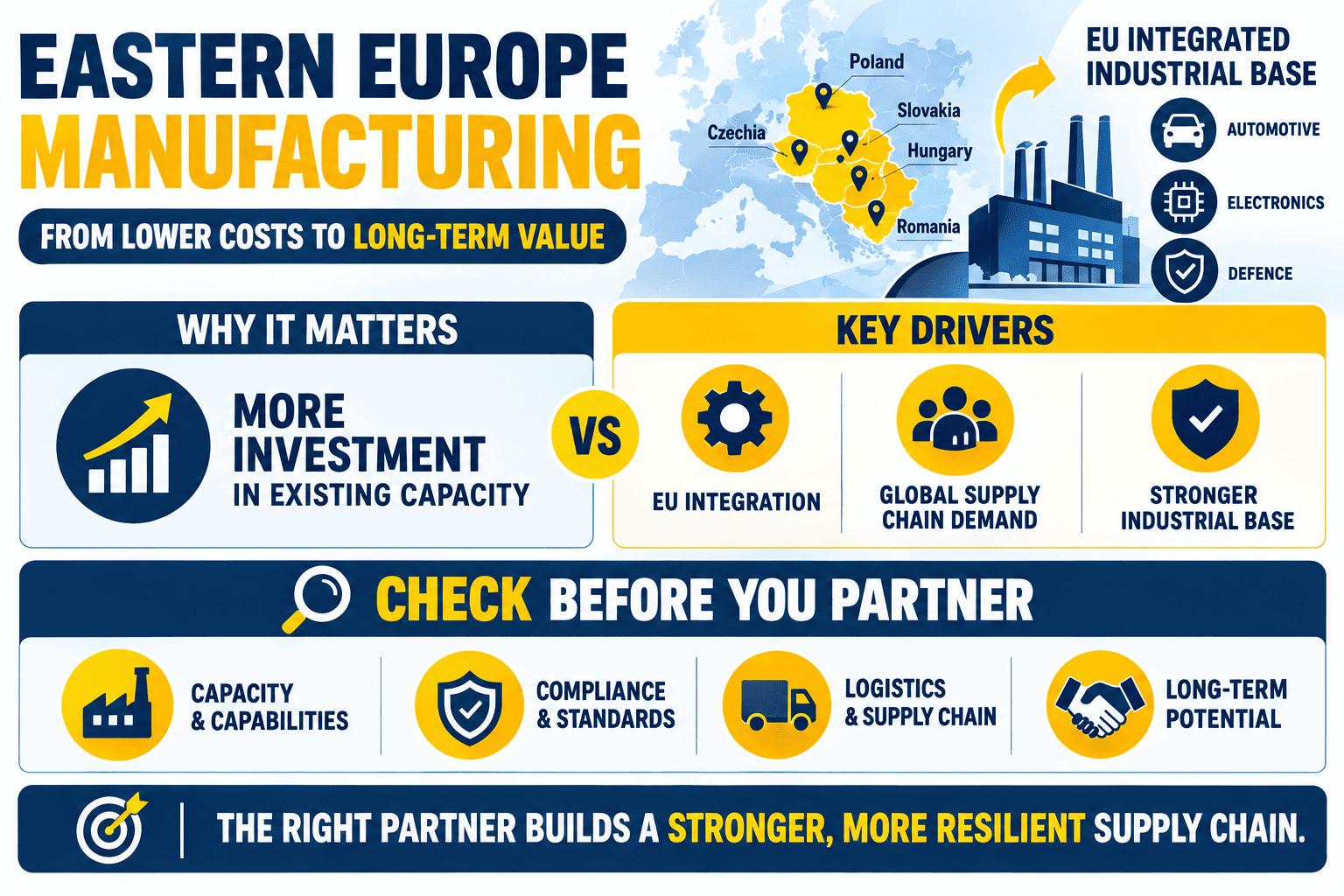
Eastern Europe’s manufacturing story has quietly shifted from “cheaper than Germany” to something more structural: an EU-integrated industrial base that global automakers, electronics brands, and now defence supply chains are building around rather than just buying from. That shift shows up in the pattern of investment, not just its size, existing manufacturers are deepening capacity in Poland, Romania, Hungary, Czechia, and Slovakia rather than simply testing the region and moving on. This article looks at what is actually driving that shift, where the region still has real gaps, and what a company needs to check before treating an Eastern European manufacturer as a long-term partner rather than a one-off supplier, alongside the wider context of cross-border manufacturing partnerships within global supply chains.
📅 Published June 25, 2026⏱ 12 min read✍️ GTsetu Editorial🔄 Updated September 7, 2026
For most of the post-Cold War period, Eastern Europe’s pitch to global manufacturers was a variation on one theme: lower wages than Western Europe, a location close enough to matter, and EU accession opening the door. That pitch still holds real truth. But the region moving today is not the region of a decade ago. Automotive OEMs are expanding electric-vehicle production in Hungary, defence and dual-use manufacturing is scaling across Poland, Romania, Czechia, and Slovakia, and companies once satisfied with a lower quote are now looking for durable cross-border business partnerships, not just cheaper capacity.
Section 1
Eastern Europe’s Manufacturing Position Today
The clearest evidence of the region’s shift is the type of investment landing there, not just its volume. According to Gergely Sos, Operational Director Eastern Europe at redi-Group, the region has developed from a mainly cost-driven production location into a strategically important part of Europe’s industrial network, with the automotive sector remaining one of its strongest pillars alongside growing activity in electronics, aerospace, defence, rail, and logistics.
5
Core CEE manufacturing economies KPMG highlights for industrial depth: Poland, Romania, Czechia, Slovakia, and Hungary
~€1,000
Approximate average gross monthly salary in Romania, versus over €4,000 in Germany, per Dragon Sourcing
Up to 50%
Share of eligible project costs covered by Hungarian investment grants for qualifying manufacturing FDI, per CE Interim
30 yrs
International quality and engineering experience redi-Group brings to its regional supplier-development network across Hungary, Romania, Slovakia, Czechia, and Poland
Behind these figures is a pattern worth noting: much of the region’s recent momentum is coming from manufacturers already operating there choosing to deepen their footprint, expanding electric-vehicle lines, opening new engineering centres, adding supplier-development capacity, rather than first-time entrants testing the water. That is a meaningfully different signal than a cold start. It suggests global manufacturers who have already run production in Eastern Europe are finding the experience good enough to build on.
💡 Why this distinction matters
New-entrant investment tells you a region is attractive on paper. Capacity-deepening investment from companies already operating there tells you the experience of actually running a plant has held up. Eastern Europe’s recent automotive and defence-industrial investment leans heavily toward the latter, a stronger signal for companies evaluating whether to commit to a regional manufacturing partner for the long term.
Section 2
Why Global Companies Are Choosing Eastern Europe
The Core Drivers
No single factor explains the region’s rise. It is a combination of EU market access, government incentives, engineering depth, and geography that together make Eastern Europe a lower-risk, higher-upside choice than a purely cost-driven comparison would suggest.
Most Eastern European manufacturing hubs, Poland, Hungary, Romania, Czechia, Slovakia, and the Baltic states, are full EU members, which means goods produced there move tariff-free and largely friction-free into every other EU market. Dragon Sourcing notes this membership grants tariff-free trade and simplified cross-border logistics, positioning countries like Poland, Hungary, and Romania as gateways to Western Europe and beyond.
🎯
Why it matters: A product made in Poland or Romania reaches Germany, France, or the Netherlands under the same regulatory and customs regime as a product made domestically. That is a structural advantage no non-EU sourcing destination can fully replicate for European-bound goods.
2
Sustained Government Incentives for Manufacturing FDI
Special economic zones, investment grants, tax relief
Policy Driven
Governments across the region actively compete for manufacturing investment. Poland’s Special Economic Zones offer tax exemptions, reduced land prices, and simplified regulations; Hungary provides investment grants covering up to 50 percent of eligible project costs; and Slovakia and Bulgaria offer comparable packages, according to CE Interim. Serbia has also streamlined procedures for establishing new manufacturing plants.
🎯
Why it matters: Layered, competing national incentive programmes give manufacturers real room to negotiate favourable terms, provided they understand which package actually applies to their project and location.
3
Deep Automotive and Engineering Base, Now Widening
Automotive, electronics, IT, and an expanding defence-industrial layer
Sector Depth
Poland, Hungary, and Czechia host manufacturing plants for major automotive brands including Volkswagen, BMW, and Audi, per Dragon Sourcing, while Romania and Bulgaria have built strong positions in IT services and electronics assembly. KPMG’s regional analysis adds that the same industrial base, precision machining, metallurgy, electronics, and software, built over three decades, is now also underpinning a fast-scaling defence and dual-use manufacturing layer across Poland, Romania, Czechia, Slovakia, and Hungary.
🎯
Why it matters: A supplier base built for automotive-grade process discipline transfers readily into other demanding sectors, giving global buyers a wider set of use cases than a single-industry cluster would allow.
4
Proximity to Western Europe and a Credible Nearshoring Case
Shorter lead times, easier oversight, reduced concentration risk
Nearshoring
Eastern Europe’s geography keeps manufacturers close to critical markets like Germany and France, cutting transportation costs and delivery times while easing integration with existing supply chains, according to CE Interim. As rising costs and stricter regulation reshape Western European operations, that proximity has turned Eastern Europe into a genuine nearshoring alternative to long-distance Asian sourcing for companies prioritising responsiveness over the lowest possible unit cost.
🎯
Why it matters: Shorter, more visible supply chains reduce the concentration risk that a single distant region can create, a board-level priority for most global manufacturers pursuing global expansion today.
Section 3
Which Sectors Are Driving the Region’s Growth
Eastern Europe’s manufacturing strength is spread across several distinct clusters, each with its own country-level centre of gravity. Understanding which country leads which sector matters more than treating the region as a single homogeneous market when scoping an international sourcing decision.
Sector
Leading Countries
Positioning
Trend
Automotive & Components
Poland, Hungary, Czechia, Slovakia
Established OEM plants and Tier 1/2 supplier base
↑ EV investment expanding
Electronics & IT
Romania, Bulgaria, Poland
Skilled-workforce assembly and software-linked manufacturing
↑ Steady growth
Defence & Dual-Use Manufacturing
Poland, Romania, Czechia, Slovakia, Hungary
Fastest-growing investment category per KPMG
↑ Fastest-growing segment
Textiles & Apparel
Poland, Bulgaria
Established supply-chain infrastructure
→ Stable
Agriculture & Food Processing
Hungary, Romania
Grains, vegetables, meats, and processed foods
→ Stable
Rail, Aerospace & Industrial Equipment
Czechia, Hungary, Romania, Poland
Growing beyond automotive into adjacent engineering-heavy sectors
↑ Early but expanding
The direction of travel matters as much as current scale. redi-Group’s regional leadership points to electromobility, battery production, and digitalised quality management as the trends most likely to shape the next few years, alongside continued opportunity in aerospace, defence, and industrial engineering, sectors that bring similarly high requirements for process stability, documentation, and traceability. Companies sourcing from the region today are increasingly dealing with suppliers investing in their own engineering capability, not just their production capacity.
Section 4
The Challenges Eastern Europe Still Has to Solve
None of this makes Eastern Europe a frictionless choice. Several structural issues are well documented and worth weighing honestly before committing to a regional manufacturing partnership.
The speed of new-site ramp-ups outpaces the speed of process maturity. Production equipment can be installed quickly, but redi-Group notes that building stable processes, developing qualified suppliers, and establishing experienced local organisations takes considerably longer, a gap that becomes visible during new-plant launches and ramp-ups.
Skills shortages in engineering, quality, and technical management. Suppliers may have strong technical capabilities while still adapting to demanding international customer requirements such as structured problem-solving, process audits, and APQP, and skills shortages add another layer of complexity, per redi-Group’s regional director.
Rising labour costs narrow the pure cost advantage. Wages have climbed steadily even as the region remains cheaper than Western Europe, meaning the low-cost case that first attracted investors has narrowed and the value proposition is shifting toward productivity and engineering depth.
Regulatory and incentive variation between countries. Dragon Sourcing points out that each country in the region has its own regulations and compliance requirements, which can vary significantly, making a single pan-regional playbook risky without country-specific verification.
Cross-plant quality risk in complex, multi-technology supply chains. Conventional, hybrid, and electric technologies now run in parallel across multiple production locations and supplier levels, so a quality issue at one sub-supplier can affect several plants within a short period, requiring both fast local response and root-cause engineering depth.
📌 The honest read
Eastern Europe’s competitive position is not likely to erode quickly, but the region is mid-transition: from being valued mainly for cost to being valued for productivity, engineering capability, and process discipline. Companies building a long-term manufacturing relationship there should plan for that shift rather than assuming today’s cost profile stays static for the life of the partnership.
Section 5
Eastern Europe vs. Asian Manufacturing Hubs
Eastern Europe is not competing to be the cheapest option in the world; it is competing on proximity, EU access, and process maturity. For companies weighing it against established Asian sourcing destinations, the trade-offs tend to run along fairly consistent lines.
Factor
Eastern Europe
Established Asian Hubs
Market access
Full EU single-market membership for most countries
Depends on bilateral and regional trade agreements
Rising in established hubs, lower in newer entrants
Regulatory environment
Harmonised EU standards, but country-specific variation
Varies significantly by country
Best fit for
EU-bound goods, complex or regulated products needing close oversight
High-volume, cost-sensitive production for global distribution
Most global manufacturers running a diversification strategy are not choosing Eastern Europe instead of Asia; they are building a multi-region sourcing footprint that uses each for what it does best, mirroring the broader pattern seen in other rising manufacturing regions, including emerging clusters like the Nigerian industrial and agro cluster. That approach reduces concentration risk further than committing to one alternative destination, but it also means a company will likely need to evaluate more than one manufacturing partnership at once, using consistent partnership evaluation criteria across markets.
Section 6
Vetting and Formalising an Eastern European Manufacturing Partnership
Regional momentum does not de-risk an individual supplier relationship. A promising country-level trend still leaves a company needing to answer very specific questions about a specific factory: is it legally registered, does it have the production capacity and quality processes it claims, what happens if a shipment is delayed by a force majeure event, and who owns the specifications once they are shared. This is where most sourcing decisions actually succeed or fail.
🏛️
Confirm legal registration and business status
Verify the company’s registration, incorporation date, and current standing in its specific country before any commercial discussion goes further.
Government-sourced verification
📄
Protect specifications and pricing before you share them
Put a formal NDA in place, and follow it with a proper business partnership contract, before sensitive product or pricing data changes hands.
NDA-first engagement
📜
Check certifications relevant to your export markets
Review how the agreement handles disruption, including force majeure in global trade, before signing, not after a shipment is delayed.
Contract terms review
🔬
Research the specific country and incentive scheme, not just the region
Incentive packages, labour availability, and compliance requirements vary significantly by country; a tailored market study for manufacturers can uncover this before capital is committed.
🤝 For Verified Long-Term Manufacturing Partnerships
GTsetu: Verified Discovery and Secure Engagement for Manufacturers, Distributors, and Raw Material Suppliers
Eastern Europe’s investment numbers explain why the region is worth serious consideration. They do not tell you whether a specific manufacturer in Poland, Romania, or Hungary is who they claim to be, or whether your product specifications will stay confidential during early-stage discussions. That gap is what GTsetu is built to close. It is a structured partnership platform, not a directory or a general marketplace, where every company is verified on 6 government-sourced points before engagement, where discovery is anonymous until mutual interest is confirmed, where NDAs are executed digitally before any commercial information changes hands, and where document exchange happens through an encrypted workspace rather than email attachments.
GTsetu is used by industrial manufacturers, distributors, and raw material suppliers across 100+ countries, including across Eastern Europe, to build out a distributor network, source international wholesale distribution partners, or find manufacturing and technology partnership relationships they intend to keep for years, not a single order cycle. It complements, rather than replaces, on-the-ground factory audits and country-level research, but it removes much of the identity and documentation risk before that deeper diligence even begins.
🏛️
6-Point Government-Sourced Verification
Name, Address, Registration Number, Company Status, Company Type, and Date of Incorporation, verified using government tie-ups before any engagement.
🕵️
Anonymous Discovery
Browse verified manufacturer and distributor profiles across 100+ countries without revealing your own identity or sourcing strategy until you choose to engage.
📄
Built-In NDA Workflow
Digital NDA with timestamped signatures before any pricing, formulations, or product specs are shared. No sensitive information exposed without protection.
🔐
Encrypted Document Workspace
All commercial documents shared through encrypted channels with a full access audit trail, not email attachments.
🌍
100+ Countries, Including Eastern Europe
Verified manufacturers and distributors across Europe, Asia, the Middle East, Africa, Australia, and the Americas. Built for cross-border partnership formation, not one-off quotes.
🚫
Zero Commission
No success fee, no broker commission, ever. Your partnership economics remain entirely between you and your partner.
It is also worth noting that Eastern Europe is far from the only region rewriting global sourcing maps. Manufacturers evaluating diversification often run parallel conversations across multiple regions at once, comparing CEE’s EU-integrated base against Southeast Asian hubs and emerging clusters elsewhere. A platform built for B2B matchmaking across countries, rather than one built around a single geography, makes it easier to run that comparison with consistent verification standards throughout.
FAQ
Frequently Asked Questions
QWhy are global companies choosing Eastern Europe as a manufacturing partner?
Eastern Europe combines EU single-market access, a mature automotive and electronics supplier base, competitive labour and operating costs relative to Western Europe, and geographic proximity to major European customers. Companies pursuing nearshoring and supply chain diversification away from long, single-region supply lines have made countries like Poland, Romania, Hungary, the Czech Republic, and Slovakia some of the most active manufacturing relocation destinations in Europe, and recent investment data shows existing manufacturers deepening their commitment through EV production, engineering centres, and defence-industrial capacity rather than just testing the market.
QIs Eastern Europe still a low-cost manufacturing destination?
Eastern Europe remains cost-competitive relative to Western Europe, with average wages, roughly €1,000 a month in Romania versus over €4,000 in Germany, still well below Western European levels, but rising labour costs, skills shortages, and demographic pressure mean the region’s advantage is shifting from pure low cost toward productivity, engineering depth, and higher value-added output. Government programmes across the region increasingly target higher-tech manufacturing and supplier development rather than cost alone.
QWhat are the main risks of manufacturing in Eastern Europe?
Common risks include skills shortages in engineering, quality, and technical management roles, the speed at which new plants and supplier networks are expected to reach stable quality levels, uneven infrastructure outside established industrial clusters, demographic and brain-drain pressure on the regional workforce, and country-by-country variation in regulation and incentive schemes. Verifying a manufacturing partner’s registration, capacity, and quality track record before committing is essential, and building contingency terms for disruption into the contract from the outset matters just as much.
QHow should a company vet a manufacturing partner in Eastern Europe?
Beyond a standard factory audit, companies should verify legal registration and business status, confirm actual production capacity and quality processes against claimed capability, check which certifications and incentive programmes actually apply, and put a formal agreement and confidentiality protections in place before sharing sensitive specifications or pricing. Platforms built for verified B2B partnership formation, rather than general directories or RFQ marketplaces, can substantially reduce this due diligence burden by handling identity verification and document security upfront.
QShould a company choose Eastern Europe or an Asian hub for manufacturing diversification?
It depends on the product and priority. Eastern Europe tends to suit EU-bound goods and complex or regulated production where proximity, oversight, and single-market access matter most. Established Asian hubs tend to suit high-volume, cost-sensitive production for global distribution. Many global manufacturers are not choosing one over the other; they are building sourcing footprints that use both, alongside other emerging regions, for what each does best.
Considering Eastern Europe for Your Next Manufacturing Partnership?
GTsetu is purpose-built for manufacturers, distributors, and raw material suppliers in industrial sectors seeking verified long-term trade partnerships, across 100+ countries including Eastern Europe, with government-sourced partner verification, built-in NDA workflows, and zero commission.
They represents the product, and research team behind GTsetu, a global B2B collaboration platform built to help companies explore cross-border partnerships with clarity and trust. The team focuses on simplifying early-stage international business discovery by combining structured company profiles, verification-led access, and controlled collaboration workflows.
With a strong emphasis on trust, and disciplined engagement, Team GTsetu shares insights on global trade, partnerships, and cross-border collaboration, helping businesses make informed decisions before entering deeper commercial discussions.