How Do You Compare Multiple Suppliers Before Choosing One? | GTsetu Blog
Home ›
Blogs ›
Compare Multiple Suppliers Before Choosing
📊 Procurement & Supplier Strategy · 2026
How Do You Compare Multiple Suppliers Before Choosing One?
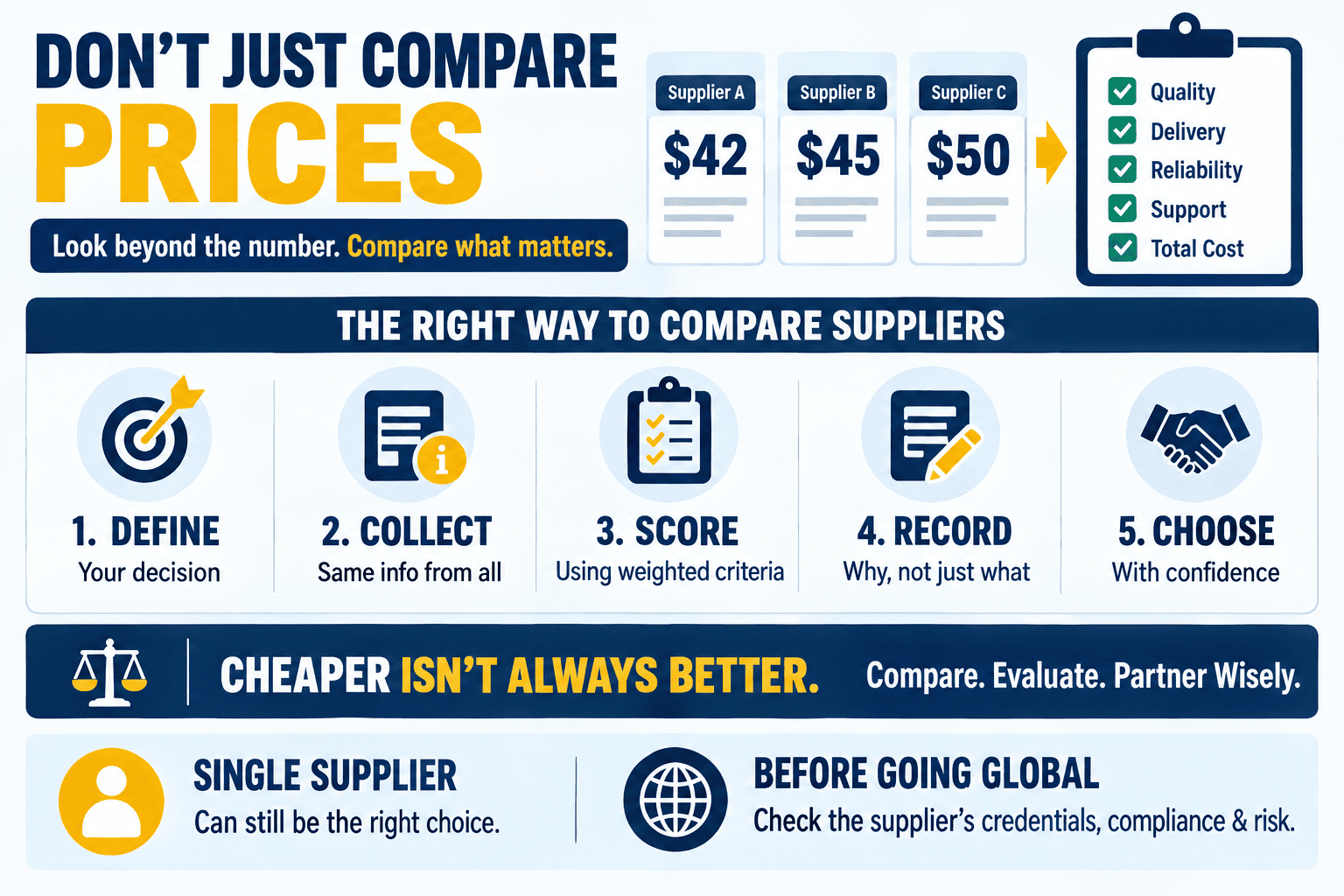
Three quotes land on your desk: $42, $45, and $50 for the same item. The instinct is to take the cheapest one and move on. That instinct is also the single most common way procurement decisions go wrong, because a price is not a comparison, it is one column in a much longer table. Comparing multiple suppliers properly means defining what decision you are actually making, collecting the same information from everyone, scoring each supplier against the same weighted criteria, and writing down why, not just what, before you commit. This article walks through that framework end to end, including where a single-supplier relationship still beats a multi-supplier one, and what to check before you formalise any cross-border business partnership with the supplier you pick.
📅 Published July 2, 2026⏱ 11 min read✍️ GTsetu Editorial🔄 Updated September 8, 2026
Buyers face this scenario constantly: multiple supplier quotes arrive, each looking reasonable on its own, and the pressure is to decide quickly. The real challenge was never collecting the quotes. It is comparing them intelligently enough that the decision still looks sound six months later, after the order has shipped, the invoice has landed, and something has inevitably gone slightly differently than promised.
Section 1
Why Supplier Comparison Usually Goes Wrong
Most flawed supplier decisions do not come from a lack of effort. They come from a comparison process that was too informal to support a repeatable, defensible choice. According to Jodoo’s guidance on vendor comparison, many supplier decisions are shaped by partial information, one team focuses on price, another on delivery speed, a third remembers past frustration with a supplier but has no consistent record to back it up. Without a shared framework, comparisons tend to run into the same handful of problems every time.
1 price
column is usually the only thing rushed comparisons actually align on, per Jodoo’s procurement research
93%
of supply chain executives are now prioritising flexibility, resilience, and agility in sourcing, per McKinsey, cited by Akirolabs
68%
of organisations say recent supply chain crises forced them to adapt their business model, per Capgemini, cited by Akirolabs
5 factors
Hyperbots identifies as the core elements of any structured supplier comparison: cost, delivery, quality, financial risk, and scalability
Trustbridge’s procurement guidance frames the core failure mode simply: the instinct to choose the lowest price is a trap that can cost far more than the initial savings, because a lower price can hide quality compromises, delivery delays, or hidden fees that only emerge after commitment. Without a structured comparison, buying decisions become guesses dressed up as strategy.
💡 The reframe that fixes most comparisons
Fair comparison does not mean every supplier is equal, and it does not mean removing judgement from the decision. It means every supplier is assessed through the same method, with the same inputs, so the trade-offs between them become visible instead of buried in a gut feeling nobody can defend later.
Section 2
A Framework for Comparing Suppliers Fairly
A Repeatable Six-Step Process
Jodoo’s procurement research lays out a structured sequence that scales from a single sourcing decision to a recurring supplier review cycle. Each step exists to remove one specific source of bias or missing information from the comparison.
1
Define the Purpose of the Comparison
New supplier, renewal, replacement, or a routine quote review?
Scope First
Before scoring anyone, clarify what decision is actually being made. A supplier-replacement decision after performance issues should weight reliability and transition risk heavily. A routine sourcing comparison may lean more on pricing, lead time, and documentation readiness. Without a defined purpose, teams end up comparing suppliers without agreeing on what “better” even means.
🎯
Why it matters: Two people can look at the same set of quotes and reach opposite conclusions if they are silently optimising for different outcomes. Naming the decision first prevents that.
2
Collect the Same Information From Every Supplier
Pricing, scope, lead time, certifications, references, terms
Consistent Inputs
If one supplier is scored using detailed information and another is assessed from incomplete notes, the comparison is already uneven before scoring even starts. Trustbridge’s guidance adds a sharper version of this same rule for quotes specifically: use a standardised RFQ that clearly defines what every quote must include, and if a quote arrives incomplete, send a follow-up request rather than filling the gap with an assumption.
🎯
Why it matters: A $42 quote and a $50 quote are not comparable at all if one excludes installation, warranty support, or a compliance certificate the other includes.
3
Score Every Supplier Against the Same Weighted Criteria
A vendor scorecard does not need to be complex. Simple 1–5 ratings per category, low/medium/high labels for risk-related criteria, or weighted scoring where certain categories matter more, all work. The advantage is not that scoring makes the decision automatic; it is that it makes trade-offs visible. A supplier may be cheapest but weaker on compliance. Another may cost more but be stronger on delivery reliability and support.
🎯
Why it matters: Not every criterion deserves equal weight. A packaging supplier for a low-risk category should be scored differently from a strategic supplier whose failure would affect delivery timelines or customer commitments.
4
Record Notes Behind Every Score, Not Just the Number
Why a score is low matters as much as the score itself
Documented Evidence
If a supplier receives a lower score for quality, delivery, or compliance, the reviewer should record why. A score alone shows a supplier is weaker; a note explains whether the weakness is minor, temporary, or serious enough to affect the outcome. Trustbridge’s research frames this the same way from the buyer’s side: undocumented decisions are hard to defend when questioned later, and provide no learning for future sourcing cycles.
🎯
Why it matters: Written context is what lets a team justify the decision later, spot patterns across suppliers, and revisit the call fairly if conditions change.
Section 3
The Criteria That Actually Belong on Your Scorecard
Hyperbots defines supplier comparison as the structured process of evaluating and contrasting multiple suppliers based on performance, cost, capability, risk, and strategic value, in order to make data-driven sourcing decisions rather than instinctive ones. The exact weighting will vary by category and spend level, but most experienced procurement teams converge on a similar set of criteria.
Criterion
What It Actually Measures
Why Buyers Skip It (and Shouldn’t)
Total Cost of Ownership
Price plus freight, duties, rework, warranty, and payment terms, not just the quoted unit price
Headline price is easiest to compare, so it dominates by default
Quality Consistency
Whether the supplier meets specification reliably, order after order, not just on the sample
Hard to verify without references or a documented track record
Delivery Reliability
On-time performance and how the supplier communicates when a delay is coming
Often assumed rather than checked against real history
Compliance & Documentation
Certifications, registration status, and whether required paperwork is current
Invisible until an audit or a customs hold forces the question
Financial Stability & Risk Exposure
Whether the supplier can absorb a shock without failing to deliver
Rarely checked for anything below a major strategic supplier
Responsiveness & Communication
How clearly and quickly the supplier handles follow-up, problems, and change requests
Only becomes visible once something has already gone wrong
Trustbridge’s guidance adds a useful segmentation on top of this list: once you have compared multiple quotes, you can classify suppliers by value proposition, some compete purely on price and suit non-critical commodities, others differentiate on quality or service and suit critical components, and a smaller group offers balanced value suited to longer strategic partnerships. Matching the supplier type to the category, rather than applying one standard to everything, is where a scorecard turns into an actual sourcing strategy.
📌 A quick sense check on price
Trustbridge’s research offers a useful benchmark: if three suppliers consistently quote within a narrow band for the same component, a quote significantly above that range is likely overpriced, and a quote significantly below it deserves scrutiny for hidden compromises rather than automatic celebration.
Section 4
Single Supplier vs. Multiple Suppliers: Which Should You Choose?
Comparing suppliers eventually raises a bigger question than which one wins this round: should you be sourcing from one supplier at all, or spreading the same category across several? Blue Link ERP frames this as a core sourcing-strategy decision, and Akirolabs adds that the choice is a risk multiplier or a resilience enabler depending on how it is made.
Factor
Single-Supplier Sourcing
Multi-Supplier Sourcing
Relationship depth
Stronger, more collaborative; easier to negotiate favourable long-term terms
Shallower per supplier, but reduces reliance on any one relationship
Pricing leverage
Volume discounts from consolidated spend
Ongoing competitive pressure between suppliers on price and service
Administrative load
Lower; one contract, one set of invoices, one scorecard
Higher; more contracts, POs, and performance reviews to manage
Disruption risk
High; a single point of failure if the supplier is disrupted
Lower; other suppliers can absorb volume if one is disrupted
Best fit for
Mission-critical, proprietary, or highly customised categories where quality and IP protection are non-negotiable
High-volume, commoditised, or business-critical categories where continuity matters most
Akirolabs’ guidance highlights five factors worth running through before deciding either way: category criticality, market concentration, innovation needs, the cost-versus-resilience trade-off, and compliance or ESG requirements. A proprietary aerospace component and a box of packaging tape do not belong on the same sourcing model, even inside the same company.
Section 5
Common Mistakes That Undermine a Comparison
Even teams that intend to compare suppliers carefully fall into a short, repeating list of traps. Trustbridge and Jodoo’s research converge on largely the same failure points, which is itself a signal of how common they are.
Ranking on price before scope is normalised. A lower price is often just a less complete quote, missing installation, warranty coverage, or post-launch support that a competing supplier included by default.
Using inconsistent criteria across suppliers. If one supplier is judged mainly on price and another mainly on relationship history, the comparison was never actually apples-to-apples.
Ignoring supplier track record and financial stability. A new supplier quoting aggressively low may lack the resources to deliver consistently; an established supplier quoting higher may be paying for predictability the spreadsheet doesn’t show.
Scoring without evidence. A number with no note behind it cannot be defended later and offers no learning for the next sourcing cycle.
Deciding in isolation. Leaving out quality, engineering, or finance stakeholders risks missing requirements or constraints that only surface after the contract is signed.
⚠️ The pattern behind most bad supplier decisions
It’s rarely that buyers didn’t try. It’s that the comparison process was informal enough to let one loud variable, usually price, drown out several quieter ones that mattered more by the time the order actually shipped.
Section 6
From Scorecard to Signed Agreement
A scorecard tells you who should win. It does not protect you once they do. The step most comparisons skip entirely is turning the winning score into an actual, enforceable relationship, verifying who the supplier legally is, protecting what you share with them, and agreeing in writing what happens when something goes wrong.
🏛️
Confirm legal registration and business status
A scorecard is only as reliable as the identity behind it. Verify registration and current standing before commercial terms go further.
Government-sourced verification
📄
Put a formal agreement in place before volume ramps up
Turn the winning scorecard into a proper business partnership contract that reflects the terms actually compared, not just a verbal handshake on price.
Contract-first engagement
📜
Verify the certifications you scored, not just the ones claimed
Delivery reliability is a scorecard category for a reason. Cover force majeure in global trade in the contract before the first disruption, not during it.
Contingency terms
🔬
Validate the comparison with independent market research
Cross-check your scorecard’s cost and capability assumptions against a proper market study for manufacturers before scaling the order.
Location-level research
🤝
Bring in expert support for a first-time, high-stakes comparison
🤝 For Verified Long-Term Manufacturing Partnerships
GTsetu: Verified Discovery and Secure Engagement for Manufacturers, Distributors, and Raw Material Suppliers
A scorecard only works if the numbers going into it are real. GTsetu is built to close that gap before comparison even starts. It is a structured partnership platform, not a directory or a general marketplace, where every company is verified on 6 government-sourced points before engagement, where discovery is anonymous until mutual interest is confirmed, where NDAs are executed digitally before any commercial information changes hands, and where document exchange happens through an encrypted workspace rather than email attachments.
GTsetu is used by industrial manufacturers, distributors, and raw material suppliers across 100+ countries to run exactly this kind of side-by-side comparison, whether the goal is building out a distributor network, sourcing international wholesale distribution partners, or finding a technology partnership meant to last for years, not a single order cycle. It complements a scorecard rather than replacing it, but it removes much of the identity and documentation risk before the scoring even begins.
🏛️
6-Point Government-Sourced Verification
Name, Address, Registration Number, Company Status, Company Type, and Date of Incorporation, verified using government tie-ups before any engagement.
🕵️
Anonymous Discovery
Browse and compare verified manufacturer and distributor profiles across 100+ countries without revealing your identity or sourcing strategy until you choose to engage.
📄
Built-In NDA Workflow
Digital NDA with timestamped signatures before any pricing, formulations, or product specs are shared during comparison.
🔐
Encrypted Document Workspace
Quotes, specifications, and scorecard evidence stored through encrypted channels with a full access audit trail, not email attachments.
🌍
100+ Countries to Compare Across
Verified manufacturers and distributors across Asia, Europe, the Middle East, Africa, Australia, and the Americas, for a genuinely apples-to-apples comparison.
🚫
Zero Commission
No success fee, no broker commission, ever. Your comparison and your partnership economics stay entirely between you and the supplier.
A structured comparison also travels well across markets. Whether you are weighing suppliers in an established hub or scoping newer clusters such as the Nigerian industrial and agro cluster, the same criteria and scorecard logic apply. A platform built for B2B matchmaking across countries, rather than one tied to a single geography, makes it far easier to run that comparison with consistent verification standards from one market to the next, especially as part of a broader global expansion or international materials sourcing effort.
FAQ
Frequently Asked Questions
QHow do you compare multiple suppliers before choosing one?
Define what decision you are actually making, collect the same information from every supplier, score each one against the same weighted criteria, such as price, quality, delivery, compliance, and responsiveness, and record notes behind every score, not just the number. A scorecard does not remove judgement; it gives judgement a consistent structure so the final choice is easier to defend and repeat.
QShould you always choose the supplier with the lowest price?
No. The lowest quoted price often hides quality compromises, incomplete scope, or slower delivery that costs more later. Buyers should compare total cost of ownership, not just the headline number, and only treat price as the deciding factor once quality, delivery, and reliability are genuinely equal across suppliers.
QWhat criteria matter most when comparing suppliers?
Most procurement teams compare suppliers across pricing and total cost, quality consistency, delivery reliability, compliance and documentation readiness, responsiveness and communication, and financial stability or risk exposure. The right weighting depends on the category and how critical the item or service is to your operations, and not every criterion should carry equal weight for every purchase.
QIs it better to use a single supplier or multiple suppliers?
It depends on category criticality, market concentration, and your priority between cost and resilience. Single sourcing offers simplicity, deeper collaboration, and volume pricing, but creates a single point of failure. Multiple sourcing improves resilience, competitive pricing, and access to varied capabilities, at the cost of more complex supplier management and administrative overhead.
QWhat is the biggest mistake buyers make when comparing supplier quotes?
Focusing on price before confirming that quotes actually cover the same scope. A cheaper quote that excludes installation, warranty, or compliance documentation another supplier included is not really cheaper, it is just less complete, and ranking on price before normalising scope produces a comparison of packaging styles rather than value.
GTsetu is purpose-built for manufacturers, distributors, and raw material suppliers in industrial sectors seeking verified long-term trade partnerships, across 100+ countries, with government-sourced partner verification, built-in NDA workflows, and zero commission.
They represents the product, and research team behind GTsetu, a global B2B collaboration platform built to help companies explore cross-border partnerships with clarity and trust. The team focuses on simplifying early-stage international business discovery by combining structured company profiles, verification-led access, and controlled collaboration workflows.
With a strong emphasis on trust, and disciplined engagement, Team GTsetu shares insights on global trade, partnerships, and cross-border collaboration, helping businesses make informed decisions before entering deeper commercial discussions.