India as a Contract Manufacturing Base for Global Companies
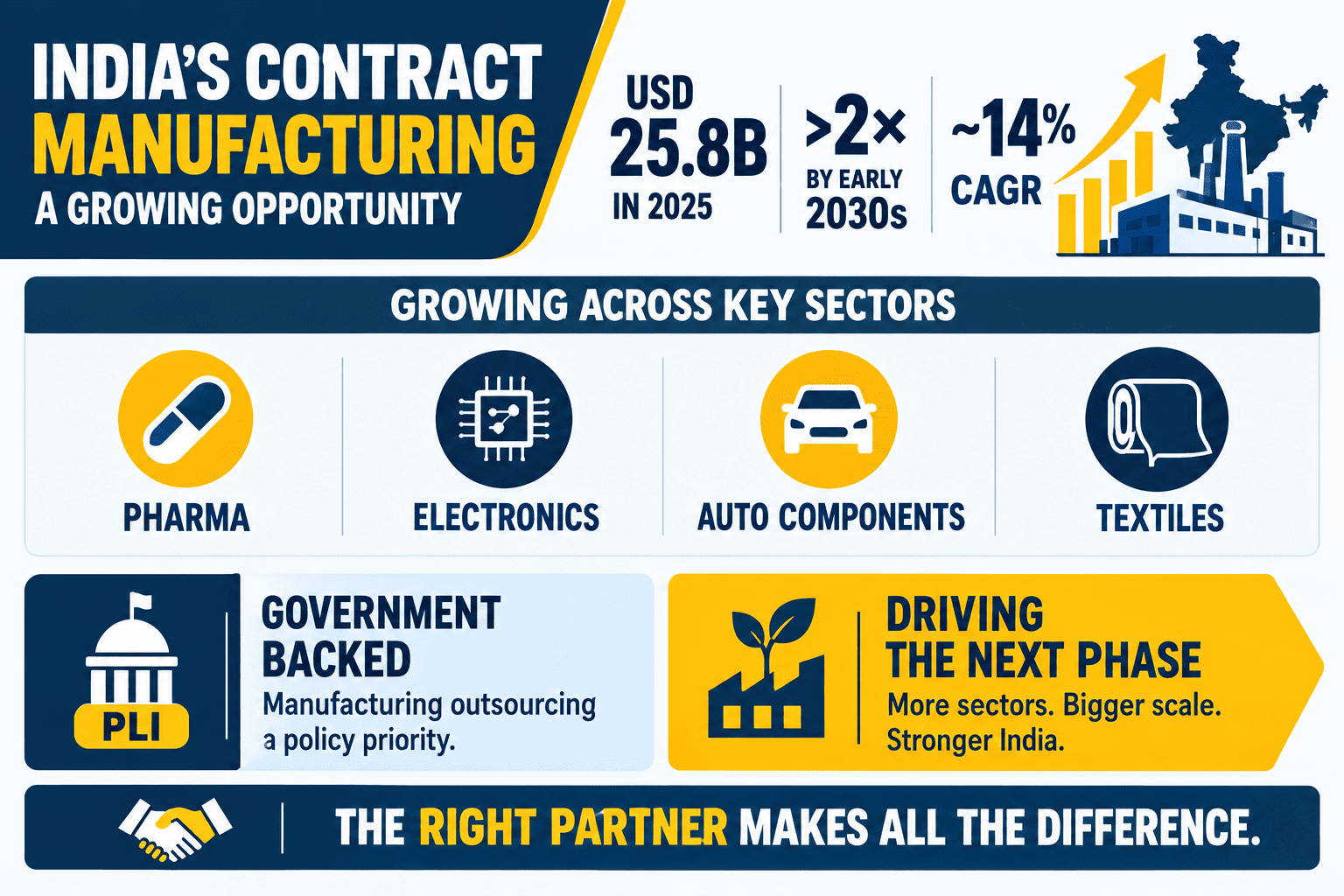
India’s contract manufacturing organisation market was valued at roughly USD 25.8 billion in 2025 and is projected to more than double by the early 2030s, growing at a compound annual rate of around 14 percent. That growth is not confined to one sector: pharmaceuticals, electronics, auto components, and textiles are all expanding their reliance on Indian contract manufacturers, backed by a government that has made manufacturing outsourcing a deliberate policy priority through incentive schemes like PLI. This article looks at what is actually driving that shift, which sectors lead it, where the real risks sit, and what a company needs to check before treating an Indian contract manufacturer as a long-term partner rather than a one-off vendor.
📅 Published July 9, 2026⏱ 13 min read✍️ GTsetu Editorial🔄 Updated September 6, 2026
Contract manufacturing, where a brand outsources production to a third-party manufacturer instead of building and running its own factory, has existed in India for decades. What has changed is the scale and sophistication of the relationship. Global companies are no longer just placing bulk orders with the lowest-cost Indian vendor; they are building long-term production partnerships that involve technology transfer, joint quality systems, and multi-year capacity commitments, the kind of relationship covered in our guide to cross-border manufacturing partnerships within global supply chains.
Section 1
India’s Contract Manufacturing Market in Numbers
Market sizing for contract manufacturing in India varies depending on scope and methodology, but the direction is consistent across every major research firm: strong, broad-based, double-digit growth.
~US$25.8B
Estimated size of India’s contract manufacturing organisation market in 2025
~14%
Projected CAGR for India’s contract manufacturing market through the early 2030s
~US$58B
Forecast market size by 2031 under several industry projections
60%
Share of the world’s vaccines supplied by India, underlining its pharma manufacturing depth
This growth is not happening in isolation. It sits inside a much larger expansion of India’s overall manufacturing sector, which is being reshaped by the Production-Linked Incentive (PLI) scheme, a policy lever that has directed tens of billions of dollars toward electronics, batteries, pharmaceuticals, and other priority sectors, alongside continued “China plus one” realignment that is redirecting global sourcing volume toward India. For companies planning a global expansion strategy that includes an Indian manufacturing footprint, this is a rare case of policy, capital, and market demand all pointing the same direction at once.
💡 Why this distinction matters
Broad manufacturing sector growth and contract manufacturing growth are related but not identical. A rising tide in India’s overall industrial base creates the supplier ecosystem, skilled labour, and infrastructure that contract manufacturers depend on. But a company evaluating a specific outsourcing decision still needs to look at contract manufacturing capacity in its own category, not just the country-level growth story.
Section 2
Why Global Companies Are Outsourcing to India
The Core Drivers
India’s rise as a contract manufacturing base rests on a handful of compounding advantages: cost, policy, scale, and category depth, each reinforcing the others.
1
Cost-Competitive, Increasingly Skilled Labour
A large workforce combined with a deep engineering talent pool
Cost AdvantageSkilled Workforce
India pairs one of the world’s largest labour pools with a genuinely large technical talent base, producing roughly 1.5 million engineering graduates a year. That combination lets contract manufacturers scale headcount for labour-intensive production while still finding the technical staff needed for quality control, process engineering, and regulatory compliance, a mix that is harder to find in smaller manufacturing economies.
🎯
Why it matters: Cost advantage alone rarely sustains a long-term outsourcing relationship. India’s combination of cost and technical depth is what lets contract manufacturers take on more complex, higher-value work rather than staying confined to basic assembly.
2
Deliberate Government Policy Backing Manufacturing Outsourcing
PLI 2.0, Make in India, and sector-specific incentives
Policy Driven
India’s Production-Linked Incentive scheme, now in its second phase and worth an estimated USD 26 billion in allocated support, ties direct financial incentives to incremental production and sales in priority sectors including electronics, pharmaceuticals, and batteries. Layered on top of the long-running Make in India programme and state-level incentives for industrial investment, this creates a policy environment that actively rewards manufacturers, including contract manufacturers, for scaling output rather than just maintaining it.
🎯
Why it matters: A policy framework that rewards scale gives contract manufacturers a direct financial reason to invest in capacity ahead of demand, which is exactly what a global brand needs when planning multi-year outsourcing volumes.
3
Genuine Category Depth, Not Just Assembly Capacity
Pharmaceuticals, electronics, auto components, and textiles
Sector Depth
India’s contract manufacturing strength is most visible in pharmaceuticals, where the country is the world’s third-largest pharmaceutical industry by volume and value and supplies a majority of global vaccine output, with API and intermediates alone accounting for more than half of pharma contract manufacturing revenue. But the depth extends well beyond pharma: electronics contract manufacturing is one of the fastest-growing PLI-backed segments, and established capacity exists in auto components, textiles, and industrial equipment as well.
🎯
Why it matters: Category depth means a global brand can typically find an experienced, regulation-literate manufacturer already serving its specific product type, rather than asking a generalist factory to learn a new category from scratch.
4
A Credible Home for Supply Chain Diversification
China-plus-one realignment and a large domestic market
Diversification
India has captured a meaningful share of manufacturing relocated as part of “China plus one” strategies, helped by an estimated USD 22 billion FDI wave tied specifically to that realignment. Unlike smaller diversification destinations, India also offers direct access to its own enormous domestic market, meaning a manufacturing footprint built for export can often serve local demand at the same time.
🎯
Why it matters: Reducing single-country concentration risk is now standard practice for global manufacturers, and India is one of the few destinations that can absorb meaningful volume while also offering a large domestic demand base to justify the investment on its own terms.
Section 3
Which Sectors Are Driving Growth
India’s contract manufacturing strength is not evenly distributed across industries. Some categories, particularly pharmaceuticals, have scaled to global significance, while others are earlier in their growth curve but expanding quickly on the back of PLI-linked investment. This sector-level detail matters more than the country-level headline when a company is running market research for manufacturers ahead of an outsourcing decision.
Sector
Approx. Market Signal
Global Position
Trend
Pharmaceutical & Healthcare CMO
~US$8.2B (2025), ~12.8% CAGR
World’s 3rd-largest pharma industry by volume
↑ Fastest-scaling segment
API & Intermediates
~52% of pharma CMO revenue
Leading global generics supplier base
↑ Consistent leadership
Biologics & Large Molecules
~15.3% CAGR forecast
Rising share of global biologics contracts
↑ Fastest-growing molecule type
Electronics
PLI-linked, high FDI concentration
Rapidly scaling assembly and component base
↑ Fastest-growing PLI segment
Auto Components
Established, broad supplier base
Significant regional and export supplier
→ Steady
Textiles & Apparel
Long-established capacity
Major global exporter
→ Stable
Geography matters within India as much as sector does. Hyderabad, for instance, has become the country’s most integrated pharmaceutical outsourcing hub, anchored by a large dedicated pharma zone, dense specialist talent pools, and recent multinational capacity investment. Companies evaluating an Indian contract manufacturing partnership are increasingly choosing a specific industrial cluster within a sector, not just a country, much as they would when comparing regional strengths against other emerging clusters like the Nigerian industrial and agro cluster.
Section 4
The Challenges Contract Manufacturers in India Still Face
None of this makes India a frictionless choice. Several structural issues are well documented and worth weighing honestly before committing to an Indian contract manufacturing partnership.
Inconsistent quality control outside top-tier manufacturers. India’s contract manufacturing base spans everything from globally certified, export-grade facilities to smaller operations with far less mature quality systems, making manufacturer-level due diligence essential rather than optional.
Intellectual property protection concerns. Sharing proprietary formulations, designs, or process know-how with a third-party manufacturer always carries some exposure, which is why a properly structured business partnership contract with clear IP and confidentiality clauses needs to be in place before sensitive information changes hands.
Import dependency for key inputs. Categories like electronics and active pharmaceutical ingredients still rely significantly on imported raw materials, particularly from China, which adds an upstream supply chain risk layer worth mapping through proper international sourcing of manufacturing materials.
Regulatory complexity that varies by state and sector. Compliance requirements, particularly in pharma and food-adjacent categories, differ meaningfully across states, and evolving requirements such as CDSCO Schedule M upgrades mean certification standards keep moving, which makes ongoing attention to manufacturing certifications for international trade a continuous task, not a one-time check.
Heightened regulatory scrutiny from importing markets. As India’s export volumes grow, so does scrutiny from destination-market regulators, adding to the broader global trade compliance burden that both the manufacturer and the buyer need to manage jointly.
📌 The honest read
India’s contract manufacturing growth story is real and well-supported by capital, policy, and demand. But growth at the country level does not automatically de-risk a specific factory relationship. The gap between India’s best contract manufacturers and its median ones remains wide, which is exactly why manufacturer-level verification matters more in India than the headline growth numbers might suggest.
Section 5
India vs. Other Contract Manufacturing Destinations
India is not the only beneficiary of global manufacturing diversification. Vietnam, in particular, is frequently discussed alongside India as a complementary rather than competing option, since the two economies tend to play to different strengths.
Factor
India
Vietnam
Population / labour pool
~1.4 billion
~98 million
Strongest sectors
Pharmaceuticals, electronics, auto components, textiles
Textiles, footwear, electronics, furniture
Government flagship programme
PLI scheme, Make in India
Manufacturing FDI incentives, free trade zones
Domestic market size
Very large, standalone demand driver
Smaller, primarily export-oriented
Best fit for
Complex, regulated, and high-tech manufacturing at scale
Fast-turnaround export assembly and light manufacturing
Most global manufacturers running a serious diversification strategy are not picking one country over another; they are building a multi-country contract manufacturing footprint that plays to each location’s strengths. That approach reduces concentration risk further than betting on a single alternative, but it also means evaluating and formalising more than one manufacturing relationship at once, using consistent partnership evaluation criteria across every market rather than a different standard for each.
Section 6
Vetting and Formalising a Contract Manufacturing Partnership
A strong national growth story does not de-risk an individual contract manufacturer. It still comes down to specific, answerable questions: is this factory legally registered, does it hold the certifications it claims, what happens to the relationship if a shipment is delayed by a force majeure event, and who owns the intellectual property once specifications are shared. This is where sourcing decisions actually succeed or fail.
🏛️
Confirm legal registration and business status
Verify the manufacturer’s registration, incorporation date, and current standing before any commercial discussion goes further.
Government-sourced verification
📄
Protect specifications and IP before you share them
Put a formal NDA in place, followed by a proper business partnership contract, before proprietary designs or formulations change hands.
NDA-first engagement
📜
Check certifications relevant to your product and market
Review how the agreement handles disruption, including force majeure in global trade, before signing, not after a shipment is delayed.
Contract terms review
🔬
Research the specific cluster, not just the country
Capabilities, incentives, and talent availability vary significantly by industrial cluster; a tailored market study for manufacturers uncovers this before capital is committed.
🤝 For Verified Long-Term Manufacturing Partnerships
GTsetu: Verified Discovery and Secure Engagement for Manufacturers, Distributors, and Raw Material Suppliers
India’s growth numbers explain why the country is worth serious consideration as a contract manufacturing base. They do not tell you whether a specific factory is who it claims to be, or whether your proprietary specifications will stay confidential during early-stage discussions. That gap is what GTsetu is built to close. It is a structured partnership platform, not a directory or a general marketplace, where every company is verified on 6 government-sourced points before engagement, where discovery is anonymous until mutual interest is confirmed, where NDAs are executed digitally before any commercial information changes hands, and where document exchange happens through an encrypted workspace rather than email attachments.
GTsetu is used by industrial manufacturers, distributors, and raw material suppliers across 100+ countries, including India, to build out a distributor network, source international wholesale distribution partners, or find manufacturing and technology partnership relationships they intend to keep for years, not a single production run. It complements, rather than replaces, on-the-ground factory audits and sector-specific research, but it removes much of the identity and documentation risk before that deeper diligence even begins.
🏛️
6-Point Government-Sourced Verification
Name, Address, Registration Number, Company Status, Company Type, and Date of Incorporation, verified using government tie-ups before any engagement.
🕵️
Anonymous Discovery
Browse verified manufacturer and distributor profiles across 100+ countries without revealing your own identity or sourcing strategy until you choose to engage.
📄
Built-In NDA Workflow
Digital NDA with timestamped signatures before any pricing, formulations, or product specs are shared. No sensitive information exposed without protection.
🔐
Encrypted Document Workspace
All commercial documents shared through encrypted channels with a full access audit trail, not email attachments.
🌍
100+ Countries, Including India
Verified manufacturers and distributors across Asia, the Middle East, Europe, Africa, Australia, and the Americas. Built for cross-border partnership formation, not one-off quotes.
🚫
Zero Commission
No success fee, no broker commission, ever. Your partnership economics remain entirely between you and your partner.
India is also frequently just one part of a broader sourcing map. Manufacturers evaluating diversification often run parallel conversations across multiple regions at once, comparing Indian contract manufacturing capacity against options in Southeast Asia and emerging clusters elsewhere. A platform built for B2B matchmaking across countries, rather than one built around a single geography, makes it easier to run that comparison with consistent verification standards throughout, and to manage the resulting cross-border business partnerships from a single, structured workspace.
FAQ
Frequently Asked Questions
QWhy do global companies use contract manufacturing in India?
Global companies use contract manufacturing in India for a combination of cost-competitive skilled labour, a deep and diversified supplier base, government incentives like the Production-Linked Incentive scheme, and sector depth in pharmaceuticals, electronics, textiles, and auto components. It lets brands scale production without owning factories, while tapping India’s manufacturing capacity and regulatory expertise, particularly in pharma where India already supplies a large share of the world’s generic medicines and vaccines.
QHow big is the contract manufacturing market in India?
Estimates vary by research firm and scope, but most place India’s contract manufacturing organisation market in the range of roughly USD 20 to 30 billion as of 2025-2026, growing at a compound annual growth rate of around 11 to 15 percent, with some forecasts projecting the market to nearly double by the early 2030s. Pharmaceutical and healthcare contract manufacturing make up a particularly large and fast-growing share of this total.
QWhat are the risks of contract manufacturing in India?
Common risks include inconsistent quality control across smaller manufacturers, intellectual property protection concerns when sharing proprietary designs or formulations, regulatory and compliance complexity that varies by state and sector, supply chain dependency on imported raw materials in categories like electronics and active pharmaceutical ingredients, and infrastructure or logistics bottlenecks outside major industrial clusters. Verifying a manufacturer’s registration, certifications, and compliance history before committing significantly reduces these risks.
QHow should a company choose a contract manufacturing partner in India?
Beyond a factory audit, a company should verify the manufacturer’s legal registration and business status, confirm actual production capacity and relevant certifications, check compliance and quality history, and put a formal agreement with confidentiality protections in place before sharing proprietary specifications. Platforms built for verified B2B partnership formation, rather than general directories or RFQ marketplaces, can meaningfully reduce this due diligence burden by handling identity verification and document security upfront.
QShould a company choose India or Vietnam for contract manufacturing?
It depends on the product and priority. India tends to suit complex, regulated, and high-tech manufacturing, particularly pharmaceuticals and electronics, backed by a very large domestic market that can absorb output alongside export volume. Vietnam tends to suit fast-turnaround export assembly and light manufacturing where speed to major Western markets via free trade agreements matters most. Many global manufacturers are not choosing one over the other; they are building sourcing footprints that use both for what each does best.
Considering India for Your Next Manufacturing Partnership?
GTsetu is purpose-built for manufacturers, distributors, and raw material suppliers in industrial sectors seeking verified long-term trade partnerships, across 100+ countries including India, with government-sourced partner verification, built-in NDA workflows, and zero commission.
They represents the product, and research team behind GTsetu, a global B2B collaboration platform built to help companies explore cross-border partnerships with clarity and trust. The team focuses on simplifying early-stage international business discovery by combining structured company profiles, verification-led access, and controlled collaboration workflows.
With a strong emphasis on trust, and disciplined engagement, Team GTsetu shares insights on global trade, partnerships, and cross-border collaboration, helping businesses make informed decisions before entering deeper commercial discussions.