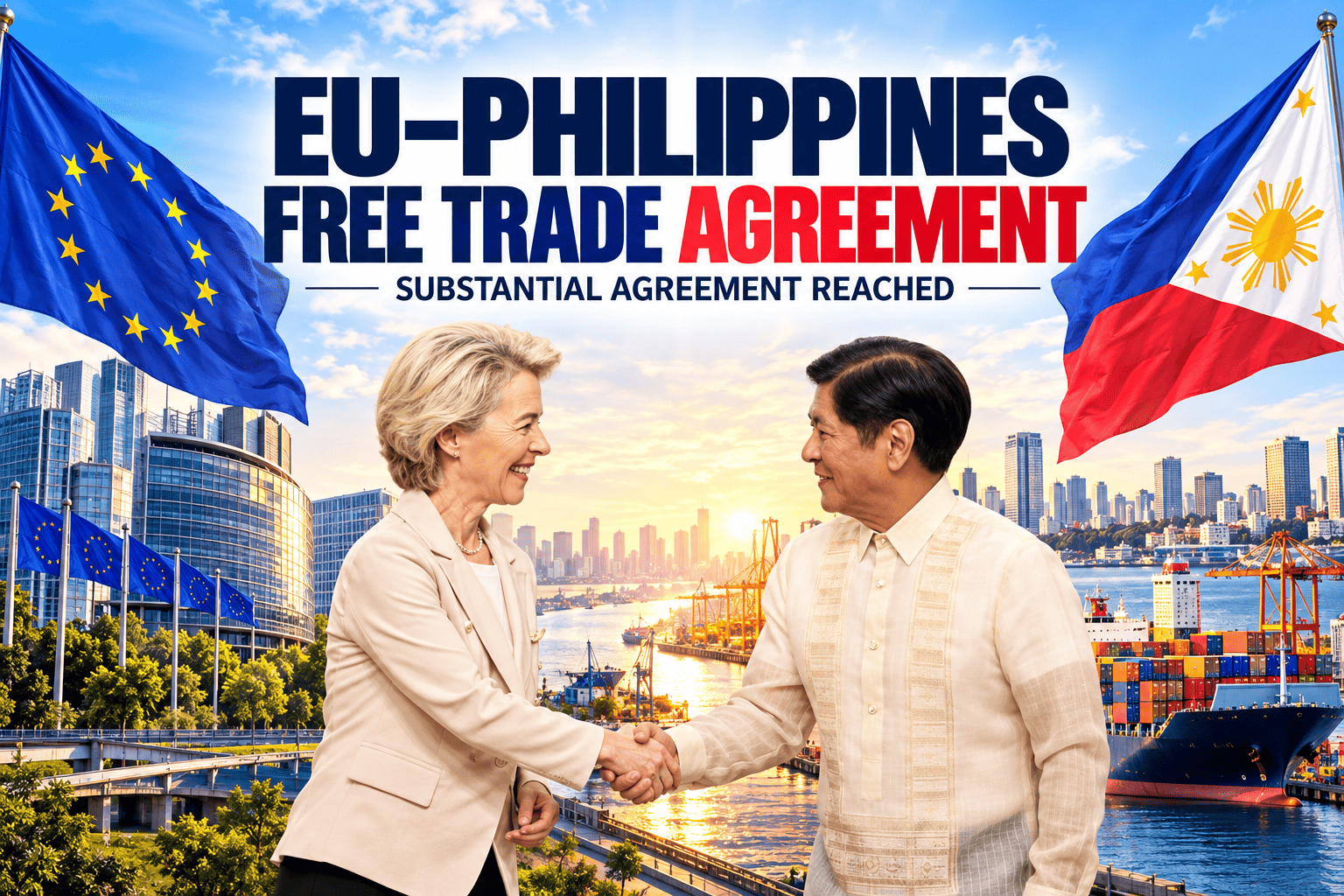
EU–Philippines Free Trade Agreement: What It Covers & What It Means
🇪🇺 🇵🇭 The EU–Philippines Free Trade Agreement is a bilateral trade deal between the European Union and the Philippines, negotiated to replace reliance on the EU’s unilateral GSP+ preference scheme with a reciprocal, durable set of market-access commitments. Talks first began in 2016, stalled, and resumed in 2024, with the two sides announcing substantial agreement on the core terms in September 2026. This article explains what the agreement is, what it is expected to cover, how it differs from the current arrangement, the steps that stand between substantial agreement and entry into force, and what it means for manufacturers, distributors, and exporters on both sides.
📄 Trade Agreement Explainer✍️ GTsetu Editorial🌍 EU — Philippines
Parties
🇪🇺 European Union — 🇵🇭 Philippines
Agreement Type
Bilateral Free Trade Agreement (FTA)
Negotiations
Launched 2016, resumed 2024
Latest Milestone
Substantial agreement announced, September 2026
A note on where this deal stands: Reaching “substantial agreement” means negotiators have settled the core terms across the major chapters of the deal. It is a distinct legal state from signature and entry into force. Legal scrubbing, translation, formal signature, and ratification on both sides still need to be completed before the agreement creates binding obligations. This article explains the agreement itself and what it is designed to do, rather than reporting on its day-to-day progress.
Trade agreements are frequently described in terms that blur the distinction between “agreed,” “signed,” and “in force,” three very different legal states with very different implications for businesses planning around them. This article sets out what the EU–Philippines FTA is, what it is expected to contain, and how companies can think about it, particularly those considering cross-border business partnerships that would sit across the two markets.
Section 1
What the EU–Philippines FTA Is
The EU–Philippines Free Trade Agreement is a bilateral trade deal between the European Union and the Philippines. Its purpose is to reduce or remove tariffs on trade in goods, improve access for services and investment, and establish shared rules across areas such as digital trade, intellectual property, government procurement, and sustainability. Where the Philippines currently trades with the EU under a unilateral preference scheme, an FTA would replace that with a reciprocal, negotiated framework in which both sides make commitments.
Negotiations were launched in 2016, stalled after roughly a year, and resumed in March 2024, consistent with the EU’s broader push to deepen trade ties across the Indo-Pacific. The two sides announced substantial agreement on the core terms in September 2026, following a call between European Commission President Ursula von der Leyen and Philippine President Ferdinand Marcos Jr. and joint statements from EU Trade Commissioner Maroš Šefčovič and Philippine Trade Secretary Ma. Cristina Aldeguer-Roque.
The Philippines would become the fourth ASEAN country, after Singapore, Vietnam, and Indonesia, to reach a bilateral free trade agreement with the EU, reflecting Brussels’ wider strategy of deepening trade ties across Southeast Asia.
📌 What “substantial agreement” means
Reaching substantial agreement means negotiators have landed on the core terms across the major chapters of the deal, tariffs, services, digital trade, sustainability, and so on. What typically remains is legal scrubbing of the text, translation into the EU’s official languages, formal signature by both parties, and ratification, in the EU’s case by the European Parliament, and in the Philippines’ case by the Senate. Only once ratification is complete does an FTA enter into force and create binding legal obligations.
Section 2
Key Figures Behind the Deal
€17.6B
Bilateral trade in goods between the EU and the Philippines in 2025
€10.3B
Bilateral trade in services between the EU and the Philippines in 2024
94–97%
Share of bilateral trade and tariff lines the agreement is expected to liberalise
113M
Philippine population, offering EU exporters a sizeable Southeast Asian consumer market
For scale, the European Commission has framed the Philippines as an important market for EU exporters given its population of over 113 million, while Philippine officials and industry groups have pointed to estimates of up to $12 billion in additional export potential for Philippine goods entering the EU’s market of roughly 450 million consumers. The agreement would also effectively upgrade the Philippines’ current trade arrangement with the EU, which runs under the Generalized Scheme of Preferences Plus (GSP+) covering more than 6,000 Philippine product lines, a unilateral preference scheme set to expire by 2027.
Section 3
What the Agreement Is Expected to Cover
Core Provisions
Based on the joint statements and Commission readouts accompanying the substantial agreement announcement, the agreement is expected to span several major areas.
1
Tariff Elimination on Industrial & Key Agricultural Goods
Covering more than 94% of tariff lines
Market Access
The deal is expected to eliminate tariffs across the large majority of bilateral trade, including EU exports of machinery, transport equipment, pharmaceutical products, and medical devices, alongside Philippine agricultural and manufactured exports into the EU market.
2
Digital Trade & Intellectual Property Rules
Modern rules for a digital-first economy
Digital Trade
The agreement includes modern digital trade provisions and strengthened intellectual property protections, relevant to companies operating in technology partnership arrangements or exporting IP-sensitive products between the two markets.
3
Government Procurement & Investment Access
New opportunities in public contracting and energy investment
Investment
The deal is expected to clarify rules on government procurement access and open the door to greater cross-border investment, including in the energy sector, areas that directly affect how companies approach global expansion planning into either market.
4
Sustainability & Labour Commitments
A dedicated chapter on environmental and labour standards
Sustainability
The agreement embeds binding commitments on sustainable development, labour standards, and references to the Paris Agreement, though it has also drawn criticism in some quarters over human rights considerations tied to the broader bilateral relationship.
Section 4
How an FTA Differs from GSP+
The Philippines currently exports to the EU under the Generalized Scheme of Preferences Plus (GSP+), a unilateral arrangement under which the EU grants reduced tariffs on more than 6,000 product lines without requiring reciprocal concessions. GSP+ is set to expire by 2027, and it can be suspended or withdrawn on policy grounds, which makes it less predictable as a long-term basis for market access.
Aspect
GSP+ (current arrangement)
EU–Philippines FTA (expected)
Nature
Unilateral EU preference scheme
Reciprocal, negotiated agreement
Reciprocity
One-way: EU grants preferences
Both sides make tariff and rules commitments
Duration
Set to expire by 2027
Open-ended once in force, subject to the agreement’s own provisions
Stability
Can be suspended or withdrawn on policy grounds
Binding treaty commitments, harder to change unilaterally
Scope
Tariff preferences on goods only
Goods, services, digital trade, IP, procurement, sustainability
The practical significance for businesses is durability. A unilateral scheme can lapse or be suspended, whereas an FTA creates reciprocal obligations that are harder to unwind. That difference matters for any company making multi-year investment or supply chain decisions involving either market.
Section 5
From Substantial Agreement to Entry into Force
Substantial agreement is a milestone, not a finish line. The remaining path to a legally binding agreement generally follows the same sequence for EU bilateral FTAs.
1
Legal scrubbing
The agreed text is reviewed line by line by legal services on both sides to ensure consistency, precision, and that it reflects what negotiators actually agreed.
2
Translation
The text is translated into all official EU languages, a step that can take considerable time given the length and technical density of a modern FTA.
3
Formal signature
Both parties formally sign the finalised agreement, signalling their intent to proceed to ratification.
4
Ratification
Approval by the European Parliament and the Philippine Senate, the final step before the agreement can take legal effect.
5
Entry into force
The agreement becomes binding, and tariff reductions and other provisions begin to phase in according to the agreed schedule.
💡 Timing perspective
Other recent EU bilateral FTAs in the Indo-Pacific region have typically taken from several months to over a year between a “substantial agreement” announcement and formal signature, with ratification adding further time. For planning purposes, the relevant date is entry into force, not the announcement of substantial agreement.
Section 6
Who Stands to Benefit
🇪🇺
EU exporters of machinery & pharma
Tariff elimination on key EU export categories including machinery, transport equipment, pharmaceuticals, and medical devices.
Reduced tariff barriers
🇵🇭
Philippine manufacturers & agri-exporters
Preferential access to the EU’s roughly 450-million-consumer market, upgrading current GSP+ terms before they expire.
A further data point for companies weighing the Philippines against other Southeast Asian sourcing destinations for cross-border manufacturing partnerships.
Sourcing diversification
🤝
Distributors building EU-Philippines trade lanes
Longer-term regulatory clarity supports building out a durable distributor network between the two markets ahead of entry into force.
Distribution planning
Section 7
What Businesses Can Do to Prepare
An agreement that has not yet been signed or ratified creates no binding legal obligations, but it does create a credible planning horizon. Companies that wait for entry into force before beginning any preparation will be a step behind competitors who use this window productively.
Start market research now. Use the runway before signature to conduct proper market research for manufacturers on the Philippine or EU market, rather than waiting until the agreement is in force and competitors have a head start.
Identify and begin vetting potential partners. Finding and verifying a distributor, manufacturing partner, or raw material supplier takes time; using partnership evaluation criteria now means being ready to move quickly once tariff reductions take effect.
Build flexibility into contracts being signed today. For agreements being negotiated now that may run past the FTA’s entry into force, consider how tariff changes should be treated, alongside other contingencies like force majeure in global trade, within the business partnership contract.
Get expert guidance if this is a new market.International business development consulting can help translate the agreement’s eventual terms into a concrete entry plan specific to your sector.
🤝 For Verified Long-Term Trade Partnerships
GTsetu: Build EU-Philippines Trade Relationships That Outlast the Negotiation Cycle
A trade agreement removes tariff and regulatory friction. It does not remove the need to find a manufacturer, distributor, or supplier you can actually trust on the other side of that friction. GTsetu is a structured partnership platform, not a directory or a general marketplace, where every company is verified on 6 government-sourced points before engagement, where discovery is anonymous until mutual interest is confirmed, where NDAs are executed digitally before any commercial information changes hands, and where document exchange happens through an encrypted workspace with a full audit trail.
Companies in the EU and the Philippines can use GTsetu to start identifying and vetting verified partners for international wholesale distribution, raw material sourcing, or manufacturing collaboration, so that when an agreement is signed and enters into force, the commercial relationship is already built rather than still being found, a use case similar to how businesses have approached other recent deals like the UAE-Philippines CEPA or the EU-Mercosur trade agreement.
🏛️
6-Point Government-Sourced Verification
Name, Address, Registration Number, Company Status, Company Type, and Date of Incorporation, verified before any engagement.
🕵️
Anonymous Discovery
Browse verified EU and Philippine partner profiles without revealing your own identity or strategy until you choose to engage.
📄
Built-In NDA Workflow
Digital NDA with timestamped signatures before any pricing, specs, or formulations are shared.
🔐
Encrypted Document Workspace
All commercial documents shared through encrypted channels with a full access audit trail.
🌍
100+ Countries
Verified manufacturers and distributors across Europe, Southeast Asia, and 100+ other countries.
🚫
Zero Commission
No success fee, no broker commission, ever, on any partnership formed through the platform.
The EU–Philippines FTA is one of several active bilateral and regional trade agreements currently in motion around the world, each worth understanding depending on where your business sources, manufactures, or distributes. GTsetu maintains explainers for the following agreements alongside this one.
The EU-Philippines Free Trade Agreement is a bilateral trade deal under negotiation between the European Union and the Philippines. Its core purpose is to reduce or eliminate tariffs on bilateral trade, improve market access for goods and services, and set common rules on areas like digital trade, intellectual property, government procurement, and sustainability. The two sides announced substantial agreement on the terms in September 2026, but the deal is not yet signed or in force.
QWhat does the EU-Philippines FTA cover?
The agreement is expected to liberalise more than 94 to 97 percent of bilateral trade, eliminating tariffs on industrial goods and key agricultural products, alongside rules on digital trade, intellectual property protection, government procurement, and a sustainability chapter covering labour and environmental commitments, including references to the Paris Agreement.
QWhy does the EU-Philippines FTA matter for businesses?
The agreement would give EU exporters preferential access to the Philippines’ market of over 113 million people, and give Philippine exporters preferential access to the EU’s market of roughly 450 million consumers, while also providing long-term regulatory clarity for planning cross-border supply chains and investment, compared with the current Generalized Scheme of Preferences Plus arrangement, which is due to expire.
QHow does the EU-Philippines FTA differ from GSP+?
GSP+ is a unilateral preference scheme under which the EU grants the Philippines reduced tariffs on more than 6,000 product lines without requiring reciprocity. It is set to expire by 2027. An FTA, by contrast, is a reciprocal, negotiated agreement in which both sides commit to tariff reductions and shared rules. An FTA therefore offers more durable and predictable market access than a unilateral scheme that can lapse.
QWhat has to happen before the EU-Philippines FTA takes effect?
After negotiators reach substantial agreement, the text goes through legal scrubbing and translation into the EU’s official languages, followed by formal signature by both parties, and then ratification, in the EU’s case by the European Parliament, and in the Philippines’ case by the Senate. Only once ratification is complete does the agreement enter into force and create binding legal obligations.
QShould businesses start preparing before the agreement is signed?
Yes, within reason. While the agreement creates no binding obligations until it is signed and ratified, substantial agreement is a strong signal of the terms businesses can expect. Companies can productively use this window to research the market, begin identifying and vetting potential partners, and understand likely certification and rules-of-origin requirements, so they are positioned to move quickly once the agreement enters into force rather than starting from zero.
Build EU-Philippines Trade Relationships on Verified Ground
GTsetu is purpose-built for manufacturers, distributors, and raw material suppliers in industrial sectors seeking verified long-term trade partnerships, across 100+ countries, with government-sourced partner verification, built-in NDA workflows, and zero commission.
They represents the product, and research team behind GTsetu, a global B2B collaboration platform built to help companies explore cross-border partnerships with clarity and trust. The team focuses on simplifying early-stage international business discovery by combining structured company profiles, verification-led access, and controlled collaboration workflows.
With a strong emphasis on trust, and disciplined engagement, Team GTsetu shares insights on global trade, partnerships, and cross-border collaboration, helping businesses make informed decisions before entering deeper commercial discussions.