Korea–Serbia CEPA: What It Covers and What It Means for Trade
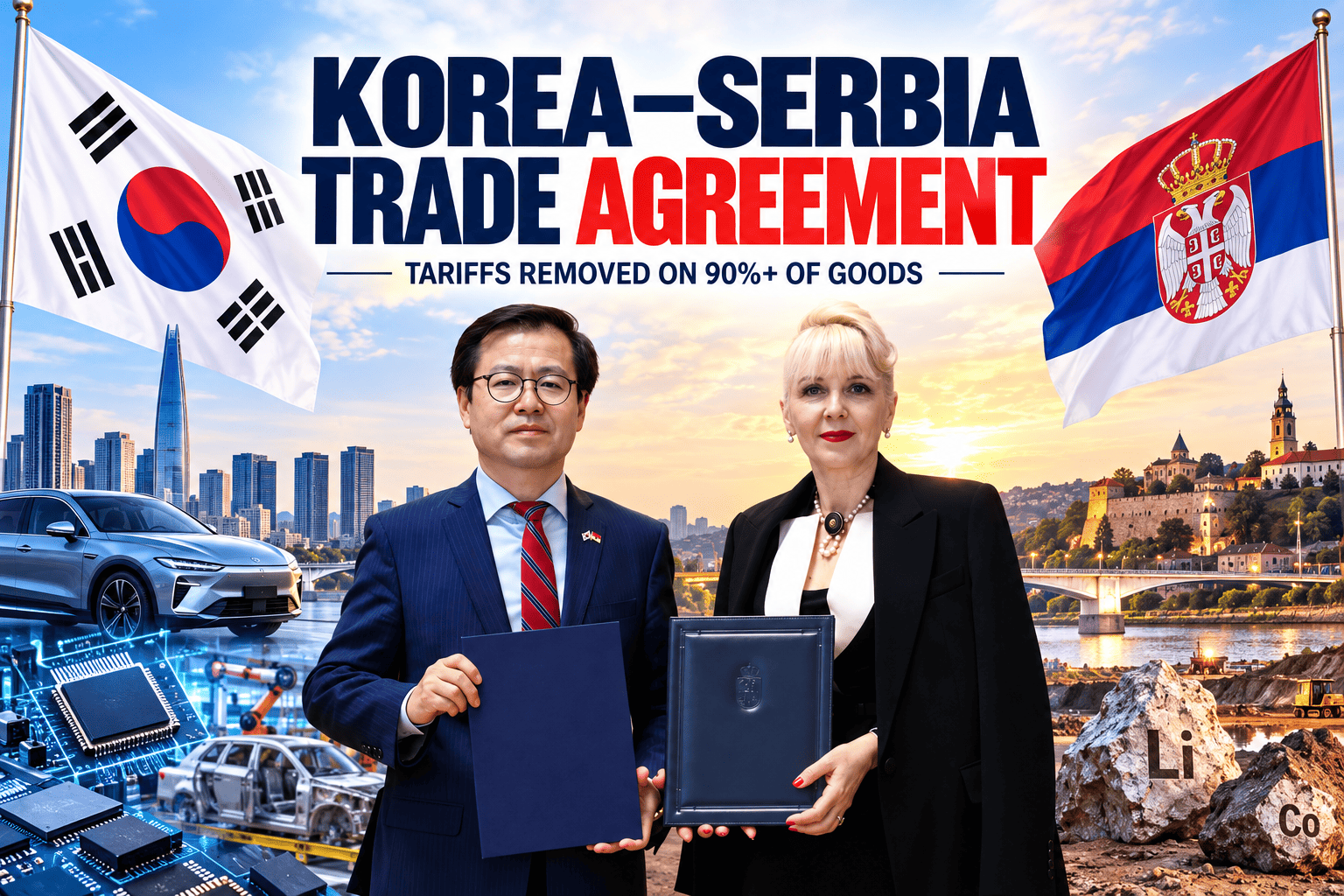
On 5 June 2026 in Belgrade, Korea’s chief trade negotiator Yeo Han-koo and Serbia’s Minister of Domestic and Foreign Trade Jagoda Lazarević signed a joint declaration confirming the conclusion of negotiations for the Korea–Serbia Comprehensive Economic Partnership Agreement, Korea’s first free trade deal with any country in the Balkans. The agreement eliminates tariffs on more than 90 percent of tariff lines, opens Serbian critical minerals like lithium and cobalt to Korean supply chains, and secures market access for Korean semiconductors, EVs, and auto parts. As of 1 October 2026, the deal is concluded but not yet formally signed, with legal review, translation, and ratification still ahead. This article covers what’s actually in the agreement and what businesses on both sides should be tracking, as part of our broader coverage of agreements such as the UAE–Philippines CEPA and the India–EU free trade agreement.
📅 Published June 12, 2026⏱ 11 min read✍️ GTsetu Editorial🔄 Updated October 1, 2026
Date
5 June 2026
Parties
🇰🇷 South Korea – 🇷🇸 Serbia
Agreement
Korea–Serbia CEPA
Type
CEPA
Status as of 1 Oct 2026
Negotiations concluded; not yet signed
Trade ministries don’t usually call a deal a “springboard,” but that’s the word Korea’s own trade minister used to describe this one. Serbia, a country of roughly 6.6 million people, isn’t a market Korea needed for scale. What it offers instead is geography, an EU-adjacent manufacturing base, and a mineral endowment increasingly central to Korea’s battery and semiconductor industries. That combination is what turned a Balkan CEPA into one of Korea’s more closely watched trade agreements of 2026.
Section 1
Overview: Korea’s First Balkan Free Trade Deal
According to Korea’s Ministry of Trade, Industry and Resources, the two countries began pursuing CEPA negotiations following a 2023 meeting between their prime ministers, formally launched negotiations in September 2024, and reached agreement through the first formal round and a series of intersessional discussions. The Korea Times reported the conclusion as Korea’s first trade agreement with a Balkan nation, intended to help both countries bolster trade ties and address global economic uncertainties.
90%+
of tariff lines eliminated between Korea and Serbia, covering 96% of import value for both sides, per Korea’s trade ministry
12 chapters
the agreement covers, including Trade in Goods, Rules of Origin, Customs Facilitation, IP, TBT, and Economic Cooperation
25%
the tariff Serbia previously charged on semiconductors and electronics, now being eliminated under the CEPA
48 hrs
maximum customs clearance time for general imports under the agreement’s expedited clearance rules, with 6 hours for express shipments
Korea’s trade ministry framed Serbia’s appeal directly: a manufacturing base in automobiles and machinery, strong human resources, close proximity to the EU market, and an extensive existing FTA network. Rising costs at established Eastern European production hubs have also drawn fresh attention to Serbia as a manufacturing and investment destination, adding urgency to building an institutional foundation for bilateral trade, a dynamic that echoes broader shifts discussed in coverage of agreements like the EU–Mercosur trade agreement.
💡 Why this deal exceeds a regional predecessor
Korea’s trade ministry noted that the CEPA’s tariff liberalization exceeds the level achieved under the China–Serbia FTA, which entered into force in 2024. For a country positioning itself as a manufacturing alternative to higher-cost hubs elsewhere in Eastern Europe, outpacing an existing major-power agreement is a meaningful signal of how seriously both sides approached these talks.
Section 2
What’s Actually in the Agreement
Beyond Tariffs: A Broader Economic Partnership
A CEPA, by design, goes further than a conventional free trade agreement. Korea’s trade ministry describes it as combining tariff reductions and market-opening measures with broader economic cooperation spanning supply chains, energy, and future industries.
1
Market Access for Korean Exports
Semiconductors, EVs, auto parts, consumer goods, defense products
Market Access
Serbia agreed to eliminate tariffs on semiconductors and electronic products that had previously carried duties of up to 25 percent, a consequence of Serbia’s non-participation in the WTO Information Technology Agreement. The CEPA secures market access for electric and hybrid vehicles and immediately eliminates tariffs on all automotive parts. Tariffs on Korean food and beauty products are also being eliminated, alongside improved market access for medical devices, pharmaceuticals, and defense products.
🎯
Why it matters: Serbia’s prior IT Agreement non-membership meant Korean electronics faced real cost disadvantages there; removing that barrier opens a market that was previously structurally closed to competitive Korean pricing.
2
Flexible Rules of Origin for Industrial Goods
Broad allowance for non-originating materials, with carve-outs for sensitive goods
Supply Chain Flexibility
The two sides introduced rules of origin that broadly allow non-originating materials for major categories including automobiles, petroleum and chemical products, electronics, machinery, and processed foods, explicitly accounting for diversified parts and materials supply chains. Stricter criteria such as the wholly-obtained rule apply to fresh agricultural and fishery products, while gim (seasoned laver) and ginseng drinks carry originating-content requirements tied to domestic production.
🎯
Why it matters: Flexible origin rules for industrial goods mean manufacturers don’t need a fully localized supply chain to qualify for preferential tariffs, a practical accommodation for companies already sourcing components across multiple countries.
3
Expedited Customs and Strengthened IP Protection
48-hour general clearance, 6-hour express clearance, online IP enforcement
Trade Facilitation
The CEPA requires release of general imports within 48 hours of arrival and express shipments within 6 hours. It also strengthens protections for copyrights, trademarks, and industrial designs, including new provisions addressing online IP infringement through measures such as website blocking and mechanisms to prevent repeated violations.
🎯
Why it matters: Predictable, fast customs clearance reduces working-capital drag for exporters on both sides, while explicit online IP enforcement addresses a gap many older-generation trade agreements don’t cover.
Beyond market access, the agreement establishes a framework for cooperation in supply chains, energy, minerals, and economic security. The two sides also agreed to expand cooperation in AI, healthcare, biotechnology, manufacturing, transportation and logistics, SMEs, and tourism, positioning the CEPA as a platform for ongoing engagement rather than a one-time tariff reset.
🎯
Why it matters: Trade minister Yeo Han-koo specifically framed this cooperation platform, not just market opening, as the agreement’s lasting significance amid protectionism and global supply chain restructuring.
Section 3
Tariff Elimination: Who Gets What
Korea’s trade ministry was explicit that both sides sought a mutual balance of interests rather than one-sided liberalization. Serbia’s largest single export category to Korea, corn for feed and processing, representing more than 40 percent of Serbia’s exports to Korea, received tariff concessions through immediate and 10-year elimination schedules. In exchange, Korea minimized liberalization on sensitive agricultural and livestock products.
Category
Direction
Treatment
Semiconductors & electronics
Korea → Serbia
Tariffs up to 25% eliminated
Electric & hybrid vehicles
Korea → Serbia
Market access secured
Automotive parts
Korea → Serbia
Immediate elimination
Corn for feed & processing
Serbia → Korea
Immediate + 10-year elimination
Lithium, cobalt, nickel, graphite, rare earths
Serbia → Korea
Immediate or within 5 years
Rice, honey, berries, meat, dairy
Korea → Serbia (sensitive)
Liberalization minimized
Fresh agricultural & fishery products
Both (sensitive)
Wholly-obtained rule applied
📌 Dual certification, dual verification
The two countries agreed to permit both authorized and self-certification systems for origin certification, backed by multiple verification mechanisms to ensure the system’s credibility, a practical accommodation that gives exporters flexibility in how they document origin while preserving enforcement integrity on both sides.
Section 4
Critical Minerals: The Strategic Core of the Deal
Strip away the tariff schedules and the CEPA’s strategic center of gravity becomes clear: critical minerals. The Herald Business reported that Serbia carries significant geopolitical weight and is rich in critical minerals including lithium, copper, and zinc, making it a strong candidate for supply chain cooperation with Korea’s battery and semiconductor industries.
Korea’s trade ministry confirmed the agreement eliminates tariffs immediately or within five years on key Serbian exports including lithium, cobalt, nickel, graphite, and rare earth elements, materials it explicitly described as essential inputs for advanced industries including rechargeable batteries and semiconductors. By establishing a cooperation channel with a country holding these specific minerals, the agreement is expected to help diversify Korea’s critical mineral supply chains and build a more stable procurement foundation, a strategic motivation comparable to the mineral and supply-chain dimensions seen in agreements like the UAE–DRC CEPA.
Lithium and cobalt — core battery-grade inputs for Korea’s EV and energy-storage manufacturers, now on accelerated tariff-elimination schedules.
Nickel and graphite — additional battery-chemistry inputs, reinforcing the deal’s focus on securing a diversified upstream base for Korean battery makers.
Rare earth elements — inputs for semiconductors and advanced electronics, an area where supply concentration has been a persistent strategic concern for manufacturers globally.
Copper and zinc — broader industrial minerals cited alongside the battery-specific inputs as part of Serbia’s overall mineral endowment relevant to Korean supply chain planning.
Section 5
Timeline: From Talks to Ratification
A CEPA’s conclusion of negotiations is a milestone, not a finish line. Several formal steps remain before the agreement takes legal effect.
✓
2023
Prime ministers agree to pursue CEPA negotiations
Korean and Serbian prime ministers meet and set the groundwork for formal talks.
✓
September 2024
Formal CEPA negotiations launch
The first formal negotiating round begins, followed by a series of intersessional discussions.
✓
5 June 2026
Negotiations conclude; joint declaration signed in Belgrade
Trade Minister Yeo Han-koo and Minister Jagoda Lazarević sign a joint declaration confirming the conclusion of negotiations.
⏳
In progress
Legal review and official translation
The agreement text undergoes legal review and translation before formal signature, the step Korea’s government says it will pursue “without delay.”
⏳
Pending
Formal signature
Once legal review and translation are complete, the two governments proceed to formal signature of the agreement text.
⏳
Pending
Economic impact assessment & National Assembly ratification
Korea’s National Assembly must provide ratification consent following an economic impact assessment before the CEPA can enter into force.
⚠️ What “concluded but not signed” means for planning
As of 1 October 2026, businesses should treat the CEPA’s specific tariff schedules and provisions as highly likely but not yet legally binding. Signature, ratification, and entry into force are procedural rather than substantive hurdles at this stage, but contracts and sourcing plans should still account for the gap between “concluded” and “in force.”
Section 6
What It Means for Businesses on Both Sides
Trade Minister Yeo also met with Serbian Deputy Prime Minister Adrijana Mesarović and Serbian Chamber of Commerce President Marko Čadež during his Belgrade visit, and held a roundtable with Korean companies already operating in Serbia to discuss expected export-expansion effects for items like automotive parts, EVs and hybrids, and cosmetics, as well as hear on-the-ground difficulties. That roundtable signals the practical direction companies should prepare for.
🏛️
Verify counterpart registration before relying on preferential terms
Confirm a Serbian or Korean partner’s legal registration and standing independently before structuring deals around CEPA tariff schedules that aren’t yet in force.
Government-sourced verification
📄
Build CEPA-contingent terms into contracts now
Draft a business partnership contract that explicitly accounts for the gap between conclusion and entry into force, rather than assuming today’s tariff schedule is final.
Contract-first engagement
📜
Confirm which certifications and rules of origin actually apply
Plan for the ratification timeline, not just the tariff numbers
Account for force majeure in global trade and ratification delays when setting delivery or pricing commitments tied to CEPA-dependent terms.
Contingency terms
🔬
Research Serbia’s manufacturing and minerals landscape directly
Cross-check the CEPA’s strategic framing with independent market research for manufacturers before committing capital to new Serbian supply relationships.
Location-level research
🤝
Get expert guidance before a first move into this corridor
🤝 For Verified Long-Term Manufacturing Partnerships
GTsetu: Verified Discovery and Secure Engagement for Manufacturers, Distributors, and Raw Material Suppliers
A CEPA opens the door; it doesn’t verify who’s standing on the other side of it. Whether you’re a Korean manufacturer eyeing Serbia’s automotive and critical-minerals base, or a Serbian producer looking to reach Korean buyers newly freed from a 25 percent tariff, GTsetu is built to close the identity and documentation gap a trade agreement alone can’t address. It is a structured partnership platform, not a directory or a general marketplace, where every company is verified on 6 government-sourced points before engagement, where discovery is anonymous until mutual interest is confirmed, where NDAs are executed digitally before any commercial information changes hands, and where document exchange happens through an encrypted workspace rather than email attachments.
GTsetu is used by industrial manufacturers, distributors, and raw material suppliers across 100+ countries, including South Korea and Serbia, to build out a distributor network, source international wholesale distribution partners, or form a technology partnership meant to last well beyond the CEPA’s ratification timeline. It complements the market access a trade agreement creates, but it removes much of the identity and documentation risk before that market access is ever put to use.
🏛️
6-Point Government-Sourced Verification
Name, Address, Registration Number, Company Status, Company Type, and Date of Incorporation, verified using government tie-ups before any engagement.
🕵️
Anonymous Discovery
Browse verified manufacturer and distributor profiles across 100+ countries without revealing your identity or sourcing strategy until you choose to engage.
📄
Built-In NDA Workflow
Digital NDA with timestamped signatures before any pricing, formulations, or product specs are shared.
🔐
Encrypted Document Workspace
All commercial documents shared through encrypted channels with a full access audit trail, not email attachments.
🌍
100+ Countries, Including Korea and Serbia
Verified manufacturers and distributors across Asia, Europe, the Middle East, Africa, Australia, and the Americas.
🚫
Zero Commission
No success fee, no broker commission, ever. Your partnership economics remain entirely between you and your partner.
The Korea–Serbia Comprehensive Economic Partnership Agreement is a free trade agreement between South Korea and Serbia whose negotiations concluded on 5 June 2026 in Belgrade. It is Korea’s first free trade agreement with any country in the Balkan Peninsula, covering 12 chapters including trade in goods, rules of origin, customs facilitation, intellectual property, technical barriers to trade, and broader economic cooperation.
QWhat does the Korea–Serbia CEPA cover?
The agreement eliminates tariffs on more than 90 percent of tariff lines, covering 96 percent of import value for both sides. It secures market access for Korean semiconductors, electric and hybrid vehicles, and auto parts, eliminates Serbia’s tariffs of up to 25 percent on semiconductors and electronics, and sets tariff elimination schedules for Serbian critical minerals including lithium, cobalt, nickel, graphite, and rare earth elements. It also includes expedited customs clearance, IP protections, and a cooperation framework covering supply chains, energy, minerals, AI, and biotechnology.
QHas the Korea–Serbia CEPA been signed yet?
As of 1 October 2026, negotiations have concluded and a joint declaration was signed in Belgrade on 5 June 2026, but the CEPA itself has not yet been formally signed. The text still requires legal review and official translation before signature, after which it will need an economic impact assessment and ratification by South Korea’s National Assembly before entering into force.
QWhy is Serbia significant for Korea’s critical minerals strategy?
Serbia holds significant reserves of critical minerals including lithium, copper, and zinc, inputs essential for rechargeable batteries, semiconductors, and other advanced industries. The CEPA establishes a cooperation channel intended to help Korea diversify its critical mineral supply chains and secure a more stable procurement foundation, reducing reliance on any single sourcing region.
QHow does the Korea–Serbia CEPA compare to the China–Serbia FTA?
Korea’s trade ministry stated that the Korea–Serbia CEPA’s tariff liberalization exceeds the level of liberalization achieved under the China–Serbia FTA, which entered into force in 2024. This positions Korea’s agreement as the more comprehensive of the two in terms of tariff-line coverage, alongside its broader economic cooperation chapters on supply chains, minerals, and future industries.
GTsetu is purpose-built for manufacturers, distributors, and raw material suppliers in industrial sectors seeking verified long-term trade partnerships, across 100+ countries including South Korea and Serbia, with government-sourced partner verification, built-in NDA workflows, and zero commission.
They represents the product, and research team behind GTsetu, a global B2B collaboration platform built to help companies explore cross-border partnerships with clarity and trust. The team focuses on simplifying early-stage international business discovery by combining structured company profiles, verification-led access, and controlled collaboration workflows.
With a strong emphasis on trust, and disciplined engagement, Team GTsetu shares insights on global trade, partnerships, and cross-border collaboration, helping businesses make informed decisions before entering deeper commercial discussions.