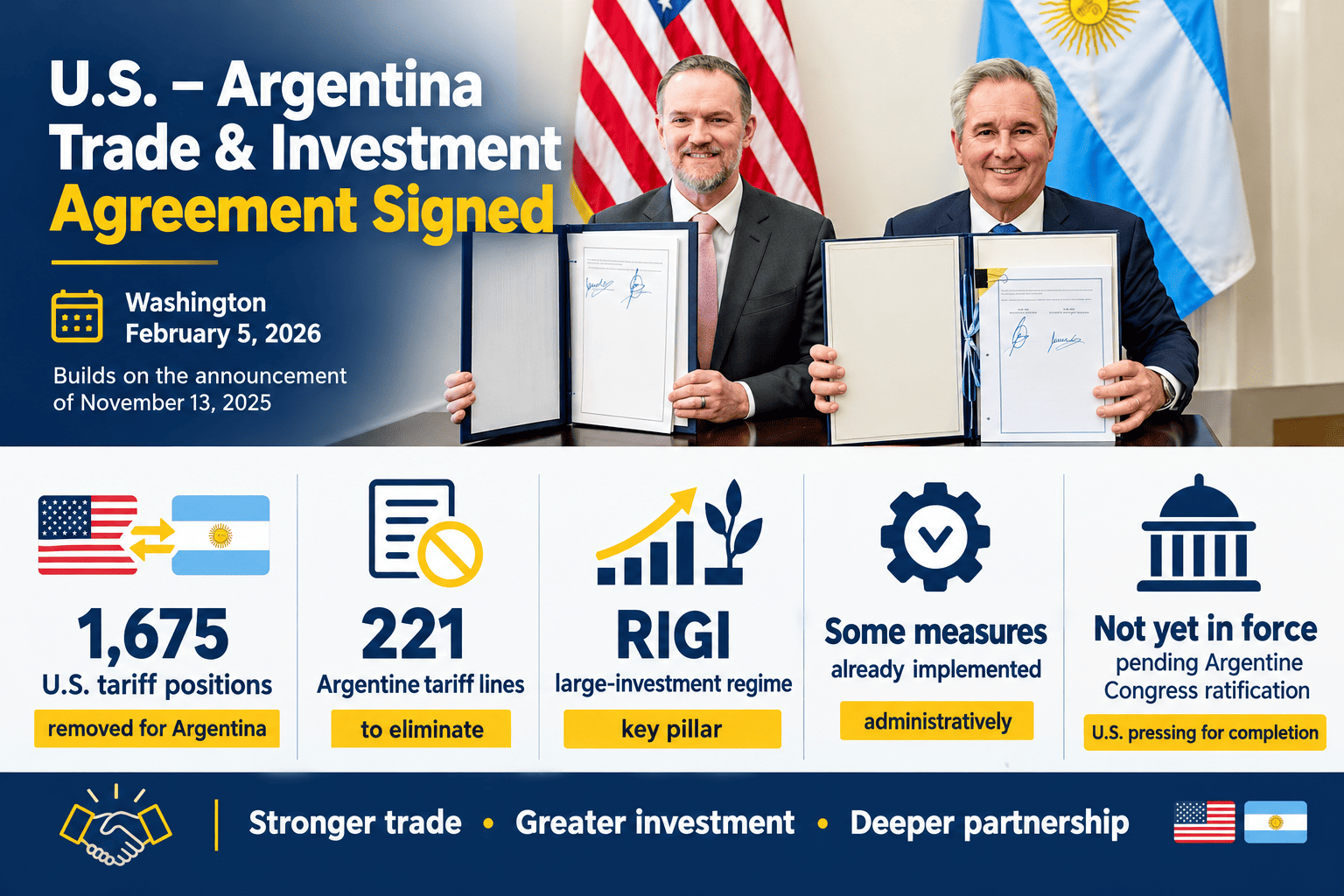
U.S.–Argentina Agreement on Reciprocal Trade and Investment
The United States and Argentina signed the Agreement on Reciprocal Trade and Investment (ARTI) in Washington on February 5, 2026, formalising a framework first announced on November 13, 2025. The agreement removes U.S. reciprocal tariffs on 1,675 Argentine tariff positions, commits Argentina to eliminate tariffs on 221 tariff lines, and positions Argentina’s RIGI large-investment regime as a central pillar of the relationship. Argentina has implemented some measures administratively, but the agreement has not yet been ratified by the Argentine Congress and is not fully in force, with Washington actively pressing Buenos Aires to complete ratification.
📅 Signed February 5, 2026📍 Signed in Washington, D.C.📊 Status: Not Yet in Force🔄 Page updated September 14, 2026
ARTI is the first agreement of its kind in the region to combine trade and investment commitments at this scale, positioning Argentina as the first South American country to secure an agreement of this magnitude with the United States, and placing it among a select group of countries with preferential U.S. market access. For manufacturers, distributors, and investors tracking Argentina’s re-engagement with global markets, the agreement is a significant marker, even while it remains unratified, relevant to broader global expansion and cross-border business partnership planning across the region.
Section 1
Agreement Overview
1,675
Argentine tariff positions on which the U.S. removes its reciprocal tariff
221
Tariff lines Argentina commits to eliminate, including machinery, transport equipment, medical devices and chemicals
80,000t
Additional U.S. beef import quota granted by Argentina in 2026, on top of an existing 20,000 tonnes
10%
Cap on other U.S. reciprocal tariff rates on Argentine goods, above existing MFN duty
Formally known as the United States–Argentina Agreement on Reciprocal Trade and Investment, ARTI was signed by U.S. Trade Representative Jamieson Greer and Argentina’s Minister of Foreign Affairs, International Trade, and Worship Pablo Quirno. It formalises and expands the existing U.S.-Argentina Trade and Investment Framework Agreement, addressing tariff measures, non-tariff barriers, intellectual property protection, digital trade, commercial disciplines, investment, labour, environment, and implementation and enforcement procedures.
📌 Signed does not mean in force
ARTI was signed in February 2026, but as of the most recent reporting it has not been ratified by the Argentine Congress. Argentina has implemented some of the agreement’s measures administratively ahead of formal ratification, and U.S. officials, including Deputy Trade Representative Jeff Goettman, have publicly pressed Argentine ministers to move the ratification process forward. Businesses should treat the agreement’s full legal entry into force as pending, not confirmed.
Section 2
Timeline: From Framework to Signing
✓
November 13, 2025 — Framework announced
Days after Argentina’s legislative elections, the United States and Argentina announced a joint statement on a framework for a reciprocal trade and investment agreement.
✓
February 5, 2026 — ARTI formally signed
Ambassador Jamieson Greer and Minister Pablo Quirno signed the agreement in Washington, D.C., finalising its text and tariff schedules.
⚠
February 20, 2026 — U.S. Supreme Court strikes down IEEPA reciprocal tariffs
The U.S. Supreme Court ruled against the legal basis for the broader IEEPA reciprocal tariff programme, an external development affecting the legal mechanics underpinning parts of the agreement’s tariff framework.
⚠
July 24, 2026 — Section 301 tariff applied
Following the Supreme Court ruling, the United States began applying a 10% tariff to Argentine goods under a different legal authority, Section 301 of the Trade Act, rather than the original IEEPA mechanism.
⏳
August 27, 2026 — U.S. presses for ratification
Deputy Trade Representative Jeff Goettman met with Argentine ministers in Buenos Aires to press for progress on the Argentine Congress’s ratification of the agreement.
⏳
Pending — Argentine Congressional ratification
Full entry into force of ARTI’s commitments depends on the Argentine Congress completing its ratification process. No confirmed date is available as of this page’s last update.
Section 3
Tariff Terms: What Each Side Gives
ARTI’s tariff schedules are detailed and split across multiple annexes, but the core commercial terms can be summarised across both directions of trade. Businesses relying on these terms for sourcing or export planning should also factor in standard manufacturing certifications for international trade and documentation requirements.
Direction
Commitment
Detail
US → Argentina goods
Reciprocal tariff removed
1,675 Argentine tariff positions, under Schedule 2A
US → Argentina goods
Zero reciprocal rate
Range of agricultural-related goods, under Schedule 2B
US → Argentina goods
Capped reciprocal rate
10% maximum on all other goods, in addition to existing MFN duty
Argentina → US goods
Tariff elimination
221 tariff lines: machinery, transport equipment, medical devices, chemicals
Argentina → US goods
Reduced tariff
2% rate on an additional 20 tariff lines
Argentina → US agriculture
Import quota expansion
80,000 additional tonnes of U.S. beef in 2026, four quarterly tranches, on top of 20,000 tonnes already allocated
💡 The legal basis shifted mid-agreement
The original IEEPA-based reciprocal tariff framework referenced in ARTI’s text was struck down by the U.S. Supreme Court on February 20, 2026, shortly after signing. The United States subsequently began applying a 10% tariff to Argentine goods under Section 301 authority instead, from July 24, 2026. Businesses relying on ARTI’s tariff terms should track the practical, currently applied rates rather than only the rates described in the original signed text, given this intervening legal change.
Section 4
RIGI: The Investment Centrepiece
Beyond tariffs, ARTI gives a central role to Argentina’s Régimen de Incentivo para Grandes Inversiones, or RIGI, a large-investment incentive regime enacted in 2024. Under ARTI, Argentina commits to fast-track qualifying American investment projects, particularly in mining, through the RIGI framework, effectively turning the regime into a key mechanism for implementing the agreement’s investment provisions.
1
Long-Term Stability for Qualifying Investments
30-year tax, customs, and foreign exchange stability
Investment Incentive
RIGI is valid for two years, extendable by one, and provides 30-year tax, customs, and foreign exchange stability for investments exceeding $200 million, with enhanced benefits for projects over $1 billion that position Argentina as a new global supplier.
🎯
Why it matters: For large U.S. investors, particularly in mining and energy, this regulatory stability is a significant factor in committing capital to Argentina over other regional alternatives.
2
Reduced Tax Burden for Mega-Projects
Corporate tax cut from 25% to 15% for qualifying investments
Tax Incentive
The enhanced RIGI regime cuts the corporate income tax rate for qualifying mega-projects from 25% to 15%, allows companies to deduct 60% of their first-year investment, and eliminates export tariffs and import duties from day one of the project.
🎯
Why it matters: These terms materially improve project economics for large-scale U.S. investment, though eligibility thresholds limit the regime to major capital commitments rather than smaller manufacturing or distribution investments.
3
Criticism Over Asymmetric Obligations
The agreement’s binding commitments fall overwhelmingly on Argentina
Contested
Critics, including the Transnational Institute, have highlighted that Argentina’s obligations appear more than a hundred times in the agreement text under the imperative “Argentina shall”, covering commitments to eliminate import licensing, accept U.S. standards, facilitate investment, and alter its regulatory framework, while U.S. commitments are comparatively vague, framed as the U.S. will “work to consider” or “review” rather than binding obligations. By one analysis, only around 5% of the agreement’s binding commitments fall on the United States.
🎯
Why it matters: This asymmetry is part of why ratification in Argentina’s Congress has not been straightforward, and businesses should watch domestic Argentine political reaction as a factor in the agreement’s timeline.
Section 5
A Notably Asymmetric Agreement
Compared to many bilateral trade agreements, ARTI stands out for the concentration of binding commitments on one party. This is a relevant factor for any business evaluating the agreement’s durability, since politically contested terms carry a higher risk of delay, renegotiation, or domestic pushback during the ratification process, a consideration worth weighing alongside standard partnership evaluation criteria when planning dependent business activity around the agreement.
Negotiated on a compressed timeline. The agreement moved from framework announcement to signed text in under three months, following legislative elections in Argentina, a notably fast pace for an agreement of this scope.
Limited public consultation. Critics have noted the agreement was negotiated without broad consultation across Argentine industry and civil society sectors typically involved in major trade negotiations.
Heavily weighted obligations. The bulk of binding regulatory and market-access commitments fall on Argentina, while U.S. commitments on tariff review and investment financing support are framed in non-binding language.
Ratification uncertainty. As of the most recent reporting, the Argentine Congress has not completed ratification, and the United States has continued to apply diplomatic pressure to move the process forward.
Section 6
What This Means for Businesses
For manufacturers, distributors, and investors on both sides, ARTI’s unratified status is not a reason to wait entirely, but it is a reason to plan with appropriate caution and build flexibility into any commercial commitments tied to the agreement.
🏭
US manufacturers exporting the newly tariff-free categories
GTsetu: Verified Discovery and Secure Engagement Ahead of ARTI’s Entry Into Force
An agreement like ARTI creates real commercial opportunity, but political and legal uncertainty around ratification makes verified, well-documented partnerships more important, not less. GTsetu is built to support exactly this kind of cautious, well-prepared market entry. It is a structured partnership platform, not a directory or a general marketplace, where every company is verified on 6 government-sourced points before engagement, where discovery is anonymous until mutual interest is confirmed, where NDAs are executed digitally before any commercial information changes hands, and where document exchange happens through an encrypted workspace with a full audit trail.
Manufacturers, distributors, and investors in the United States and Argentina can use GTsetu to start building verified relationships now, while the agreement works through ratification, rather than scrambling to find a trustworthy partner once the terms are fully locked in. GTsetu is used by industrial businesses across 100+ countries to formalise technology partnership and international wholesale distribution relationships, applying consistent verification standards to every market, regardless of where a given trade agreement sits in its own ratification process.
🏛️
6-Point Government-Sourced Verification
Name, Address, Registration Number, Company Status, Company Type, and Date of Incorporation, verified using government tie-ups before any engagement.
🕵️
Anonymous Discovery
Browse verified U.S. and Argentine partner profiles without revealing your own identity or sourcing strategy until you choose to engage.
📄
Built-In NDA Workflow
Digital NDA with timestamped signatures before any pricing, formulations, or product specs are shared.
🔐
Encrypted Document Workspace
All commercial documents shared through encrypted channels with a full access audit trail, not email attachments.
🌍
100+ Countries
Verified manufacturers and distributors across Asia, the Middle East, Europe, Africa, Australia, and the Americas, including the United States and Argentina.
🚫
Zero Commission
No success fee, no broker commission, ever. Your partnership economics remain entirely between you and your partner.
QWhat is the U.S.–Argentina Agreement on Reciprocal Trade and Investment?
The U.S.–Argentina Agreement on Reciprocal Trade and Investment, known as ARTI, is a comprehensive bilateral agreement covering tariffs, non-tariff barriers, intellectual property, digital trade, investment, labour, environment, and enforcement. It was signed in Washington on February 5, 2026 by U.S. Trade Representative Jamieson Greer and Argentina’s Minister of Foreign Affairs, International Trade, and Worship Pablo Quirno, building on a framework announced on November 13, 2025.
QWhen will the U.S.–Argentina trade agreement take effect?
The agreement was signed on February 5, 2026 but has not yet been ratified by the Argentine Congress and is not yet fully in force. Some measures have reportedly been implemented administratively by Argentina ahead of formal ratification, while the United States has pressed Argentina to complete its ratification process.
QWhat tariff changes does the agreement include?
The United States removes its reciprocal tariff on 1,675 Argentine tariff positions, applies a zero percent reciprocal rate to a range of agricultural goods, and caps other reciprocal rates at 10% above the existing MFN duty. Argentina, in turn, commits to eliminate tariffs on 221 tariff lines covering machinery, transport equipment, medical devices, and chemicals, and to reduce tariffs to 2% on another 20 lines. Argentina also agreed to an additional beef import quota of 80,000 tonnes in 2026, delivered in quarterly tranches.
QWhat is RIGI and why does it matter for this agreement?
RIGI, the Régimen de Incentivo para Grandes Inversiones, is Argentina’s large-investment incentive regime, offering 30-year tax, customs, and foreign exchange stability for qualifying investments. The ARTI agreement gives RIGI a central role in the bilateral relationship, with Argentina committing to fast-track qualifying American projects, particularly in mining, under the regime, making RIGI eligibility a key consideration for U.S. investors evaluating opportunities in Argentina under the new agreement.
QWhy has the tariff basis for this agreement already changed once?
Shortly after ARTI was signed, the U.S. Supreme Court struck down the IEEPA legal authority underpinning the broader U.S. reciprocal tariff programme on February 20, 2026. The United States subsequently began applying a 10% tariff to Argentine goods under a different legal basis, Section 301 of the Trade Act, from July 24, 2026. This shows that even after signing, the practical tariff treatment under an agreement can change due to developments outside the agreement’s own text, which is why businesses should track currently applied rates rather than rely solely on the original signed terms.
GTsetu is purpose-built for manufacturers, distributors, and raw material suppliers in industrial sectors seeking verified long-term trade partnerships, across 100+ countries including the United States and Argentina, with government-sourced partner verification, built-in NDA workflows, and zero commission.
They represents the product, and research team behind GTsetu, a global B2B collaboration platform built to help companies explore cross-border partnerships with clarity and trust. The team focuses on simplifying early-stage international business discovery by combining structured company profiles, verification-led access, and controlled collaboration workflows.
With a strong emphasis on trust, and disciplined engagement, Team GTsetu shares insights on global trade, partnerships, and cross-border collaboration, helping businesses make informed decisions before entering deeper commercial discussions.