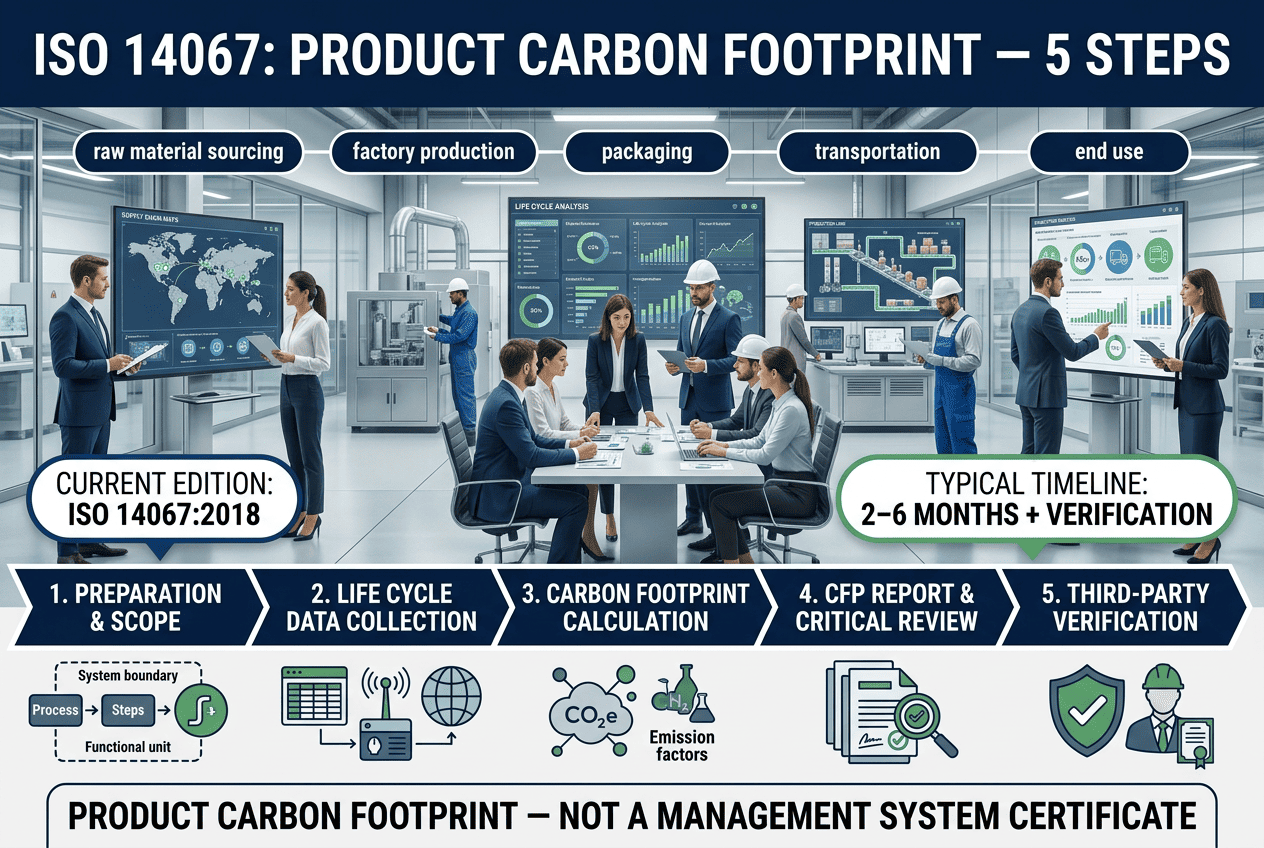
Direct Answer: ISO 14067 is the international standard for quantifying the carbon footprint of a product (CFP). Strictly speaking it is not a management system certification: you quantify your product’s footprint according to the standard and then have the study independently verified by an accredited body, which issues a verification statement. The process has 5 steps: Preparation (goal, functional unit, system boundary, PCR), Data Collection (primary and secondary data across the life cycle), Calculation (life cycle inventory and GHG results in CO₂e), CFP Study Report & Critical Review, and Third-Party Verification. A first product typically takes 2–6 months plus verification time. The current edition is ISO 14067:2018. This guide walks you through each step.
📅 November 3, 2026⏱ 16 min read✍️ GT Setu Editorial Team🔄 Updated regularly
2018
Current Edition (Confirmed 2024)
5
Key Steps to Verification
2–6
Months (First Product, Typical)
0%
GTsetu Broker Commission
ISO 14067 is the international standard for quantifying the carbon footprint of products. Developed by ISO Technical Committee 207, Subcommittee 7 (Greenhouse Gas Management and Related Activities), it sets out principles, requirements and guidelines for calculating and reporting the greenhouse gas (GHG) emissions and removals associated with a product across its life cycle, in a manner consistent with the life cycle assessment standards ISO 14040 and ISO 14044. The first edition, ISO 14067:2018, replaced the earlier technical specification ISO/TS 14067:2013.
For manufacturers, exporters and suppliers, a credible product carbon footprint is increasingly a commercial requirement. Buyers use it for Scope 3 reporting, procurement decisions and regulatory preparedness. This guide covers the complete process from defining your study to independent verification, and clarifies an important point: ISO 14067 is not certified like a management system, but a study conducted to it can be verified. If you already operate management systems, see our guides on ISO 14001 environmental management and ISO 9001 quality management for the processes that support good data.
📋 Who Is This Guide For?
This guide is written for sustainability managers, product and quality leaders, operations directors, exporters and business owners who need to quantify, report or verify the carbon footprint of products. It covers both the in-house approach (using internal teams and software) and the consultant-led route. It is equally relevant for manufacturers responding to customer carbon data requests and for distributors and suppliers who must provide product-level data to their principals. For related partnership structures, see our guides on supplier collaboration platforms and distributors and manufacturers.
SECTION 1
1 What Is ISO 14067 & Why Does It Matter?
🌍 The Standard Explained
ISO 14067:2018, Greenhouse gases — Carbon footprint of products — Requirements and guidelines for quantification, specifies how to quantify and report the carbon footprint of a product (CFP), or a partial CFP, expressed in CO₂ equivalents. It addresses only a single impact category, climate change. Communication of CFP information is covered separately by ISO 14026, verification requirements by ISO 14064-3, and product category rules by ISO/TS 14027. ISO 14067 is not a management system standard, so conformity is demonstrated through an independent third-party verification of the CFP study rather than a conventional certificate.
🌐
Globally Recognised Method
ISO 14067 gives manufacturers and buyers a shared, LCA-based methodology for product carbon data across borders and supply chains.
🏛️
Market Access & Buyer Requirements
Large buyers and public bodies increasingly request product-level carbon data. A credible, verified CFP helps you respond and retain customers.
🔄
Hotspot Identification
A CFP shows where emissions occur across materials, manufacturing, transport, use and end of life, so reduction effort targets what matters.
📈
Credible Climate Claims
Independent verification protects you from greenwashing risk and increases the trust customers and regulators place in your numbers.
SECTION 2
2 Key Benefits of an ISO 14067 Carbon Footprint
A product carbon footprint built to ISO 14067 delivers commercial, operational and strategic benefits. The value grows when the CFP is used to drive design, sourcing and process decisions rather than produced once for a customer request.
1
Impact category covered: climate change, expressed in CO₂ equivalents
100-yr
Global warming potential time horizon used for characterising GHGs
2013 → 2018
ISO/TS 14067 upgraded to a full International Standard
🏷️
Customer & Tender Readiness
Verified product carbon data helps you answer buyer questionnaires, qualify for green procurement and win business from carbon-conscious customers.
Commercial
💰
Cost & Efficiency Insight
Energy, material and logistics hotspots in the footprint often coincide with cost hotspots, revealing efficiency opportunities.
Operational
🔗
Supply Chain Collaboration
Collecting supplier data builds closer relationships and drives supplier-level improvement, supporting Scope 3 reduction goals.
Partnership
📊
Data-Driven Product Design
Quantified impacts let designers compare material, energy and packaging options with evidence instead of assumptions.
Analytical
👥
Cross-Team Alignment
Procurement, engineering, operations, quality and sustainability teams work from a single, documented carbon model.
People
📋
Regulatory & Reporting Readiness
A methodologically sound CFP prepares you for evolving disclosure, border carbon and product-level climate requirements in export markets.
Compliance
SECTION 3
3 Core Principles of ISO 14067
ISO 14067 is built on principles that guide every methodological choice in a CFP study. Understanding them helps you produce a footprint that stands up to verification and to customer scrutiny.
🔄
1. Life Cycle Perspective
A CFP considers all stages from raw material acquisition through production, distribution, use and end of life, so impacts are not shifted between stages.
⚖️
2. Functional or Declared Unit
Results are expressed per defined unit of product (for example one tonne or one device over its use), which makes the footprint meaningful and traceable.
🎯
3. Relevance & Completeness
Data and methods must suit the study’s goal, and all significant emissions and removals within the boundary should be included or justified as excluded.
🧩
4. Consistency & Coherence
Assumptions, methods and data are applied uniformly through the study, and aligned with relevant rules such as PCR where they exist.
📐
5. Accuracy
Bias and uncertainties are reduced as far as practicable, with preference for good-quality primary data for significant processes.
🔍
6. Transparency
The study discloses data sources, assumptions, allocation and limitations so a reviewer can follow and reproduce the result.
🚫
7. Avoidance of Double-Counting
Emissions and removals must not be counted twice across processes or between products, a common risk in recycling and shared-energy systems.
SECTION 4
4 Step 1: Preparation — Goal, Scope & Boundary
🏗️ Building the Foundation
Preparation defines what you are measuring and why. Clear goal and scope decisions at the start prevent rework later and are the first thing a verifier will examine. This phase typically takes 2–4 weeks for a single product, longer for complex product families.
1.1
Get Trained on ISO 14067 & LCA Basics
Whoever leads the study needs working knowledge of ISO 14067, ISO 14040/14044 and GHG accounting concepts. Online and in-person courses are widely available, or you can work with an experienced practitioner.
1.2
Secure Management Support
Leadership must approve resources and data access across procurement, production and logistics. Explain how the CFP supports customer requirements and cost savings. See our guide on company global expansion for how climate compliance supports export growth.
1.3
Define the Goal of the Study
State the reason for the study, the intended application and audience, and whether results will be shared externally or verified. The goal determines required rigour and data quality.
1.4
Choose the Product & Functional or Declared Unit
Define the product precisely and the unit of analysis, such as one kilogram or one unit over a stated service life. A clear unit allows fair interpretation and, where permitted, comparison.
1.5
Set the System Boundary & Cut-Off Criteria
Decide which life cycle stages are included (cradle-to-gate, cradle-to-grave, or a partial CFP) and document any cut-offs. Boundary choices strongly influence results, so justify them.
1.6
Check for Product Category Rules (PCR)
Where a relevant CFP-PCR or reference PCR exists for your product, follow it. Identify the programme operator or customer requirements early, as they can specify boundaries, data rules and verification expectations.
💡 Pro Tip: Start with a Representative Product
If you have many similar products, begin with one high-volume or customer-requested product, build a clean model, and then extend it. Reusing the model for product variants saves significant time. The same principle applies when building a B2B network: start focused and scale.
SECTION 5
5 Step 2: Data Collection — Building Your Inventory
Data collection is usually the most time-consuming stage. ISO 14067 expects primary data for processes under your control and high-quality secondary data for the rest, with the quality of each dataset documented.
Data Category
Description
Key Consideration
Raw Materials & Inputs
Quantities and types of materials, components and packaging per functional unit, from bills of materials and purchasing records.
Use supplier-specific data for significant inputs where available.
Energy & Utilities
Electricity, fuel, steam and water used in manufacturing, allocated to the product.
Document the electricity accounting approach and grid emission factors used.
Process Emissions
Direct emissions from chemical reactions, refrigerant leaks, combustion and other on-site sources.
Measured or well-founded estimates are preferred for significant sources.
Transport & Logistics
Inbound and outbound distances, modes and loads across the supply chain.
Be explicit about mode, load factor and allocation assumptions.
Use Phase
Energy or consumables used while the product is in service, where within the boundary.
Define realistic use scenarios and service life, and justify them.
End of Life & Recycling
Disposal, recycling and recovery scenarios and associated emissions or credits.
Apply a documented allocation approach for recycling and avoid double-counting.
Secondary Data & Emission Factors
Background data from recognised LCA databases for upstream materials and energy.
Record source, version, geography, year and data quality for each dataset.
Supporting Records
Invoices, meter readings, production logs and supplier declarations that evidence the data.
Verifiers sample these records, so keep them organised and retrievable.
💡 Data Collection Best Practices
DO: Prioritise primary data for the biggest contributors, keep a data-quality log, and request supplier data through a structured template.
DON’T: Rely on generic averages for dominant processes, mix inconsistent years or geographies without noting it, or overwrite source data without version control.
Use structured templates for supplier data requests and internal data sheets. This approach also helps when drafting manufacturer-distributor contracts: a proven structure reduces gaps and disputes.
SECTION 6
6 Step 3: Calculation — Quantifying GHG Emissions
With goal, scope and data defined, you build the life cycle inventory model and calculate emissions and removals. The result is expressed in kilograms of CO₂ equivalent per functional or declared unit using 100-year global warming potentials.
🧮
Build the Life Cycle Inventory
Model every process in the boundary, link inputs and outputs, and scale flows to the functional unit using spreadsheets or LCA software.
Model
🌡️
Apply GWP Characterisation
Convert each GHG into CO₂ equivalents using 100-year GWP factors, and state which assessment report values you used.
Impact
🌿
Treat Biogenic & Fossil Carbon Correctly
Report fossil and biogenic emissions and removals separately, including land use change and carbon stored in products where relevant.
Carbon
⚡
Handle Electricity & Allocation
Document how electricity, co-products and recycling are allocated, and test alternatives where choices could change the conclusion.
Allocation
📈
Run Sensitivity & Uncertainty Checks
Test key assumptions and data to understand how robust the result is and which inputs matter most.
Robustness
🔎
Interpret Results & Hotspots
Identify dominant stages and processes, check completeness, and translate findings into reduction opportunities.
Insight
🧪
Quality-Check Internally
Have a second person review calculations, units and sources before the study goes to external review.
QA
SECTION 7
7 Step 4: CFP Study Report & Critical Review
🔍 Documenting & Reviewing Your Study
ISO 14067 requires a CFP study report that documents the goal, scope, data, methods, results and limitations, so the footprint can be understood and verified. The standard also provides for critical review of the study. A clear, complete report is the single most important input to third-party verification.
📋
Document Goal & Scope
Record the intended application, product, functional unit, boundary, cut-offs and any PCR or programme followed.
📂
Describe Data & Methods
List data sources and quality, allocation procedures, GWP factors, biogenic carbon treatment and electricity approach.
📊
Present Results Clearly
Report the CFP in CO₂e per unit with life cycle stage breakdown, and show fossil and biogenic components separately.
⚠️
State Limitations
Explain that the CFP covers climate change only and disclose uncertainties, exclusions and assumptions that affect interpretation.
👤
Arrange a Critical Review
An independent reviewer examines methodology, data and reporting. Needed in some contexts and valuable as a pre-verification check.
✅
Close Review Comments
Resolve every reviewer comment, update the report and keep a record of changes for the verifier.
💡 Treat the Report as a Living Document
A well-structured study report is reusable: it speeds up updates when data changes and supports customer questions. Version your model and report so you can show exactly what changed and why. The same discipline applies in partnership evaluations: document decisions so they can be reviewed.
Verification is the final step. An independent, accredited verification body assesses your CFP study against ISO 14067 and the verification requirements of ISO 14064-3, then issues a verification statement. It is generally voluntary but often required by customers or programmes.
Verification Stage
What Happens
Key Focus
Application & Scoping
You submit the CFP study report, calculation model, PCR (if any) and supporting evidence. The verifier agrees scope, level of assurance and timing.
Clear scope, defined product and agreed assurance level.
Document & Model Review
The verifier checks the report, methodology, data sources, emission factors and calculations for conformity with ISO 14067.
Methodological conformity and calculation accuracy.
Evidence Sampling & Site Check
The verifier samples source records and may interview staff or visit sites to confirm primary data.
Traceability from reported figures to source evidence.
Findings & Corrections
Issues are raised and you correct the model or report. Several rounds of correction are common.
Closing all material misstatements and nonconformities.
Verification Statement
If conformity is confirmed, the body issues a verification statement (and, in some schemes, a certificate or conformity statement) for the specific study and results.
Defined scope, product, results and validity conditions.
Update & Re-verification
When data, processes or methods change materially, or at intervals set by the programme or verifier, the study is updated and re-verified.
Keeping the CFP current and credible.
💡 Preparing for Verification
Organise your evidence: Prepare a data index linking every number in the model to its source record, and brief the people who will answer verifier questions on data origin and assumptions.
Select your verifier: Confirm accreditation and scope, and ensure independence from whoever prepared the study. See partnership evaluation criteria for a framework that also applies to verifier selection.
SECTION 9
9 Certification vs Verification: What ISO 14067 Really Offers
Many people search for “ISO 14067 certification,” but the standard works differently from management system standards. Being precise helps you avoid misleading claims and choose the right assurance route.
Aspect
ISO 14067 CFP
Management System (e.g. ISO 9001 / 14001)
What is assessed
A specific product’s carbon footprint study and results
The organisation’s management system
Assurance route
Third-party verification (ISO 14064-3), verification statement
Certification audit, certificate with surveillance cycle
Scope of impact
Climate change only
Broad system performance
Mandatory?
Usually voluntary; driven by customers, programmes or regulation
Voluntary but often customer-required
Related communication
Governed separately, for example ISO 14026 for communication
Certificate and mark use rules
📋 Be Careful with Claims and Comparisons
A CFP covers only climate change, so it should not be used alone to claim overall environmental superiority. Comparing the CFPs of different products is only reliable where methods and rules are aligned, such as under a shared PCR. Also note that ISO has indicated a revision of ISO 14067 is in progress; the 2018 edition remains in force until a new edition is published, so check the current status with your verifier. For environmental management alignment, see our guide on ISO 14001 certification.
SECTION 10
10 Costs & Timeline: What to Expect
Cost and timeline vary with product complexity, supply chain depth, data quality, tooling and the verifier. The ranges below are indicative planning figures, not quotes; obtain written proposals from several providers.
More tiers and suppliers mean more data requests and modelling effort
Supplier response time is the most common delay
Data Availability & Quality
Poor records require data gathering, estimation and extra checks
Data gaps extend the collection phase
Boundary & Scope
Cradle-to-grave studies cost more than cradle-to-gate
Use-phase and end-of-life modelling add time
Tools & Software
LCA or carbon software licences add cost but lower effort for repeat studies
Templates and tools can shorten later studies noticeably
Consultant Involvement
Consultant-supported single product studies are often in the range of a few thousand to tens of thousands of dollars
Experienced practitioners reduce rework
Third-Party Verification
A separate verifier fee, varying by scope, products and assurance level
Often several weeks to a few months, with correction rounds
📋 Plan for Updates and Product Families
Budget for periodic updates when processes, suppliers or electricity sources change, and consider grouping similar products to verify efficiently where the verifier’s rules allow it. When evaluating consultants or software, apply the same partnership evaluation criteria you would use for any B2B engagement.
SECTION 11
11 How to Choose a Verification Body
The verification body independently assesses your study and issues the statement customers will rely on. Global inspection and certification groups such as SGS publish verification services for product carbon footprints under ISO 14067, so compare several options.
🏛️
Accreditation Status
Choose a body accredited for GHG verification (ISO 14065) by a recognised national accreditation body, such as ANAB, UKAS, DAkkS or NABCB, with scope covering product carbon footprints.
🏭
Sector & LCA Experience
Verifiers who understand your industry’s processes, materials and PCRs will ask sharper, more useful questions.
📋
Programme & Customer Recognition
Check whether your customers or chosen programme accept the verifier’s statements, especially for export markets.
💰
Cost & Value
Compare scope, review rounds, site visits and statement validity. The lowest quote may exclude essential work.
⚖️
Independence
The verifier must be independent of whoever prepared the study. Do not use the same firm for both without confirming it is permitted and safeguarded.
🤝
Relationship & Support
Look for clear communication and realistic timelines. A good verifier explains findings so you can fix them quickly.
💡 Verifier Selection Checklist
Ask: Are you accredited to ISO 14065 and does your scope include product carbon footprints? Which standards and programmes do you verify against (ISO 14067, ISO 14064-3, PCR)? What assurance level do you offer? What does the statement cover and how long is it valid? How many correction rounds are typical? Can you provide sector references? Combine the answers with your partnership evaluation criteria.
SECTION 12
12 Common Mistakes & How to Avoid Them
📏
Vague Goal and Boundary
Starting without a clear goal, functional unit and boundary leads to rework and results that cannot be interpreted.
Avoid: Fix goal, unit and boundary in writing before collecting data.
📉
Generic Data for Key Processes
Using industry averages where your own data exists hides real performance and weakens verification.
Avoid: Collect primary data for dominant processes and document secondary data sources.
⚡
Unclear Electricity & Allocation Choices
Undocumented electricity accounting, co-product allocation or recycling treatment is a frequent source of verifier findings.
Avoid: State each choice, justify it and test the sensitivity of results.
📢
Overstated Claims
Using a CFP to claim overall environmental superiority, or comparing products without aligned rules, creates credibility and legal risk.
Avoid: Keep claims within the study’s scope and follow communication rules such as ISO 14026. See risk allocation principles for related thinking.
🗂️
Weak Evidence Trail
Numbers that cannot be traced to records stall verification and force costly rework.
Avoid: Maintain a data index and keep source documents organised. Structured programmes such as global partner service models can help standardise supplier data exchange.
🔄
One-Off Study Mindset
Treating the CFP as a single report means it quickly becomes outdated and fails to drive reductions.
Avoid: Build a maintainable model, schedule updates and use hotspots to set reduction targets.
SECTION 13
13 Related ISO Standards & Integration
A product carbon footprint works best alongside your wider management systems. Quality, environmental, safety and information systems provide the controlled processes and records that make CFP data reliable. Explore the related guides below.
Automotive suppliers increasingly provide component carbon footprints alongside safety and quality evidence.
SECTION 14
14 How GTsetu Supports Your Carbon Footprint Journey
🔗 GTsetu — Verified B2B Platform
Connect with Verified Partners & Build Low-Carbon Supply Chains
A verified product carbon footprint shows customers you take climate data seriously. GTsetu complements it by connecting you with verified manufacturers, distributors and suppliers, helping you source materials and components from partners who can share credible data. Our platform provides:
✅
Verified Company Profiles
Every company on GTsetu is verified on 6 key data points (Name, Address, Registration Number, Company Status, Company Type, Date of Incorporation) using government tie-ups, complementing your supplier due diligence.
🕵️
Anonymous Discovery
Browse verified partner profiles without revealing your identity until you’re ready to engage, protecting your sourcing strategy and commercial confidentiality.
📄
Built-In NDA Workflow
Digital mutual NDA with timestamped signatures, activated before any sensitive commercial or technical data is exchanged, supporting confidentiality of bills of materials and process data.
🔐
Encrypted Document Workspace
AES-256 encryption at rest, TLS in transit, role-based access controls, and full audit trail, ensuring the secure exchange of emission data, specifications and contracts with partners.
🚫
Zero Broker Commission
GTsetu charges zero commission on any partnership formed. All commercial value stays between you and your verified partner, supporting your cost objectives.
🌏
Global Network of Verified Partners
Access verified manufacturers, distributors and suppliers across 100+ countries, helping you build a supply base able to provide product-level carbon data.
ISO 14067:2018 specifies principles, requirements and guidelines for quantifying and reporting the carbon footprint of a product (CFP), in a manner consistent with life cycle assessment standards ISO 14040 and ISO 14044. It addresses a single impact category, climate change. It matters because customers, regulators and supply chain partners increasingly ask for credible, comparable product-level greenhouse gas data, and it is a useful input to partnership evaluation by potential clients.
QCan a company get ISO 14067 certified?
ISO 14067 is not a management system standard, so organisations are not certified to it in the way they are to ISO 9001 or ISO 14001. Instead, a product carbon footprint study prepared according to ISO 14067 can be independently verified by an accredited third-party body, which issues a verification statement (and, in some schemes, a certificate or conformity statement) for the study. Verification is generally voluntary unless a customer, programme or regulation requires it.
QWhat are the 5 main steps to an ISO 14067 verified carbon footprint?
The 5 main steps are: (1) Preparation: define the goal, product, functional or declared unit, system boundary and any applicable product category rules. (2) Data Collection: gather primary and secondary data across the life cycle. (3) Calculation: build the life cycle inventory and calculate GHG emissions and removals in CO₂e. (4) CFP Study Report & Critical Review: document the study and have it reviewed. (5) Third-Party Verification: an accredited body assesses the study and issues a verification statement. This structured approach is similar to building any distributor network: start with a solid foundation and build methodically.
QHow long does an ISO 14067 carbon footprint take?
A first CFP for a single product typically takes about 2–6 months depending on data availability, supply chain depth and whether you use consultants or software. Verification adds time, often several weeks to a few months depending on the verifier and the number of review rounds. Additional products are usually quicker once the model and data processes exist.
QHow much does an ISO 14067 carbon footprint and verification cost?
Costs vary widely with product complexity, supply chain depth, data quality, tooling and verifier fees. As an indicative planning range, a consultant-supported CFP for a single product may run from a few thousand to tens of thousands of dollars, with third-party verification as a separate fee. Software-based approaches can lower cost for simple products. Always obtain written quotes from several providers.
QHow do I choose a verification body for ISO 14067?
Choose a verification body accredited to ISO 14065 for greenhouse gas verification by a national accreditation body, whose scope covers product carbon footprints and ISO 14067, and that applies ISO 14064-3 verification requirements. Check sector experience, independence from whoever prepared the study, programme recognition by your customers, and compare quotes. Apply the same rigour you would use with partnership evaluation criteria when selecting any business partner.
QWhat is the difference between a CFP, an EPD and a full LCA?
A CFP under ISO 14067 covers only climate change. A full life cycle assessment covers multiple impact categories, and an Environmental Product Declaration (EPD) reports several impact categories following product category rules and typically requires third-party verification within a programme. Choose a CFP when buyers ask specifically for carbon data, and an EPD or LCA when a broader environmental profile is required. See also ISO 14001 for organisation-level environmental management.
Ready to Build a Verified, Low-Carbon Supply Chain?
Connect with verified manufacturers, distributors and suppliers on GTsetu: compliance-backed verification, anonymous discovery, built-in NDA workflows, and zero broker commissions. Find partners who share your commitment to credible climate data.
They represents the product, and research team behind GTsetu, a global B2B collaboration platform built to help companies explore cross-border partnerships with clarity and trust. The team focuses on simplifying early-stage international business discovery by combining structured company profiles, verification-led access, and controlled collaboration workflows.
With a strong emphasis on trust, and disciplined engagement, Team GTsetu shares insights on global trade, partnerships, and cross-border collaboration, helping businesses make informed decisions before entering deeper commercial discussions.