What Questions Should You Ask a Potential Manufacturing Partner? | GTsetu Blog
Home ›
Blogs ›
Questions to Ask a Manufacturing Partner
❓ Sourcing & Due Diligence · 2026
What Questions Should You Ask a Potential Manufacturing Partner?
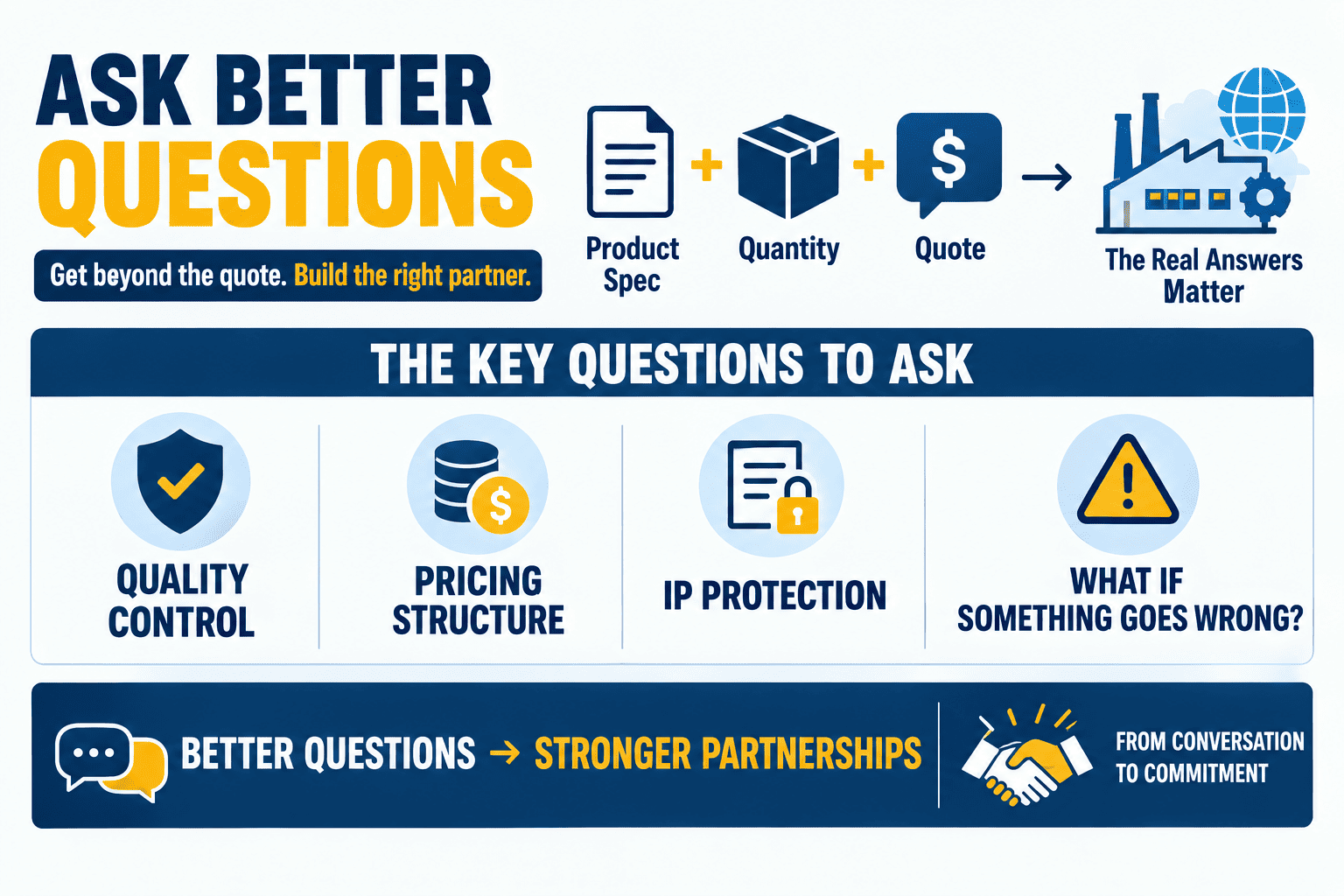
Most sourcing conversations start the same way: a product spec, a rough quantity, and a request for a quote. What separates a durable manufacturing relationship from an expensive mistake almost never shows up in that first email. It shows up in the answers, or the evasions, that come back once you ask harder questions about quality control, pricing structure, intellectual property protection, and what happens when something goes wrong. This article walks through the questions experienced buyers actually ask before committing to a manufacturing partner, why each one matters, and how to move from a good conversation to a properly vetted and formalised cross-border business partnership.
📅 Published September 8, 2026⏱ 11 min read✍️ GTsetu Editorial🔄 Updated September 8, 2026
Factories are busy, and a strong first impression on a call is easy to manufacture, no pun intended. The questions in this guide are drawn from how experienced procurement teams, product companies, and OEM buyers actually vet manufacturing partners before committing budget, specifications, and reputation to the relationship. None of them require legal training to ask, but the answers you get back will tell you almost everything about whether this is a partner you can build with for years or one that will cost you a product launch.
GTsetu
Find verified global partners. Build your next business relationship.
Discover verified companies · Explore global opportunities · Connect securely · Collaborate with confidence
Why the Right Questions Matter More Than the Right Answers
There is no universal “correct” answer to most of these questions. A manufacturer with a 500-unit minimum order quantity is not automatically worse than one with a 50-unit minimum, and a 12-week lead time is not automatically a red flag. What matters is whether the answers are specific, consistent, and verifiable, and whether they actually match what your business needs. A manufacturer who cannot answer clearly, or who gives you a different answer than the one their existing clients would give, is telling you something important before you have even placed an order.
💡 Come prepared, not just curious
Before you reach out to any potential partner, map out your product specifications, target quantities, budget range, and timeline. Good manufacturers are busy, and having your requirements organised before the first conversation makes it easier for them to give you precise answers instead of generic reassurances, and easier for you to compare responses across multiple candidates.
Section 2
The Core Questions to Ask Every Manufacturing Partner
The Questions That Do the Most Work
These are the questions that consistently separate a well-run manufacturing operation from one that will cause problems later, whether you are sourcing a single component or handing over an entire product line.
1
“What are your quality control measures?”
Certifications, sampling, defect rates, and corrective action
Quality
This single question reveals more than almost any other, because a real answer touches processes, compliance, and sourcing standards all at once. Ask for a sample before committing to a larger order; a manufacturer confident in their quality will provide one readily. If they resist, ask instead about certifications such as ISO 9001, their defect rate, and how they handle quality issues when they arise. As a natural follow-up, ask where they source their own materials, since your finished product is only as reliable as their upstream sourced materials.
🎯
What a strong answer looks like: Specific certifications you can independently verify, a willingness to share samples or inspection reports, and a clear process for what happens when a defect is found, not just an assurance that defects “rarely happen.”
2
“How do you price your orders, and what is your MOQ?”
Minimum order quantity, shipping fees, sample costs, added services
Pricing
Pricing structures are rarely a single number. Ask about the minimum order quantity and how pricing changes at different volumes, since smaller runs typically cost more per unit. Ask separately about shipping and logistics fees, sample pricing, and any additional services such as finishing, assembly, or engineering support that could be bundled in to streamline production and reduce delivery times. Shop this question across several partners; the cheapest quote often means a manufacturer is cutting corners somewhere you have not yet asked about.
🎯
What a strong answer looks like: A clear, itemised breakdown rather than a single bundled figure, and transparency about how costs shift with volume, materials, or added services.
3
“What is your lead time, and can you scale with us?”
Production capacity, subcontracting, seasonal flexibility, disruption recovery
Capacity
Understand what a normal lead time looks like for your industry and how much time your business can realistically afford to give the manufacturing process before it affects your cash flow. Then ask what happens when something goes wrong: does the manufacturer have a recovery process, and can they outsource to other plants or contractors if needed? Pair this with a direct question about scalability, their production capacity, whether they work with subcontractors, and whether they are investing in technology to future-proof their operations as your order volumes grow or fluctuate seasonally.
🎯
What a strong answer looks like: A realistic lead time backed by a contingency plan for delays, and concrete evidence, not just assurances, that the manufacturer can flex volume up or down as your business changes.
4
“How do you protect intellectual property and confidential data?”
NDAs, data security, competitor exposure, cybersecurity protocols
IP & Security
A manufacturing partner works with multiple businesses, sometimes including your competitors, so your specifications and designs may be exposed unless the right protocols are in place. Ask directly how they safeguard proprietary information, whether they will sign a non-disclosure agreement before receiving your specs, and how they handle cybersecurity to prevent knockoffs or unauthorised use of your designs. This is not a question to skip even for a simple product; exposure risk exists regardless of complexity.
🎯
What a strong answer looks like: A willingness to sign an NDA before any sensitive information changes hands, clear data-handling protocols, and an explicit answer about what prevents your designs from reaching a competitor working with the same factory.
GTsetu
Turn your expertise into global business opportunities.
Beyond the four questions that do the most diagnostic work, a fuller evaluation typically covers the categories below. Not every category applies to every sourcing decision, but each one has caused real problems for buyers who skipped it.
Category
What to Ask
Why It Matters
Communication & project management
What channels, point of contact, and reporting cadence will we use?
Reveals how disputes and delays will actually be handled day to day
Supplier network
Who are your own material suppliers, and do you have backups?
Your supply chain risk extends one layer beyond the manufacturer itself
Sustainability practices
What are your environmental compliance and waste-reduction practices?
Increasingly a buyer and end-consumer requirement, not just optics
Post-sales support
What warranty terms and return or repair process do you offer?
Affects your own customer experience long after the shipment arrives
Risk & contingency planning
What is your business continuity plan for major disruptions?
Determines how resilient your supply chain is to shocks outside anyone’s control
Track record
Can you share references from businesses similar to mine?
A manufacturer’s experience with comparable products predicts execution quality
Several of these categories, particularly risk and contingency planning, connect directly to how disruption is handled contractually. A manufacturer’s verbal reassurance about “having a plan” only matters if it is backed by clear force majeure provisions in the trade agreement itself, so treat the conversation and the contract as two parts of the same due diligence exercise.
Section 4
Answers That Should Make You Pause
Just as important as knowing what to ask is recognising when an answer, or the absence of one, should slow you down before you commit specifications, deposits, or exclusivity to a partner.
Vague or evasive answers on certifications. A manufacturer that cannot name specific, current certifications, or resists having you verify them independently, is a materially different risk than one that provides documentation readily.
Reluctance to provide samples. Sample resistance without a clear reason, such as extremely high tooling costs, often signals a manufacturer is not confident in the consistency of their own output.
No willingness to sign an NDA. This is one of the clearest disqualifying signals in the entire process. A partner unwilling to protect your confidential information before seeing it is unlikely to protect it after.
Pricing that is dramatically below every other quote. Cheaper is not always better, and manufacturers who sacrifice quality, labour standards, or compliance to hit an unusually low price rarely disclose that trade-off upfront.
No clear answer on subcontracting. If a manufacturer cannot tell you whether, or to whom, they subcontract work, you may be signing a contract with one company while your actual production happens somewhere else entirely, with different quality standards and different certifications for international trade.
📌 The honest read
None of these red flags is automatically disqualifying on its own, context matters, and a small specialist manufacturer may legitimately lack certain formal certifications while still being an excellent partner. What matters is whether the manufacturer is transparent about limitations rather than evasive about them. Transparency, more than any single answer, is the real signal you are testing for.
GTsetu
Build your ecosystem. Connect your members globally.
Dedicated ecosystem presence · Member discovery · Global connections · Expert access · Collaboration opportunities
Asking the right questions only helps if you compare the answers consistently across every candidate. Buyers who ask a slightly different set of questions to each manufacturer, or who weigh answers informally rather than side by side, often end up choosing based on rapport rather than substance. Building a simple scorecard, quality evidence, pricing transparency, lead time realism, IP protection, and communication clarity, applied identically to every candidate, produces a far more defensible decision, and one you can revisit if the relationship changes later using consistent partnership evaluation criteria.
This matters even more when you are evaluating manufacturers across different countries as part of a broader global expansion or cross-border manufacturing strategy, since certification standards, labour practices, and typical lead times vary meaningfully by region and can otherwise make an apples-to-oranges comparison feel more scientific than it actually is.
Section 6
From Good Answers to a Formal Partnership
Good answers in conversation are a starting point, not a substitute for verification and formal documentation. A promising call still leaves you needing to confirm a manufacturer’s legal standing, protect your specifications on paper rather than just in a verbal assurance, and agree on what happens if the relationship runs into trouble.
🏛️
Confirm legal registration and business status
Verify the company’s registration, incorporation date, and current standing before any commercial discussion goes further.
🤝 For Verified, Well-Vetted Manufacturing Partnerships
GTsetu: Verified Discovery and Secure Engagement Before You Ever Ask a Single Question
Every question in this guide assumes you already have a manufacturer on the phone willing to answer honestly. The harder problem is often earlier than that: finding a partner whose registration, certifications, and business status are genuinely verified before you invest time in the conversation at all. That gap is what GTsetu is built to close. It is a structured partnership platform, not a directory or a general marketplace, where every company is verified on 6 government-sourced points before engagement, where discovery is anonymous until mutual interest is confirmed, where NDAs are executed digitally before any commercial information changes hands, and where document exchange happens through an encrypted workspace rather than email attachments.
GTsetu is used by industrial manufacturers, distributors, and raw material suppliers across 100+ countries to build out a distributor network, source international wholesale distribution partners, or find manufacturing and technology partnership relationships they intend to keep for years, not a single order cycle. It complements, rather than replaces, the questions in this guide and any on-the-ground facility audits, but it removes much of the identity and documentation risk before that deeper diligence even begins.
🏛️
6-Point Government-Sourced Verification
Name, Address, Registration Number, Company Status, Company Type, and Date of Incorporation, verified using government tie-ups before any engagement.
🕵️
Anonymous Discovery
Browse verified manufacturer and supplier profiles across 100+ countries without revealing your own identity or sourcing strategy until you choose to engage.
📄
Built-In NDA Workflow
Digital NDA with timestamped signatures before any pricing, specifications, or designs are shared. No sensitive information exposed without protection.
🔐
Encrypted Document Workspace
All commercial documents shared through encrypted channels with a full access audit trail, not email attachments.
🌍
100+ Countries
Verified manufacturers and distributors across Asia, Europe, the Middle East, Africa, Australia, and the Americas. Built for cross-border partnership formation, not one-off quotes.
🚫
Zero Commission
No success fee, no broker commission, ever. Your partnership economics remain entirely between you and your partner.
It is also worth noting that the right questions can vary somewhat by region. Manufacturers evaluating partners across multiple geographies at once, including emerging clusters like the Nigerian industrial and agro cluster, alongside established hubs elsewhere, often find that a platform built for B2B matchmaking across countries makes it easier to apply the same verification standard everywhere, rather than reinventing due diligence for every new market.
FAQ
Frequently Asked Questions
QWhat is the most important question to ask a potential manufacturing partner?
There is no single most important question, but quality control and financial or legal transparency tend to surface the most risk the fastest. Asking how a manufacturer controls quality reveals their processes, sourcing standards, and certifications in one answer, while asking about pricing structure and payment terms reveals whether the relationship will be transparent or full of surprise costs later.
QHow many questions should I ask before choosing a manufacturing partner?
Most experienced buyers work from a checklist of roughly 8 to 12 core questions spanning quality control, pricing and MOQs, lead times, scalability, intellectual property protection, communication systems, supplier network resilience, and contingency planning. The exact number matters less than making sure every major risk category is covered before specifications or pricing are shared.
QShould I ask about intellectual property protection even for a simple product?
Yes. A manufacturing partner may work with several businesses at once, including possible competitors, so IP exposure is a risk regardless of how simple the product is. Asking about confidentiality protocols, data security, and how designs are protected during and after production is a standard question, not an advanced one, and should be resolved with an NDA before specifications are shared.
QWhat should I do after I get answers to these questions?
Verify the answers rather than taking them at face value. Confirm legal registration and business status independently, request references or samples, check certifications directly rather than relying on a claim, and put a formal NDA and partnership agreement in place before sharing sensitive specifications or committing to an order. Platforms built for verified B2B partnership formation can reduce much of this manual verification burden.
Ready to Find and Vet Your Next Manufacturing Partner?
GTsetu is purpose-built for manufacturers, distributors, and raw material suppliers in industrial sectors seeking verified long-term trade partnerships, across 100+ countries, with government-sourced partner verification, built-in NDA workflows, and zero commission.
They represents the product, and research team behind GTsetu, a global B2B collaboration platform built to help companies explore cross-border partnerships with clarity and trust. The team focuses on simplifying early-stage international business discovery by combining structured company profiles, verification-led access, and controlled collaboration workflows.
With a strong emphasis on trust, and disciplined engagement, Team GTsetu shares insights on global trade, partnerships, and cross-border collaboration, helping businesses make informed decisions before entering deeper commercial discussions.