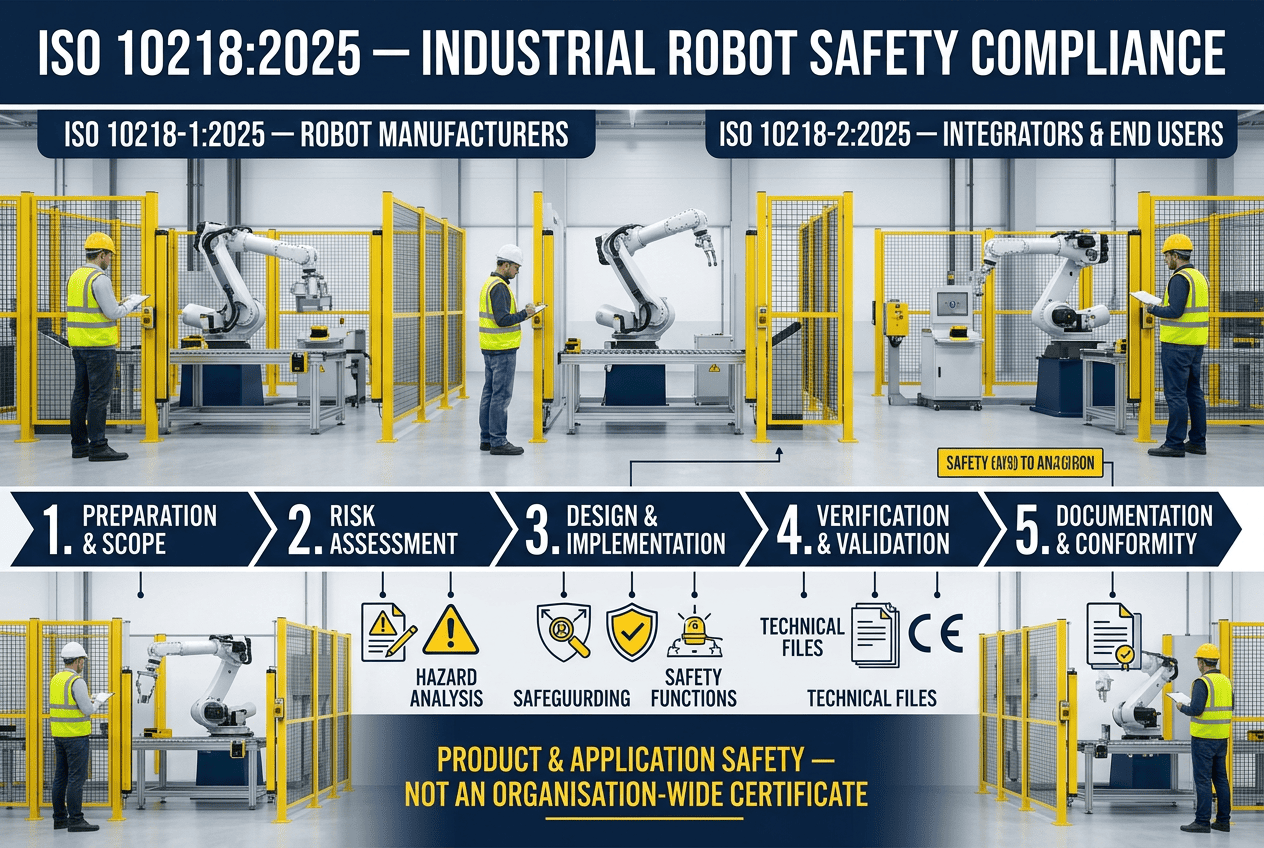
Direct Answer: ISO 10218 is the international safety standard for industrial robots, published in two parts: ISO 10218-1:2025 (industrial robots, mainly for robot manufacturers) and ISO 10218-2:2025 (industrial robot applications and robot cells, mainly for integrators and end users). Unlike ISO 9001, it is a product and application safety standard, so there is no single organisation-wide “ISO 10218 certificate”. Instead, you demonstrate conformity through a 5-step process: Preparation (role, edition, scope and legal requirements), Risk Assessment & Specification (hazard analysis across the lifecycle), Design & Implementation (safeguarding and safety functions), Verification & Validation (testing every safety function), and Documentation & Conformity Assessment (technical file, declarations, CE marking and optional third-party assessment). This guide walks you through every step, with practical tips for a smooth compliance journey.
📅 November 3, 2026⏱ 17 min read✍️ GT Setu Editorial Team🔄 Updated regularly
2025
Current Editions (Feb 2025)
2
Parts: Robot & Robot Cell
5
Key Steps to Compliance
0%
GTsetu Broker Commission
ISO 10218 is the international safety standard for industrial robots. Developed under ISO technical committee work on robotics, it sets out safety requirements for the design and construction of industrial robots (Part 1) and for the integration of robots into applications and robot cells (Part 2). The current editions, ISO 10218-1:2025 and ISO 10218-2:2025, were published in February 2025 and replace the 2011 editions. Part 2:2025 also absorbs the collaborative-operation content that previously sat in the technical specification ISO/TS 15066.
For manufacturers, system integrators and factory owners, conformity with ISO 10218 is often a contractual and legal expectation. In Europe, the 2025 editions have been adopted as EN ISO 10218-1:2025 and EN ISO 10218-2:2025, and their references were published in the Official Journal of the EU in September 2026, so they now give a presumption of conformity with the relevant requirements of the Machinery Directive 2006/42/EC. This guide explains what “ISO 10218 certification” really means in practice and covers the complete compliance process from initial preparation through to final conformity assessment. See our related guides on partnership evaluation criteria and business verification to understand how robot safety compliance fits into partner due diligence. If you are new to ISO standards, start with how to get ISO 9001 certification.
📋 Who Is This Guide For?
This guide is written for robot manufacturers, automation and system integrators, machine builders, safety engineers, plant managers and procurement teams that buy robot cells. It is equally relevant for end users who must specify safety requirements in purchase orders and for distributors that supply robots and automation equipment. For related partnership structures, see our guides on supplier collaboration platforms and distributors and manufacturers.
⚠️ Important: ISO 10218 Is Not a Management System Certificate
ISO 9001, ISO 14001 or ISO 27001 certify an organisation’s management system. ISO 10218 does not work that way. It is a safety standard applied to specific robots and robot applications. You demonstrate conformity by designing, verifying and documenting each product or cell against the standard, and then following the conformity route required in your market (for example technical file, declaration, CE marking, and optionally an independent third-party assessment). Be cautious of any provider that offers a generic “ISO 10218 company certificate” without examining the actual robot or cell.
SECTION 1
1 What Is ISO 10218 & Why Comply?
🤖 The Standard Explained
ISO 10218 is the international standard for industrial robot safety. ISO 10218-1:2025 (third edition) is titled “Robotics, Safety requirements, Part 1: Industrial robots” and addresses the robot itself. ISO 10218-2:2025 (second edition) is titled “Robotics, Safety requirements, Part 2: Industrial robot applications and robot cells” and addresses the complete application: the robot, end effector, workpieces, fixtures, safeguarding and operator interfaces. Both are now maintained by ISO/TC 299 “Robotics”. The standards rely on the machinery risk assessment principles of ISO 12100 and the functional safety concepts of ISO 13849-1 and IEC 62061.
🛡️
Protecting People
Industrial robots can generate large forces and speeds. The standard defines how hazards such as crushing, impact and trapping must be identified and reduced so operators, programmers and maintenance staff are protected.
⚖️
Legal & Market Access
In the EU, applying the harmonised EN ISO 10218 editions supports presumption of conformity with the Machinery Directive. Elsewhere, national adoptions (such as the US ANSI/A3 R15.06 series) align with the same requirements.
🤝
Collaborative Robots Included
The 2025 editions integrate collaborative operation requirements, including hand guiding, speed and separation monitoring, and power and force limiting, into one framework.
📈
Customer & Insurer Confidence
Documented conformity with ISO 10218 reassures buyers, insurers and auditors that your robot or cell has been designed and validated against recognised safety requirements.
SECTION 2
2 Key Benefits of ISO 10218 Compliance
Compliance with ISO 10218 delivers benefits across safety, commercial and operational dimensions. While the process requires engineering time and documentation effort, the cost of designing safety in from the start is typically far lower than the cost of retrofitting safeguards after an incident or a failed customer audit.
2
Parts of the standard: Part 1 for robots, Part 2 for applications and robot cells
250
mm/s, maximum reduced speed parameter specified in ISO 10218-2:2025
2
Robot classes in ISO 10218-1:2025, Class 1 (very weak robots) and Class 2 (all others)
🏷️
Market Access & Customer Acceptance
Documented conformity opens doors with OEMs, tier-1 suppliers and public buyers that require compliant robotic equipment in their specifications.
Commercial
🦺
Fewer Injuries & Less Downtime
A systematic risk assessment and validated safeguarding reduce the likelihood of serious incidents, investigations, production stoppages and compensation claims.
Operational
🔗
Clear Responsibilities Across the Supply Chain
Part 1 and Part 2 split duties between robot makers and integrators, so each party knows what safety information must be provided and what must be verified.
Partnership
🧮
Right-Sized Safety Design
The 2025 editions replaced a blanket performance level requirement with default performance levels per safety function, and allow deviations when justified by a more thorough risk assessment.
Engineering
👥
Safer Human-Robot Collaboration
Defined collaborative modes and contact limits let you deploy cobots and shared workspaces with a recognised basis for validation, rather than relying on supplier claims alone.
People
📋
Defensible Compliance Record
A complete safety file, risk assessment, circuit design, test records and residual risk information, demonstrates due diligence to regulators, insurers and customers.
Compliance
SECTION 3
3 ISO 10218-1 vs 10218-2 & What Changed in 2025
The two parts work together. A robot built to Part 1 provides the safety functions and information that an integrator then uses to build a compliant application under Part 2. Knowing which part applies to your role is the first step in any compliance project.
Aspect
ISO 10218-1:2025 (Robots)
ISO 10218-2:2025 (Applications & Cells)
Primary audience
Robot manufacturers (OEMs)
System integrators, machine builders and end users
Scope
Design and construction of the industrial robot, including its controller and built-in safety functions
Integration of the robot with tooling, workpieces, safeguards and peripherals into a complete application or cell
Edition status
Third edition; replaces ISO 10218-1:2011
Second edition; replaces ISO 10218-2:2011
Typical evidence
Safety manual, safety function specifications and performance levels, test records, instructions for integrators
The previous blanket requirement of PL d, Category 3 has largely been replaced. Safety functions are listed with default required performance levels, which designers may adopt or adjust through a more detailed risk assessment.
🏷️
Two Robot Classes
Class 1 covers very weak robots that do not pose a significant hazard on reasonable assessment and carry reduced control requirements. Class 2 covers all other industrial robots.
🤝
ISO/TS 15066 Integrated
Collaborative operation content, including contact limits for pressure and force and the treatment of quasi-static versus transient contact, now sits within ISO 10218-2.
⏹️
Normal Stop Function
A safety function for normal stopping, for example at the end of a shift, is now required, which also helps reduce misuse of the emergency stop.
🔐
Cybersecurity & Interlocks
Additions and changes cover cybersecurity, start and restart interlocks and reset, mechanical strength, lifting operations and risk assessment.
📦
Load/Unload & Grippers
Content from the technical reports ISO/TR 20218-1 and ISO/TR 20218-2 on manual load and unload stations and gripper systems has been integrated.
📋 Always Name the Edition
Many existing robots and cells were built to the 2011 editions, and some customers or regions still reference them or the US R15.06 adoption. When you write a specification, request for quote or technical file, state the exact edition (for example “ISO 10218-2:2025”) and the date it applies from. Confirm the status of harmonised or adopted versions in your target market before you finalise your compliance route.
SECTION 4
4 Step 1: Preparation, Role, Edition & Scope
🏗️ Building the Foundation
The preparation phase sets the foundation for your entire ISO 10218 project. The goal is to establish who is responsible for what, which edition and legal requirements apply, and exactly what product or application is in scope. Time spent here prevents expensive redesign later.
1.1
Identify Your Role
Are you the robot manufacturer, the integrator of a robot application or cell, or the end user who modifies or operates it? Robot manufacturers focus on Part 1; integrators and end users focus on Part 2. Many projects involve all three, with information handed from one to the next.
1.2
Confirm Legal & Customer Requirements
Determine the applicable regulations in each market (for example the EU Machinery Directive and, in due course, the Machinery Regulation, or national workplace safety rules) and any customer specifications. Check how the standard is adopted locally, such as EN ISO 10218 in Europe or ANSI/A3 R15.06 in the United States.
1.3
Define the Application Completely
Record the robot model, payload, end effector, workpieces, cycle time, production rate, all operating modes (automatic, manual, setup, maintenance, cleaning) and the people who will interact with the system. Define the limits of the machine as required by risk assessment. See partnership evaluation criteria for a framework that also helps when scoping vendor responsibilities.
1.4
Choose the Operating Concept
Decide whether the cell will use traditional perimeter guarding, presence-sensing devices or a collaborative mode such as hand guiding, speed and separation monitoring, or power and force limiting. This choice shapes the risk assessment, the sensors and the validation effort.
1.5
Assemble the Team & Training
Compliance needs mechanical, controls and safety competence. Make sure at least one person is trained in machinery risk assessment (ISO 12100), functional safety (ISO 13849-1, IEC 62061) and the 2025 editions of ISO 10218. Consider external support where internal expertise is limited.
1.6
Gather Robot Safety Information
Integrators should obtain and read the robot manufacturer’s safety manual and documentation of safety functions and performance levels before designing safety circuits. These documents determine what the robot can contribute to the overall system.
💡 Pro Tip: Settle Responsibilities in the Contract
Misunderstandings between robot suppliers, integrators and end users are a leading cause of compliance gaps. Agree in writing who performs the risk assessment, who validates safety functions, who holds the safety file and who approves changes. The same principle applies when drafting manufacturer-distributor contracts, define responsibilities up front.
SECTION 5
5 Step 2: Risk Assessment & Specification
The risk assessment is the core obligation for any robot application. It follows the principles of ISO 12100 and must cover every phase of the system’s lifecycle, from installation and commissioning through production, maintenance, cleaning and decommissioning. The result is a specification of the safety functions and protective measures the design must deliver.
Risk Assessment Stage
Description
Key Consideration
Define Limits
Intended use, reasonably foreseeable misuse, space limits and time limits across all lifecycle phases.
Include setup, programming, fault recovery and maintenance, not just normal production.
Identify Hazards
Walk through each operating mode and task. Consider mechanical hazards (crushing, shearing, impact, entanglement, ejection), electrical, thermal, noise, vibration and hazards from processed materials.
Evaluate the end effector and process as well as the robot; a safe arm does not make a sharp or hot tool safe.
Estimate Risk
For each hazard, assess severity of harm, frequency and duration of exposure, probability of the hazardous event and possibility of avoidance.
Use a documented and consistent scoring method such as a risk graph.
Evaluate Risk
Decide whether each risk is acceptable or must be reduced.
Record the decision and the criteria used.
Reduce Risk
Apply the hierarchy: inherently safe design first, then safeguarding and complementary measures, then information for use such as warnings, training and PPE.
Do not rely on training or PPE where design or guarding can remove the hazard.
Specify Safety Functions
Define which safety functions are needed (for example emergency stop, protective stop, enabling function, reduced speed, normal stop) and the required performance level or SIL for each.
Start from the default performance levels in ISO 10218-2:2025; justify any deviation with the more detailed assessment the standard describes.
Review & Update
Reassess after any change in tooling, programs, layout or location.
Treat the risk assessment as a living document.
💡 Risk Assessment Best Practices
DO: Involve operators, maintenance staff and programmers in hazard identification, because they know the real tasks and workarounds. Photograph and sketch the layout, and keep assumptions explicit.
DON’T: Reuse an old assessment for a new cell without checking every assumption, assume a cobot needs no assessment, or leave tooling and workpieces out of scope.
Link to related risk disciplines: Product risk frameworks such as ISO 14971 and workplace safety systems such as ISO 45001 use similar risk-based thinking and can help you structure the process and records.
SECTION 6
6 Step 3: Design & Implementation
With the risk assessment and safety requirements specification in hand, you can design and build the protective measures. The aim is a system in which the safeguards, safety functions and operating procedures together reduce risk to an acceptable level, with each function implemented at its required performance level.
🧱
Perimeter Guarding & Interlocks
Enclose the robot’s operating envelope with fixed guards and interlocked gates using safety-rated devices. Position guards using proper minimum-distance calculations and make sure gate opening triggers a protective stop.
Guarding
📡
Presence-Sensing Devices
Use light curtains or safety laser scanners where physical barriers are impractical, such as part load and unload stations. Verify zone configuration, response times and coverage against the design intent.
Sensing
🛑
Safety Functions & Performance Levels
Implement emergency stop, protective stop, enabling function, reduced speed (limited to 250 mm/s or less for the reduced speed parameter) and normal stop at the performance levels derived from your assessment, using safety-rated PLCs and validated components.
Functional Safety
🤝
Collaborative Modes
For hand guiding, speed and separation monitoring or power and force limiting, design the application so protective separation distances, speeds and contact limits are met. Remember that force limiting does not make a hazardous tool safe.
Collaboration
🔐
Cybersecurity & Access Control
Protect safety-related controls, parameters and networks from unauthorised change. Consider alignment with information security practice such as ISO 27001.
Security
📘
Information for Use
Prepare operating instructions, warnings, lockout and maintenance procedures, and training materials. Instructions should describe residual risks that remain after design and safeguarding.
Documentation
🔧
Quality of Build
Consistent workmanship, controlled changes and traceable components keep the as-built cell aligned with the validated design. A quality system such as ISO 9001 supports this discipline.
Quality
SECTION 7
7 Step 4: Verification & Validation
🔍 Proving the System Works
Verification and validation demonstrate that the safety functions and safeguards actually perform as designed, before the system enters production. This step is the equivalent of the internal audit in a management system: it turns design intent into measured evidence and must be completed, with problems corrected, before conformity is declared.
📋
Validation Plan
List every safety function, its required performance level, the test method, acceptance criteria and who performs and witnesses the test. Tie each item back to the risk assessment.
⏱️
Stopping Performance
Measure actual stopping times and distances and compare them to the values used to position safeguards. Brake wear, payload variations and mechanical compliance can make real values worse than calculated ones.
🚪
Interlocks, E-Stops & Sensors
Test every interlock, emergency stop and protective device, including fault conditions. Confirm sensor coverage and zone settings match the design and that restart interlocks and resets behave correctly.
💻
Safety Logic & Performance Level
Verify that safety PLC programs execute correctly under all conditions and that the achieved performance level of each safety function meets or exceeds the required level, with supporting calculations or tool reports.
🖐️
Contact Measurements (Collaborative)
For power and force limiting, measure contact force and pressure at relevant body regions and compare with the limits in ISO 10218-2:2025, considering quasi-static and transient contact. Do not rely on supplier default settings alone.
✅
Close Out Findings
Record any failed tests, correct the design or settings, retest and document the final result. Update the risk assessment if the corrective action changes the risk picture.
💡 Validation as a Quality Gate
Treat validation as a formal gate before shipment or start-up, not a final formality. Many integrators complete a preliminary risk assessment at concept stage, refine it in detailed engineering and validate during build and commissioning, so surprises appear early. This is the same philosophy behind structured partnership evaluations, test early, document results and fix gaps before commitment.
SECTION 8
8 Step 5: Documentation & Conformity Assessment
The final step is to compile the evidence and follow the conformity route required in your market. Because ISO 10218 certifies products and applications rather than organisations, the exact route depends on what you place on the market and where. The table below shows the typical building blocks.
Element
What It Involves
Key Focus
Safety File / Technical File
Risk assessment, design drawings, safety circuit diagrams, performance level calculations, validation and test records, residual risk information and instructions.
Completeness, traceability and version control. It is the primary evidence for regulators and customers.
Robot (Part 1) Conformity
Robot manufacturers verify the robot against Part 1 and supply safety information. Depending on the market, an industrial robot may be treated as partly completed machinery with a declaration of incorporation.
Clear safety manual and documented safety function performance.
Complete Cell / Application (Part 2) Conformity
Integrators verify the whole cell. In the EU, a complete machine is typically supported by a declaration of conformity and CE marking, with the integrator taking responsibility as manufacturer of the final machine.
Whole-system safety, not just component compliance.
Harmonised Standard Route
Applying EN ISO 10218-1:2025 and EN ISO 10218-2:2025 gives a presumption of conformity with the essential requirements they cover under the Machinery Directive.
Reference the exact standard editions in your documentation.
Third-Party Assessment (Optional or Required)
An independent test or certification body reviews documentation and may witness tests or measure forces, then issues a report or certificate for the robot or cell.
Useful for customer acceptance, insurers, export markets or where contracts require independent verification.
Ongoing Change Management
Any modification, new tool, program, layout or relocation, triggers a review of the risk assessment and possibly re-validation.
Keep the safety file current for the life of the system.
📋 Check Your Market’s Rules
Conformity routes differ by region and are changing. In the EU, the Machinery Regulation (EU) 2023/1230 is due to replace the Machinery Directive from January 2027, so verify which instrument and which standards references apply on the date you place equipment on the market. In the US, the A3 R15.06-2025 adoption of the same content is the common reference. Always confirm with your authority, notified body or test lab, because this guide is general information, not legal advice.
💡 Preparing for Third-Party Review
Organise the file: Provide a clear index, consistent naming and direct links between hazards, protective measures and test results. Make the validation evidence easy to trace.
Prepare the people: Be ready to explain how the system works, how restart and reset are controlled, and how maintenance is done safely.
Select your reviewer early: See the next sections for how to choose a testing body and use partnership evaluation criteria as a framework.
SECTION 9
9 Costs & Timeline: What to Expect
There is no standard price list or fixed duration for ISO 10218 conformity, because the work scales with the robot or cell, the safeguarding concept and the evidence required. The table below describes the main drivers. Use it to frame requests for quotation from integrators, consultants and test bodies rather than as a fixed budget.
Factor
Impact on Cost
Impact on Timeline
Your Role (Manufacturer vs Integrator)
Robot manufacturers carry design verification across product variants; integrators carry per-project risk assessment and validation.
Manufacturers plan across product development cycles; integrators fit work within each project schedule.
Cell Complexity
More robots, stations, operating modes and interfaces increase assessment, design and validation effort.
Complex cells need longer risk assessment and commissioning phases.
Safeguarding Concept
Simple guarded cells are generally more predictable; collaborative applications add sensing, measurement equipment and detailed contact validation.
Collaborative validation, including force and pressure measurement, adds test time.
Required Performance Levels
Higher required performance levels need more robust architectures, components and verification work.
May lengthen design, calculation and testing.
Edition Transition
Moving designs and templates from the 2011 to the 2025 editions requires engineering updates and training. Part 2 alone is a substantially larger document than before.
Allow time for gap analysis against the 2025 requirements.
Third-Party Involvement
Independent assessment, witnessed tests and measurement services add fees but can speed customer acceptance.
Booking lead times and report issuance should be planned early.
Documentation Tools & Templates
Standard templates and software for risk assessment and safety calculations reduce engineering hours.
Reusable structures can shorten each project’s documentation phase.
📋 Budget Beyond the Test Report
Teams often budget for testing and overlook staff training, safeguarding hardware, validation instruments, documentation time and later change management. Include these in your business case, and when evaluating integrators, consultants or test providers, use the same partnership evaluation criteria you would apply to any B2B engagement.
SECTION 10
10 How to Choose a Testing / Certification Body
If your contract, market or risk profile calls for independent verification, choosing the right testing or certification body matters. Look for an organisation that understands robotics and machinery safety specifically, not just management system auditing. The ISO robotics sector page is a useful starting point for understanding the wider family of robotics standards.
🏛️
Accreditation Status
Prefer a body accredited by a recognised national accreditation body for the relevant scope, for example product certification under ISO/IEC 17065 or testing under ISO/IEC 17025, and confirm that robot or machinery safety is within that scope.
🤖
Robotics & Functional Safety Expertise
Ask about experience with industrial robots, collaborative applications, safety PLCs and performance level verification. Engineers who have assessed similar cells will spot practical issues faster.
🆕
Knowledge of the 2025 Editions
Confirm that the body works to ISO 10218-1:2025 and ISO 10218-2:2025 and understands how ISO/TS 15066 content has been integrated, rather than applying outdated checklists.
📏
Measurement Capability
For collaborative applications, check whether the body can perform calibrated contact force and pressure measurements and issue traceable results.
🌐
Market Recognition
Verify that your customers, insurers and target markets accept the body’s reports or certificates, especially if you export to several regions.
💰
Cost & Transparency
Compare itemised quotes covering document review, site visits, witnessed tests, measurements and report issuance. Understand what is included and what triggers extra fees.
💡 Selection Checklist
Ask each candidate: Is robot safety within your accredited scope? Which engineers with robotics experience will be assigned? Which edition of ISO 10218 will you assess against? Will you perform or witness validation tests and force measurements? What deliverables do you issue and how are they recognised? What changes require re-assessment? Use the answers alongside your partnership evaluation criteria to make an informed decision.
SECTION 11
11 Common Mistakes & How to Avoid Them
📅
Working to the Wrong Edition
Using the 2011 editions or outdated templates when customers or regulators expect the 2025 editions leads to rework and rejected documentation.
Avoid: State the exact edition in every specification and contract, and run a gap analysis for existing designs.
🤖
Assuming a Cobot Is Automatically Safe
The end effector, workpiece and process can create hazards that force limiting does not address, such as sharp tools, heat or clamping against fixed objects.
Avoid: Assess the complete application, and measure contact forces and pressures during validation.
🧪
Calculating but Not Measuring
Stopping distances and safeguard positions based only on calculation can be wrong once brakes, payloads and compliance are accounted for.
Avoid: Verify by measurement and document the results.
🔄
Not Updating After Changes
New programs, tools, layouts or relocation can change the risk profile, yet the original assessment stays on the shelf.
Avoid: Build a change-control step that triggers risk review. See risk allocation principles for allocating responsibility when systems cross organisational boundaries.
📚
Weak Safety Documentation
Scattered drawings, missing test records and unclear residual risk information make third-party review slow and leave you exposed after an incident.
Avoid: Maintain one controlled safety file and treat it as a project deliverable, not an afterthought.
🎓
Insufficient Training
Operators and maintenance staff who do not understand modes, interlocks and restart procedures can defeat even a well-designed system.
Avoid: Provide role-based training and keep records. Consider global partner service models for structured training and support across sites.
SECTION 12
12 ISO 10218 & Related Standards
ISO 10218 sits within a wider ecosystem of safety, quality, security and risk standards. Within the robot safety family you will also encounter ISO 12100 (risk assessment), ISO 13849-1 and IEC 62061 (functional safety), ISO 13855 (positioning of safeguards), ISO 14119 (interlocking devices) and the ISO/TR 20218 series. Beyond those, the management system and sector standards below often complement a robotics compliance programme. Explore each guide to see where it fits.
📋Quality
ISO 9001, Quality Management
A quality system helps control design changes, supplier quality and records, all of which support a consistent, traceable robot safety file.
A structured product risk process whose thinking parallels machinery risk assessment, useful where robots are used in medical device manufacturing or surgery-adjacent equipment.
A different domain with similar functional safety thinking. Automotive suppliers often use robotic cells that must meet ISO 10218 on the shop floor while their products meet ISO 26262.
Connected robots and safety controllers face cyber threats. ISO 27001 provides an organisational framework that complements the cybersecurity provisions in ISO 10218.
ISO/TS 15066:2016 was the technical specification for collaborative robots. Its content on collaborative operation and biomechanical contact limits has now largely been incorporated into ISO 10218-2:2025, so new projects should work from the 2025 edition of ISO 10218 and check whether any remaining references to the technical specification still apply in your documentation or contracts.
SECTION 13
13 How GTsetu Supports Your ISO 10218 Compliance Journey
🔗 GTsetu, Verified B2B Platform
Connect with Verified Partners & Build Safe Automation Supply Chains
Robot safety compliance depends on trustworthy robot makers, integrators, component suppliers and test providers. GTsetu complements your compliance work by connecting you with verified manufacturers, distributors and suppliers, so the partners behind your automation projects are as reliable as your own engineering. Our platform provides:
✅
Verified Company Profiles
Every company on GTsetu is verified on 6 key data points (Name, Address, Registration Number, Company Status, Company Type, Date of Incorporation) using government tie-ups, complementing your due diligence on integrators and component suppliers.
🕵️
Anonymous Discovery
Browse verified partner profiles without revealing your identity until you’re ready to engage, protecting your sourcing strategy and commercial confidentiality.
📄
Built-In NDA Workflow
Digital mutual NDA with timestamped signatures, activated before any sensitive commercial or technical data is exchanged, protecting your cell designs, specifications and know-how.
🔐
Encrypted Document Workspace
AES-256 encryption at rest, TLS in transit, role-based access controls, and full audit trail, ensuring the secure exchange of safety specifications, drawings and test documentation with partners.
🚫
Zero Broker Commission
GTsetu charges zero commission on any partnership formed. All commercial value stays between you and your verified partner.
🌏
Global Network of Verified Partners
Access verified manufacturers, distributors and suppliers across 100+ countries, helping you find automation and robotics partners aligned with your compliance expectations.
ISO 10218 is the international safety standard for industrial robots. It has two parts: ISO 10218-1:2025 “Robotics, Safety requirements, Part 1: Industrial robots”, aimed mainly at robot manufacturers, and ISO 10218-2:2025 “Robotics, Safety requirements, Part 2: Industrial robot applications and robot cells”, aimed at integrators and end users. Both were published in February 2025 and replace the 2011 editions. Conformity helps protect workers, supports legal compliance such as CE marking, and is frequently demanded by customers and insurers. It is also a key factor in partnership evaluation when you select automation suppliers.
QCan a company be ISO 10218 certified like ISO 9001?
Not in the same way. ISO 10218 is a product and application safety standard rather than a management system standard, so there is no organisation-wide ISO 10218 certificate like an ISO 9001 certificate. Instead, robots, robot cells and applications are designed, verified and validated against the standard, and conformity is documented through a technical file and, depending on the market, a declaration of conformity or incorporation, CE marking, and optionally an independent third-party assessment or test report. For the management system route, see our guide on ISO 9001 certification.
QWhat are the 5 main steps to achieve ISO 10218 compliance?
The 5 main steps are: (1) Preparation, identify your role, applicable edition, scope and legal requirements. (2) Risk Assessment & Specification, assess hazards across the full lifecycle and define safety requirements. (3) Design & Implementation, select safeguarding, implement safety functions at the required performance level and integrate the cell. (4) Verification & Validation, test every safety function, stopping performance and, for collaborative applications, contact limits. (5) Documentation & Conformity Assessment, compile the technical file, instructions and declarations, and obtain third-party assessment where required or desired. This structured approach is similar to building any distributor network, start with a solid foundation and build methodically.
QWhat changed in ISO 10218:2025 compared with the 2011 editions?
Key changes include a more flexible, risk-based approach to functional safety with default performance levels for each safety function instead of a blanket PL d requirement, two robot classes in Part 1, incorporation of the collaborative operation content of ISO/TS 15066 into Part 2, a requirement for a normal stop function, and new or expanded material on cybersecurity, restart interlocks and manual load and unload stations. Part 2 has also grown considerably in length, which is why a gap analysis of existing designs is worthwhile.
QHow long does ISO 10218 compliance take and what does it cost?
There is no fixed fee or duration. Effort depends on whether you are a robot manufacturer or an integrator, the complexity of the cell, the type of safeguarding or collaborative mode, the performance levels required, and whether third-party testing is used. Simple guarded cells may be completed within the normal project schedule, while complex collaborative or multi-robot systems need more risk assessment, validation measurements and documentation. Obtain quotes from integrators and test bodies based on your specific application.
QWhat documents are required for ISO 10218 compliance?
Typical documentation includes the application definition, the risk assessment and risk reduction records, safety requirements specification, safeguarding and safety circuit designs, performance level calculations or verification reports, validation and test records (including stopping performance and, where relevant, contact measurements), operating and maintenance instructions, residual risk information, and the declarations needed for your market. Keeping everything in one controlled safety file makes reviews easier, much like using a business partnership contract template saves time in legal drafting.
QHow do I choose a conformity assessment or testing body for robot safety?
Look for an independent testing, inspection and certification body that is accredited for the relevant scope (for example ISO/IEC 17065 for product certification or ISO/IEC 17025 for testing laboratories) and has documented experience with robotics, machinery safety and functional safety. Confirm that they work to the 2025 editions, can perform contact force and pressure measurements for collaborative applications if needed, and that your customers and target markets accept their reports. Apply the same rigour as when using partnership evaluation criteria to choose any business partner.
QDoes ISO 10218 apply to collaborative robots?
Yes. Collaborative robots are industrial robots used in collaborative applications, so ISO 10218 applies. In the 2025 editions, the collaborative operation requirements previously found in ISO/TS 15066 have been incorporated into ISO 10218-2, including hand guiding, speed and separation monitoring, and power and force limiting, along with contact pressure and force limits. A cobot does not make an application safe by itself, so the complete application, including the tool and workpiece, must be assessed.
QHow does ISO 10218 relate to other ISO standards?
ISO 10218 builds on machinery risk assessment (ISO 12100) and functional safety (ISO 13849-1, IEC 62061), and complements management system standards such as ISO 45001 for occupational health and safety, ISO 27001 for information security, and ISO 9001 for quality. Sector standards such as ISO 13485, ISO 14971 and ISO 26262 may also apply depending on your industry.
Ready to Build a Safe, Verified Automation Supply Chain?
Connect with verified manufacturers, distributors and suppliers on GTsetu, compliance-backed verification, anonymous discovery, built-in NDA workflows and zero broker commissions. Find partners who share your commitment to safety and quality.
They represents the product, and research team behind GTsetu, a global B2B collaboration platform built to help companies explore cross-border partnerships with clarity and trust. The team focuses on simplifying early-stage international business discovery by combining structured company profiles, verification-led access, and controlled collaboration workflows.
With a strong emphasis on trust, and disciplined engagement, Team GTsetu shares insights on global trade, partnerships, and cross-border collaboration, helping businesses make informed decisions before entering deeper commercial discussions.