Why Buyer Readiness Matters in Marketing
Understanding buyer readiness is essential for any marketing strategy because it recognizes that a purchase is not an instantaneous decision. By evaluating how customers react to a product at different psychological levels, companies can build strategies that generate more sales and increase profitability. Proper advertising is critical to make consumers aware of a product’s existence, and then guide them through the stages until they finally decide to purchase. Segmenting the demographics of customers based on their readiness stage allows companies to formulate separate strategies for each stage, maximizing sales revenue.
📊 Key Statistic
Organizations that tailor their marketing content to specific buyer readiness stages can see up to a 40% increase in lead conversion rates compared to those using a one-size-fits-all approach. Aligning content with the customer’s psychological state drives more effective engagement.
The Six Stages of Buyer Readiness
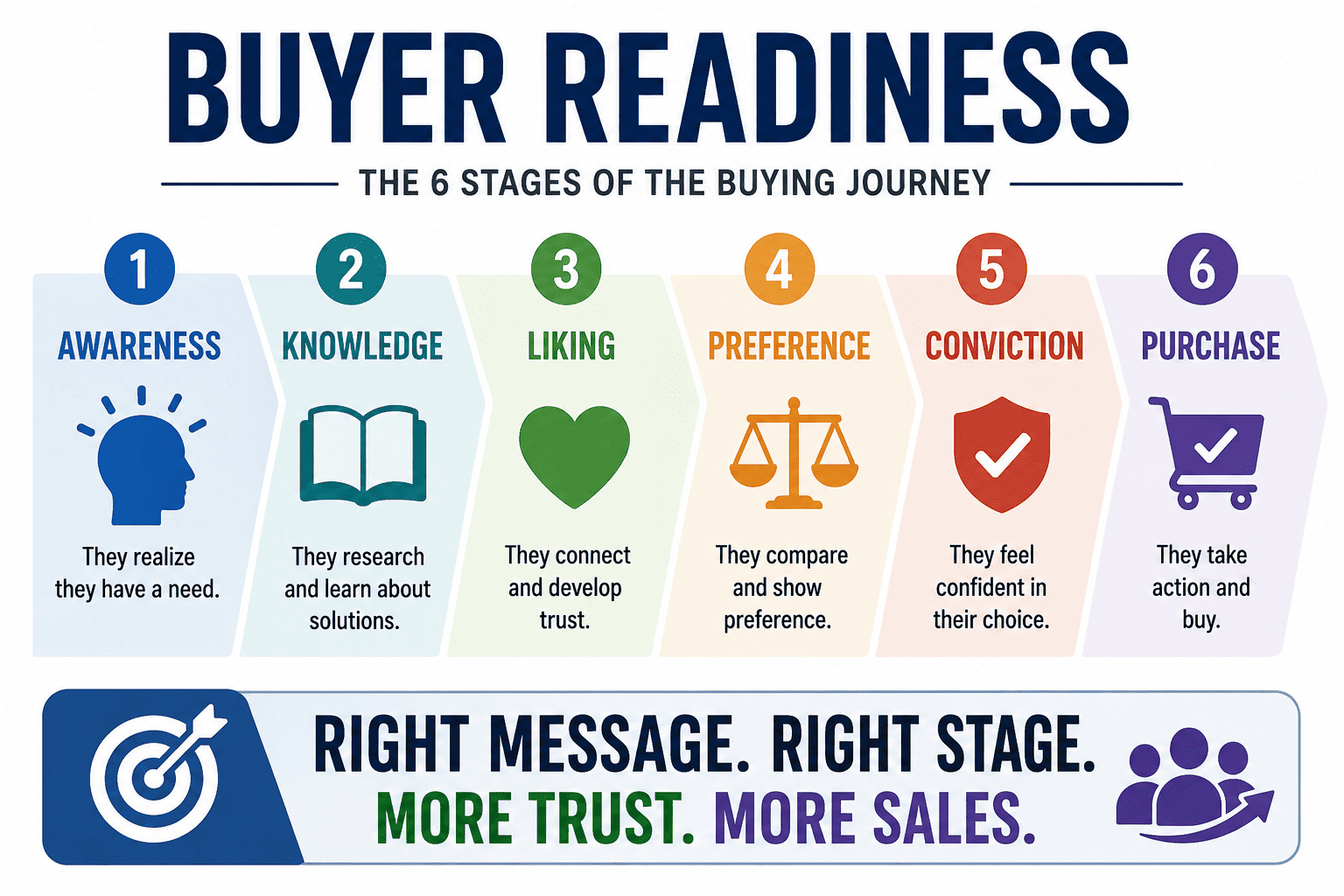
Each stage represents a distinct psychological state that a consumer progresses through. Understanding these stages allows marketers to create targeted campaigns that resonate with the consumer’s current mindset.
| Stage | Description | Marketing Focus |
|---|
| 1. Awareness | The customer becomes aware of the existence of the product or service for the first time. They have a rough idea of what the product is. | Focus on building brand visibility and reaching the maximum number of potential customers. |
| 2. Knowledge | The customer now knows the product exists but lacks detailed information about its benefits and features. | Provide comprehensive information about product features, benefits, and how it helps solve customer problems. |
| 3. Liking | The customer not only knows about the product but also starts to feel favorable toward it, beginning to relate to the product. | Understand customer feelings and ideas, bringing them out through the product and its messaging. |
| 4. Preference | The customer chooses to prefer the product over all other competitive options available in the market. | Understand the buyer’s preference list and position the product at the top of that list through competitive differentiation. |
| 5. Conviction | The customer gains a strong reason and belief that the product is suitable and beneficial for them, making them willing to buy. | Provide powerful reasons and social proof to build belief and confidence in the product’s suitability. |
| 6. Purchase | The final stage where the customer builds enough confidence and motivation to make the actual buying decision. | Remove final barriers to purchase, provide clear calls-to-action, and make the buying process seamless. |
📌 Note on the Model
While this six-stage model is the most common framework, variations exist. The AIDA model (Attention, Interest, Desire, Action) is a similar framework, and Shapiro and Bonoma (1984) described a six-stage model for industrial markets: Awareness, Knowledge, Interest, Preference, Conviction, and Purchasing power. The core principle remains: customers move through psychological stages before buying.
Practical Application
How to Use Buyer Readiness in Marketing Strategy
The buyer readiness stages are very useful for segmenting target customers based on their current level. A clever marketing strategy will design an advertising plan that targets customers depending on the stage they are currently in.
| Buyer Readiness Stage | Marketing Approach | Content Type |
|---|
| Awareness | Broad reach campaigns to introduce the product. Use mass media, social media ads, and PR to generate buzz. | Blog posts, social media posts, short videos, infographics. |
| Knowledge | Educational content that highlights features, benefits, and unique value propositions. | E-books, white papers, detailed product guides, webinars. |
| Liking | Emotional and relational marketing. Show how the product fits into the customer’s life and values. | Brand stories, user-generated content, testimonials, case studies. |
| Preference | Competitive differentiation. Show why your product is superior to alternatives. | Comparison charts, competitor analysis, product demos, free trials. |
| Conviction | Build trust and credibility. Use social proof, expert endorsements, and detailed case studies. | Customer reviews, ratings, detailed case studies, expert opinions. |
| Purchase | Facilitate the transaction. Remove barriers, offer incentives, and provide a seamless checkout. | Clear pricing, limited-time offers, easy checkout process, excellent customer support. |
Beyond the Stages: Readiness vs. Knowledge
Buyer Readiness Does Not Mean Buyer Knowledge
As Gartner’s Hank Barnes emphasizes, even advanced stages of readiness do not mean the customer is fully knowledgeable about what they need. A buyer can be ready to buy due to urgency, but may lack confidence and clarity about the specifics. This knowledge gap is a critical opportunity for sales and marketing teams.
💡 Insight from Hank Barnes (Gartner)
“When someone has to buy due to a critical situation, there may be a big knowledge gap. Be the one that helps them gain confidence and you will win more business.” Instead of just answering questions, proactive sellers volunteer information, dig deeper, and provide prescriptive guidance. This builds trust and differentiates them from competitors who simply wait for the buyer to ask questions.
This principle is especially relevant in B2B procurement, complex services, and situations where urgency is forcing a purchase. By helping buyers navigate their uncertainty, you can build confidence and win more business. The opportunity is not just in selling, but in helping the customer learn how to buy.
Real-World Example
Buyer Readiness in Action: Assisted Living Decision
The following example, shared by Hank Barnes of Gartner, illustrates how buyer readiness and knowledge gaps play out in a real purchasing decision.
🏥 Case Study: Assisted Living Facility Selection
Situation: An 87-year-old mother’s health is declining, requiring a move to an assisted living facility. Her family is ready to buy (high readiness) but lacks knowledge about what they need, the options available, and what to look for.
Vendor A: Waited for the family to ask questions, rarely volunteered information, and left them feeling uncertain.
Vendor B: Answered questions, then proactively dug deeper, volunteered ideas, and provided prescriptive guidance. They built confidence and won the business.
Lesson: High buyer readiness does not equal high buyer knowledge. Sellers who bridge the knowledge gap by being proactive and prescriptive build trust and differentiate themselves.
Risks & Mitigation
Common Risks in Misunderstanding Buyer Readiness
⚠️
Assuming Readiness = Knowledge
Mitigation: Always assess the customer’s knowledge level, even if they show high readiness. Use diagnostic questions to identify gaps and provide proactive guidance.
⚠️
One-Size-Fits-All Content
Mitigation: Segment your audience by readiness stage and tailor content accordingly. Use marketing automation to deliver stage-appropriate messaging.
⚠️
Ignoring the Psychological Journey
Mitigation: Map your sales and marketing funnel to the six buyer readiness stages. Ensure that each stage has a clear objective and appropriate content to move the buyer to the next stage.
FAQ
Frequently Asked Questions About Buyer Readiness
QWhat are the six stages of buyer readiness?
The six stages are: Awareness (knowing the product exists), Knowledge (understanding its benefits), Liking (feeling favorable toward it), Preference (preferring it over competitors), Conviction (believing it is the right choice), and Purchase (making the final buying decision). These stages represent the psychological journey a consumer takes before making a purchase.
QWhy is understanding buyer readiness important for marketing?
Understanding buyer readiness helps marketers tailor their messaging and strategies to the customer’s psychological state. By addressing the specific needs at each stage—from building awareness to reinforcing conviction—companies can guide prospects more effectively through the purchase process, leading to higher conversion rates and stronger customer relationships.
QWhat is the difference between buyer readiness and buyer knowledge?
Buyer readiness refers to the psychological willingness to purchase, which can exist even when the buyer lacks complete knowledge about the product. As Hank Barnes of Gartner points out, a buyer can be ‘ready to buy’ but still uncertain about what they need. Effective sellers bridge this gap by providing proactive, prescriptive guidance to build confidence.
QHow can companies use buyer readiness stages in their strategy?
Companies can segment their target customers based on which readiness stage they are in. For example, customers in the awareness stage are reached with broad advertising, while those in the conviction stage may need detailed case studies and expert endorsements. By tailoring marketing campaigns to each stage, companies can maximize their sales revenue and profitability.