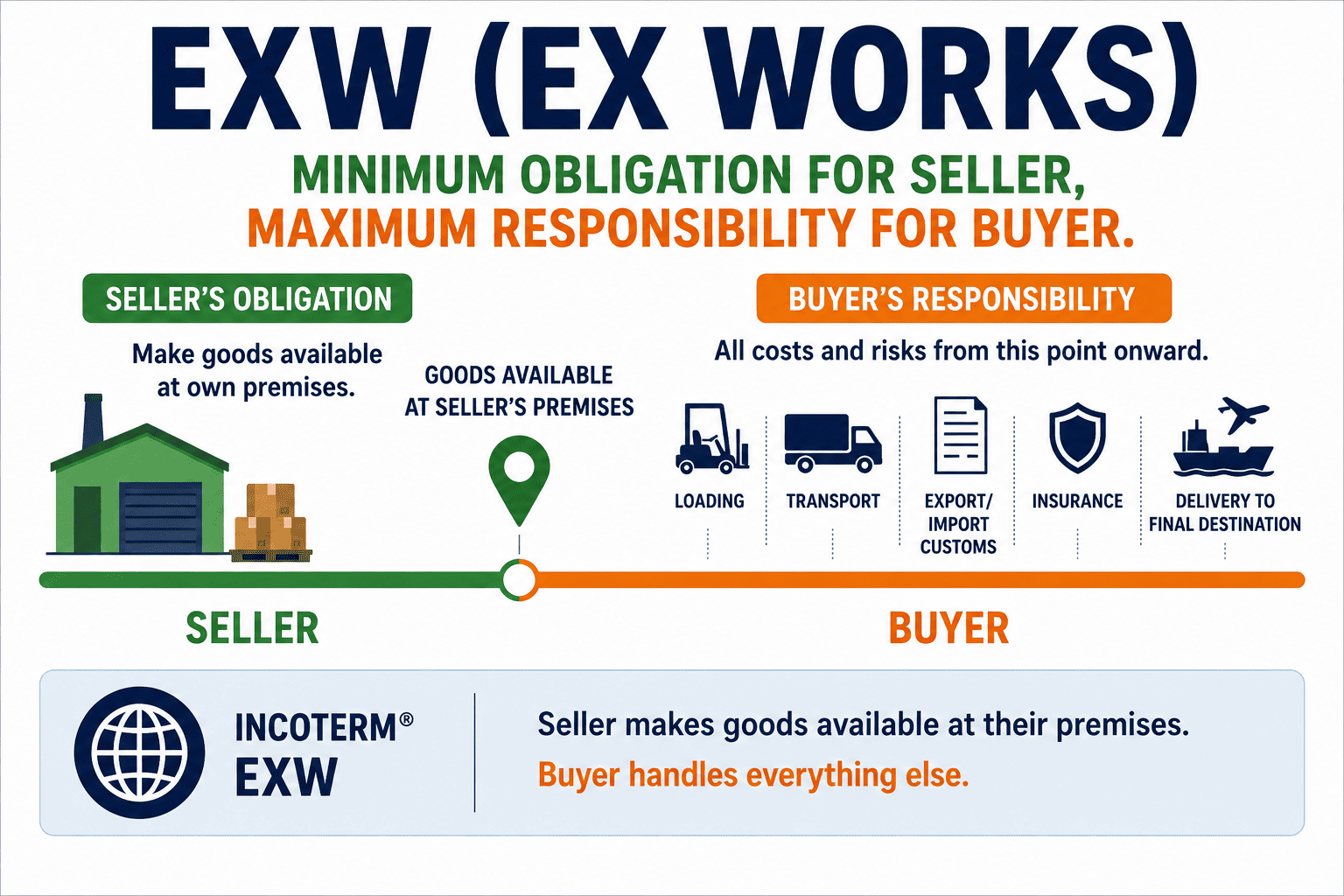
Why EXW Matters in International Trade
EXW is a foundational Incoterm that provides clarity and structure to global trade transactions. It is particularly important because it clearly delineates the point at which risk and cost transfer from the seller to the buyer. For buyers with sophisticated logistics capabilities, EXW offers maximum control over the supply chain. For sellers, especially those without export experience, EXW simplifies the process by removing the burden of export procedures and freight arrangements.
📊 Key Statistic
According to the ICC’s 2020 Incoterms survey, EXW is one of the most frequently used Incoterms, particularly in domestic transactions and for initial international sales. Approximately 30% of global trade transactions use EXW or similar terms where the buyer takes on significant responsibility.
EXW vs. Other Common Incoterms
The choice of Incoterm significantly impacts costs, risks, and administrative burden. EXW sits at one end of the spectrum, while terms like DDP (Delivered Duty Paid) represent the opposite extreme. Understanding these differences is crucial for choosing the right term for your transaction.
| Incoterm | Seller Responsibility | Buyer Responsibility | Risk Transfer Point |
|---|
| EXW (Ex Works) | Goods made available at seller’s premises | All costs and risks from pickup, including loading, transport, export/import clearance, insurance | When goods are made available at seller’s premises |
| FCA (Free Carrier) | Deliver goods cleared for export to carrier nominated by buyer | Main carriage, insurance, import clearance, and costs from carrier receipt | When goods are handed to carrier at named place |
| FOB (Free on Board) | Deliver goods on board the vessel at named port of shipment, including export clearance | Main carriage, insurance, import clearance, and costs from loading on vessel | When goods are on board the vessel |
| CIF (Cost, Insurance & Freight) | Cost, insurance, and freight to destination port, plus export clearance | Import clearance, duties, and costs from destination port onward | When goods are on board the vessel |
| DDP (Delivered Duty Paid) | All costs and risks to deliver goods to buyer’s premises, including import duties and taxes | Unloading at final destination | When goods are delivered to buyer’s premises |
📌 Choosing the Right Incoterm
If you’re a buyer with strong logistics expertise and established relationships with freight forwarders, EXW can offer cost savings and control. However, if you’re new to international trade, consider FCA, which shifts export clearance responsibility to the seller, reducing your compliance burden.
Core Responsibilities Under EXW
Seller’s Obligations Under EXW
The seller’s duties under EXW are minimal and limited to the preparation and availability of the goods at their own premises.
| Obligation | Description |
|---|
| Make Goods Available | Have the goods ready for collection at the agreed place (factory, warehouse, etc.) on the agreed date within the agreed time window. |
| Packaging & Marking | Pack the goods appropriately for transport (unless otherwise agreed) and provide necessary markings for identification. |
| Commercial Documentation | Provide the commercial invoice, packing list, and any other documents required by the sales contract or buyer. |
| Notice to Buyer | Provide sufficient notice to the buyer that the goods are ready for collection, including the exact pickup location and contact details. |
| Assist with Export Information | If requested and at the buyer’s cost and risk, provide any information or assistance needed for the buyer to obtain export licenses or complete export formalities. |
Buyer’s Obligations Under EXW
The buyer bears the vast majority of responsibilities, costs, and risks under EXW, making it essential to have strong logistics and compliance capabilities.
| Obligation | Description |
|---|
| Collection & Loading | Arrange for pickup at the seller’s premises and load the goods onto the transport vehicle (unless otherwise agreed). All costs and risks associated with loading are borne by the buyer. |
| Export Customs Clearance | Obtain all export licenses, permits, and complete export customs formalities in the seller’s country. This is a critical and often challenging responsibility for buyers unfamiliar with local regulations. |
| Transportation | Arrange and pay for all transportation, including pre-carriage to the port/airport, main carriage, and onward carriage to the final destination. |
| Import Customs Clearance | Handle all import customs formalities, duties, and taxes in the destination country. |
| Insurance | Arrange and pay for insurance coverage for the goods from the point of delivery onward (optional but strongly recommended). |
| Risk & Costs | Bear all risks of loss or damage to the goods from the moment they are made available at the seller’s premises. Pay all costs associated with the goods from that point forward, including storage, handling, demurrage, and any penalties. |
| Proof of Delivery | Provide the seller with evidence that delivery has been taken (e.g., a signed delivery receipt). |
Practical Guidance
Key Considerations When Using EXW
While EXW offers a straightforward framework, there are several critical factors to consider to ensure a smooth transaction and avoid unexpected issues.
1
Clarify Delivery Details in the Contract
Specify the exact location (address, contact person, loading facilities), the date and time window for pickup, and any site access restrictions. Clearly state who is responsible for loading and any related costs.
2
Understand Export Compliance
If the buyer is not established in the seller’s country, they may face challenges with export clearance. Some countries require a local exporter, which the buyer may not be. In such cases, consider using FCA instead to shift this responsibility to the seller.
3
Manage Logistics Effectively
Buyers must have a reliable logistics network, including freight forwarders, customs brokers, and transport providers. Delays in collection can lead to storage charges or penalties, while unfamiliarity with regulations can cause customs holds.
4
Consider Insurance Coverage
Since the buyer bears all risk from the point of delivery, arranging comprehensive insurance is essential. The seller is under no obligation to provide insurance, but may assist with information if requested.
5
Address VAT/GST Implications
In some jurisdictions, the buyer may face VAT/GST issues if the seller cannot prove the goods were exported. Ensure proper documentation is in place to support the export status and avoid unexpected tax liabilities.
Real-World Example
EXW Example: Sourcing Generators from Two Suppliers
This example illustrates how a buyer might choose between an EXW offer and a delivered price offer from competing suppliers.
📄 Scenario: Generator Procurement
Supplier A offers 100 generators at $1,000 each, with shipping included (DDP to the buyer’s warehouse).
Supplier B offers the same generators at $900 each under EXW terms at their factory in Country X.
Decision: The buyer calculates the additional costs to collect, transport, clear customs, and deliver the generators from Supplier B’s factory. If the total additional cost is less than $10,000 (the $100 per unit difference × 100 units), the buyer chooses Supplier B to achieve cost savings while maintaining control over the logistics process. If the costs are higher or the buyer lacks logistics expertise, they may prefer the convenience of Supplier A’s delivered price.
Risks & Mitigation
Common Risks Under EXW & How to Mitigate Them
⚠️
Export Clearance Delays
Mitigation: Engage a local customs broker in the seller’s country. Alternatively, consider using FCA, where the seller handles export clearance.
⚠️
Damage During Loading
Mitigation: Clearly specify in the contract who is responsible for loading and the standard of care required. The buyer can also have their own logistics team present to supervise.
⚠️
Unexpected Costs
Mitigation: Conduct thorough Commercial Due Diligence and include all potential costs in your logistics budget. Get quotes from multiple freight forwarders and factor in contingencies for delays.
FAQ
Frequently Asked Questions About EXW
QWhat does EXW mean in shipping?
EXW stands for Ex Works, an Incoterm where the seller makes the goods available at their premises (factory, warehouse, etc.). The buyer is then responsible for all costs and risks, including loading, transportation, export and import customs clearance, insurance, and final delivery.
QWhat are the seller’s obligations under EXW?
Under EXW, the seller must have the goods ready and packaged at the agreed location (their premises) at the agreed time. They must provide necessary documentation and notify the buyer. They are not responsible for loading, export clearance, or any transportation costs.
QWhat are the buyer’s obligations under EXW?
The buyer must collect the goods from the seller’s premises, handle all loading, arrange and pay for all transport (including main carriage), manage export and import customs clearance, pay all duties and taxes, and arrange insurance. All risk transfers to the buyer once the goods are made available at the seller’s location.
QWhat is the difference between EXW and FCA?
The key difference is that under FCA (Free Carrier), the seller is responsible for loading the goods onto the buyer’s transport and clearing them for export. Under EXW, the buyer is responsible for both loading and all export formalities. EXW gives the seller the least responsibility, while FCA shifts export clearance to the seller.
QWhen should I use EXW Incoterms?
EXW is suitable when the buyer has a strong logistics capability and wants full control over the shipping process, or when the seller is not experienced in export procedures. It is often used for domestic transactions or when buyers are consolidating shipments from multiple suppliers.