Labor Management in International Manufacturing: A Practical Guide | GTsetu Blog
Home ›
Blogs ›
Labor Management in International Manufacturing
🏭 Workforce & Operations · 2026
Labor Management in International Manufacturing: A Practical Guide
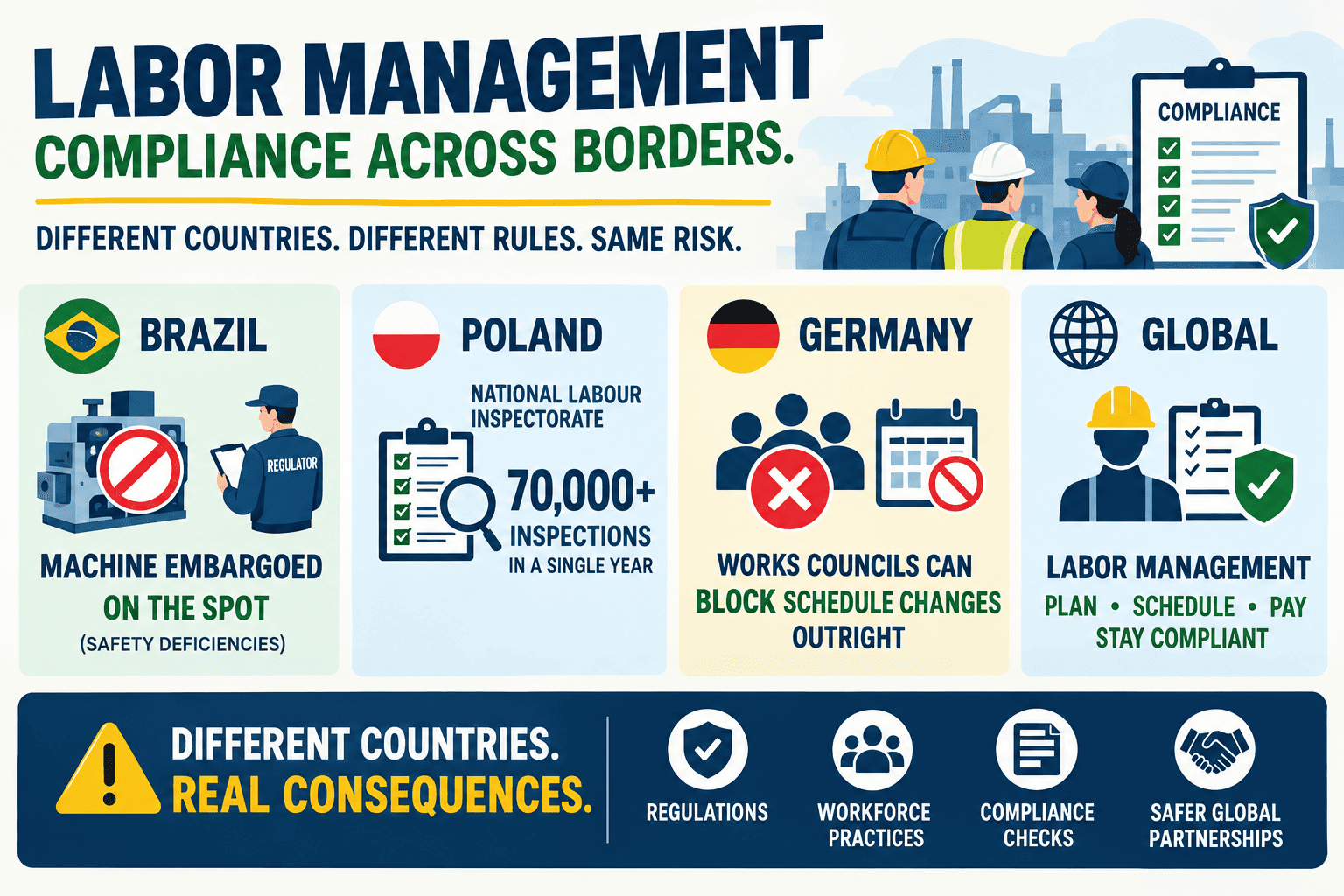
Manufacturing is one of the only parts of a global business where a single missing document can shut down a production line the same day. In Brazil, a regulator can embargo a machine on the spot if safety deficiencies are found. In Poland, the National Labour Inspectorate ran over 70,000 inspections in a single year. In Germany, works councils can block a shift schedule change outright. Labor management is the practice of planning, scheduling, paying, and staying compliant with a manufacturing workforce across every country of operation, and it is regulated based on physical risk in a way that office-based compliance simply is not. This article breaks down what labor management actually covers, why the rules differ so much by country, where most compliance failures actually happen, and how to vet a manufacturing partner’s workforce practices before committing to the relationship, as part of the broader discipline of cross-border business partnerships.
📅 Published September 8, 2026⏱ 13 min read✍️ GTsetu Editorial🔄 Updated September 8, 2026
A distributed knowledge workforce and a factory floor are not the same compliance problem. A missed deadline on an HR policy update is an administrative headache. A missed overtime approval, an expired equipment certification, or an unconsulted works council in manufacturing can be a production stoppage, a fine, or an invalidated termination, sometimes all three at once. Companies that scale manufacturing operations across borders successfully tend to treat labor management as infrastructure that supports global expansion, not as a policy document that sits in an HR folder.
Section 1
Why Labor Management Is Different, in Numbers
The numbers behind manufacturing labor compliance make the physical-risk distinction concrete. These are not abstract policy requirements; they are enforcement activities happening on factory floors right now.
5%
Of establishments Germany’s federal and state authorities must inspect annually under its Occupational Health and Safety Act
70,000+
Inspections conducted by Poland’s National Labour Inspectorate (PIP) in a single recent year
€25,000
Maximum fine per incident under Germany’s Occupational Health and Safety Act, with criminal liability possible for worker harm
2x
How much more likely union membership is in manufacturing versus commercial services globally, per ILO data
Behind these figures is a consistent operational reality: manufacturing labor cost, one of the largest and least transparent drivers of operational cost across manufacturing organizations, often stays fragmented across plants, payroll systems, and scheduling platforms. Without a unified view of workforce data, leaders struggle to connect labor cost, productivity, and compliance risk to actual plant performance, which is exactly the gap that turns a routine payroll error into a compliance incident.
💡 Why this distinction matters
Regulators overseeing manufacturing do not rely only on employee complaints or year-end audits. They inspect facilities directly, often unannounced, with authority to halt operations. A missing certification is not read as a paperwork gap; it is read as an unsafe working condition. That single reframe is what makes labor management in manufacturing a production-continuity issue rather than a purely legal one.
Section 2
The Core Compliance Categories in Manufacturing
Six Baseline Areas, With Manufacturing-Specific Weight
Every global employer navigates the same broad compliance categories, but manufacturing adds real complexity to each one, driven by shift structures, physical safety risk, and higher union density than almost any other sector.
1
Payroll, Contracts, and Role Classification
Shift premiums, hazard pay, and job classifications tied to safety duties
PayrollClassification
Manufacturing payroll rarely stays simple: shift premiums, hazard pay, union wage agreements, and overtime thresholds all introduce calculation variability that has to be handled precisely, and errors here are daily payroll inputs rather than rare edge cases. Employment contracts must reflect specific safety responsibilities, equipment operation requirements, and shift structures, since a generic office-role template routinely fails in a plant environment where job classification determines pay scale and union inclusion.
🎯
Why it matters: Poland’s Labour Code already requires contracts to specify the type and place of work; from 2026, its labour inspectorate gains authority to reclassify contractor arrangements as employment relationships administratively, without a court referral, which is directly relevant for manufacturers using contractors for specialised equipment roles.
2
Certification and Training Records
Equipment operation, hazard communication, and emergency preparedness documentation
Documentation
Manufacturing roles require proof of competency, and regulators expect that proof documented, current, and immediately accessible: equipment operation certifications, safety training completion records, hazard communication documentation, and periodic recertification logs. A missing or outdated certification is not treated as a paperwork issue; it is interpreted as an unsafe working condition on the spot.
🎯
Why it matters: Recordkeeping has to answer three questions instantly during an inspection: is the worker qualified, is the certification valid in this jurisdiction, and can the company prove it right now.
3
Termination, Restructuring, and Employee Data
Collective consultation, government notification, and dual-purpose safety records
Restructuring
Manufacturing layoffs often trigger collective consultation requirements, government notification thresholds, and severance formulas tied to tenure and role. In Germany, employers planning mass redundancies must notify the Federal Employment Agency within 30 days before termination notices go out, or the terminations may be invalid; works council consultation is required before notices are issued. In Brazil, collective dismissals require union negotiation under Supreme Federal Court precedent. Safety training logs and health records tied to workplace exposure also fall under data privacy regulation while serving as audit evidence, a dual role that raises both scrutiny and retention requirements.
🎯
Why it matters: Plant closures or workforce reductions can escalate into legal and reputational risk quickly if the consultation and notification sequence is handled incorrectly or too late.
4
Unified Workforce Visibility Across Plants
Connecting scheduling, time capture, and payroll into one source of truth
Technology
Workforce management, time capture, and payroll often operate on disconnected systems that were never designed to work together at enterprise scale, which makes labor cost data difficult to reconcile across plants and business units. Manufacturers increasingly face rising wages outpacing productivity, aging labor pools, record absenteeism and turnover, and multiple payrolls and regional wage regulations running in parallel, all of which multiply when systems stay siloed.
🎯
Why it matters: A single, integrated foundation for labor planning, time capture, payroll execution, and workforce analytics is what lets leaders actually see the relationship between labor cost, compliance risk, and plant performance, rather than reconstructing it after the fact.
Section 3
Shift Work, Overtime, and Union Obligations by Country
Few areas generate more consistent compliance failures than working-time rules, and the exact thresholds vary sharply by country. Understanding country-level detail here matters as much as understanding it for international sourcing of manufacturing materials, since a labor compliance failure can halt the very production line the sourced materials feed into.
Market
Working-Time Rule
Union / Works Council Weight
Enforcement Style
European Union
48-hour average max week, 11 hours daily rest, 24-hour weekly rest (Working Time Directive)
Varies by member state, often high
Directive plus national add-ons
Germany
EU baseline plus strict national rules
Works councils hold co-determination rights
High, annual inspection targets
Poland
EU baseline; PIP reform expands enforcement in 2026
Unions consulted before redundancies
High, 70,000+ inspections/year
Mexico
Phased reduction from 48 to 40 hrs/week by 2030; overtime capped at 12 hrs/week
200-hour annual overtime cap (300 for designated manufacturing sectors)
Lower than EU/Latin America
Expanding in export manufacturing zones
Union density compounds the challenge further. Globally, union membership in manufacturing is roughly twice as likely as in commercial services, ranging from about 1.3 times as likely in the Nordics and the UK to roughly 3 times as likely in Germany, Poland, and Mexico. In practice, this means a restructuring that takes six weeks in a non-unionised market can take six months in Germany once works council consultation is required, a timeline difference worth building into any partnership evaluation criteria for a manufacturing site.
Section 4
Where Most Labor Management Failures Actually Happen
Labor management failures in manufacturing rarely come from one dramatic event. They come from a handful of repeatable, well-documented gaps that show up across countries and company sizes.
Incorrect overtime calculations tied to rotating shifts. Shift differentials, premium rates, and rotating schedules introduce daily calculation risk that generic payroll processes are not built to absorb.
Worker misclassification under contractor arrangements. Authorities assess the reality of control and supervision, both typically high in plant settings, which makes contractor models far harder to defend than in office-based roles; Poland’s 2026 reform doubles maximum fines for exactly this pattern.
Incomplete or outdated certification records. A missing equipment certification is read as an unsafe working condition during an inspection, not a filing gap, and can trigger an immediate shutdown in markets like Brazil.
Under-resourced union or works council consultation. Skipping or rushing formal consultation on shift changes, overtime policy, or restructuring can invalidate the action entirely in markets with strong works council rights.
Treating compliance as an HR function instead of a cross-functional one. The most effective global manufacturing organizations align compliance with operations early, with HR, legal, and operations sharing accountability, rather than routing everything through a single compliance owner.
📌 The honest read
None of this is really about legal exposure in the abstract. A missed payroll calculation creates employee dissatisfaction. A misclassified worker creates tax liability. A safety violation can shut down a production line the same day. The companies that get this right treat labor compliance as production risk from day one, not as a policy review that happens once a year.
Section 5
EOR vs. Local Entity for Manufacturing Labor
For companies expanding manufacturing operations into a new market, one of the first structural decisions is whether to use an employer of record (EOR) or establish a local entity. The right answer depends on scale, timeline, and risk tolerance, not on a single universal best practice.
Factor
Employer of Record (EOR)
Local Entity
Best team size
Typically under 20-30 employees
Larger, permanent workforce
Speed to market
Fast, no entity formation needed
Slower, requires legal and tax setup
Control over operations
Employment relationship only
Full operational and employment control
Best fit
Market testing, initial ramp-up
Permanent, large-scale manufacturing presence
What it does NOT remove
Plant-level safety and production risk ownership
N/A, company owns everything directly
Many companies use a hybrid approach in practice: an EOR for initial market entry and workforce ramp-up, transitioning to a local entity once the operation reaches scale and the compliance infrastructure justifies the investment. It is worth being clear-eyed about what an EOR does and does not solve: it becomes the legal employer and handles contracts, payroll, and statutory compliance, but the company still owns everything that happens on the factory floor, safety compliance, operational decisions, and plant management remain its responsibility.
Section 6
Vetting a Manufacturing Partner’s Labor Practices
Whether a company is setting up its own operation or qualifying a manufacturing partner’s existing facility, labor practices deserve the same scrutiny as production capacity or quality systems. A factory with excellent equipment and a weak labor compliance record is still an operational risk waiting to surface, and it belongs in the same conversation as risk allocation in cross-border deals.
🏛️
Confirm registration and labor law standing
Verify the partner’s legal registration and whether it has any history of labor inspection findings before deep engagement.
Government-sourced verification
📋
Request certification and training documentation directly
Ask to see, not just hear about, equipment operation certifications and safety training records, and confirm they’re current, not just on file.
Documentation audit
📄
Protect specifications before sharing them
Put a formal NDA in place, then follow with a proper business partnership contract, before sensitive production data changes hands.
NDA-first engagement
⚖️
Understand what happens if labor disruption occurs
Review how the agreement handles disruption, including force majeure in global trade, before signing rather than after a shutdown.
Contract terms review
🔬
Research the specific market, not just the country
Union density, inspection intensity, and working-time rules vary by region within a country; a tailored market study for manufacturers surfaces this before commitment.
Location-level research
🤝
Get expert support for a first cross-border labor decision
🤝 For Verified, Long-Term Manufacturing Partnerships
GTsetu: Verified Discovery and Secure Engagement for Manufacturers, Distributors, and Raw Material Suppliers
A strong labor compliance framework tells a company what questions to ask. It does not, on its own, confirm that a specific manufacturing partner’s certifications, registrations, and labor standing are actually what they claim to be. That gap is what GTsetu is built to close. It is a structured partnership platform, not a directory or a general marketplace, where every company is verified on 6 government-sourced points before engagement, where discovery is anonymous until mutual interest is confirmed, where NDAs are executed digitally before any commercial information changes hands, and where document exchange happens through an encrypted workspace rather than email attachments.
GTsetu is used by industrial manufacturers, distributors, and raw material suppliers across 100+ countries to qualify new manufacturing relationships, build out a distributor network, or find a reliable supply chain partner they intend to work with for years, not a single production run. It complements, rather than replaces, on-the-ground audits and labor documentation review, but it removes much of the identity and documentation risk before that deeper diligence even begins.
🏛️
6-Point Government-Sourced Verification
Name, Address, Registration Number, Company Status, Company Type, and Date of Incorporation, verified using government tie-ups before any engagement.
🕵️
Anonymous Discovery
Browse verified manufacturer and distributor profiles across 100+ countries without revealing your own identity or sourcing strategy until you choose to engage.
📄
Built-In NDA Workflow
Digital NDA with timestamped signatures before any pricing, formulations, or product specs are shared. No sensitive information exposed without protection.
🔐
Encrypted Document Workspace
All commercial documents shared through encrypted channels with a full access audit trail, not email attachments.
🌍
100+ Countries of Verified Manufacturers
Verified manufacturers and distributors across Asia, the Middle East, Europe, Africa, Australia, and the Americas. Built for cross-border partnership formation, not one-off quotes.
🚫
Zero Commission
No success fee, no broker commission, ever. Your partnership economics remain entirely between you and your partner.
QWhat is labor management in international manufacturing?
Labor management in international manufacturing is the practice of planning, scheduling, paying, and staying compliant with a manufacturing workforce across every country of operation. It covers payroll and statutory reporting, employment contracts and role classification, shift and overtime rules, union and works council obligations, and the certification and training records regulators expect to see during on-site inspections.
QWhy is labor compliance different in manufacturing compared to office-based industries?
Manufacturing is regulated based on physical risk, not just the employment relationship. Regulators inspect facilities on-site, often unannounced, and can halt production immediately over safety or documentation failures. A missing equipment certification or an overtime violation is treated as an operational failure, not administrative oversight, which makes labor compliance a production-continuity issue rather than a purely legal one.
QWhat are the biggest labor management risks when manufacturing abroad?
The most common risks are incorrect overtime calculations tied to rotating shifts, misapplied shift differentials, worker misclassification in markets that scrutinise contractor arrangements, incomplete safety and certification documentation, and under-resourced consultation processes with unions or works councils during restructuring. Each of these can trigger fines, invalidated terminations, or an immediate production shutdown depending on the country.
QShould a company use an employer of record or set up a local entity for manufacturing labor?
An employer of record (EOR) tends to fit smaller teams, faster market entry, and testing a new market before committing to entity formation, since it removes the need to build local employment infrastructure from scratch. A local entity fits a permanent, large-scale manufacturing presence where the company needs direct control over all employment and operational decisions. Many companies start with an EOR for market entry and transition to a local entity once operations reach scale.
QHow much does union density affect manufacturing labor management?
Significantly. Union membership in manufacturing is roughly twice as likely globally as in commercial services, and works councils in markets like Germany hold co-determination rights that can block shift schedule and overtime policy changes outright. A restructuring that takes six weeks in a non-unionised market can take six months in a market where formal works council consultation is legally required.
Evaluating a Manufacturing Partner’s Workforce Practices?
GTsetu is purpose-built for manufacturers, distributors, and raw material suppliers in industrial sectors seeking verified long-term trade partnerships, across 100+ countries, with government-sourced partner verification, built-in NDA workflows, and zero commission.
They represents the product, and research team behind GTsetu, a global B2B collaboration platform built to help companies explore cross-border partnerships with clarity and trust. The team focuses on simplifying early-stage international business discovery by combining structured company profiles, verification-led access, and controlled collaboration workflows.
With a strong emphasis on trust, and disciplined engagement, Team GTsetu shares insights on global trade, partnerships, and cross-border collaboration, helping businesses make informed decisions before entering deeper commercial discussions.