How Do You Find the Right Manufacturing Partner for a New Product? | GTsetu Blog
Home ›
Blogs ›
Finding the Right Manufacturing Partner
🧭 Sourcing & Partnership Guide · 2026
How Do You Find the Right Manufacturing Partner for a New Product?
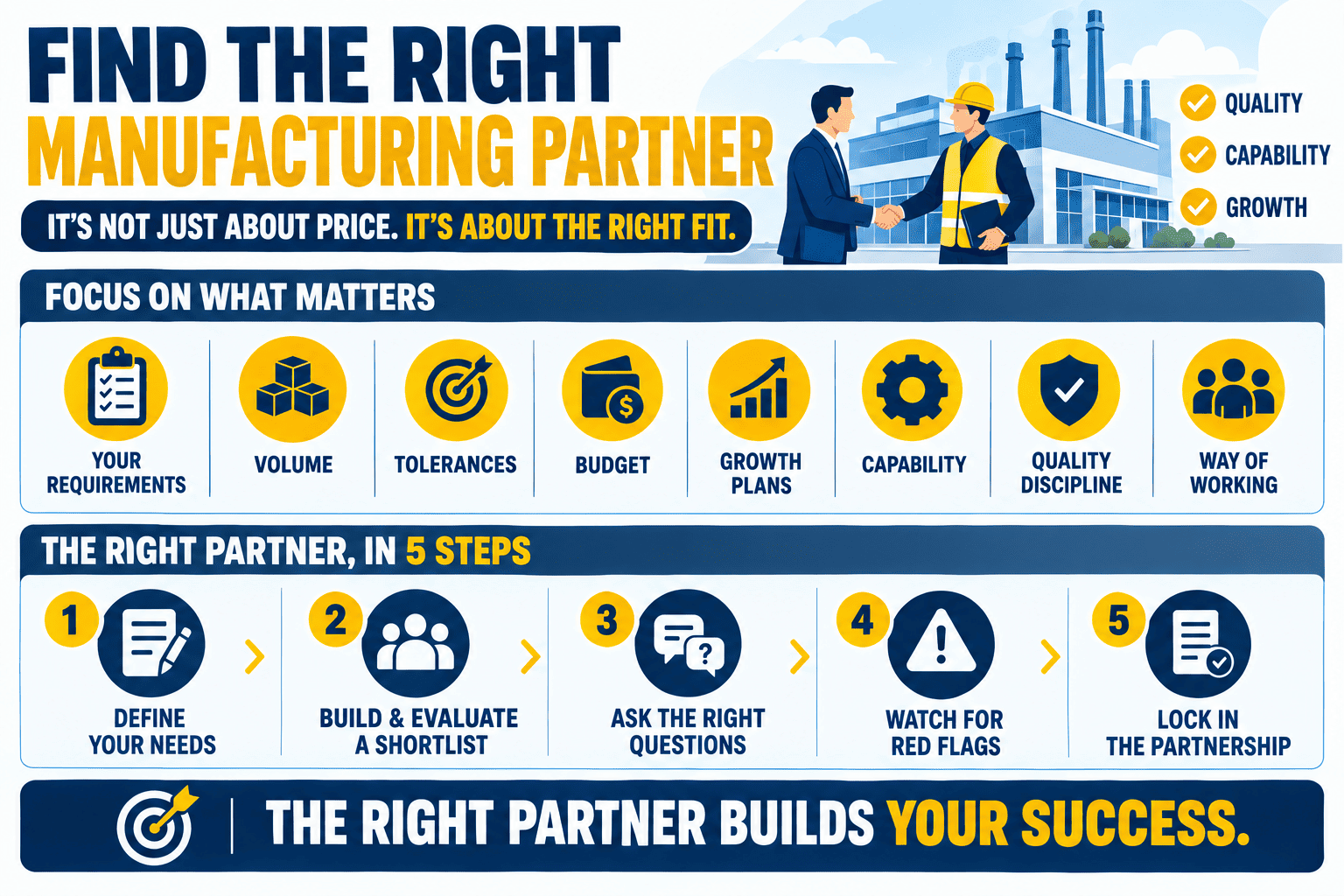
The manufacturer offering the lowest quote is rarely the right long-term partner, and the one with the most impressive-looking factory tour is not automatically it either. Finding the right manufacturing partner for a new product means matching your specific requirements, volume, tolerances, budget, and growth plans, against a manufacturer’s actual capability, quality discipline, and way of working, not just their price sheet. This guide walks through the full process: how to define what you actually need before you start looking, how to build and evaluate a shortlist, the questions that reveal more than a factory tour does, the red flags worth walking away from, and how to formalise the relationship once you’ve found the right fit.
📅 Published September 10, 2026⏱ 12 min read✍️ GTsetu Editorial🔄 Updated September 10, 2026
Every founder or product team eventually hits the same milestone: the design is finished, the prototype works, and now someone has to actually make the thing, reliably, at the quality level you need, at a price that supports your business. That moment is where a lot of otherwise good products stumble, not because the product idea was wrong, but because the manufacturing partnership behind it was rushed, under-vetted, or chosen for the wrong reasons. This is one of the most consequential decisions in building a manufacturing partnership within a global supply chain, and it deserves a real process, not a quick price comparison.
Section 1
Before You Start Looking: Define What You Actually Need
The single biggest mistake in manufacturer selection happens before any factory is even contacted: approaching the search with a vague brief. A manufacturer can only be evaluated against requirements that are actually specified. Before reaching out to anyone, get clear on the following.
Technical specifications and tolerances. Materials, dimensions, tolerances, finishes, and performance requirements, documented precisely enough that two different factories reading the same brief would build the same product.
Realistic volume, now and in twelve to eighteen months. A manufacturer sized for your launch volume may not be able to scale with you, and a manufacturer sized for scale may not want your launch-sized order. Both numbers matter.
Certification and compliance requirements. Depending on your product category and target markets, this could mean specific quality, safety, or industry certifications, which should be treated as a hard filter, not a nice-to-have. Understanding manufacturing certifications for international trade early avoids discovering a disqualifying gap after you’ve already committed.
Budget reality, including landed cost. Unit price alone is not the number that matters, freight, duties, quality-related rework, and communication overhead all factor into what a manufacturing relationship actually costs.
How much hand-holding you can offer. A newer or smaller factory may offer a better price but need more oversight from your side; a larger, more established manufacturer may cost more but require far less day-to-day management.
💡 Write the brief before the search, not during it
Manufacturers respond very differently to a precise, documented brief than to a loose product description. A clear brief filters out mismatched candidates early and gives you an apples-to-apples basis for comparing quotes, instead of discovering mid-negotiation that two “comparable” quotes were actually built on different assumptions.
Section 2
The Factors That Actually Determine a Good Fit
Beyond Price
Price is easy to compare and therefore gets over-weighted. The factors below are harder to compare, which is exactly why they deserve deliberate attention rather than being left as an afterthought.
1
Demonstrated Experience in Your Product Category
Not general manufacturing capability, specific category depth
Capability Fit
A factory that has made products broadly similar to yours already understands the failure points, tolerances, and quality checks your category typically requires. A factory new to your category may be capable in principle but will learn those lessons on your production run, at your expense, and potentially your customers’ expense too.
🎯
What to check: Ask for examples of similar products they’ve manufactured, and ideally speak to an existing client in a comparable category, not just a generic reference.
2
Real Quality Systems, Not Just Quality Claims
A documented process, not a verbal assurance
Quality Discipline
Every manufacturer will tell you quality matters to them. Far fewer can show a documented inbound material inspection process, in-process quality checks, final inspection protocols, and a clear record of how defects and returns have historically been handled.
🎯
What to check: Ask to see their quality control documentation and defect rate history, and confirm which certifications are current versus expired or in progress.
3
Capacity That Matches Where You’re Headed, Not Just Where You Are
Room to scale without switching partners mid-growth
Scalability
Switching manufacturers is expensive and disruptive, involving requalification, new tooling in many cases, and a period of quality risk while the new relationship stabilises. A manufacturer with headroom to grow with you, even if it costs slightly more today, is often the better long-term choice than the cheapest option that will be outgrown within a year or two.
🎯
What to check: Ask directly what their maximum monthly capacity is for your product type, and how a forecasted volume increase would be accommodated.
4
Culture and Communication Fit
How the relationship actually runs, day to day
Working Style
A manufacturing partnership is a constant back-and-forth over specifications, defects, schedule changes, and problem-solving, often across time zones and languages. A manufacturer that is technically capable but slow, evasive, or inflexible in communication will create friction on every single order, regardless of how good their factory is on paper. This is one of the most underweighted factors in manufacturer selection, precisely because it is hard to assess from a spec sheet.
🎯
What to check: Pay close attention to responsiveness, clarity, and honesty during the sourcing conversation itself, it is the best preview you’ll get of how the relationship will actually run.
Section 3
The Questions That Reveal More Than a Factory Tour
A factory tour shows you the equipment. The right questions show you how the manufacturer actually operates when things don’t go perfectly, which is what matters far more over a multi-year relationship.
Question
What You’re Really Testing
“Tell me about a time a production run went wrong. What happened?”
Honesty and problem-solving approach, not just whether failures ever happen
“What is your current capacity utilisation, and where does my order fit in your schedule?”
Whether your order gets real priority or gets squeezed between larger clients
“Who owns the tooling, and what happens to it if we end the relationship?”
IP and asset clarity before you’ve invested in tooling costs
“What is your defect rate, and how is it tracked?”
Whether quality control is a real measured process or a verbal claim
“What happens if a shipment is delayed by something outside your control?”
“Can I speak to a current client in a similar product category?”
Willingness to be transparently referenceable, not just quote-ready
📌 How they answer matters as much as what they answer
A manufacturer that answers these questions directly, even when the honest answer is imperfect, is demonstrating exactly the kind of transparency a long-term partnership needs. Vague, deflective, or overly polished answers to direct operational questions are themselves useful information.
Section 4
Red Flags Worth Walking Away From
Some warning signs are subtle. Others are not, and are worth treating as near-automatic disqualifiers regardless of how attractive the pricing looks.
Refusal to allow a facility visit or independent audit. A legitimate manufacturer with genuine capacity generally welcomes scrutiny; reluctance is one of the clearest warning signs in the entire process.
Pricing significantly below every other quote, without a clear explanation. Unusually low pricing is sometimes legitimate efficiency, but is more often a sign of corners being cut somewhere, materials, labour standards, or quality control, that will surface later.
Reluctance to sign an NDA before discussing specifications. Protecting your product details before deeper engagement is standard practice; resistance to it is a signal worth taking seriously.
No clear, consistent point of contact. If communication is already inconsistent during the courtship phase, when the manufacturer is trying to win your business, it is unlikely to improve once the contract is signed.
Pressure to commit to large volumes before any trial run. A confident, capable manufacturer is generally comfortable starting with a smaller trial order to prove quality and reliability before scaling commitment.
Vague or unverifiable claims about certifications. Certifications should be checkable against the issuing body; a manufacturer unwilling or unable to provide verifiable documentation is a serious gap in partnership evaluation criteria.
Section 5
The Step-by-Step Process
Putting the factors above into a repeatable sequence gives you a process you can run consistently, whether you’re sourcing domestically or building out international manufacturing relationships for the first time.
1
Document your requirements precisely
Specifications, volume projections, certifications, and budget, written down before any manufacturer conversation begins, so every quote you receive is comparing the same thing.
2
Build a shortlist based on category experience
Prioritise manufacturers with demonstrated experience in your specific product category over generalist factories, using structured market research for manufacturers to identify credible candidates rather than relying on a single directory search.
3
Verify before you engage deeply
Confirm legal registration, business status, and certification validity before sharing sensitive specifications, ideally protected by an NDA from the first substantive conversation.
4
Ask the direct operational questions
Use the question set above to evaluate honesty, capacity reality, and problem-solving approach, not just capability on paper.
5
Run a trial order before committing volume
A smaller trial run tests actual quality, communication, and reliability under real conditions, at far lower risk than committing to full production volume immediately.
6
Formalise the relationship properly
Move from trial to a documented agreement covering quality standards, IP, pricing, and contingency terms, the foundation of a relationship built to last, not just a single order.
Section 6
Formalising the Relationship
A strong sourcing process still needs to end in a proper agreement, not a verbal understanding or a purchase order alone. A well-structured business partnership contract should clearly define quality standards and acceptance criteria, intellectual property ownership for designs and tooling, pricing terms and how they may change with volume or material costs, confidentiality obligations, and what happens in the event of disruption, including force majeure provisions covering events outside either party’s control.
Getting this right at the outset also means thinking explicitly about risk allocation in cross-border deals, who bears the cost of a defective batch, a delayed shipment, or a raw material price spike, rather than leaving it ambiguous until a dispute forces the question. If this is your first time formalising an international manufacturing relationship, international business development consulting can help ensure the agreement reflects standard practice for your sector and target market, rather than being written from scratch under time pressure.
🤝 For Verified Long-Term Manufacturing Partnerships
GTsetu: Verified Discovery and Secure Engagement for Manufacturers, Distributors, and Raw Material Suppliers
Everything above describes how to evaluate a manufacturer once you’ve found one. The harder problem for many companies is finding a credible, verifiable shortlist in the first place, particularly when sourcing internationally, where a directory listing tells you almost nothing about whether a company is legitimate, currently operating, or capable of the volume it claims. GTsetu is built to close that gap. It is a structured partnership platform, not a directory or a general marketplace, where every company is verified on 6 government-sourced points before engagement, where discovery is anonymous until mutual interest is confirmed, where NDAs are executed digitally before any commercial information changes hands, and where document exchange happens through an encrypted workspace with a full audit trail.
GTsetu is used by product companies, distributors, and raw material buyers across 100+ countries to find verified manufacturing partners, build out a distributor network once a product is ready to scale, or formalise technology partnership and international wholesale distribution relationships alongside the manufacturing side of the business. It complements, rather than replaces, the vetting process outlined above, but it removes much of the identity and documentation risk before that deeper diligence even begins.
🏛️
6-Point Government-Sourced Verification
Name, Address, Registration Number, Company Status, Company Type, and Date of Incorporation, verified using government tie-ups before any engagement.
🕵️
Anonymous Discovery
Browse verified manufacturer profiles across 100+ countries without revealing your product plans or sourcing strategy until you choose to engage.
📄
Built-In NDA Workflow
Digital NDA with timestamped signatures before any pricing, specifications, or designs are shared.
🔐
Encrypted Document Workspace
All technical files and commercial documents shared through encrypted channels with a full access audit trail, not email attachments.
🌍
100+ Countries
Verified manufacturers, distributors, and suppliers across Asia, the Middle East, Europe, Africa, Australia, and the Americas.
🚫
Zero Commission
No success fee, no broker commission, ever. Your partnership economics remain entirely between you and your partner.
Finding the right manufacturing partner is ultimately one part of a bigger picture: building the kind of cross-border business partnerships that support a growing product business, whether the next step is expanding into new markets or simply scaling production with the same trusted partner. A platform built for B2B matchmaking, rather than a one-off directory search, makes it easier to apply the same rigorous evaluation process every time you need to find a new partner, not just the first one.
FAQ
Frequently Asked Questions
QHow do I find the right manufacturing partner for a new product?
Start by defining your product’s real requirements, tolerances, materials, volume, and certifications, before you approach any manufacturer. Build a shortlist based on demonstrated experience in your product category, not just price. Evaluate each candidate on capability fit, quality systems, communication style, and cultural compatibility, ask direct questions about capacity and past failures, run a trial order before committing volume, and formalise the relationship with a clear contract covering IP, quality standards, and contingency terms.
QWhat questions should I ask a potential manufacturing partner?
Ask about their experience manufacturing similar products, their current capacity and how a new order fits into their existing schedule, their quality control process and relevant certifications, how they handle design changes and defects, who owns tooling and intellectual property, their minimum order quantities and lead times, and what happens if a shipment or production run is disrupted. Their answers, and how directly they answer, tell you as much as the content itself.
QWhat are red flags when evaluating a manufacturing partner?
Common red flags include reluctance to provide references or allow a facility visit, vague or evasive answers about quality control and certifications, pricing that is significantly below every other quote without a clear explanation, unwillingness to sign an NDA before sharing specifications, no clear point of contact or slow, inconsistent communication during early conversations, and pressure to commit to large volumes before a trial run.
QWhy does culture fit matter when choosing a manufacturing partner?
A manufacturing partnership involves constant back-and-forth over specifications, quality issues, schedule changes, and problem-solving, often across time zones and languages. A manufacturer whose communication style, responsiveness, and approach to problem-solving do not match how your team works will create friction on every order, regardless of how capable their factory is on paper. Culture fit determines how smoothly the relationship runs day to day, not just whether the manufacturer can technically produce the product.
QShould I always start with a trial order before committing to a manufacturer?
In almost all cases, yes. A trial order tests real-world quality, communication responsiveness, and reliability under actual production conditions, at a fraction of the risk of committing to full volume immediately. A manufacturer confident in their own capability will generally be comfortable with this approach; resistance to a reasonable trial run is itself worth treating as a signal during evaluation.
GTsetu is purpose-built for manufacturers, distributors, and raw material suppliers in industrial sectors seeking verified long-term trade partnerships, across 100+ countries, with government-sourced partner verification, built-in NDA workflows, and zero commission.
They represents the product, and research team behind GTsetu, a global B2B collaboration platform built to help companies explore cross-border partnerships with clarity and trust. The team focuses on simplifying early-stage international business discovery by combining structured company profiles, verification-led access, and controlled collaboration workflows.
With a strong emphasis on trust, and disciplined engagement, Team GTsetu shares insights on global trade, partnerships, and cross-border collaboration, helping businesses make informed decisions before entering deeper commercial discussions.