What Should You Include in a Supplier Request for Quotation (RFQ)? | GTsetu Blog
Home ›
Blogs ›
Supplier Request for Quotation (RFQ)
📋 Procurement & Sourcing · 2026
What Should You Include in a Supplier Request for Quotation (RFQ)?
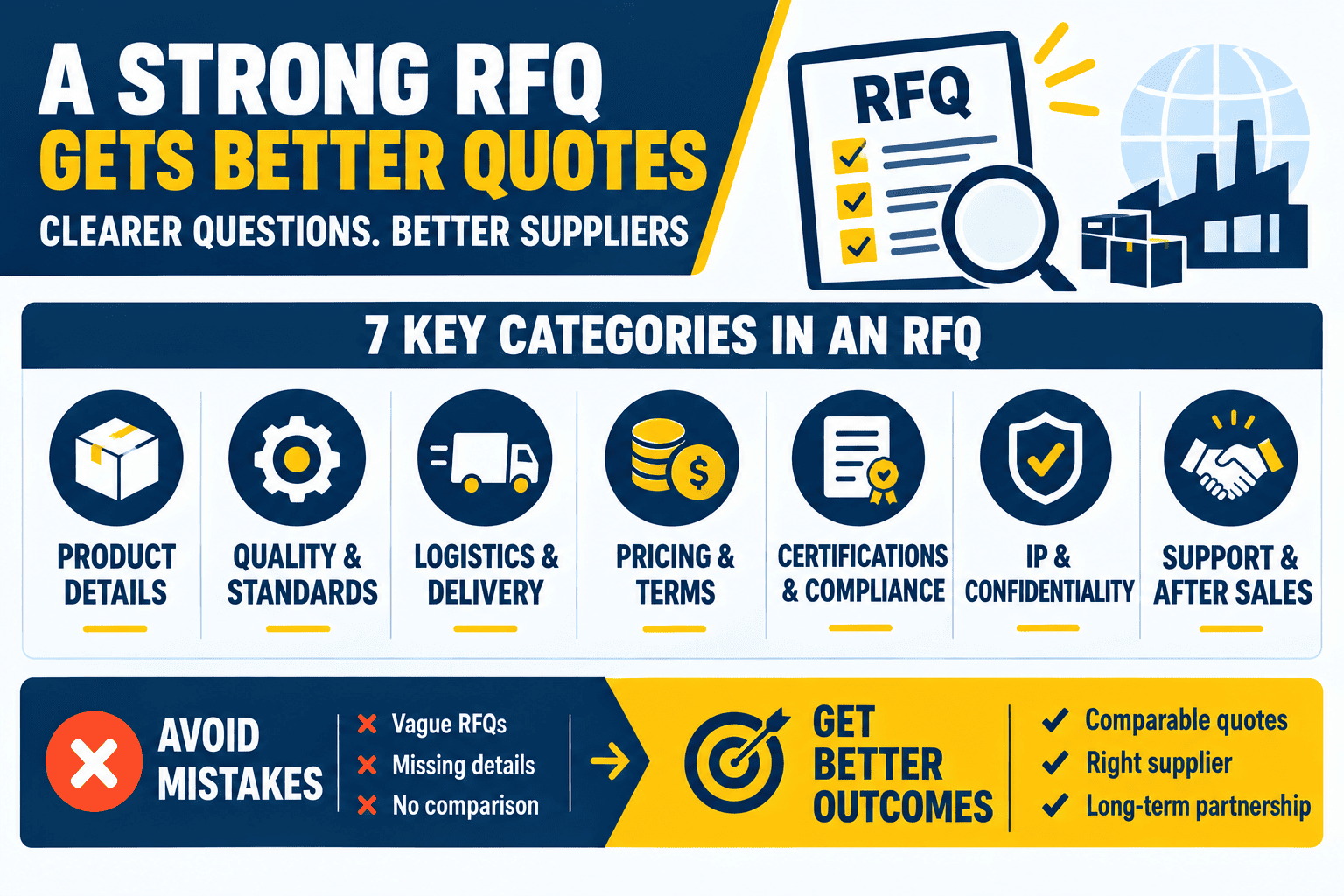
Nearly 60% of RFQs fail to capture the right level of detail, and the result is predictable: incomplete quotes, pricing that cannot be compared apples to apples, and supplier decisions made on guesswork instead of evidence. An RFQ is not just a price request. It is a structured tool that forces clarity before money changes hands, and its effectiveness depends entirely on the questions it includes. This article walks through the seven categories every supplier RFQ needs, the specific questions that belong in each, the mistakes that quietly sabotage the process, and how a strong quote turns into a formal supply chain partnership rather than a one-off purchase order.
📅 Published September 10, 2026⏱ 11 min read✍️ GTsetu Editorial🔄 Updated September 10, 2026
Most procurement teams have sent an RFQ that came back looking fine on paper and fell apart in practice, a quote that assumed a different scope, a delivery date that turned out to be aspirational, or a price that ballooned once installation and taxes were added. None of that is really the supplier’s fault. It is what happens when an RFQ leaves room for assumptions. A tightly built RFQ removes that room, and that discipline matters just as much when the supplier sits on the other side of a border as it does with a domestic vendor, particularly for anyone doing international sourcing.
Section 1
What an RFQ Actually Is
A request for quotation is a formal document a buyer sends to suppliers asking for price quotes on specific, clearly defined products or services. It sits in a family of procurement documents that are often confused with one another, but each serves a different purpose at a different stage of sourcing.
60%
Of RFQs fail to capture the right level of detail, leading to incomplete or incomparable quotes
7
Core categories a well-structured RFQ should cover, from vendor qualifications to compliance
3-6
Qualified suppliers most procurement teams shortlist for a single RFQ process
1
Document type an RFQ is not: it assumes the requirement is already defined, unlike an RFI or RFP
The distinction matters because using the wrong tool wastes everyone’s time. An RFI, or request for information, is used early, when a buyer is still learning what suppliers and solutions exist. An RFP, or request for proposal, is used when the buyer knows the problem but wants suppliers to propose how they would solve it, alongside price. An RFQ comes later still: the specification is locked, the approach is known, and the only real variable left to compare is price and terms. Sending an RFQ before the specification is genuinely locked is one of the most common reasons quotes come back inconsistent.
💡 Why this distinction matters
An RFQ that quietly tries to do an RFP’s job, asking suppliers to also propose their approach or recommend alternatives, tends to produce responses that are hard to compare, because each supplier answered a slightly different question. If the specification genuinely isn’t fixed yet, that’s a sign to run an RFP first and save the RFQ for once the scope is settled.
Section 2
The Seven Categories Every RFQ Needs
What Belongs in the Document
The specific questions vary by industry and by what is being sourced, but the categories that show up consistently across procurement guides, ERP documentation, and sourcing platforms are the same seven. Skipping any one of them tends to leave a predictable gap in the quotes that come back.
1
Vendor Background & Qualifications
Track record, capacity, and references before price is even discussed
Foundation
Before a single price is compared, an RFQ should ask how long the supplier has operated in the relevant industry, what certifications or accreditations they hold, what their production capacity or service delivery capability actually is, and for two or three references from similar engagements. This is where a buyer confirms they are not just comparing prices between suppliers, but comparing prices between suppliers who can genuinely deliver.
🎯
Why it matters: The cheapest quote from a supplier who cannot actually meet the volume or timeline is not a real option, and this section is what filters that out before it wastes anyone’s time later in the process.
2
Technical Specifications & Scope
The single biggest source of incomparable quotes when left vague
Highest Impact
The RFQ should spell out exactly what is being quoted, materials, components, tolerances, standards, quantities, and ask suppliers directly what assumptions they made in preparing their quote, what is explicitly included and excluded, and what limitations or dependencies exist. A supplier working from a vague spec will quietly fill the gaps with their own assumptions, and two suppliers rarely fill those gaps the same way.
🎯
Why it matters: This is consistently cited as the single biggest reason RFQs fail to produce comparable quotes. The clearer the specification, the fewer assumptions a supplier has to make, and the more the resulting prices are actually quoting the same thing.
3
Pricing Structure & Total Cost of Ownership
Itemised, not headline, pricing is what actually compares
Cost Clarity
An RFQ should require an itemised quotation, unit cost, taxes, duties, and fees broken out separately, along with volume or early-payment discounts, installation or onboarding charges, whether shipping and handling are included, which costs are recurring versus one-time, and how long the quoted price stays valid. A single headline number hides too much to be useful on its own.
🎯
Why it matters: Two suppliers can quote the same headline price and mean very different total costs once installation, taxes, and validity windows are accounted for. Itemisation is what makes the comparison real rather than superficial.
4
Delivery, Quality, and Compliance
The categories most likely to be skipped, and most costly when they are
Risk Coverage
Delivery questions should cover standard and expedited lead times, how the supplier handles delays or shortages, and packaging and tracking standards. Quality questions should cover warranty coverage, quality control processes, and how defects are handled. Compliance questions should cover payment terms, applicable licenses and certificates, insurance coverage, and data security or confidentiality obligations, especially relevant given manufacturing certifications for international trade.
🎯
Why it matters: These questions are the ones most often left out because they feel like paperwork rather than pricing, yet a missed delivery window or an uninsured supplier turns into a far more expensive problem than a slightly higher unit price ever would.
Two further categories round out a complete RFQ, though they carry less weight than the four above: value-added services, training, extended warranties, scalability for future volume, which help differentiate suppliers beyond price alone; and evaluation criteria, a brief statement of how responses will be scored, which sets supplier expectations and reduces post-award disputes about why a particular bid was chosen.
Section 3
Quick Reference: RFQ Section by Section
Section
What to Capture
Why It’s There
Vendor Information
Company details, years in business, certifications, references
Unit cost, taxes, discounts, one-time vs. recurring charges, price validity
Enables true cost comparison
Delivery & Logistics
Lead times, expedited options, packaging, disruption handling
Confirms operational feasibility
Quality & Warranty
QC process, warranty terms, defect handling, KPIs
Protects against long-term risk
Contractual & Compliance
Payment terms, licenses, insurance, data security, anti-bribery policies
Reduces legal and regulatory exposure
Value-Added Services
Training, support, scalability, optional upgrades
Differentiates suppliers beyond price
Section 4
Common Mistakes That Undermine an RFQ
Even a well-intentioned RFQ process tends to fail in the same handful of ways. These mistakes show up repeatedly, whatever the industry or the size of the buying organisation.
Specifications left vague. An incomplete or loosely worded specification forces suppliers to quote against their own assumptions, which is the single most common reason quotes come back looking inconsistent or unexpectedly priced.
Comparing only the headline price. Focusing on the lowest quoted number, rather than total cost of ownership, service reliability, and compliance, raises the risk of poor quality, missed service levels, and higher costs down the line.
Ignoring delivery terms and hidden costs. Installation, onboarding, and tax charges that were never itemised in the RFQ tend to surface only after the order is placed, by which point negotiating leverage has largely evaporated.
Treating every category of spend the same way. A commodity item and a custom-engineered component do not need the same depth of RFQ, and applying one rigid template to both either overburdens simple purchases or under-specifies critical ones.
No defined evaluation criteria. Suppliers left guessing how a decision will be made, purely on price, or on a broader mix of factors, tend to submit responses optimised for the wrong thing, and buyers open themselves up to disputes over why a bid was or wasn’t selected.
📌 The honest read
An RFQ is not about asking more questions. It is about asking the right ones, at the right level of specificity, for the category of spend in front of you. A five-line RFQ for a commodity part and a twelve-section RFQ for a custom-tooled component can both be well-built, provided each is proportionate to what is actually being bought and to how much risk a wrong answer would create.
Section 5
Evaluating the Quotes You Receive
A well-built RFQ only pays off if the responses are evaluated with the same rigour that went into asking for them. That means comparing unit cost against bundled cost and total cost of ownership rather than the headline figure alone, weighing price stability and validity periods, and checking discount structures for genuine long-term savings rather than a one-time incentive. It also means assessing each supplier’s track record: on-time delivery history, historical defect rates, scalability, and financial stability, alongside a hard check of certifications, compliance documentation, and insurance coverage. A missing certificate or an unclear compliance answer at this stage is one of the more reliable warning signs in the entire RFQ process.
💰
Compare total cost, not headline price
Weigh unit cost, taxes, one-time fees, and price validity together, not the top-line number in isolation.
TCO comparison
📊
Check delivery and defect history
A supplier’s past on-time delivery rate and defect record predicts future performance far better than a quote alone.
Track record
📜
Verify certifications and compliance
Confirm claimed certifications and compliance documents actually exist and are current, not just listed on the response.
Documentation check
🏗️
Confirm capacity against claims
Cross-check the volume a supplier claims they can deliver against evidence of comparable past orders.
Capacity validation
🔍
Look for scope mismatches
Where quotes differ sharply, check whether suppliers quoted the same scope before assuming one is simply cheaper.
GTsetu: Verified Discovery and Secure Engagement for Manufacturers, Distributors, and Raw Material Suppliers
A well-built RFQ tells you how a supplier’s price, capacity, and terms compare. It does not tell you whether that supplier is who they claim to be, or whether the specifications and pricing you share during the RFQ process will stay confidential once several competing suppliers have seen them. That gap is what GTsetu is built to close. It is a structured partnership platform, not a directory or a general marketplace, where every company is verified on 6 government-sourced points before engagement, where discovery is anonymous until mutual interest is confirmed, where NDAs are executed digitally before any commercial information changes hands, and where document exchange happens through an encrypted workspace rather than email attachments.
GTsetu is used by industrial manufacturers, distributors, and raw material suppliers across 100+ countries to build out a distributor network, source international wholesale distribution partners, or find manufacturing and technology partnership relationships worth running an RFQ against in the first place. It complements, rather than replaces, the RFQ process itself, but it removes much of the identity and documentation risk before a supplier ever receives your specification.
🏛️
6-Point Government-Sourced Verification
Name, Address, Registration Number, Company Status, Company Type, and Date of Incorporation, verified using government tie-ups before any engagement.
🕵️
Anonymous Discovery
Browse verified manufacturer and distributor profiles across 100+ countries without revealing your own identity or sourcing strategy until you choose to engage.
📄
Built-In NDA Workflow
Digital NDA with timestamped signatures before any pricing, formulations, or product specs are shared. No sensitive information exposed without protection.
🔐
Encrypted Document Workspace
All commercial documents shared through encrypted channels with a full access audit trail, not email attachments.
🌍
100+ Countries
Verified manufacturers and distributors across Asia, the Middle East, Europe, Africa, Australia, and the Americas. Built for cross-border partnership formation, not one-off quotes.
🚫
Zero Commission
No success fee, no broker commission, ever. Your partnership economics remain entirely between you and your partner.
Winning an RFQ is the beginning of a supplier relationship, not the end of the sourcing process. The pricing, delivery, and compliance answers gathered during the RFQ should feed directly into the underlying business partnership contract, so the commitments a supplier made in writing during evaluation are the same commitments they are held to once the order is placed. That agreement should also address what happens when something goes wrong, including how force majeure and disruption scenarios are handled, and how risk is allocated between buyer and supplier when a cross-border shipment is delayed or a currency shifts mid-contract.
A request for quotation, or RFQ, is a formal document a buyer sends to suppliers asking for price quotes on specific, clearly defined products or services. Unlike an RFI, which gathers general information, or an RFP, which evaluates a proposed approach, an RFQ assumes the requirement is already well defined and is built to produce comparable, apples-to-apples pricing from multiple suppliers.
QWhat are the main categories of questions an RFQ should include?
A well-built RFQ covers seven categories: vendor background and qualifications, technical specifications and scope, pricing structure and total cost of ownership, delivery and logistics, quality assurance and warranty terms, contractual and compliance documentation, and value-added services. Leaving any category out tends to produce quotes that cannot be fairly compared.
QWhy do RFQs often fail to produce useful quotes?
Most RFQs fail because the underlying specification is vague, forcing suppliers to quote based on their own assumptions rather than a shared understanding of scope. That produces quotes that look comparable on price but are not actually quoting the same thing, along with hidden costs, delivery surprises, and compliance gaps that only surface after an order is placed.
QHow many suppliers should be included in an RFQ process?
Most procurement teams shortlist between three and six qualified suppliers for an RFQ. That range is usually enough to create genuine price competition without making the evaluation process unmanageable, though the right number depends on how critical or specialised the item being quoted is.
QShould an RFQ include a budget range?
This is a judgment call rather than a fixed rule. Sharing a budget range can help suppliers tailor a realistic proposal and save time on both sides, but it can also anchor pricing and limit how competitive the responses turn out to be. Many procurement teams prefer to withhold budget and evaluate quotes purely on their own merits, especially for categories of spend where price discovery matters more than speed.
Ready to Turn a Winning Quote Into a Verified Partnership?
GTsetu is purpose-built for manufacturers, distributors, and raw material suppliers in industrial sectors seeking verified long-term trade partnerships, across 100+ countries, with government-sourced partner verification, built-in NDA workflows, and zero commission.
They represents the product, and research team behind GTsetu, a global B2B collaboration platform built to help companies explore cross-border partnerships with clarity and trust. The team focuses on simplifying early-stage international business discovery by combining structured company profiles, verification-led access, and controlled collaboration workflows.
With a strong emphasis on trust, and disciplined engagement, Team GTsetu shares insights on global trade, partnerships, and cross-border collaboration, helping businesses make informed decisions before entering deeper commercial discussions.