How Do Companies Qualify a New Supplier Before Placing an Order? | GTsetu Blog
Home ›
Blogs ›
How Companies Qualify a New Supplier
📋 Procurement & Sourcing Process · 2026
How Do Companies Qualify a New Supplier Before Placing an Order?
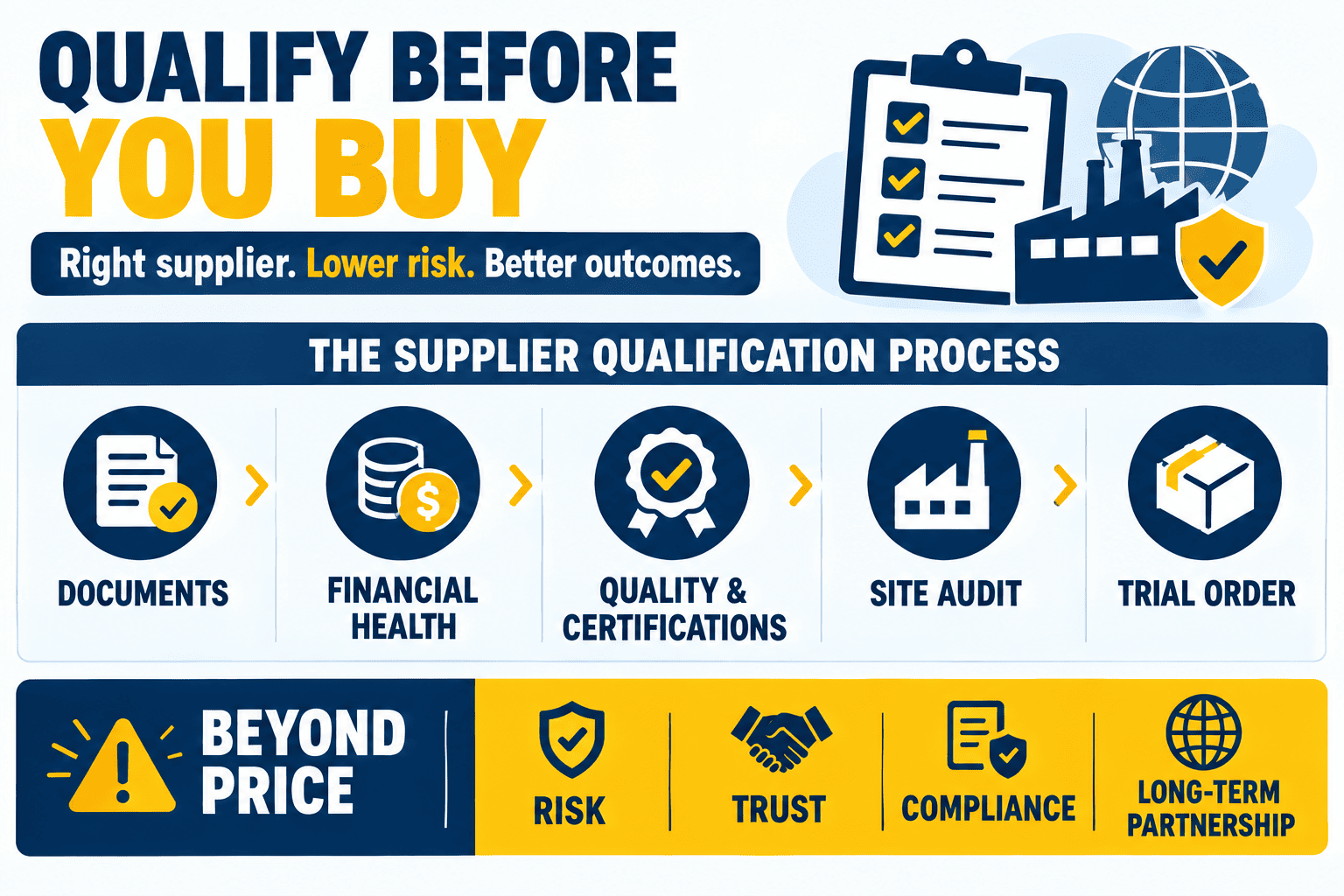
Placing a first order with an unqualified supplier is one of the more expensive mistakes a procurement or sourcing team can make. Before any purchase order goes out, most companies run the prospective supplier through a structured qualification process: documentation checks, a financial health review, a look at quality systems and certifications, sometimes a site audit, and often a small trial order before the relationship scales. This guide breaks down that process step by step, the criteria that matter beyond price, and where the traditional approach runs into real limits when the supplier is new, unfamiliar, or based in another country.
📅 Published September 16, 2026⏱ 13 min read✍️ GTsetu Editorial🔄 Updated September 16, 2026
Every purchase order carries some risk that the supplier behind it won’t deliver, on time, at the right quality, or at all. Supplier qualification is how procurement teams manage that risk before it becomes a production line stoppage or a compliance failure. It is not a single checkbox; it is a layered process that scales in depth with how much is riding on the relationship.
This guide walks through how the qualification process typically works, the criteria that matter beyond a quoted price, and how the depth of that process should change depending on whether you are qualifying a small domestic vendor or building a long-term supply chain partner in a new country. We also explain, separately, why some of the hardest parts of qualifying a new supplier, verifying who they actually are and protecting your information while you evaluate them, are increasingly handled by dedicated verification platforms rather than manual checklists alone.
💡 How to read this guide
Section 2 walks through the qualification process in order. Section 3 covers the criteria that matter beyond cost. Section 5 is worth reading closely if you are qualifying a supplier you have never met, in a country where you have no existing network to vouch for them.
Section 1
Why Supplier Qualification Matters
Skipping or rushing qualification tends to look fine right up until it doesn’t. The costs of an unqualified supplier show up later, and they are usually larger than the cost of doing the qualification properly upfront.
Quality failures reach your customers. A supplier without a real quality system can pass initial samples and still drift on consistency once volume ramps up, and the failure surfaces in your finished product, not theirs.
Financial instability disrupts supply. A supplier under financial stress may cut corners, delay shipments, or fail outright mid-contract, leaving you exposed exactly when you can least absorb it.
Compliance gaps become your liability. Labour practices, environmental standards, and export documentation failures at a supplier can create legal and reputational exposure for the buyer, not just the supplier.
Concentration risk compounds quietly. A supplier who is itself dependent on a single sub-supplier, or a single country, passes that fragility on to you without it being visible in the quote.
Unverified identity is a real fraud risk. For first-time cross-border relationships in particular, confirming that a company is legally registered and actually operating as described is a basic but frequently skipped step.
📌 Key question before you qualify a supplier
How much is riding on this relationship? A low-value, easily substituted item warrants a light qualification process. A safety-critical component, a sole-source material, or a supplier you are building a multi-year relationship with warrants the full process described in Section 2, and the deeper verification covered in Section 5.
Section 2
The Supplier Qualification Process, Step by Step
From First Contact to Approved Supplier List
Most companies run some version of the following sequence, though the depth of each step scales with the risk and value of the relationship being qualified.
1
Define Requirements & Risk Tier
Set the bar before you start evaluating anyone against it
Internal Step
Before evaluating any supplier, procurement teams define what “qualified” actually means for this specific purchase: required certifications, minimum capacity, lead time tolerance, and how critical the item is to production. This also sets the risk tier, which determines how deep the rest of the process needs to go.
What it involves
Technical specification and quality tolerance documentation
Risk classification: low, medium, or high criticality
Minimum certification and compliance requirements
Common mistakes
Treating every supplier with the same shallow process regardless of risk
Skipping risk classification and discovering criticality only after a failure
🎯
Why it matters: Getting this wrong means either wasting weeks over-qualifying a low-risk vendor, or dangerously under-qualifying a supplier for a critical component.
2
Initial Screening & Documentation Request
Business registration, references, and a completed supplier questionnaire
Screening
The supplier is asked to provide business registration documents, relevant certifications, references from existing customers, and a completed supplier questionnaire covering capacity, equipment, and quality processes. This is the fastest, cheapest filter and eliminates suppliers who clearly don’t meet baseline requirements before anyone invests more time.
What it involves
Business registration and legal entity verification
Standard supplier questionnaire covering capacity and processes
Customer references and case history in the relevant category
Common mistakes
Accepting self-reported documents without any independent verification
Skipping reference checks because the supplier’s own pitch sounded strong
🎯
Why it matters: This is where most fraudulent or misrepresented suppliers should be caught, but only if the documentation is actually checked rather than filed.
3
Financial Health Check
Confirm the supplier can actually deliver on what they promise
Risk Control
A supplier under financial stress is more likely to cut corners on quality, delay shipments, or fail mid-contract. Rising input costs and tightening working capital can strain even established vendors, so a financial health check, credit reports, payment history, and basic solvency indicators, is standard practice before committing volume to a new supplier, and worth repeating periodically for existing ones.
What it involves
Credit and payment history review
Basic solvency and cash-flow indicators where available
Scale of financial exposure relative to the supplier’s size
Common mistakes
Treating this as a one-time check rather than an ongoing monitor
Ignoring financial risk because samples and pricing looked good
🎯
Why it matters: Financial distress is often the earliest visible signal of future delivery or quality problems, well before they show up in an actual shipment.
4
Quality System & Certification Review
ISO and industry-specific certifications, quality control processes
Quality
This step checks whether the supplier’s quality management system is real and current, not just a certificate on file. It typically includes verifying ISO 9001 or industry-specific certifications directly with the issuing body, and reviewing the supplier’s documented inspection and defect-handling processes.
What it involves
Direct verification of ISO or industry certifications with the issuer
Review of documented quality control and inspection processes
Historical defect rates and corrective action records, where available
Common mistakes
Accepting a scanned certificate without checking it against the issuing registry
Why it matters: A certificate that doesn’t check out with the issuing body is one of the clearest red flags in the entire process.
5
Site Audit or Virtual Facility Assessment
See the operation, not just the paperwork
On-Site / Virtual
For higher-risk or higher-value relationships, a physical or live-video facility audit confirms that stated capacity, equipment, and working conditions actually exist and match what was represented on paper. This step is expensive relative to the earlier ones, which is exactly why it’s reserved for suppliers that pass the earlier screens.
What it involves
On-site or live virtual walkthrough of the production facility
Verification of equipment, headcount, and stated capacity
Working conditions and social compliance observations
Common mistakes
Auditing a showcase facility that isn’t the one that will actually produce the order
Skipping this step entirely for cross-border suppliers due to travel cost
🎯
Why it matters: This is the step most often skipped for international suppliers due to cost and distance, which is also why it’s the step where the most serious mismatches go undetected.
6
Sample Testing & Trial Order
Prove the process at small scale before committing to volume
Trial Phase
A trial order, run at a fraction of expected volume, tests whether the supplier’s actual output matches samples, whether lead times hold under real conditions, and how they handle a defect or delay when one occurs. This is often the first point where a supplier’s true responsiveness under pressure becomes visible.
What it involves
Small trial order at production scale, not a hand-picked sample
Independent lab testing where product safety or performance matters
Assessment of communication and problem resolution during the trial
Common mistakes
Approving a supplier off hand-selected samples that don’t reflect real production runs
Rushing straight to full volume to save time, skipping the trial phase
🎯
Why it matters: This is usually the first real-world test of everything the earlier steps only assessed on paper.
7
Contract, Terms & Approved Supplier List Entry
Formalise terms and add the supplier to the system of record
Formal Approval
Once a supplier clears the earlier steps, terms are formalised in a contract covering pricing, quality standards, delivery terms, and remedies if something goes wrong, before the supplier is added to the approved supplier list and becomes eligible to receive purchase orders without a fresh qualification cycle each time.
What it involves
Formal contract covering pricing, quality, delivery, and remedies
Clear terms for disruption events and non-performance
Addition to the approved supplier list with a defined review cycle
No clause addressing force majeure or disruption scenarios for cross-border supply
🎯
Why it matters: A qualified supplier without a properly structured contract still leaves you exposed the first time something doesn’t go to plan.
Qualification doesn’t end at contract signature. Most procurement teams re-evaluate approved suppliers periodically, tracking on-time delivery, defect rates, and financial health over time, since a supplier that passed qualification two years ago can drift out of tolerance without anyone noticing until an order fails.
Section 3
Qualification Criteria Beyond Cost
Price is the easiest variable to compare and, on its own, the least reliable predictor of a good supplier relationship. Procurement teams increasingly weigh a broader set of criteria before approving a new vendor.
Innovation and collaboration. Suppliers willing to experiment and adapt alongside your product roadmap create more long-term value than the lowest bidder on a fixed spec.
Financial stability. A supplier’s ability to weather rising input costs without cutting corners or missing shipments.
Diversified sub-supplier base. A supplier that is itself dependent on a single upstream source passes that fragility on to you invisibly.
Geographic footprint. Suppliers with production in more than one region offer a cushion against localised disruptions, a lesson many buyers learned the hard way during regional lockdowns and port closures.
Technology and visibility. Suppliers offering real-time order status, automated processing, and shipment tracking materially reduce the operational overhead of managing the relationship.
Compliance and sustainability. Labour practices, environmental standards, and willingness to work toward shared sustainability targets increasingly factor into approval, not just cost per unit.
Communication reliability. How a supplier responds during a minor problem in the trial phase is a strong predictor of how they’ll respond to a major one later.
💡 A useful test
Before approving a new supplier, ask: if this relationship hits a real problem in year two, do I actually know who I’m dealing with, what their financial position looks like, and whether the contract protects me? If the honest answer is no on any of those, the qualification process isn’t finished yet, regardless of how attractive the quoted price is.
Section 4
How Qualification Depth Changes by Risk Tier
Not every purchase warrants the full seven-step process. The table below is a rough guide to how much qualification depth is proportionate to different types of purchases.
Risk Tier
Example
Documentation Check
Financial Check
Site Audit
Trial Order
Low risk
Commodity, easily substituted item
✓ Required
⚠ Optional
✗ Not needed
⚠ Optional
Medium risk
Custom component, moderate order value
✓ Required
✓ Required
⚠ Virtual assessment
✓ Required
High risk
Sole-source, safety-critical, high value
✓ Required
✓ Required, ongoing
✓ Full on-site audit
✓ Required, staged
New cross-border supplier
First-time international partner, any tier
✓ Independently verified
✓ Required
⚠ Virtual, cost-dependent
✓ Strongly recommended
📌 The pattern to notice
New cross-border suppliers deserve the same rigour as high-risk domestic ones, and often more, precisely because you lack the informal signals, a mutual contact, a known reputation, a prior transaction history, that make domestic qualification faster. That gap is exactly what Section 5 addresses.
Section 5
Manual Qualification vs. Pre-Verified Partner Discovery: A Different Need Entirely
The seven-step process above works. It also takes real time and money, particularly documentation verification and site audits, and it is hardest to do well for exactly the suppliers where it matters most: new partners in unfamiliar countries, where you have no existing network, no shared language of trust, and limited ability to independently confirm a company is who it claims to be before you invest weeks in evaluating them.
This is a structurally different problem from running the qualification checklist faster. It’s a discovery and trust problem: finding companies worth qualifying in the first place, in a market where you cannot easily tell a legitimate manufacturer from a shell entity using public information alone, and doing it in a way that protects your specifications and pricing before any formal relationship or NDA is in place.
What you need
Traditional Manual Qualification
Pre-Verified Partner Platform
Deep evaluation of a known, shortlisted supplier
✓ This is what the process is built for
⚠ Complementary, not a replacement
Confirming a new company’s legal identity before you invest time
✗ Manual, slow, jurisdiction-dependent
✓ Government-sourced verification upfront
Browsing prospective partners without exposing your sourcing strategy
✗ Outreach reveals your identity immediately
✓ Anonymous discovery until mutual interest
Protecting specs and pricing before a formal relationship exists
⚠ Depends on ad hoc NDAs, if any are used at all
✓ Built-in digital NDA workflow
Secure document exchange with an audit trail
✗ Typically email attachments
✓ Encrypted workspace, full audit trail
Finding candidates across 100+ countries in one place
⚠ Fragmented across directories, agents, referrals
✓ Centralised, purpose-built for this
🤝 For Long-Term Supplier & Distribution Partnerships
GTsetu: Verification Built Into Discovery, Before You Ever Start the Qualification Process
GTsetu is not a replacement for a proper qualification process, it front-loads the hardest part of it. Every company on the platform is verified on 6 government-sourced points before you ever make contact, so the identity-confirmation work that normally eats the first weeks of qualifying a new international supplier is already done. From there, you can browse anonymously, execute an NDA digitally, and exchange technical documents through an encrypted workspace, all before committing to the deeper audit and trial-order stages.
GTsetu is used by manufacturers, distributors, and raw material buyers across 100+ countries to find and formally engage verified supply chain partners, whether that means qualifying a new manufacturing supplier, building a distributor network, or formalising a technology partnership that depends on trust before any commercial terms are discussed.
🏛️
6-Point Government-Sourced Verification
Name, Address, Registration Number, Company Status, Company Type, and Date of Incorporation, verified using government tie-ups before any engagement.
🕵️
Anonymous Discovery
Browse verified supplier and partner profiles across 100+ countries without revealing your own identity or sourcing strategy until you choose to engage.
📄
Built-In NDA Workflow
Digital NDA with timestamped signatures before any pricing, formulations, or product specs are shared.
🔐
Encrypted Document Workspace
All commercial documents shared through encrypted channels with a full access audit trail, not email attachments.
🌍
100+ Countries
Verified manufacturers, distributors, and raw material suppliers across Asia, the Middle East, Europe, Africa, Australia, and the Americas.
🚫
Zero Commission
No success fee, no broker commission, ever. Your sourcing economics remain entirely between you and your partner.
📌 GTsetu and your internal qualification process are not competitors
Most serious buyers run both. GTsetu handles verified discovery and the confidentiality layer before a relationship exists. Your internal process still runs the financial health check, quality audit, and trial order once a verified candidate is identified. Together they shorten the riskiest part of qualifying a new cross-border business partnership without skipping any of the diligence that actually protects you.
Section 6
Which Approach Fits Your Situation?
Use this reference to match your qualification effort to the situation you’re actually in. Most sourcing teams combine more than one approach depending on the supplier and the stakes.
📋
Qualify a known, domestic, low-risk vendor
You have an existing network or referral and the purchase is low-value or easily substituted.
Documentation review only
🏭
Qualify a supplier for a custom, moderate-value component
You need confidence in quality and delivery but a full on-site audit isn’t proportionate yet.
Full 7-step process, virtual audit
🔬
Qualify a sole-source or safety-critical supplier
Failure here is expensive and hard to recover from quickly.
Full process, on-site audit, staged trial
🌍
Qualify a first-time supplier in a new country
You have no existing network there and limited ability to verify identity independently.
GTsetu, then full process
🔒
Protect specs and pricing before a relationship is confirmed
You need NDA protection before sharing anything sensitive with a prospective supplier.
GTsetu (only platform with this)
🤝
Build a long-term manufacturing or distribution partnership
You’re not placing one order, you’re structuring a relationship meant to last years.
GTsetu + formal contract
📈
Diversify sourcing across multiple new geographies
You want to reduce concentration risk and need candidates in several countries at once.
Supplier qualification is the process a company runs before placing an order with a new vendor, to confirm the vendor can reliably deliver the required quality, volume, and compliance standards. It typically includes documentation review, a financial health check, a quality or certification review, and sometimes a site audit or sample order, before the supplier is added to an approved supplier list.
QWhat is the difference between supplier pre-qualification and full supplier qualification?
Pre-qualification is an initial screening step, usually a documentation and questionnaire review, to filter out suppliers who clearly do not meet baseline requirements. Full qualification goes further, including financial health checks, quality system audits, sample or trial orders, and formal sign-off before the supplier is added to an approved supplier list and can receive purchase orders.
QHow long does supplier qualification take?
It depends on the risk category of the purchase. A low-risk, low-value item might be qualified in days through documentation review alone. A high-risk, high-value, or safety-critical component can take weeks or months, involving a financial health check, an on-site or virtual facility audit, sample testing, and formal contract negotiation before the first purchase order is placed.
QWhy isn’t price the main factor in supplier qualification?
A low price does not protect a buyer from a supplier that cannot scale, has weak financial health, fails a compliance audit, or turns out not to be who they claimed to be. Procurement teams weigh cost alongside quality systems, financial stability, capacity, geographic risk, compliance history, and communication reliability, because a disruption or quality failure from an unqualified supplier usually costs far more than any price saved upfront.
QHow is qualifying an international supplier different from a domestic one?
The core steps are the same, but the informal signals that speed up domestic qualification, a mutual contact, a known reputation, an existing trade relationship, are usually missing with a new international supplier. That makes independent identity verification and confidentiality protection more important earlier in the process, which is why many buyers use a verified partner platform like GTsetu to handle discovery and initial trust-building before running their own financial and quality checks.
QDo small and mid-size companies need a formal qualification process too?
Yes, though the process can be lighter than what a large enterprise runs. Even a small company placing its first order with a new supplier benefits from confirming business registration, checking at least one reference, and getting a small trial order before committing to full volume. Skipping this is exactly how smaller buyers end up most exposed to fraud or quality failure, since they typically have less room to absorb a bad outcome.
Qualifying a New International Supplier or Partner?
GTsetu front-loads the hardest part of supplier qualification, verified identity and confidential discovery, so your team can focus its diligence on quality, capacity, and terms. Government-sourced verification, built-in NDA workflows, and zero commission, across 100+ countries.
They represents the product, and research team behind GTsetu, a global B2B collaboration platform built to help companies explore cross-border partnerships with clarity and trust. The team focuses on simplifying early-stage international business discovery by combining structured company profiles, verification-led access, and controlled collaboration workflows.
With a strong emphasis on trust, and disciplined engagement, Team GTsetu shares insights on global trade, partnerships, and cross-border collaboration, helping businesses make informed decisions before entering deeper commercial discussions.