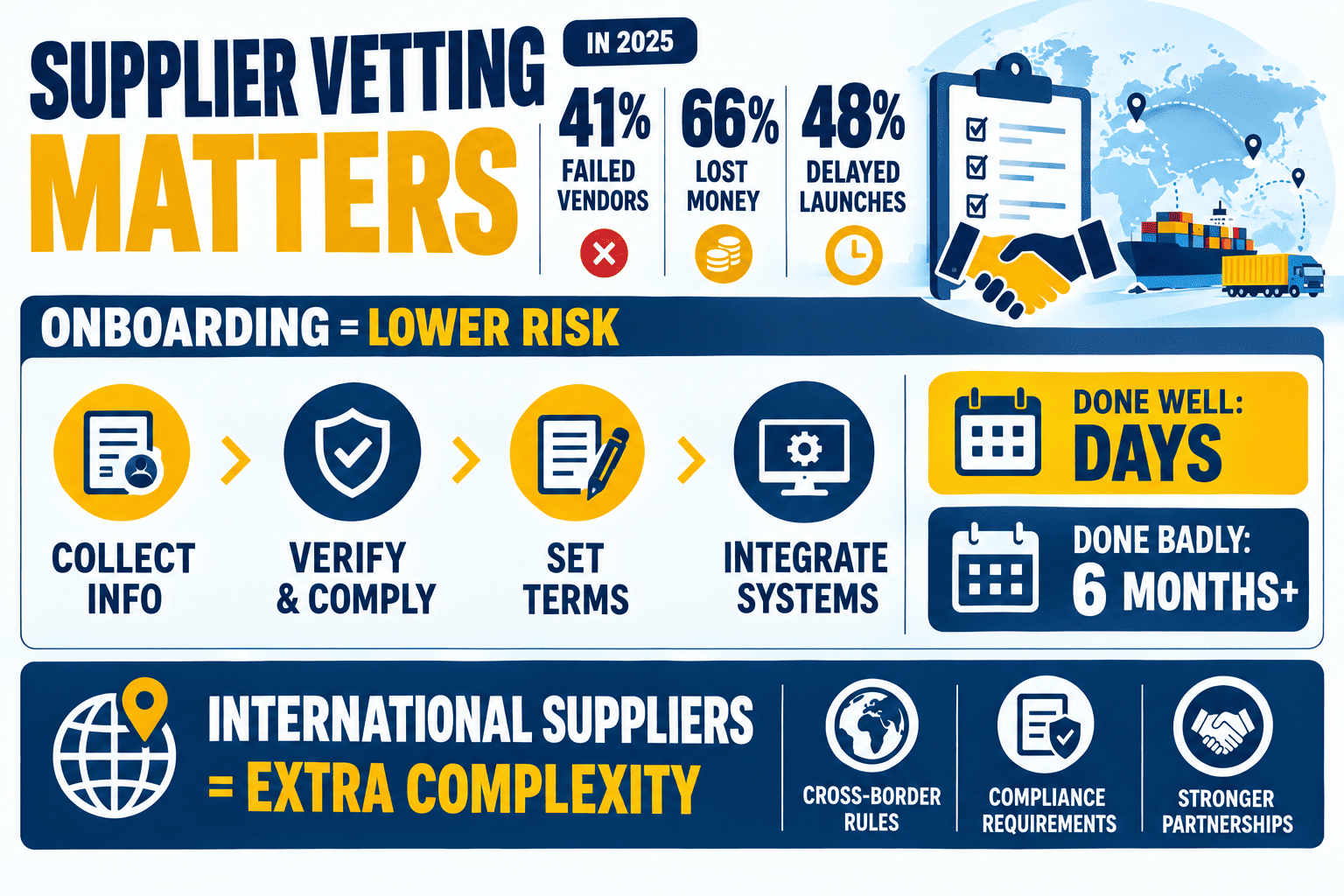
In 2025, poor supplier vetting led 41 percent of companies to at least one failed vendor relationship, with 66 percent losing money and 48 percent suffering product launch delays. Onboarding is where most of that risk is either caught or missed. It is the process of collecting a supplier’s information, verifying they are legitimate and compliant, formalising terms, and integrating them into your systems, all before the first purchase order is issued. Done well, it takes days. Done badly, it has been reported to stretch to six months, or to be skipped entirely until an invoice arrives. This article walks through the steps for onboarding an international supplier specifically, where cross-border complexity adds layers that domestic onboarding never has to handle, and how it fits into a broader cross-border business partnership strategy.
📅 Published September 9, 2026⏱ 12 min read✍️ GTsetu Editorial🔄 Updated September 9, 2026
Onboarding is often treated as administrative box-ticking, the paperwork you get through before the real work starts. That framing is exactly why it fails so often. Onboarding is the point at which you establish whether a supplier is legitimate, whether they can deliver, what happens when something goes wrong, and how the two organisations will actually communicate. Every one of those questions becomes far more expensive to answer after the first order is placed, and harder still when the supplier operates in a different jurisdiction, currency, and regulatory regime.
Section 1
What Supplier Onboarding Actually Covers
Supplier onboarding is the process of getting a new supplier set up and approved in your purchasing environment: collecting and verifying company details, financials, and compliance documents, confirming they meet your standards and applicable regulations, agreeing terms, and integrating them into your systems. It is distinct from supplier performance management, which is about monitoring and improving the relationship over time. Onboarding gets you to a qualified, compliant, contracted starting point; performance management takes it from there.
41%
Of companies experienced a failed vendor relationship in 2025 traced to poor vetting
43%
Of companies actually review supplier licences and registrations to confirm they can operate legally
82%
Of companies are not confident in the accuracy of their own vendor data
54%
Sooner that companies using simplified, integrated onboarding forms catch potential risks
💡 Onboarding is a filter, not a formality
The value of onboarding is not that documents get collected, it is that unsuitable suppliers get identified before you are commercially committed to them. A process that simply gathers paperwork without anyone genuinely reviewing it delivers the administrative cost of onboarding with none of the risk reduction.
Section 2
The Core Steps in an Onboarding Process
From Selection to First Order
Onboarding is systematic but rarely perfectly linear. The sequence below reflects how most procurement teams structure it, with the depth of each step scaled to how critical the supplier is.
1
Preliminary Research and Risk Assessment
Background, financial stability, geopolitical exposure, fit with requirements
Due Diligence
Before collecting a single form, build a preliminary risk profile: the supplier’s background, financial stability, reputation, and the scope of what they actually offer. For international suppliers this step carries extra weight, since it needs to account for geopolitical and jurisdictional risk alongside financial and operational risk. Location matters, particularly when a supplier operates in a high-risk country or across multiple borders. The output is a decision on whether to proceed at all, informed by proper market research for manufacturers in that region.
🎯
Why it matters: Discovering a disqualifying issue at this stage costs a few hours. Discovering it after contracting costs a relationship, a timeline, and often a product launch.
2
Collect and Verify Documentation
Legal identity, tax, banking, licences, insurance, data protection policies
Compliance
Use a standardised form to collect core data, then follow up for documents specific to the supplier type, industry, or jurisdiction. Crucially, do not stop at collection: verify independently against public records, business registries, and government databases. Only 43 percent of companies actually review supplier licences and registrations to confirm they can legally operate, and when that verification is skipped, the consequences land on the buyer, not the vendor. Cross-border sourcing makes independent verification harder and more important at the same time.
🎯
Why it matters: Submitted documents establish what a supplier claims. Independent verification establishes what is actually true, and the gap between the two is where most onboarding failures originate.
3
Evaluate Capability and Secure Internal Approval
Production capability, quality systems, references, cross-functional sign-off
Evaluation
Assess production capabilities, quality control processes, and past performance, with site visits or audits where the supplier’s criticality justifies them, and reference checks with existing customers in a similar region or industry. Then bring in the internal stakeholders who each own a piece of the decision: procurement confirms the supplier meets business requirements, finance validates payment and tax details, legal clears licences and regulatory compliance, and IT determines what systems access is appropriate and how securely data can be shared.
🎯
Why it matters: Defining who approves what, in what order, prevents the most common onboarding delay: parallel work by multiple teams that never actually converges into a decision.
4
Contract, Integrate, and Enable the Supplier
NDAs, SLAs, payment setup, systems access, process walkthrough
Activation
Negotiate and finalise the agreement, covering delivery schedules, payment terms, quality standards, IP rights, confidentiality, KPIs, service levels, penalties, escalation paths, and exit and termination clauses. Then integrate: create the supplier record in your purchasing and accounting systems with the approved legal name, tax details, payment method, and currency, and define how POs, approvals, and invoices will flow. Finally, actually instruct the supplier, walking them through your process rather than assuming they will infer it, which matters more across language and time-zone differences.
🎯
Why it matters: A supplier who is contracted but not enabled will still generate errors, delays, and rework, because they are guessing at expectations nobody explained.
Section 3
The Documentation Checklist for International Suppliers
Cross-border onboarding requires everything domestic onboarding does, plus several items that only apply when money, goods, and data move between jurisdictions. The table below covers the standard pack.
Category
What to Collect
Cross-Border Consideration
Legal & business identity
Legal name, registered address, registration number
Registry formats differ by country; verify at source
Tax information
Tax classification, TIN or VAT number, country of tax residence
Withholding and treaty rules vary by jurisdiction pair
Banking & payment
Account details, SWIFT or routing codes, default currency
Currency exposure and cross-border payment fees apply
Licences & certifications
Industry- and region-specific operating documentation
Equivalence across markets is rarely automatic
Security & compliance
Data protection policies, signed NDAs, code of conduct
Data residency and privacy law differ by region
Insurance & references
Proof of coverage, customer references or case studies
Prefer references from your own market where possible
A word of caution on form design: longer questionnaires do not produce better answers. Exhaustive forms are difficult to review and harder to complete, and they tend to generate rushed responses and skipped fields. Companies using simplified, integrated onboarding forms have been found to catch potential risks 54 percent sooner than those relying on sprawling questionnaires. Focus on collecting what you will actually verify, and confirm the manufacturing certifications for international trade that genuinely apply to your product and destination market rather than requesting everything indiscriminately.
Section 4
Tiering: Not Every Supplier Needs the Same Process
Around 57 percent of companies apply the same assessment criteria to every vendor. That makes the process consistent, but it also makes it slow, spending the same effort on a one-time office-supplies vendor as on a sole-source critical component manufacturer. A tiered approach matches onboarding depth to risk and business impact.
Supplier Tier
Profile
Onboarding Depth
Critical
High risk, high impact; essential to daily operations
Full due diligence, legal review, clear SLAs, escalation paths
Leverage
Low risk, high impact; competitive supply market
Focus on terms, pricing, and contract alignment
Bottleneck
High risk, low impact; hard to replace if disrupted
Risk-focused onboarding, backup suppliers, close monitoring
Non-critical
Low risk, low impact; consumables and non-essentials
Lightweight standardised form, minimal approvals
Deciding which tier a supplier belongs to should be structured rather than subjective, since different internal teams will naturally weight risk differently. Applying consistent partnership evaluation criteria across candidates, and factoring in regulatory exposure, data access requirements, and spend thresholds, produces a far more defensible tiering decision than an informal judgement call, especially when the supplier will occupy an ongoing supply chain partner role rather than fulfilling a single order.
Section 5
Where Onboarding Commonly Breaks Down
The failure modes are consistent across organisations and industries, which makes them straightforward to design around once you know what to look for.
Too many people, no single view. Procurement, finance, legal, and IT each handle their own part, but without one place where everyone can see progress, work happens in parallel and never converges. Worse, if multiple teams contact the supplier separately, the supplier receives conflicting instructions and no clear sense of priority.
The process is manual and reactive. Progress tracked in spreadsheets, data collected across scattered emails and calls, no audit trail. Some companies do not begin onboarding until after an invoice arrives, meaning the supplier has passed no due diligence whatsoever.
Data is incomplete from the start. With 82 percent of companies not confident in their vendor data accuracy, outdated details and blank fields are close to inevitable when information relies on manual entry, and they cause onboarding to stall or generate problems later.
Requirements are inconsistent. One team requests tax forms, another banking details, a third follows up weeks later for certifications, all through different channels. Suppliers reasonably conclude that working with your company will be equally disjointed.
Suppliers disengage. Exhaustive questionnaires and complicated setups deter vendors from completing onboarding at all. One-word answers or no reply is a signal worth acting on, either by simplifying the process or by reconsidering the supplier, particularly in a cross-border manufacturing partnership where engagement predicts long-term collaboration quality.
📌 The honest read
Most onboarding problems are process problems, not supplier problems. Before concluding that international suppliers are difficult to onboard, check whether your own requirements are clearly defined, whether one team owns the process end to end, and whether everything lives in a single place both sides can see. Fixing that usually resolves more delay than any amount of supplier chasing.
Section 6
Formalising and Protecting the Relationship
Verification and documentation get you to a qualified supplier. What turns that into a durable relationship is how the commercial terms, confidentiality protections, and disruption provisions are written down before the first order, not renegotiated after the first problem. This matters more in cross-border arrangements, where jurisdiction, enforcement, and currency all add complexity that a domestic agreement never has to resolve, and where formalising the relationship properly is part of any credible global expansion plan.
🏛️
Verify legal registration independently
Confirm registration, incorporation date, and current standing at source rather than accepting submitted documents at face value.
🤝 For Verified International Supplier Relationships
GTsetu: Verified Identity and Secure Document Exchange From the First Contact
The hardest part of international supplier onboarding is not collecting documents, it is independently verifying them across an unfamiliar jurisdiction, and doing it before you have invested weeks in the relationship. That gap is what GTsetu is built to close. It is a structured partnership platform, not a directory or a general marketplace, where every company is verified on 6 government-sourced points before engagement, where discovery is anonymous until mutual interest is confirmed, where NDAs are executed digitally before any commercial information changes hands, and where document exchange happens through an encrypted workspace rather than email attachments and scattered inboxes.
GTsetu is used by industrial manufacturers, distributors, and raw material suppliers across 100+ countries to build out a distributor network, source international wholesale distribution partners, or find manufacturing and technology partnership relationships they intend to keep for years, not a single order cycle. It complements, rather than replaces, your internal onboarding workflow, but it removes much of the identity and documentation risk before that process even begins.
🏛️
6-Point Government-Sourced Verification
Name, Address, Registration Number, Company Status, Company Type, and Date of Incorporation, verified using government tie-ups before any engagement.
🕵️
Anonymous Discovery
Browse verified supplier and manufacturer profiles across 100+ countries without revealing your own identity or sourcing strategy until you choose to engage.
📄
Built-In NDA Workflow
Digital NDA with timestamped signatures before any pricing, specifications, or commercial terms are shared. No sensitive information exposed without protection.
🔐
Encrypted Document Workspace
All onboarding documents shared through encrypted channels with a full access audit trail, not email attachments.
🌍
100+ Countries
Verified suppliers and distributors across Asia, Europe, the Middle East, Africa, Australia, and the Americas. Built for cross-border partnership formation, not one-off quotes.
🚫
Zero Commission
No success fee, no broker commission, ever. Your partnership economics remain entirely between you and your supplier.
Onboarding requirements also vary considerably by region, from registry structures and tax documentation to which certifications carry weight locally. Buyers onboarding suppliers across several markets at once, including emerging clusters like the Nigerian industrial and agro cluster, often find that a platform built for B2B matchmaking across countries makes it far easier to apply one consistent verification standard everywhere, rather than rebuilding the process for each new jurisdiction.
FAQ
Frequently Asked Questions
QWhat is supplier onboarding?
Supplier onboarding is the process of collecting and verifying a new supplier’s information, confirming they meet compliance and capability standards, formalising the commercial relationship in a contract, and integrating them into your purchasing and payment systems. It happens before any order is placed, and it sets the expectations and rules that govern everything that follows.
QHow long does it take to onboard an international supplier?
Onboarding can take anywhere from a few hours to several weeks, and in poorly structured processes it has been reported to stretch to six months. The duration depends on the supplier’s risk level, how quickly they provide requested documentation, regulatory complexity in their jurisdiction, and the thoroughness of the buyer’s internal vetting and approval process.
QWhat documents do you need from a new international supplier?
A standard onboarding pack typically includes legal and business identity details such as legal name, registered address, and registration number; tax information including VAT or TIN and country of tax residence; banking and payment details with SWIFT codes and default currency; primary contacts for operational, financial, and legal matters; licences and certifications relevant to the goods supplied; data protection policies and NDAs; proof of insurance; and customer references.
QShould every supplier go through the same onboarding process?
No. A tiered approach matches onboarding depth to the supplier’s risk and business impact. Critical suppliers warrant full due diligence, legal review, clear service level agreements, and defined escalation paths, while low-risk, low-impact vendors need only a lightweight standardised form and minimal approvals. Applying identical criteria to every supplier makes the process consistent but slows it down considerably.
QWho should own the supplier onboarding process internally?
Procurement usually owns onboarding end to end, with input from other functions: finance validates payment and tax details, legal handles contracts and regulatory obligations, and IT supports systems access and integration. When ownership is unclear, the practical fix is to designate procurement as the process owner and define explicitly who approves what, in what order.
Ready to Find and Onboard Your Next International Supplier?
GTsetu is purpose-built for manufacturers, distributors, and raw material suppliers in industrial sectors seeking verified long-term trade partnerships, across 100+ countries, with government-sourced partner verification, built-in NDA workflows, and zero commission.
They represents the product, and research team behind GTsetu, a global B2B collaboration platform built to help companies explore cross-border partnerships with clarity and trust. The team focuses on simplifying early-stage international business discovery by combining structured company profiles, verification-led access, and controlled collaboration workflows.
With a strong emphasis on trust, and disciplined engagement, Team GTsetu shares insights on global trade, partnerships, and cross-border collaboration, helping businesses make informed decisions before entering deeper commercial discussions.