How Do You Manage Multiple Manufacturing Partners Across Countries? | GTsetu Blog
Home ›
Blogs ›
Managing Multiple Manufacturing Partners
🌐 Global Sourcing & Operations · 2026
How Do You Manage Multiple Manufacturing Partners Across Countries?
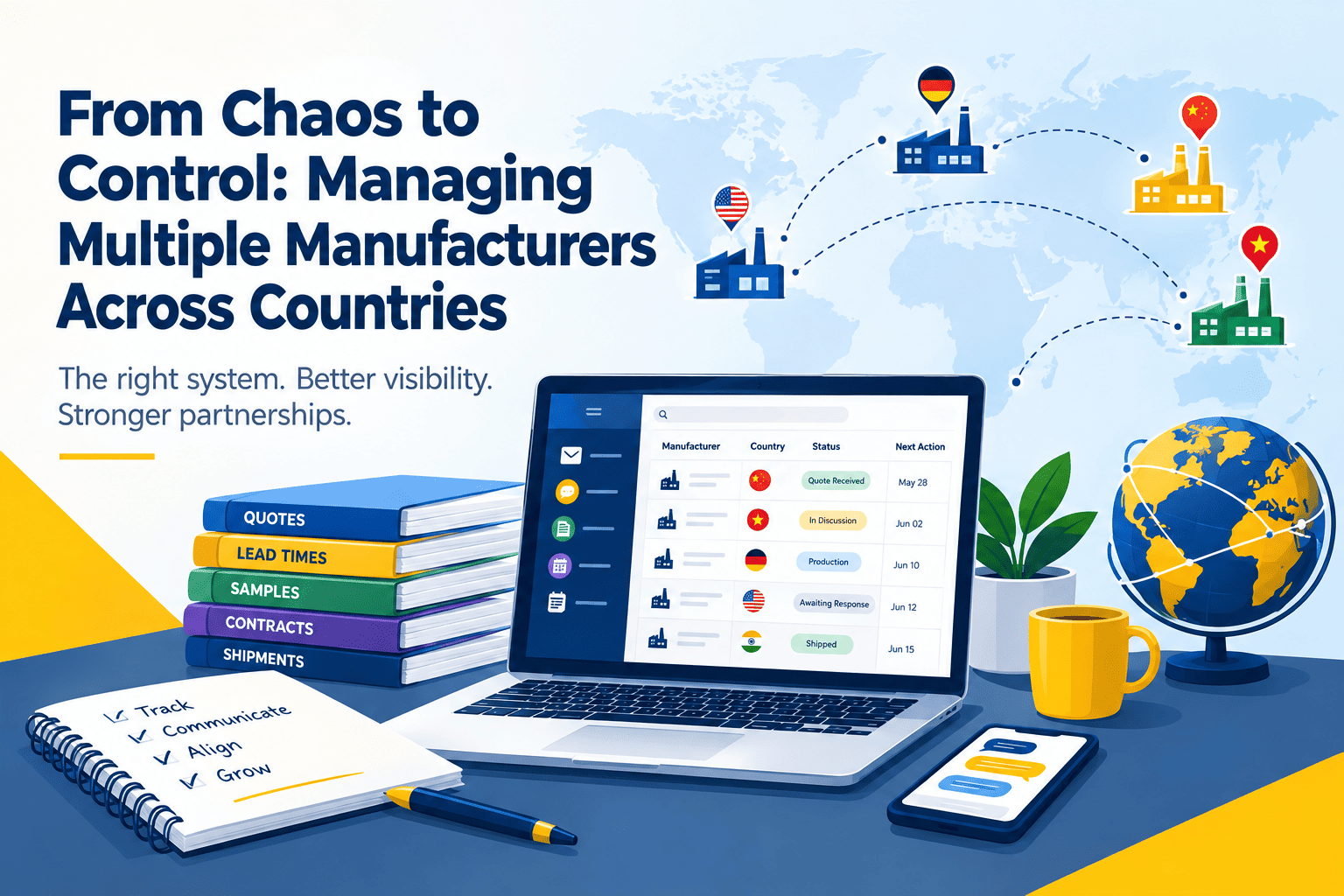
Working with several manufacturers at once, across several countries, has a way of feeling like chaos before it feels like control. Emails pile up in different threads, quotes live in different formats, lead times blur together, and nobody can quite remember which factory promised what by when. Businesses that scale past their first manufacturing relationship almost always describe the same turning point: things only became manageable once a real system replaced memory and scattered inboxes. This article walks through how to build that system, from centralized tracking and communication discipline to the strategic reasons for diversifying across countries in the first place, and how to formalise each relationship as part of a broader cross-border manufacturing strategy.
📅 Published September 10, 2026⏱ 12 min read✍️ GTsetu Editorial🔄 Updated September 10, 2026
There is a specific moment many product businesses hit: the first manufacturer is working well, a second one gets added for a new product line, then a third for redundancy, and suddenly nobody can answer a simple question like “what did Factory B quote us for this SKU last time” without digging through weeks of email. That moment is a signal, not a failure. It means the business has outgrown ad hoc management and needs an actual system, one that gets more important, not less, the more countries and time zones are involved.
Section 1
Why Businesses Work With Multiple Manufacturing Partners
A single manufacturing partner, however excellent, is a single point of failure. Multi-country sourcing spreads exposure across different regulatory environments, labour markets, and geopolitical conditions, so a disruption in one location does not stall the entire business. It also creates real commercial leverage: comparable quotes from multiple factories reveal who offers better pricing, more reliable terms, and more consistent quality, and it gives a business room to shift volume as demand, tariffs, or costs change.
💡 Diversification is a strategy, not just insurance
It’s tempting to think of a second or third manufacturing partner purely as a backup for when the first one fails. In practice, businesses that manage multiple partners well treat the portfolio as an active strategy, allocating volume deliberately based on each partner’s strengths, using competitive dynamics to negotiate better terms, and building genuine redundancy rather than a single primary supplier with theoretical backups nobody has actually vetted.
Section 2
Building the Core System: Tracking, Communication, Documentation
The Foundation Everything Else Depends On
Before any strategic thinking about diversification or collaboration can work, the basic operational system has to exist. This is the unglamorous but essential layer that most experienced multi-partner buyers converge on independently.
1
One Master Record for Every Partner
Products, pricing, MOQs, lead times, contacts, order history, all in one place
Visibility
A single tracking system, whether a shared spreadsheet, Airtable base, or a dedicated supplier management tool, should hold every manufacturer’s products, minimum order quantities, pricing, lead times, contact details, sample status, and a running log of every order placed with its actual cost. The discipline of putting everything you know into one place, rather than trusting memory or scattered threads, is what converts a chaotic multi-partner operation into a manageable one almost overnight.
🎯
Why it matters: Without a single source of truth, every new hire, every renegotiation, and every crisis starts from scratch, reconstructing information that should already exist in one accessible place.
2
Consistent Channels and a Real Communication Rhythm
Dedicated channels per partner, scheduled check-ins, no waiting until deadlines
Communication
Give each manufacturer its own dedicated communication space, a separate email folder at minimum, so historical context is never buried in an unrelated thread. Use quick channels for fast, low-stakes exchanges and shift to more formal channels for anything order-related, logging every material conversation back into the master tracking system since informal chats are the easiest thing to forget. Just as important: check in on a schedule rather than only when a deadline is looming. Knowing where every order actually stands throughout production, not just at the two ends, is what keeps a multi-country portfolio from generating surprises.
🎯
Why it matters: Coordinating across time zones and languages makes it easy for expectations to quietly diverge; a fixed check-in rhythm catches that early, when it is still cheap to fix.
3
Documentation That Survives Turnover and Time
Per-product folders with artwork, proofs, specs, and packaging detail
Documentation
Organise documentation by product, not by conversation, with every relevant file, artwork, proofs, packaging detail, specifications, living in one folder per product per manufacturer. This makes reordering close to effortless: an entire folder structure can be copied into a new order rather than reconstructed from memory or old email attachments. It also protects the business when a key employee who managed a particular relationship moves on, since the knowledge lives in the system rather than in one person’s head.
🎯
Why it matters: Institutional knowledge that only exists in someone’s inbox is a liability the moment that person is unavailable, exactly the wrong time for a multi-country operation to lose continuity.
4
A Running Scorecard on Every Partner’s Reliability
Alongside operational data, track a simple, ongoing assessment of each partner: are they consistently on time, is quality holding steady order over order, would you choose them again for a new product line. This running record becomes invaluable when planning future launches or when a partner needs to be replaced, turning what would otherwise be a gut-feel decision into one grounded in an actual track record spanning multiple orders.
🎯
Why it matters: Reliability is only visible in aggregate, one good order tells you little, but a documented pattern across a dozen orders tells you almost everything about how a partner will perform under pressure.
Section 3
Turning Suppliers Into Collaborators, Not Just Vendors
Operational tracking keeps a multi-partner portfolio from descending into chaos, but it does not, by itself, get the most value out of any single relationship. That requires treating strong partners as collaborators rather than interchangeable vendors, which yields real, measurable benefits: faster time-to-market when information flows both ways rather than being withheld, better product quality because problems surface and get solved earlier, lower costs through jointly identified savings, and more innovation when both sides are willing to exchange ideas openly.
The obstacles to this kind of collaboration are consistent and worth naming directly: growing supply chain complexity across dispersed operations, understandable reluctance to share sensitive design or process data, communication breakdowns from inconsistent channels, misaligned priorities between speed and cost, and trust issues that lead to information being withheld rather than shared. Overcoming them comes down to a handful of concrete moves, each of which matters more, not less, once several partners across several countries are in play:
Define shared KPIs explicitly. Agreeing on what success looks like, on-time delivery rate, defect rate, response time, gives both sides a common language rather than dueling internal metrics.
Build trust through transparency. Proactively surfacing issues rather than waiting to be asked is what actually earns reciprocal openness from a manufacturing partner over time, and speaks directly to why trust breaks down in global deals when it isn’t actively maintained.
Use technology to keep visibility live. Shared tools for communication, documentation, and status tracking reduce the ambiguity that email chains and spreadsheets alone cannot fully resolve.
Run regular performance reviews, not just crisis calls. A scheduled review cadence, not just an emergency call when something goes wrong, is what actually strengthens a supply chain partner relationship over multiple order cycles.
Section 4
Diversifying Across Countries Without Adding Chaos
Multi-country sourcing is where the operational discipline above earns its keep. Spreading manufacturing across geographies protects against concentrated risk, but only if the diversification itself is structured rather than accidental. A useful framework covers several dimensions at once, rather than treating “more countries” as automatically safer.
Diversification Dimension
What It Addresses
Practical Move
Geographic spread
Natural disasters, political instability, regional disruption
Avoid concentrating critical volume in one country or region
Supplier tiering by criticality
Uneven attention across a portfolio of unequal importance
Match oversight depth to how critical each partner actually is
Dual or multi-sourcing for key inputs
Single points of failure in materials or components
Qualify at least one backup source for anything mission-critical
Currency and cost exposure
Cost volatility tied to a single currency or tariff regime
Balance volume across currency zones where practical
Logistics and lead-time variance
Compounding delays across an extended, dispersed network
Build lead-time buffers that reflect the slowest link, not the fastest
Regulatory and compliance variance
Certification and documentation requirements that differ by market
Track compliance requirements per country, not as one generic checklist
None of this replaces proper groundwork before entering a new country. A tracking system and a communication rhythm manage relationships once they exist; they do not substitute for the market research needed to choose the right country and partner in the first place, or for understanding how international material sourcing for that specific market actually works.
Section 5
Common Obstacles and How to Get Ahead of Them
A handful of failure patterns show up repeatedly in multi-partner, multi-country operations. Recognising them in advance makes them far easier to design around.
Information scattered across too many channels. When quotes live in one app, orders in email, and notes in someone’s head, nothing is ever fully current, and the fix is consolidation into a single tracked system, not more tools.
Reactive rather than scheduled communication. Waiting for a deadline to check in means problems are discovered late, when options for fixing them have narrowed considerably.
Treating every partner identically. A sole-source strategic manufacturer and an easily replaced low-volume vendor do not warrant the same oversight; applying one uniform process either overspends effort on the trivial relationships or underprotects the critical ones.
Under-investing in trust with strong partners. Treating every manufacturer as a purely transactional vendor, even the ones consistently performing well, forfeits the innovation and cost benefits that genuine collaboration can unlock.
No shared understanding of what disruption means for the relationship. Without contractual clarity on delays, quality disputes, or unforeseen events, ambiguity gets resolved under pressure, rarely to both sides’ satisfaction, which is exactly what proper force majeure provisions in global trade are meant to prevent.
📌 The honest read
Most of the difficulty in managing multiple manufacturing partners is not really about the partners, it is about whether the business built a system before scaling past one relationship. The businesses that describe this as manageable, even easy, almost always point to a specific point where they stopped relying on memory and built a real tracking and communication structure. That shift, more than anything about the partners themselves, is what determines whether growth across countries feels controlled or chaotic.
Section 6
Formalising Each Relationship on Its Own Terms
A tracking system and a communication rhythm manage the relationship day to day. They do not replace the legal and commercial groundwork that protects the business when a partner underperforms, a dispute arises, or a market shifts. Each partner, regardless of how well the operational side is running, needs its own formal footing, particularly as the portfolio grows and represents a genuine part of the company’s global expansion strategy.
🏛️
Verify legal registration for every partner
Confirm registration, incorporation date, and current standing independently for each country, not just the first one you onboard.
Government-sourced verification
📄
Contract each relationship individually
Put a formal NDA and a proper business partnership contract in place per partner, since terms suited to one country rarely transfer cleanly to another.
🤝 For Managing a Verified Multi-Country Partner Portfolio
GTsetu: One Verified, Secure Home Base for Every Manufacturing Relationship
A spreadsheet or a supplier management tool tracks what you already know about each partner. The harder problem, especially across several countries at once, is establishing that each partner’s basic legal identity is genuinely verified in the first place, and keeping the increasingly sensitive documentation for each relationship secure as the portfolio grows. That gap is what GTsetu is built to close. It is a structured partnership platform, not a directory or a general marketplace, where every company is verified on 6 government-sourced points before engagement, where discovery is anonymous until mutual interest is confirmed, where NDAs are executed digitally before any commercial information changes hands, and where document exchange happens through an encrypted workspace rather than email attachments scattered across a dozen different threads.
GTsetu is used by industrial manufacturers, distributors, and raw material suppliers across 100+ countries to build out a distributor network, source international wholesale distribution partners, or find manufacturing and technology partnership relationships they intend to keep for years, across multiple countries at once, not a single order cycle with a single factory. It complements, rather than replaces, your internal tracking system, but it removes much of the identity and documentation risk that multiplies as your partner portfolio grows.
🏛️
6-Point Government-Sourced Verification
Name, Address, Registration Number, Company Status, Company Type, and Date of Incorporation, verified using government tie-ups before any engagement.
🕵️
Anonymous Discovery
Browse verified manufacturer and supplier profiles across 100+ countries without revealing your own identity or sourcing strategy until you choose to engage.
📄
Built-In NDA Workflow
Digital NDA with timestamped signatures before any pricing, specifications, or designs are shared, applied consistently across every partner in your portfolio.
🔐
Encrypted Document Workspace
All commercial documents shared through encrypted channels with a full access audit trail, not email attachments.
🌍
100+ Countries
Verified manufacturers and distributors across Asia, Europe, the Middle East, Africa, Australia, and the Americas. Built for cross-border partnership formation, not one-off quotes.
🚫
Zero Commission
No success fee, no broker commission, ever. Your partnership economics remain entirely between you and your partners.
It is also worth noting that a growing multi-country portfolio benefits from applying one consistent standard everywhere, rather than reinventing due diligence for each new market. Buyers assessing manufacturers across several regions at once, including emerging clusters like the Nigerian industrial and agro cluster, alongside more established hubs elsewhere, often find that a platform built for B2B matchmaking across countries makes exactly that consistency far easier to maintain as the portfolio scales, all grounded in durable cross-border business partnerships.
FAQ
Frequently Asked Questions
QWhy manage multiple manufacturing partners across countries instead of one?
A single manufacturing partner, however reliable, is a single point of failure. Spreading production across multiple partners and countries reduces exposure to any one factory’s capacity limits, quality lapses, or local disruptions, whether from labour disputes, natural disasters, tariff changes, or political instability. It also gives a business leverage in pricing negotiations and flexibility to shift volume as demand or costs change.
QWhat is the biggest challenge in managing manufacturing partners in different countries?
Communication and visibility consistently rank as the hardest challenges. Coordinating across time zones, languages, and differing business norms makes it easy for expectations to diverge, and without a centralized system to track orders, samples, pricing, and performance across every partner, information ends up scattered across emails and spreadsheets that nobody can reliably reference.
QHow do you keep track of multiple manufacturers without losing control?
Most experienced buyers centralize everything in a single tracking system, whether a shared spreadsheet, a dedicated tool, or a supplier management platform, covering each manufacturer’s products, pricing, minimum order quantities, lead times, contacts, and a running log of every order and its outcome. Pairing this with a consistent communication rhythm and a simple scorecard for reliability keeps the whole portfolio visible in one place rather than scattered across inboxes.
QShould every manufacturing partner be treated the same way?
No. Partners vary enormously in how critical they are to your operations, and treating a sole-source strategic supplier the same way as a low-volume, easily replaced one wastes effort in one direction and under-protects you in the other. Segmenting partners by risk and business impact, and matching the depth of oversight, contracting, and contingency planning to that segment, is more effective than applying one uniform process to every relationship.
Ready to Build Out a Verified Multi-Country Manufacturing Portfolio?
GTsetu is purpose-built for manufacturers, distributors, and raw material suppliers in industrial sectors seeking verified long-term trade partnerships, across 100+ countries, with government-sourced partner verification, built-in NDA workflows, and zero commission.
They represents the product, and research team behind GTsetu, a global B2B collaboration platform built to help companies explore cross-border partnerships with clarity and trust. The team focuses on simplifying early-stage international business discovery by combining structured company profiles, verification-led access, and controlled collaboration workflows.
With a strong emphasis on trust, and disciplined engagement, Team GTsetu shares insights on global trade, partnerships, and cross-border collaboration, helping businesses make informed decisions before entering deeper commercial discussions.