Best Alternative to HKTDC for Asian Suppliers | GTsetu Blog
Home ›
Blogs ›
Best Alternative to HKTDC for Asian Suppliers
🌏 Global Sourcing & Platforms · 2026
Best Alternative to HKTDC for Asian Suppliers
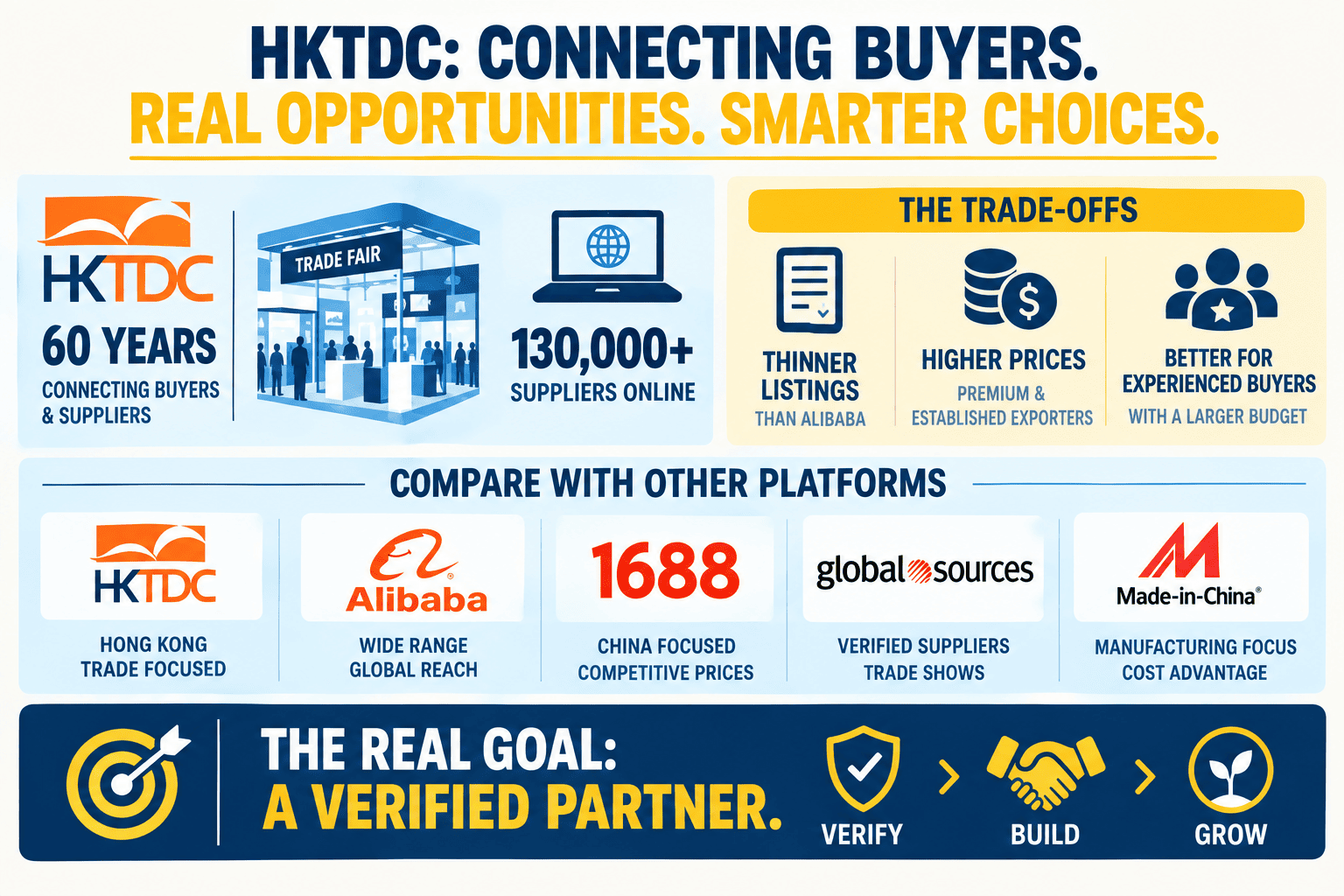
HKTDC has spent nearly sixty years building a reputation for connecting buyers with reliable Hong Kong, mainland China, and Asian exporters, largely through its trade fairs and an online marketplace of over 130,000 suppliers. But that reputation comes with real trade-offs: thinner product listings than Alibaba, pricing weighted toward premium and established exporters, and a platform built more for experienced importers with a budget to match than for a company running structured due diligence on a new long-term partner. This article compares HKTDC against the platforms buyers most often consider instead, Alibaba, 1688, Global Sources, and Made-in-China, and looks at what actually matters when the goal isn’t just a one-off order but a verified supply chain partner you can build on for years.
📅 Published September 12, 2026⏱ 11 min read✍️ GTsetu Editorial🔄 Updated September 12, 2026
Every general-purpose sourcing marketplace, HKTDC included, is built around the same basic transaction: browse listings, compare prices, place an order. That model works well for a straightforward purchase. It works far less well when the real goal is finding a manufacturing, distribution, or technology partnership that will run for years, involve shared intellectual property, and need genuine trust on both sides. Understanding where HKTDC fits, and where it doesn’t, is the first step to picking the right tool for the sourcing job in front of you.
Section 1
What HKTDC Actually Offers
HKTDC, the Hong Kong Trade Development Council, is a statutory body established in 1966 to create opportunities for Hong Kong’s small and medium businesses. It is best known for large-scale physical trade fairs held at facilities like AsiaWorld-Expo, alongside an online sourcing marketplace, HKTDC Sourcing, that connects buyers with suppliers across more than 30 industries.
130,000+
Hong Kong, China, and broader Asia wholesale suppliers and manufacturers listed on HKTDC’s online marketplace
30+
Industries covered across HKTDC’s online sourcing platform and trade fair calendar
1966
Year HKTDC was established as Hong Kong’s government-backed trade promotion body
2x
Major physical trade fairs typically run each year by HKTDC’s closest positioned competitor, Global Sources
That scale and government backing give HKTDC a genuine strength: the suppliers listed tend to skew toward more established, reliable exporters rather than the widest possible pool of factories at every price point. For buyers who value predictability over the absolute lowest unit cost, that positioning is a real advantage, and it’s why HKTDC is generally recommended to experienced importers and first-time buyers who can afford to prioritise reliability, rather than budget-constrained buyers hunting for rock-bottom pricing.
Section 2
Where HKTDC Falls Short for Modern Sourcing
The same positioning that makes HKTDC attractive to some buyers is exactly what limits it for others. A few structural gaps show up consistently in comparisons against competing platforms.
Thin product detail. Where a platform like Alibaba typically shows detailed specifications, multiple images, and rich product pages, HKTDC listings are often limited to a picture, simple attributes, and a short description, leaving buyers needing to contact the supplier directly just to get basic information.
Pricing skewed higher. HKTDC’s focus on premium, reliable exporters generally comes with higher costs than budget-oriented platforms, making it a harder sell for buyers optimising primarily for unit price.
Narrower supplier discovery outside Hong Kong. Suppliers based in mainland China or other parts of Asia are represented, but the platform’s centre of gravity remains Hong Kong-based and larger exporters, offering less visibility into smaller manufacturers or newer entrants across the wider region.
No built-in framework for confidentiality or verification depth. Like most general marketplaces, HKTDC is not designed to formalise an NDA, verify a supplier’s legal registration against government sources, or protect sensitive specifications before a relationship is confirmed, steps that matter far more for a long-term partnership than for a single transactional order.
📌 The honest read
None of this makes HKTDC a bad platform. It makes it a platform built for a specific kind of buyer and a specific kind of transaction, an experienced importer with budget to spend, looking for a reliable exporter through a trade fair or a browsable catalogue. If that describes your sourcing goal, HKTDC remains a reasonable choice. If your goal is closer to finding and formally vetting a long-term partner, the gap between what HKTDC offers and what that goal actually requires becomes the reason to look elsewhere.
Section 3
The Leading Alternatives, Compared
Four Platforms Buyers Consider Instead
1
Alibaba
The largest international B2B marketplace from China
Widest SelectionTrade Assurance
Alibaba is the default starting point for most international sourcing, offering the widest product range, detailed listings, and a built-in Trade Assurance escrow programme for basic buyer protection. Its scale is also its weakness: verification badges offer only a starting point, the most competitive factories don’t always pay for premium placement, and quality across listings varies widely.
🎯
Best for: Broad supplier discovery and price comparison across almost any product category, provided you’re prepared to do the final vetting yourself.
2
1688.com
Alibaba Group’s domestic Chinese wholesale marketplace
Lowest Prices
1688 targets Chinese domestic retailers rather than international buyers, and pricing typically runs 20 to 40 percent below equivalent Alibaba listings as a result. The trade-off is steep: the site is almost entirely in Chinese, requires Alipay, offers no buyer protection for overseas purchasers, and effectively requires a sourcing agent on the ground to use safely.
🎯
Best for: Buyers with an existing agent or sourcing partner in China who can navigate language, payment, and shipping on their behalf.
3
Global Sources
Hong Kong-based, electronics-focused, trade-show integrated
Stricter Verification
Global Sources sits closest to HKTDC in positioning: Hong Kong-based, tied to major physical trade shows twice a year, and built around connecting buyers with genuine factories rather than trading companies. Its supplier admission standards are generally stricter than Alibaba’s, though the resulting pool is smaller and less beginner-friendly, with higher minimum order quantities typical.
🎯
Best for: Electronics, tech accessories, and lifestyle product sourcing where verified factory relationships matter more than catalogue breadth.
4
Made-in-China.com
Industrial and machinery-focused, direct manufacturer access
Industrial Focus
Made-in-China specialises in industrial categories underrepresented on consumer-facing platforms, connecting buyers directly with manufacturers across machinery, auto parts, building materials, and hundreds of other industrial sectors, backed by an audited supplier verification programme.
🎯
Best for: Industrial machinery, equipment, and B2B manufacturing components where consumer marketplaces offer thin coverage.
Domestic Chinese norms, no overseas buyer protection
Chinese-language only, needs a local agent
Global Sources
Electronics, tech, lifestyle categories
Stricter admission standards, verified badges
Smaller pool, higher MOQs, less beginner-friendly
Made-in-China
Industrial machinery, equipment, components
Audited supplier programme
Uneven listing quality outside industrial niches
Section 5
Choosing the Right Platform for Your Goal
None of these platforms is objectively “the best.” Each optimises for a different combination of price, verification depth, and product category, so the right choice depends heavily on what you’re actually trying to accomplish and how thorough your own market research for manufacturers needs to be before committing.
💰
Lowest possible unit price
1688 offers the deepest discount versus international platforms, provided you have an agent to navigate it.
Consider 1688
🔍
Widest possible supplier discovery
Alibaba’s scale remains unmatched for browsing options across nearly any category.
Consider Alibaba
🔌
Electronics or lifestyle products
Global Sources’ stricter verification and trade-show integration suit these categories well.
HKTDC’s government-backed positioning still suits buyers who value reliability over rock-bottom cost.
Consider HKTDC
🤝
A verified, long-term cross-border partner
A structured partnership platform, built for confidentiality and formal agreements, fits this goal best.
Consider GTsetu
Section 6
Why a Marketplace Isn’t Always the Right Tool
Every platform compared above, HKTDC included, is fundamentally a marketplace: a place to browse listings and place an order. That is exactly the right tool for a transactional purchase. It is the wrong tool once the relationship you’re building starts to look less like a purchase order and more like a partnership, involving shared product specifications, ongoing volume commitments, or intellectual property that needs protecting before a single conversation happens.
💡 The question worth asking first
Before choosing a platform, it’s worth asking honestly whether you’re sourcing a product or building a partner. A marketplace answers the first question well. Answering the second properly requires verified identity, a confidentiality framework, and a path to a formal partnership agreement, none of which a general listings site is built to provide.
🤝 For Verified Long-Term Manufacturing Partnerships
GTsetu: Verified Discovery and Secure Engagement for Manufacturers, Distributors, and Raw Material Suppliers
HKTDC and its competitors are built to help you browse a catalogue and place an order. None of them are built to verify a supplier’s legal registration against government sources, protect your specifications and pricing with a digital NDA before a single detail is shared, or give you a secure, always-on workspace to formalise the relationship once it moves beyond a first conversation. That gap is what GTsetu is built to close. It is a structured partnership platform, not a directory or a general marketplace, where every company is verified on 6 government-sourced points before engagement, where discovery is anonymous until mutual interest is confirmed, and where document exchange happens through an encrypted workspace rather than email attachments.
GTsetu is used by industrial manufacturers, distributors, and raw material suppliers across 100+ countries, including China and the wider Asian supplier base HKTDC and its competitors draw from, to build out a distributor network, source international wholesale distribution partners, or find manufacturing relationships they intend to keep for years, not a single order cycle. It complements, rather than replaces, the marketplaces above for initial product discovery, but it removes much of the identity and documentation risk before that deeper relationship even begins.
🏛️
6-Point Government-Sourced Verification
Name, Address, Registration Number, Company Status, Company Type, and Date of Incorporation, verified using government tie-ups before any engagement.
🕵️
Anonymous Discovery
Browse verified manufacturer and distributor profiles across 100+ countries without revealing your own identity or sourcing strategy until you choose to engage.
📄
Built-In NDA Workflow
Digital NDA with timestamped signatures before any pricing, formulations, or product specs are shared. No sensitive information exposed without protection.
🔐
Encrypted Document Workspace
All commercial documents shared through encrypted channels with a full access audit trail, not email attachments.
🌍
100+ Countries
Verified manufacturers and distributors across Asia, the Middle East, Europe, Africa, Australia, and the Americas. Built for cross-border partnership formation, not one-off quotes.
🚫
Zero Commission
No success fee, no broker commission, ever. Your partnership economics remain entirely between you and your partner.
HKTDC, the Hong Kong Trade Development Council, is a government-backed trade promotion body known primarily for its large-scale physical trade fairs and an online sourcing marketplace connecting buyers with Hong Kong, mainland China, and broader Asian suppliers. It tends to suit experienced importers with an established budget looking for reliable exporters and new product development opportunities, rather than first-time buyers seeking the lowest possible price.
QWhat are the main limitations of using HKTDC for sourcing?
HKTDC’s online marketplace offers thinner product detail than competitors like Alibaba, with fewer specifications and images per listing, and its pricing tends to run higher, reflecting its positioning toward premium, reliable exporters rather than the lowest-cost factories. It is also weighted toward Hong Kong-based and larger suppliers, offering less visibility into smaller manufacturers or newer entrants across the wider region.
QWhat is the best alternative to HKTDC for sourcing from Asia?
The right alternative depends on the goal. Alibaba and 1688 offer the largest supplier pools and lowest prices but require heavier due diligence. Global Sources and Made-in-China offer stricter verification for electronics and industrial categories respectively. For companies seeking a verified, long-term, cross-border business partnership rather than a one-off transactional order, a structured partnership platform with government-sourced verification, confidentiality protections, and no commission is generally the better fit.
QIs a general marketplace or a partnership platform better for finding an Asian supplier?
It depends on what the relationship is meant to become. A general marketplace is well suited to comparing listings and placing a transactional order quickly. A partnership platform is built for the opposite case: verifying a supplier’s legal standing, protecting sensitive specifications and pricing with an NDA, and formalising the relationship into a long-term agreement, which matters far more once a company is sourcing critical components or building a multi-year supplier relationship rather than a single order.
QCan HKTDC and a verified partnership platform be used together?
Yes, and many buyers effectively do this already. A marketplace or trade fair like HKTDC is often where a promising supplier is first discovered; a structured partnership platform is where that supplier’s legal standing gets verified, confidential specifications get protected, and the relationship gets formalised into a lasting agreement. The two serve different, complementary stages of the same sourcing process.
GTsetu is purpose-built for manufacturers, distributors, and raw material suppliers in industrial sectors seeking verified long-term trade partnerships, across 100+ countries, with government-sourced partner verification, built-in NDA workflows, and zero commission.
They represents the product, and research team behind GTsetu, a global B2B collaboration platform built to help companies explore cross-border partnerships with clarity and trust. The team focuses on simplifying early-stage international business discovery by combining structured company profiles, verification-led access, and controlled collaboration workflows.
With a strong emphasis on trust, and disciplined engagement, Team GTsetu shares insights on global trade, partnerships, and cross-border collaboration, helping businesses make informed decisions before entering deeper commercial discussions.