How CBAM Works for Indian Manufacturers Exporting to the EU (2026) | GTsetu
Home ›
Blog ›
How CBAM Works for Indian Manufacturers Exporting to the EU
🌍 Global Trade & Compliance
How CBAM Works for Indian Manufacturers Exporting to the European Union
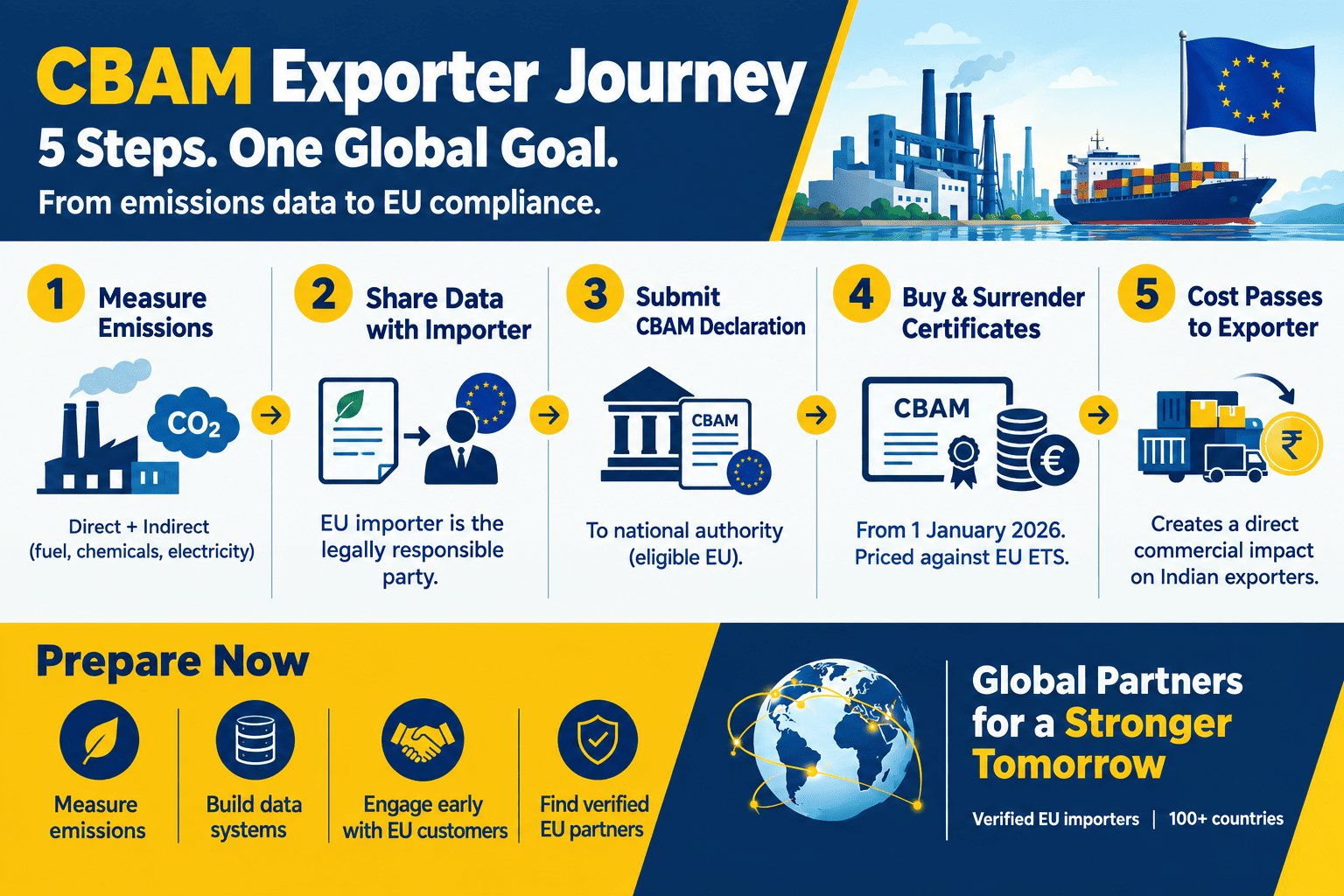
Direct Answer: The CBAM exporter journey for Indian manufacturers exporting to the European Union is a five-step process. First, the Indian manufacturer measures the embedded emissions of its production, both direct emissions from fuel and chemical reactions, and indirect emissions from electricity use. Second, the manufacturer provides this data to the EU importer (its customer), who is the legally responsible party under CBAM. Third, the EU importer submits a CBAM declaration to its national authority, reporting the emissions of the imported goods. Fourth, from 1 January 2026, the importer must purchase and surrender CBAM certificates, priced against the EU Emissions Trading System (ETS), corresponding to those emissions. Fifth, the cost of these certificates is typically passed down the supply chain, creating a direct commercial impact on the Indian exporter. Preparing now, by measuring emissions, establishing data systems, engaging early with EU customers, and finding verified EU partners, is essential. GTsetu helps Indian manufacturers find government‑tie‑up verified EU importers and partners across 100+ countries, enabling secure emissions data exchange and trusted cross-border collaboration.
📅 Published October 3, 2026🔄 Updated October 3, 2026⏱ 16 min read✍️ GTsetu Editorial Team
5
Steps in the Exporter Journey
6
Covered Sectors
100+
Countries on GTsetu
0%
Broker Commission
The European Union’s Carbon Border Adjustment Mechanism (CBAM) is fundamentally changing how Indian manufacturers export to Europe. For producers of steel, aluminium, cement, fertilisers, hydrogen, and electricity, CBAM introduces a new compliance obligation that runs through the entire export journey, from the factory floor in India to the customs point in the EU and onward to the final carbon cost.
This guide walks through the complete CBAM exporter journey for Indian manufacturers: how emissions data is measured, how it flows to the EU importer, how the declaration is filed, how certificates are purchased, and how costs ultimately affect your competitiveness. It also explains what you can do now to prepare and how GTsetu helps you find verified EU importers and partners to manage this new reality. For related context, see our guides on global market research for manufacturers, manufacturing certifications for international trade, and cross-border manufacturing partnerships.
💡 Who This Guide Is For
Indian manufacturers, exporters, and trade professionals in CBAM-covered sectors (iron and steel, aluminium, cement, fertilisers, hydrogen, electricity) who export or plan to export to the EU. It is also relevant for EU importers sourcing from India, and for business development teams evaluating the commercial impact of CBAM on their supply chains.
⚖️ Legal & Compliance Disclaimer
This guide provides general commercial and compliance education on CBAM. It does not constitute legal, tax, or regulatory advice. CBAM rules are complex and evolving. Always consult qualified legal and compliance professionals and refer to official EU sources (EU Commission, DG TAXUD) for the most current regulations.
SECTION 1
1 What is CBAM and Why It Matters for Indian Manufacturers
🎯 Definition
CBAM (Carbon Border Adjustment Mechanism) is a European Union regulation that puts a carbon price on imports of certain carbon-intensive goods. It is designed to prevent carbon leakage, where EU companies relocate production to countries with less stringent climate policies, by ensuring that imported goods face a carbon charge equivalent to what EU producers pay under the EU Emissions Trading System (ETS). For Indian manufacturers, CBAM means that your EU customers will require detailed, verified data on the embedded emissions of your products, and from 2026, they will pay a carbon cost that will be passed down the supply chain.
India is one of the EU’s largest trading partners, and Indian exports of CBAM-covered goods, particularly steel and aluminium, are significant. CBAM will have a material impact on Indian manufacturers in these sectors, affecting their cost competitiveness and their commercial relationships with EU importers.
The good news is that CBAM is a manageable challenge. By understanding the exporter journey, measuring your emissions, and engaging proactively with your EU customers and partners, you can not only comply but potentially differentiate yourself as a low-carbon supplier. For broader trade context, see our guide on cross-border business partnerships.
Why CBAM Matters for Indian Manufacturers
💰
Direct Cost Impact
From 2026, your EU customer will face CBAM certificate costs. They will seek to pass these costs down to you through lower prices. This directly affects your margins and competitiveness.
📊
Data Requirements
You must measure and report embedded emissions. This requires investment in data collection systems, monitoring equipment, and potentially third-party verification.
🏆
Competitiveness Shift
Exporters with lower carbon intensity will have a competitive advantage. Those with high-carbon production may become uncompetitive in the EU market.
🔄
Supply Chain Pressure
EU importers may reconsider their sourcing strategies, potentially shifting to suppliers in countries with lower carbon intensity or to domestic EU production.
🤝
Partnership Requirements
You will need to work closely with your EU customers to share data, agree on verification, and potentially renegotiate contracts. Trusted partnerships are essential. See our guide on supply chain partners.
🌱
Opportunity to Differentiate
Early movers who measure and reduce their carbon footprint can market themselves as low-carbon suppliers, potentially commanding premium prices. See company global expansion.
SECTION 2
2 The CBAM Exporter Journey at a Glance
The CBAM exporter journey describes the flow of information, obligations, and costs from the Indian manufacturer through to the EU importer and the final carbon cost. Here is the entire process in a single view.
1
Measure
Indian manufacturer measures embedded emissions: direct (fuel, chemical reactions) and indirect (electricity).
📊 Data Collection
2
Share
Manufacturer provides emissions data to the EU importer, along with supporting documentation.
📤 Data Transfer
3
Declare
EU importer submits an annual CBAM declaration to the national authority, reporting embedded emissions.
📋 Reporting
4
Certify
From 2026, importer purchases and surrenders CBAM certificates corresponding to those emissions.
💶 Carbon Cost
5
Pass-Through
CBAM certificate costs are passed down the supply chain, affecting the Indian exporter’s price competitiveness.
💸 Commercial Impact
6
Reduce
Manufacturer invests in decarbonisation to reduce embedded emissions, lowering future CBAM costs.
🌱 Decarbonisation
✨ GTsetu Insight
Each step in this journey depends on a trusted relationship between the Indian manufacturer and the EU importer. Without a verified, transparent partner, sharing emissions data is risky, and commercial negotiations over cost pass-through become adversarial. GTsetu helps you find verified EU partners and collaborate securely. See our guide on why trust breaks in global deals for the infrastructure that prevents partnership failures.
SECTION 3
3 Step 1: Indian Manufacturer Measures Embedded Emissions
The CBAM exporter journey begins at the factory floor in India. As the manufacturer, you must measure the embedded emissions of the goods you export to the EU. Embedded emissions are the total greenhouse gas emissions associated with the production of the goods, expressed in tonnes of CO₂ equivalent per tonne of product.
🎯 What Are Embedded Emissions?
Embedded emissions are the total GHG emissions released during the production of a good. Under CBAM, they include:
• Direct emissions: from fuel combustion, chemical reactions, and other processes at your facility.
• Indirect emissions: from the generation of electricity consumed in your production processes.
1
Map Your Production Processes
Identify all processes that contribute to the embedded emissions of your CBAM-covered goods. This includes raw material extraction, processing, manufacturing, and any on-site energy generation. Document the material and energy flows.
2
Install Monitoring & Data Collection Systems
Implement systems to measure fuel consumption, electricity use, process emissions, and production output. This may involve meters, sensors, and data loggers. Accuracy is critical, as your data will feed into your customer’s CBAM declaration.
3
Calculate Direct & Indirect Emissions
Using the collected data and appropriate emission factors, calculate the direct and indirect emissions per tonne of product. Follow the EU’s CBAM methodology and any sector-specific guidance.
4
Arrange Third-Party Verification
To ensure your data is accepted by your EU customer and the CBAM authority, consider engaging an accredited verifier. Verified data reduces the risk of disputes and penalties. See our guide on manufacturing certifications.
5
Maintain Robust Records
Keep detailed records of all measurements, calculations, and verification reports. This documentation is essential for your EU customer’s declaration and for any future audit. It also protects you in commercial negotiations over cost pass-through.
📌 Practical Considerations for Indian Manufacturers
Many Indian manufacturers have not previously measured their carbon footprint at this level of granularity. This will require investment in systems and expertise. Start early, as data collection takes time, and the first CBAM declarations from your EU customers will rely on your data. For related guidance, see our article on sourcing manufacturing materials internationally.
SECTION 4
4 Step 2: Data Transfer to the EU Importer
Once you have measured and verified your embedded emissions, you must share this data with your EU importer. The importer is your customer, the company that brings your goods into the EU. They are legally responsible for CBAM compliance, but they depend entirely on the data you provide.
🎯 The Data Exchange
You provide your EU importer with:
• The embedded emissions per tonne of product (direct and indirect).
• The methodology and emission factors used.
• Supporting documentation and verification reports.
This data must be accurate, complete, and in a format the importer can use for their CBAM declaration. The importer may also request additional information to satisfy their own compliance obligations.
📄
Data Format & Standards
Agree with your importer on the data format and standards. The EU has published templates and guidance for CBAM reporting. Using these standards reduces errors and speeds up the declaration process.
🔐
Confidentiality & Security
Emissions data and related production details can be commercially sensitive. Share them through secure, encrypted channels. GTsetu provides an encrypted workspace for exactly this purpose. See why trust breaks in global deals.
🤝
Collaborative Approach
Work with your importer as a partner. They need your data to comply, and you need them to maintain market access. A collaborative approach leads to better outcomes for both parties. See supply chain partners.
📅
Timing & Deadlines
CBAM declarations are filed annually. Ensure you provide your data well ahead of your importer’s deadline. Late or incomplete data can lead to penalties for the importer and damage the relationship.
✨ GTsetu Insight
Finding an EU importer who is committed to a long-term, transparent partnership is critical. GTsetu verifies companies using government tie-ups on six key points (legal name, registered address, registration number, company status, company type, incorporation date) so you can engage with confidence. Our B2B matchmaking tool helps you find the right partners.
SECTION 5
5 Step 3: EU Importer Files CBAM Declaration
The EU importer is the legally responsible party for CBAM. They must register as an authorised CBAM declarant and submit an annual CBAM declaration to the competent authority in their EU member state.
🎯 What is a CBAM Declaration?
A CBAM declaration is an annual report filed by the EU importer that details:
• The total quantity of covered goods imported.
• The embedded emissions of those goods.
• The carbon price already paid in the country of origin (if any).
From 2026, the declaration will also trigger the obligation to surrender CBAM certificates.
Declaration Element
What It Includes
Your Role as Exporter
Goods & Quantities
CN codes, description, quantity (tonnes) of imported goods
Provide accurate product classification and shipment data to your importer
Embedded Emissions
Direct and indirect emissions per tonne of product
Measure and provide verified emissions data
Carbon Price Paid
Any carbon price already paid in India (e.g., under a domestic ETS or carbon tax)
Inform your importer of any carbon costs you have already incurred
Verification
Confirmation that emissions data has been verified by an accredited verifier
Arrange verification and provide the report to your importer
📌 The Importer’s Responsibility
The CBAM declaration is the importer’s legal obligation, but it is entirely dependent on the data you provide. If you fail to provide accurate data, your importer may be forced to use default values (which are often higher and more costly) or may face penalties. This makes your data quality a commercial issue, not just a compliance one. For more on contracts, see our guide on business partnership contracts.
From 1 January 2026, the definitive CBAM regime begins. EU importers must purchase and surrender CBAM certificates corresponding to the embedded emissions of their imports. This is the point at which CBAM becomes a direct financial cost.
🎯 What are CBAM Certificates?
CBAM certificates are electronic certificates issued by the national CBAM authority in each EU member state. They represent the carbon price on imported goods. The price of a CBAM certificate is linked to the average weekly auction price of EU Emissions Trading System (ETS) allowances, ensuring equivalence with the carbon cost faced by EU producers.
1
Importer Registers as Authorised CBAM Declarant
The EU importer must apply to their national authority to become an authorised CBAM declarant. This involves providing company details and demonstrating compliance capability.
2
Importer Purchases CBAM Certificates
The importer buys certificates from the national authority. The number of certificates required is based on the embedded emissions of the imported goods. The price is set weekly, linked to the EU ETS.
3
Importer Surrenders Certificates
When filing the annual CBAM declaration, the importer surrenders the required number of certificates. The certificates are cancelled and cannot be reused.
4
Cost is Incurred
The cost of purchasing certificates is a new expense for the importer. This cost is significant and will be factored into the importer’s pricing and sourcing decisions.
Phase
Period
Importer Obligations
Financial Impact
Transitional
Oct 2023 – Dec 2025
Quarterly reporting of embedded emissions
No financial payment
Definitive (Phased)
Jan 2026 – Dec 2034
Annual declaration + purchase and surrender of CBAM certificates
Carbon cost begins and increases annually as free allocation is phased out
Full CBAM
From 2035
Full compliance, no free allocation
Full carbon cost on imports
✨ GTsetu Insight
The cost of CBAM certificates will be negotiated between you and your EU importer. A transparent, trust-based relationship is essential. GTsetu’s trust infrastructure, verified identities, NDA workflows, encrypted collaboration, supports these critical commercial conversations. See also our guide on force majeure in global trade for how to handle disruptions.
The final step in the CBAM exporter journey is the commercial consequence. The cost of CBAM certificates is borne initially by the EU importer, but in most commercial relationships, this cost will be passed down the supply chain to the Indian manufacturer.
🎯 How Cost Pass-Through Works
The EU importer faces a new cost: purchasing CBAM certificates. To protect their margins, they will seek to:
• Negotiate lower purchase prices from you.
• Share the CBAM cost burden with you.
• Shift sourcing to suppliers with lower embedded emissions (and therefore lower CBAM costs).
The outcome depends on your relative bargaining power and the carbon intensity of your products.
✅ Opportunities from CBAM
✅Differentiation as a Low-Carbon Supplier: If your emissions are lower than competitors, you can market this advantage and potentially command premium prices.
✅Stronger Partnerships: Collaborating with EU importers on CBAM compliance builds trust and deepens relationships, making you a preferred supplier.
✅Decarbonisation Investment: CBAM creates a financial incentive to invest in cleaner technologies, reducing long-term costs and improving sustainability.
✅First-Mover Advantage: Early preparation gives you a head start over competitors who delay.
⚠️ Challenges from CBAM
⚠️Margin Pressure: Cost pass-through directly reduces your margins unless you can offset it with efficiency gains or price increases.
⚠️Competitiveness Risk: If your carbon intensity is high, you may become uncompetitive compared to lower-carbon suppliers.
⚠️Data Burden: Measuring, verifying, and reporting emissions requires ongoing investment and administrative effort.
⚠️Market Access Risk: Failure to provide data or comply with CBAM could result in losing EU customers entirely.
📌 The Decarbonisation Imperative
CBAM is designed to incentivise decarbonisation. By putting a price on embedded carbon, it makes investments in cleaner production, renewable energy, and energy efficiency more financially attractive. Indian manufacturers who reduce their emissions will reduce their CBAM costs and maintain a competitive edge in the EU market. See our guide on company global expansion for strategic considerations.
SECTION 8
8 CBAM Timeline: Transitional to Definitive Regime
CBAM is being implemented in phases. Understanding the timeline is essential for planning your compliance and commercial strategy.
Period
Phase
Key Obligations
Financial Impact
1 Oct 2023 – 31 Dec 2025
Transitional Period
EU importers must report embedded emissions of imported goods on a quarterly basis. No financial payments required.
No direct carbon cost, but reporting burden and data collection requirements for exporters.
1 Jan 2026 – 31 Dec 2034
Definitive Regime (Phased)
EU importers must purchase and surrender CBAM certificates. Free allocation under EU ETS is phased out, and CBAM is phased in.
Direct carbon cost begins. Cost increases annually as free allocation is reduced and CBAM is fully phased in by 2034.
From 2035
Full CBAM
CBAM is fully operational. No free allocation under EU ETS for covered sectors.
Full carbon cost on imports. Exporters must be highly carbon-efficient to remain competitive.
✨ GTsetu Insight
The transitional period (2023–2025) was a “learning period” for both EU importers and non-EU exporters. If you have not yet started preparing, you are already behind. The data you collect now will form the basis for your CBAM compliance and commercial negotiations from 2026 onwards. See our guide on global market research for manufacturers for broader market intelligence.
SECTION 9
9 How Indian Manufacturers Can Prepare
Preparing for CBAM is not just about compliance; it is about protecting and enhancing your competitiveness in the EU market. Here is a step-by-step approach.
1
Map Your Products Against CBAM
Determine whether your products fall under CBAM-covered sectors and specific CN codes. If you are unsure, consult the official CBAM regulation or seek advice from trade associations or legal counsel. This is the first step to understanding your exposure.
2
Measure Your Embedded Emissions
Establish a system to measure direct and indirect emissions from your production processes. This may require installing monitoring equipment, using emission factors, and engaging with technical experts. Accurate data is the foundation of CBAM compliance.
3
Establish Robust Data Collection & Reporting
Implement systems to collect, manage, and report emissions data on an ongoing basis. This data will be required by your EU customers and may need to be verified by an accredited verifier. Consider digital tools and platforms to streamline this process.
4
Engage with Your EU Customers
Talk to your EU customers early. Understand their data requirements, timelines, and expectations. They are your partners in compliance and can provide valuable guidance on CBAM implementation. Clear communication is key to maintaining trust and market access.
5
Explore Decarbonisation Options
Identify opportunities to reduce your carbon footprint: energy efficiency improvements, renewable energy adoption, process optimization, and cleaner technologies. Reducing emissions reduces CBAM costs and enhances your long-term competitiveness. See technology partnerships for collaboration opportunities.
6
Find Verified EU Partners
Work with trusted, verified EU importers and partners who can support your CBAM compliance and help you navigate the regulatory landscape. Platforms like GTsetu can help you find and verify these partners securely. See our guide on international wholesale distributors.
7
Seek Expert Advice
CBAM is complex and evolving. Engage with legal, compliance, and technical experts who can guide you through the requirements and help you develop a robust compliance strategy. For partnership and contract guidance, see our guide on business partnership contracts.
✨ GTsetu Insight
Preparing for CBAM is a cross-functional effort involving operations, finance, legal, and commercial teams. It is also an opportunity to strengthen your relationships with EU partners by demonstrating transparency, reliability, and a commitment to sustainability. Use the partnership evaluation criteria to assess your EU partners and build a resilient, compliant supply chain.
SECTION 10
10 Finding Verified EU Importers & Partners
Your ability to comply with CBAM and maintain your EU market access depends on the strength of your relationships with EU importers and partners. These relationships must be built on trust, transparency, and verified credentials.
🎯 The Partner Challenge
Finding the right EU partners, those who are credible, committed to sustainability, and capable of supporting your CBAM compliance, is challenging. Traditional methods like trade fairs, directories, and cold outreach are slow, unverified, and risky. You need a secure, verified environment where you can discover, evaluate, and engage with trusted EU importers and partners.
🔍
Discover Verified Partners
Use a platform that verifies company credentials through government sources. GTsetu verifies legal name, registered address, registration number, company status, company type, and incorporation date. This is your foundation for trust.
🕵️
Explore Anonymously
Before revealing your identity, browse partner profiles and assess their fit. GTsetu’s anonymous discovery allows you to evaluate potential partners without exposing your company details until you are ready.
📄
Execute NDAs Securely
Before sharing sensitive emissions data, pricing, or product specifications, execute a mutual NDA. GTsetu’s built-in NDA workflow ensures confidentiality from the first interaction, with a digital audit trail.
🔐
Collaborate Securely
Share emissions data, reports, and commercial documents through encrypted channels. GTsetu’s secure workspace ensures your data is protected in transit and at rest, with access controls and audit trails.
🤝
Build Long-Term Partnerships
CBAM is not a one-time compliance exercise; it is an ongoing requirement. Build long-term partnerships with EU importers based on trust, transparency, and mutual commitment to sustainability.
💼
Zero Commission
GTsetu charges zero commission on any partnership formed. Your commercial terms remain between you and your partner. This makes GTsetu a cost-effective alternative to traditional brokers and agents. See our guide on international business development consulting for comparison.
✨ GTsetu Insight
Finding the right EU partner is not just about compliance; it is about building a resilient, competitive supply chain that can adapt to the changing regulatory landscape. GTsetu’s verified network and secure collaboration tools give you the infrastructure you need to succeed in the CBAM era. See our guide on distributor networks for more on building channel partnerships.
SECTION 11
11 How GTsetu Helps Indian Manufacturers with CBAM
🌐 Platform Spotlight, GTsetu
Your Verified Gateway to EU Importers & Partners
CBAM is changing the rules of trade with the EU. To succeed, you need to find and partner with EU importers who are credible, committed to sustainability, and capable of supporting your CBAM compliance. GTsetu provides the verified, secure platform to make this happen. We connect Indian manufacturers with government‑tie‑up verified EU importers and partners across 100+ countries, with built-in NDA workflows and encrypted collaboration. Every company on GTsetu is verified using direct government tie‑ups across six essential credentials: legal name, registered address, registration number, company status, company type, and date of certificate of incorporation. GTsetu does not verify industry certifications, emissions data, or financial standing; those must be exchanged and validated directly between partners.
✅
Government Tie‑Up Verification
6‑point verification: legal name, registered address, registration number, company status, company type, incorporation date.
📜
Certifications & Compliance
GTsetu does not verify these. They must be exchanged directly between partners during due diligence.
🕵️
Anonymous Discovery
Explore verified EU importer and partner profiles without revealing your identity until mutual interest is confirmed.
📄
Built-In NDA Workflow
Formalise confidentiality before sharing any emissions data, product specifications, pricing, or proprietary information, with a full digital audit trail.
🚫
Zero Commission
No broker fees on any deal, whether a distribution agreement, supply contract, or technology partnership.
🔐
Encrypted Collaboration
All documents and communications encrypted in transit and at rest. Secure B2B collaboration from first contact.
🌍
100+ Countries
Active verified network for EU importers, distributors, and supply chain partners.
The CBAM exporter journey describes the step-by-step process by which an Indian manufacturer exporting covered goods to the EU complies with the Carbon Border Adjustment Mechanism. It involves: (1) measuring embedded emissions; (2) sharing data with the EU importer; (3) the importer reporting to the CBAM authority; (4) the importer purchasing and surrendering CBAM certificates; and (5) cost pass-through and decarbonisation incentives.
QWho is responsible for CBAM compliance?
The legal obligation for CBAM compliance falls on the EU importer, who must register as an authorised CBAM declarant, report embedded emissions, and purchase and surrender CBAM certificates. However, Indian exporters are commercially affected because they must provide accurate emissions data to their EU customers to enable compliance.
QWhat emissions data must Indian exporters provide?
Indian exporters must measure and report both direct emissions (from fuel combustion and chemical reactions in production) and indirect emissions (from electricity consumption). The data must cover the specific goods exported, be accurate, and ideally be verified by an accredited verifier.
QWhat is a CBAM declaration?
A CBAM declaration is an annual report submitted by the EU importer to the national CBAM authority, detailing the embedded emissions of imported goods. During the transitional period (2023–2025), it is a reporting-only requirement. From 2026, it triggers the obligation to purchase and surrender CBAM certificates.
QWhat are CBAM certificates and how are they priced?
CBAM certificates are purchased by EU importers from their national authority. Their price is linked to the average weekly auction price of EU Emissions Trading System (ETS) allowances. Importers must surrender certificates corresponding to the embedded emissions of their imports. The cost is typically passed down the supply chain.
QHow can Indian exporters prepare for the CBAM definitive regime?
Indian exporters should: (1) Map products against CBAM-covered CN codes; (2) establish robust emissions measurement and data collection systems; (3) engage early with EU customers to understand their data requirements; (4) explore decarbonisation options to reduce CBAM costs; and (5) find verified EU importers and partners through platforms like GTsetu to ensure secure data exchange.
QHow does GTsetu help Indian exporters with CBAM?
GTsetu helps Indian exporters find and verify EU importers and partners across 100+ countries. With government-tie-up verification of six core credentials (legal name, registered address, registration number, company status, company type, incorporation date), built-in NDA workflows, and zero broker commission, GTsetu enables exporters to establish trusted partnerships, ensuring they can share sensitive emissions data securely and build compliant supply chains.
Ready to Find Verified EU Partners and Comply with CBAM?
Join 500+ verified manufacturers, exporters, and importers already building cross-border partnerships on GTsetu, with government‑tie‑up verification of six core credentials, built-in NDA workflows, and zero broker fees across 100+ countries. Start building your CBAM-ready supply chain today.
They represents the product, and research team behind GTsetu, a global B2B collaboration platform built to help companies explore cross-border partnerships with clarity and trust. The team focuses on simplifying early-stage international business discovery by combining structured company profiles, verification-led access, and controlled collaboration workflows.
With a strong emphasis on trust, and disciplined engagement, Team GTsetu shares insights on global trade, partnerships, and cross-border collaboration, helping businesses make informed decisions before entering deeper commercial discussions.