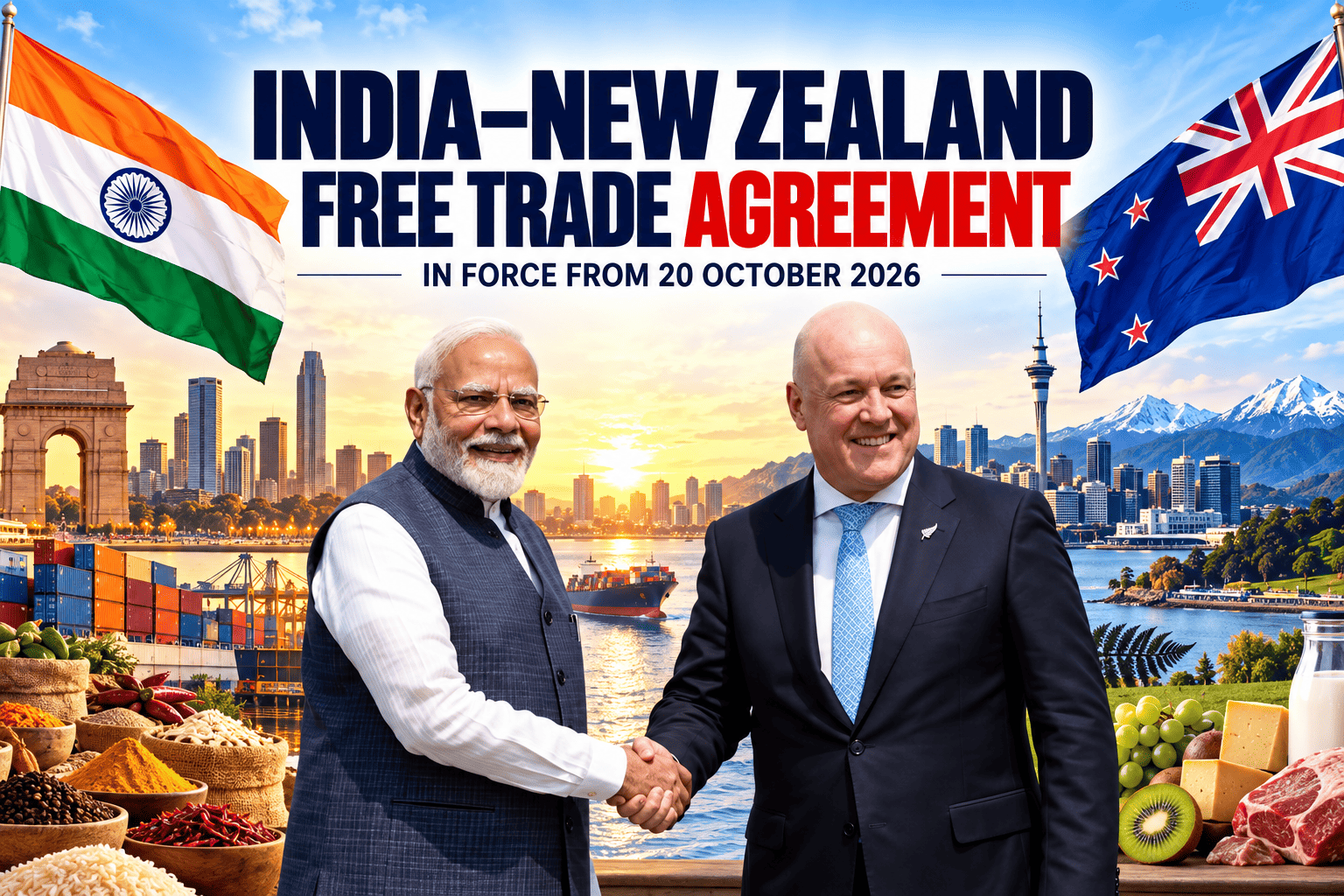
India–New Zealand Free Trade Agreement: What It Covers and When It Takes Effect
India and New Zealand signed a comprehensive Free Trade Agreement on 27 April 2026, completed ratification on both sides by 21 September 2026, and the agreement enters into force on 20 October 2026, deliberately timed to coincide with Dussehra. From that date, every tariff line covering 100 percent of India’s exports to New Zealand becomes duty-free, while 57 percent of New Zealand’s exports to India become tariff-free immediately, rising to 82 percent as the agreement phases in. The deal also carries a headline New Zealand investment commitment of US$20 billion over 15 years and new visa pathways for Indian professionals and students. This article lays out what the agreement actually covers, its full timeline from negotiation to entry into force, and what it means for businesses on both sides.
📅 Signed April 27, 2026⏱ 12 min read✍️ GTsetu Editorial🔄 Updated October 1, 2026
Date Signed
27 Apr 2026
Parties
🇮🇳 India – 🇳🇿 New Zealand
Agreement
India–New Zealand FTA
Type
Free Trade Agreement
Status (1 Oct 2026)
Ratified; enters into force 20 Oct 2026
Unlike many trade frameworks that are announced in principle long before the fine print is settled, the India-New Zealand FTA has moved through its stages unusually fast: negotiations launched in March 2025, substantive terms were concluded by December 2025, the agreement was signed in April 2026, and it will be fully in force by October 2026, a roughly 19-month span from first talks to implementation. That speed matters for businesses planning around it, since the window to prepare for 20 October is now genuinely short.
Section 1
The Agreement in Numbers
The deal’s headline figures span tariff coverage, investment, and visa mobility, three areas New Zealand’s trade minister has described as moving the relationship “from agreement to business.”
100%
Of India’s exports to New Zealand become duty-free from entry into force on every tariff line
57% → 82%
Share of New Zealand’s exports to India becoming tariff-free immediately, rising as the agreement phases in
US$20B
New Zealand’s private-sector investment promotion commitment into India over 15 years
5,000
Cap on Indian professionals holding Temporary Employment Entry visas in New Zealand at any time
💡 Bilateral trade is still small relative to the ambition
India-New Zealand bilateral merchandise trade stood at around US$1.1 to 1.3 billion in 2025-26, with total trade in goods and services at roughly US$2.4 billion. Both governments have said the FTA is intended to double bilateral trade within five years, a substantial jump from a relatively modest existing base, and one reason the agreement leans heavily on investment and services commitments alongside tariff cuts.
Section 2
Tariff Elimination: What Changes for Goods
The tariff outcomes are asymmetric but substantial on both sides. From 20 October 2026, every tariff line covering India’s exports to New Zealand becomes duty-free, immediately putting Indian industry on a level footing with New Zealand’s other trading partners. New Zealand’s own tariff reductions roll out in a more phased way: 57 percent of its exports to India, including sheep meat, wool, and over 95 percent of forestry and wood exports, become tariff-free on day one, with apples, kiwifruit, and albumin gaining preferential quota access. A further round of tariff reductions follows on 1 January 2027, and the share of tariff-free New Zealand exports rises to 82 percent as the agreement is fully phased in, with an additional 13 percent benefiting from significant, if partial, reductions.
📌 Some categories stay outside the deal
Certain politically sensitive products have been excluded from tariff concessions on both sides, a common feature of agricultural and dairy-heavy trade negotiations. Businesses should check their specific tariff line against the published schedules rather than assume blanket coverage, since the headline percentages describe the overall agreement, not every individual product.
Section 3
What’s in the Agreement: Core Provisions
Beyond Tariffs: Services, Investment, and Mobility
The agreement spans roughly 20 chapters covering trade in goods, rules of origin, services, customs and trade facilitation, sanitary and phytosanitary measures, technical barriers to trade, trade remedies, dispute settlement, and more. Four areas stand out as the agreement’s most commercially significant provisions.
1
Services Access, Wider on Both Sides Than Typical FTAs
118 New Zealand sectors offered, 106 Indian sectors offered
Services
New Zealand has offered commitments in 118 services sectors and most-favoured-nation treatment in 139 sectors, while India has offered market access in 106 sectors and MFN treatment in 45 sectors, spanning IT, healthcare, AYUSH, tourism, education support, financial services, and telecom-linked services. New Zealand’s position in the Indian services market is also futureproofed, meaning New Zealand firms automatically benefit from any future improvements India extends to other FTA partners. Some trade analysts have suggested the services and mobility provisions may ultimately outweigh the goods bargain in practical commercial value.
🎯
Why it matters: For service-sector businesses on either side, this breadth of sector coverage often creates more immediate commercial opportunity than the tariff schedule, particularly in IT and professional services.
2
The $20 Billion Investment Commitment, and Its Caveats
A dedicated New Zealand Investment Desk to support the target
Investment
New Zealand has committed to promoting an increase in private sector investment into India of US$20 billion over 15 years, and India will establish a bespoke “New Zealand Investment Desk” to assist New Zealand investors across the investment lifecycle. The commitment applies only to private sector investment and is explicitly a promotion target rather than a guarantee. Some analysts have flagged that New Zealand’s actual investment into India has been below US$1 billion over the past 25 years, making the $20 billion target a considerable step up that will require sustained effort to realise.
🎯
Why it matters: The investment figure is aspirational infrastructure, not a committed capital flow; businesses should treat the Investment Desk as a genuinely useful facilitation tool rather than assume the full $20 billion materialises on a fixed schedule.
3
Visa and Mobility Pathways, a First for New Zealand Trade Policy
Skilled employment visas, working holiday scheme, student work rights
Mobility
New Zealand opens a Temporary Employment Entry visa pathway for Indian professionals in skilled occupations facing shortages, including ICT fields, engineering, specialised health services, and certain iconic Indian professions such as Ayush practitioners, music teachers, chefs, and yoga instructors, at roughly 1,667 visas issued annually with a cap of 5,000 visa holders at any time. A Working Holiday Scheme adds 1,000 young Indians annually a 12-month multiple-entry visa, and Indian students gain the right to work 20 hours per week while studying, plus extended post-study work visas of up to three years for STEM graduates and four years for doctoral scholars.
🎯
Why it matters: These are described as several “firsts” for New Zealand’s trade policy, and they matter directly to any business planning to deploy Indian technical talent into New Zealand operations as part of a broader global expansion strategy.
4
Sector-Specific Support: Agri-Technology and Wellness
A dedicated Agri-Technology Action Plan and AYUSH promotion
Sector Programmes
Beyond tariff and market-access terms, the agreement includes a dedicated New Zealand Agri-Technology Action Plan to help Indian farmers with technical know-how in kiwifruit, apple, and honey production, projected to help grow India’s leather and footwear sector toward $50 billion by 2030 alongside other export categories. The agreement also promotes India’s AYUSH traditional medicine systems internationally and encourages medical value travel, positioning India as a global wellness hub within the broader partnership.
🎯
Why it matters: These sector-specific programmes signal where both governments expect tangible, near-term commercial activity to materialise first, ahead of the broader trade and investment ambitions playing out over 15 years.
Section 4
Which Sectors Gain the Most
Sector
Beneficiary
Key Provision
Textiles & Apparel
India
Immediate duty-free status for garments, home textiles, man-made fibers, handloom, furnishings
Leather & Footwear
India
Zero tariffs; sector projected to grow toward $50 billion by 2030
Sheep Meat, Wool, Forestry
New Zealand
Tariff-free from day one, including over 95% of forestry and wood exports
Apples, Kiwifruit, Albumin
New Zealand
Preferential quota access from entry into force
IT, Professional & Financial Services
Both
Broad sector commitments; 118 NZ and 106 Indian sectors offered
AYUSH & Wellness Tourism
India
International promotion and medical value travel encouragement
Section 5
Timeline: From Negotiation to Entry Into Force
16 Mar 2025
Negotiations formally launched
India and New Zealand formally begin FTA negotiations, setting a notably fast pace compared to many bilateral trade talks.
22 Dec 2025
Negotiations concluded
India and New Zealand announce the successful conclusion of negotiations, finalised in roughly nine months. PM Modi and PM Luxon express confidence in doubling bilateral trade over five years.
27 Apr 2026
Agreement formally signed
Commerce Minister Piyush Goyal and Trade and Investment Minister Todd McClay sign the comprehensive FTA in New Delhi, covering around 20 chapters.
17 Sep 2026
New Zealand Parliament passes approving legislation
New Zealand’s Parliament votes 93 to 29 in favour of legislation approving the free trade agreement, completing a key domestic ratification step.
21 Sep 2026
Formal ratification completed
New Zealand Trade Minister Todd McClay and India’s High Commissioner Muanpuii Saiawi exchange diplomatic notes at Parliament, in the presence of PM Christopher Luxon, confirming both countries have completed domestic ratification procedures.
20 Oct 2026
Agreement enters into force
The FTA takes legal effect, deliberately timed to Dussehra (Vijay Dashami). Tariff elimination, services commitments, and visa pathways become operative from this date.
1 Jan 2027
Second round of tariff reductions
A further scheduled round of New Zealand tariff cuts takes effect, continuing the phased path toward 82% of New Zealand exports becoming tariff-free.
Section 6
What This Means for Businesses on Both Sides
With entry into force only weeks away as of this writing, the practical task for businesses has shifted from monitoring negotiations to preparing to actually use the agreement. New Zealand’s own trade bodies have been explicit about this shift: signing created the framework, ratification gave businesses certainty, and entry into force is when exporters can start using it. The most immediate step for any business trading between the two countries is to check whether their specific products or services are covered, and from what date the relevant tariff reductions actually take effect, before speaking with an importer, distributor, customs broker, or in-market partner ahead of 20 October.
🏛️
Verify partner registration before scaling up
Confirm a counterpart’s legal registration and standing independently before committing to higher volumes under the new tariff terms.
Government-sourced verification
📄
Update or formalise contracts for the new terms
Review existing agreements and put a proper business partnership contract in place that reflects the new tariff and rules-of-origin landscape.
🤝 For Verified India–New Zealand Trade Partnerships
GTsetu: Verified Discovery and Secure Engagement as the FTA Goes Live
A tariff schedule tells you what duty applies. It does not verify who you are actually trading with, protect your specifications and pricing during early negotiations, or give you a formal record if a dispute arises once volumes scale up under the new agreement. That gap is what GTsetu is built to close. It is a structured partnership platform, not a directory or a general marketplace, where every company is verified on 6 government-sourced points before engagement, where discovery is anonymous until mutual interest is confirmed, where NDAs are executed digitally before any commercial information changes hands, and where document exchange happens through an encrypted workspace rather than email attachments.
GTsetu is used by industrial manufacturers, distributors, and raw material suppliers across 100+ countries, including both India and New Zealand, to build out a distributor network, source international wholesale distribution partners, or find manufacturing and technology partnership relationships they intend to keep for years, positioned to take full advantage of the new tariff-free access once it takes effect.
🏛️
6-Point Government-Sourced Verification
Name, Address, Registration Number, Company Status, Company Type, and Date of Incorporation, verified using government tie-ups before any engagement.
🕵️
Anonymous Discovery
Browse verified manufacturer and distributor profiles across 100+ countries without revealing your own identity or sourcing strategy until you choose to engage.
📄
Built-In NDA Workflow
Digital NDA with timestamped signatures before any pricing, formulations, or product specs are shared.
🔐
Encrypted Document Workspace
All commercial documents shared through encrypted channels with a full access audit trail, not email attachments.
🌍
100+ Countries, Including India and New Zealand
Verified manufacturers and distributors across Asia, the Middle East, Europe, Africa, Australia, and the Americas.
🚫
Zero Commission
No success fee, no broker commission, ever. Your partnership economics remain entirely between you and your partner.
The India-New Zealand FTA joins a broader wave of trade agreements reshaping sourcing decisions through 2026. Businesses tracking this shifting landscape, and applying consistent partnership evaluation criteria across markets through a B2B matchmaking platform, are often better positioned to act quickly once an agreement like this one goes live, rather than scrambling to catch up after entry into force. Trust, too, matters as much as tariff terms once trade volumes scale, and understanding why trust breaks in global deals is worth reading before relying heavily on any single new supply chain partner, as part of a genuine cross-border business partnership and the international material sourcing and cross-border manufacturing strategy it supports.
FAQ
Frequently Asked Questions
QWhen does the India-New Zealand Free Trade Agreement enter into force?
The agreement was signed on 27 April 2026, ratified by both governments on 21 September 2026, and enters into force on 20 October 2026. New Zealand’s trade minister noted the date was deliberately chosen to coincide with Dussehra (Vijay Dashami).
QWhat tariff benefits does the agreement provide?
From the date of entry into force, every tariff line covering 100% of India’s exports to New Zealand becomes duty-free. For New Zealand’s exports to India, 57% become tariff-free immediately, rising to 82% as the agreement phases in, with a further 13% benefiting from significant tariff reductions and a second round of cuts scheduled for 1 January 2027.
QWhat is the investment commitment under the agreement?
New Zealand has committed to promoting an increase in private sector investment into India of US$20 billion over 15 years. India will establish a dedicated New Zealand Investment Desk to support New Zealand investors across the investment lifecycle. Some analysts have cautioned that New Zealand’s actual investment into India has historically been below $1 billion over the past 25 years, making the target ambitious.
QDoes the agreement include visa or mobility provisions?
Yes. New Zealand will open a Temporary Employment Entry visa pathway for Indian professionals in skilled occupations facing shortages, such as ICT, engineering, and specialised health services, with roughly 1,667 visas issued annually and a cap of 5,000 visa holders in New Zealand at any time. A Working Holiday Scheme will also allow 1,000 young Indians annually a 12-month multiple-entry visa, and Indian students gain extended post-study work rights.
GTsetu is purpose-built for manufacturers, distributors, and raw material suppliers in industrial sectors seeking verified long-term trade partnerships, across 100+ countries including India and New Zealand, with government-sourced partner verification, built-in NDA workflows, and zero commission.
They represents the product, and research team behind GTsetu, a global B2B collaboration platform built to help companies explore cross-border partnerships with clarity and trust. The team focuses on simplifying early-stage international business discovery by combining structured company profiles, verification-led access, and controlled collaboration workflows.
With a strong emphasis on trust, and disciplined engagement, Team GTsetu shares insights on global trade, partnerships, and cross-border collaboration, helping businesses make informed decisions before entering deeper commercial discussions.