Why IP Licensing Matters
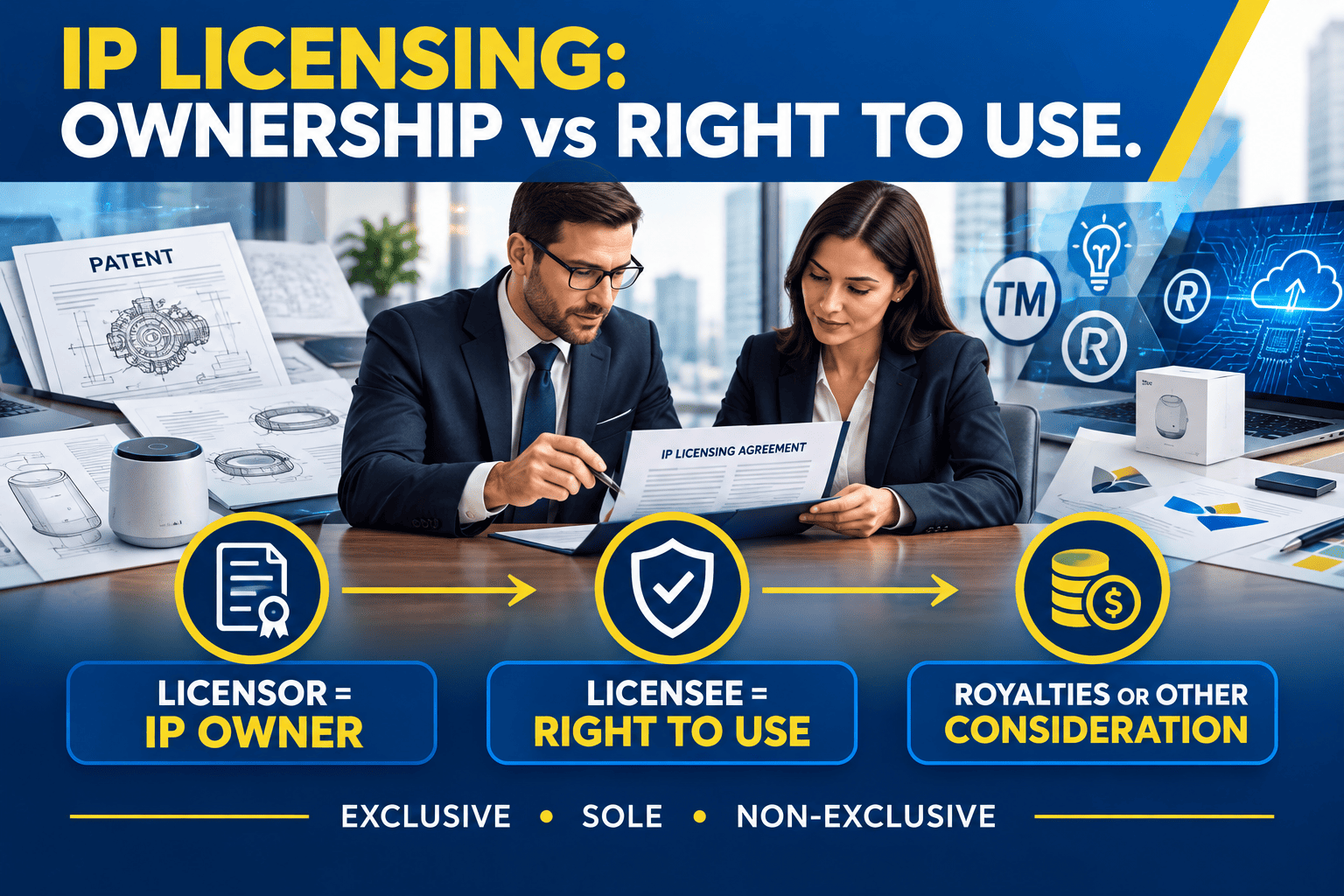
Intellectual property rights transform intangibles, knowledge, creativity, brand equity, invention, into assets that can be put to strategic use. Licensing is the primary mechanism for unlocking that value without selling the underlying asset. For the licensor, it opens new markets, adds royalty revenue streams, and shares the cost and risk of commercialisation. For the licensee, it provides access to proven technology, trusted brands, and specialised know-how without the cost of building from scratch. In industries from software, pharmaceuticals and semiconductors to franchising, media and manufacturing, licensing is the backbone of how innovation is commercialised across borders.
📊 Key Statistic
Global licensing royalty revenue runs into hundreds of billions of dollars annually, with trademarks, software, and technology licences accounting for the largest shares. For many IP-rich companies, licensing income represents a high-margin, capital-light growth channel that complements direct operations.
Licence vs. Assignment vs. Franchise: Understanding the Differences
Licensing is often confused with assignment and franchising. The three are related but legally and commercially distinct, the choice depends on whether the IP owner wants to keep ownership, share risk, or hand over control of the asset entirely.
| Structure | Ownership | What Transfers | Best Used When |
|---|
| Licence | Licensor retains ownership | Right to use the IP, limited by purpose, territory, and term | The owner wants royalty income and control, and the licensee wants access without acquiring the asset |
| Assignment | Ownership transfers permanently | All exclusive rights in the IP | The owner wishes to sell the asset outright, usually for a higher one-off value |
| Franchise | Franchisor retains ownership | Right to use a whole business system, brand, methods, know-how, under prescribed standards | A proven business model is to be replicated by independent operators in new locations |
📌 Note on Terminology
Licensing, assignment and franchising agreements are flexible documents that can be adapted to the parties’ needs. However, most countries impose specific requirements, written form, registration with a national IP office, or recordal to be opposable to third parties. Always confirm local formalities with the relevant IP office before signing.
Types of Licence
Exclusive, Sole, and Non-Exclusive Licences
The exclusivity tier is the single most commercially significant term in a licence. It determines who can use the IP, whether the licensor itself may compete, and how much the licensee is willing to pay. Exclusive rights typically command an upfront fee or higher royalty; non-exclusive rights are cheaper and lower-risk for the licensor.
| Licence Type | Who May Use the IP | Typical Commercial Structure |
|---|
| Exclusive Licence | Only the licensee, even the licensor is excluded from using the IP in the licensed scope | Higher royalty or upfront fee; often used for new-market entry where the licensee takes on significant investment |
| Sole Licence | The licensee and the licensor, no other third parties may be granted rights | Middle ground; licensor keeps the right to operate but concedes exclusivity against the rest of the market |
| Non-Exclusive Licence | Multiple licensees may use the IP simultaneously; the licensor may grant as many licences as it wishes | Lower royalties; useful for scaling a brand or technology across many partners and territories |
Beyond exclusivity, licences are commonly categorised by subject matter: technology licensing (patents, know-how, software), trademark licensing (branded goods and services), copyright licensing (literature, artistic work, media), franchising (a whole business system), and merchandising (using brand assets on third-party products). Each has its own drafting and quality-control conventions.
Essential Agreement Components
What Should Be Included in an IP Licensing Agreement
A well-drafted licence leaves nothing material to implication. The key components below are the minimum a licensee or licensor should expect to see addressed, whether the IP is a patent, a brand, or a bundle of rights.
| Section | Description |
|---|
| Parties & Recitals | Who is bound, the identity of the IP, and the commercial context of the grant. |
| Grant of Rights | What exactly is licensed (patent, trademark, know-how, software), and whether the licence is exclusive, sole, or non-exclusive. |
| Scope of Use | The permitted field of use, products or services covered, and any restrictions (e.g., manufacture only, distribution only, advertising only). |
| Territory | The geographic area in which the IP may be exploited, often defined by country, region, or market. |
| Term & Renewal | Duration of the licence, whether fixed or linked to patent expiry, and conditions for renewal or extension. |
| Compensation | Upfront lump sum, periodic royalties, minimum guarantees, or a combination; basis of royalty calculation (net sales, revenue, units) and payment timing. |
| Quality Control | Licensor’s rights to approve samples, artwork, design, and standards of quality, essential in trademark and franchise licences. |
| Background & Foreground IP | Treatment and ownership of IP each party brings in, and IP created as a result of the collaboration, including future developments. |
| Enforcement & Maintenance | Which party is responsible for enforcing IP rights and for paying maintenance and protection fees. |
| Assignment, Sublicensing & Termination | Whether the licensee may assign or sublicense, and the grounds and consequences of termination. |
How to Negotiate Successfully
Step-by-Step Guide to Negotiating an IP Licence
IP licensing negotiations reward preparation. Rushing the commercial terms or leaving scope ambiguous is the most common source of disputes and lost value. Follow these steps to structure a balanced, defensible deal.
1
Define the IP and Confirm Ownership
Identify exactly what is being licensed, confirm the licensor actually owns it, and verify that the IP is validly protected in the relevant markets. Ownership gaps are fatal to a licence.
2
Value the IP Before Negotiating
An IP valuation with comparable royalty-rate analysis guides the negotiation of fees and royalties and ensures the terms reflect the sharing of risk and reward.
3
Agree the Exclusivity Tier
Decide whether the licence will be exclusive, sole, or non-exclusive. Exclusivity changes the pricing and the licensee’s incentives, and should be matched to the investment the licensee is making.
4
Pin Down Scope, Territory, and Term
Define the permitted field of use, the geographic territory, and the duration precisely. Vague scope creates disputes over competing products, channels, and markets.
5
Structure the Compensation
Combine upfront fees, royalties, and minimum guarantees to balance risk. Align the structure with the licensee’s ability to commercialise and the licensor’s need for predictable income.
6
Address Background and Foreground IP
Specify ownership and access rights for IP each party brings in and for IP created during the collaboration. Include treatment of future developments and improvements.
7
Cover Enforcement, Termination, and Disputes
Allocate responsibility for enforcement and maintenance fees, define termination triggers, and choose a dispute-resolution forum, arbitration or mediation, suited to cross-border enforcement.
Contractual & Legal Considerations
Key Contractual Clauses in IP Licensing Agreements
An IP licence rarely stands alone. It sits inside a wider contractual framework that governs risk allocation, liability, dispute resolution, and the commercial relationship. Understanding the adjacent clauses is essential for effective risk management.
| Clause | Why It Matters |
|---|
| Master Services Agreement (MSA) | Where licensing is bundled with ongoing services, the MSA sets the framework, governance, and payment structure for the wider relationship. |
| Asset Purchase Agreement | When IP is transferred alongside other assets in a deal, the APA governs how the IP and any associated licences are treated. |
| Warranty Clause | Guarantees that the licensed IP meets specified standards and that the licensor has the right to grant the licence. |
| Breach of Contract | Defines the consequences when either party fails to perform its obligations, including remedies and termination. |
| Material Breach | Defines what constitutes a serious failure, e.g., non-payment of royalties, misuse of the IP, that allows termination. |
| Termination for Convenience | Allows a party to exit the licence without cause, typically on notice and with payment for accrued obligations. |
| Consequential Damages | Indirect losses from a breach (e.g., lost profits from a failed product launch), often waived or capped in licensing deals. |
| Incoterms 2020 | In licensing deals involving the supply of physical goods (e.g., merchandise, franchised products), Incoterms allocate logistics risk. |
| FCA (Free Carrier) | A common Incoterm in licensing-linked supply arrangements where the licensor’s manufacturing partner ships goods to the licensee. |
Cross-Border & Commercial Context
IP Licensing in a Cross-Border Context
Licensing is frequently the vehicle for entering a new market without committing capital to a local operation. The licensee provides local manufacturing, distribution, regulatory knowledge, and market access; the licensor provides the IP, quality standards, and brand. Because IP rights are territorial, the licence must be drafted with the target jurisdictions in mind, and the licensor’s IP should be protected in those markets before or alongside the grant.
Cross-border licences commonly interact with other international business structures, distribution agreements, manufacturing partnerships, joint ventures, and market-entry arrangements. Getting the wider commercial architecture right is as important as the licence terms themselves. See our guides on risk allocation in cross-border deals, cross-border manufacturing partnerships, cross-border business partnerships, and international wholesale distributors.
🌍 Market-Entry Tip
Before granting a licence into a new territory, conduct commercial due diligence on the licensee, its financial standing, operational capability, and compliance record. A licensee that cannot commercialise the IP is a poor vehicle for market entry, no matter how favourable the royalty rate.
Companies expanding their manufacturing or distribution footprint often pair licensing with structured market research and partner evaluation. See our guides on global market research for manufacturers, partnership evaluation criteria, and international business development consulting.
Real-World Example
IP Licensing Example: Technology Transfer in Pharmaceuticals
The following is a classic illustration of technology licensing in practice, based on the well-documented PLIVA case study used in IP commercialisation training.
📄 Case Study: PLIVA and Azithromycin
Scenario: A Croatian pharmaceutical company developed a patented antibiotic but lacked the manufacturing capacity, capital, and commercial expertise to bring it to global markets.
Structure: Rather than sell the patent outright, the company licensed it to a partner with the capability to commercialise the product at scale.
Outcome: The licensor retained ownership of the IP, received royalty income, and avoided the capital risk of building global distribution, while the licensee gained access to a valuable, protected product.
Lesson: Licensing is the tool of choice when an IP owner cannot or does not want to be involved in all commercialisation activities. It converts capability gaps into partnership opportunities.
Risks & Mitigation
Common Risks in IP Licensing & How to Mitigate Them
⚠️
Insufficient Ownership or Invalid IP
Mitigation: Conduct IP due diligence before signing. Verify chain of title, registrations, and that the IP is validly protected in the licensed territory.
⚠️
Ambiguous Scope of Grant
Mitigation: Define the licensed IP, permitted field of use, territory, and exclusivity tier precisely. Avoid vague wording that invites competing interpretations.
⚠️
Royalty Under-Reporting or Non-Payment
Mitigation: Include audit rights, minimum guaranteed payments, and clear reporting obligations. Define material breach and termination triggers for non-payment.
⚠️
Loss of Quality Control or Brand Damage
Mitigation: Retain approval rights over samples, artwork, and quality standards. Include audit and termination rights for non-compliance. This is especially critical in trademark and franchise licences.
⚠️
Enforcement Gaps in Foreign Territories
Mitigation: Clarify which party enforces the IP, who pays for enforcement, and how disputes are resolved. Consider local counsel and registration of the licence with the national IP office.
Compliance & Certification Context
Licensing, Compliance, and Certified Manufacturing
In many sectors, an IP licence is only commercially useful if the licensed product can meet the certification and compliance requirements of the target market. Licensing a food-equipment technology into the United States, for example, may require the licensee to hold NSF sanitation certification. Licensing a business-continuity methodology or a manufacturing process into regulated supply chains may require alignment with standards such as ISO 22301. Where the licence covers manufacturing know-how destined for export markets, the licensee may also need to demonstrate compliance with manufacturing certifications for international trade.
For licensors expanding into new industrial markets, pairing the licence with a clear market-entry plan is essential. See our guide on expanding a manufacturing and industrial automation business into the Czech Republic for an example of how licensing, partnership, and compliance interlock in practice. For technology-intensive sectors, see also our piece on Maharashtra’s FTI and the future of quantum technology in Pune.
FAQ
Frequently Asked Questions About IP Licensing
QWhat is the difference between an IP licence and an IP assignment?
A licence grants the licensee permission to use the IP while the licensor retains ownership. An assignment transfers ownership of the IP permanently to another party. Licensing is temporary and limited in scope (purpose, territory, term); assignment is a permanent sale, usually for a higher value because the original owner ceases to own the asset.
QWhat are the main types of IP licences?
The three core categories are exclusive (only the licensee may use the IP, even the licensor is excluded), sole (only the licensee plus the licensor may use it), and non-exclusive (the licensor may grant the same rights to multiple licensees). Licences can also be categorised by subject matter, technology, trademark, copyright, franchising, or merchandising.
QHow are royalties calculated in an IP licensing agreement?
Royalties are typically calculated as a percentage of net sales, revenue, or units sold, and may be combined with an upfront lump-sum fee or minimum guaranteed payments. The rate should reflect the value the IP unlocks, the exclusivity granted, the territory, and the risk shared between the parties. An IP valuation with comparable royalty-rate analysis is the most reliable basis for negotiation.
QDo IP licences need to be registered?
Registration is not always mandatory for the licence to bind the parties, but many countries require recordal with the national IP office so the licence is opposable to third parties (for example, against a later buyer of the IP). Requirements vary by jurisdiction and by IP type, consult the relevant national IP office before signing.
QWhat is background IP vs foreground IP in a licensing deal?
Background IP is the IP each party already owns and brings into the collaboration. Foreground IP is new IP created as a result of the collaboration. A well-drafted licence specifies ownership, access rights, and treatment of both, including any future developments arising from the relationship.
QCan a licensee sublicense the IP to another party?
Only if the licence expressly permits it. Sublicensing is a material right that should be granted or withheld deliberately. Where sublicensing is allowed, the licence should specify the conditions, the licensor’s approval rights, and the flow-down of obligations to the sublicensee.