Why IP Assignment Matters in Business
IP rights have essentially transformed intangibles (knowledge, creativity) into valuable assets that you can put to strategic use in your business. You can do this by directly integrating the IP in the production or marketing of your products and services, thereby strengthening their competitiveness. With IP assignment and IP licensing, IP owners can also use their IP rights to create additional revenue streams by selling them, giving others permission to use them, and establishing joint ventures or other collaboration agreements with others who have complementary assets.
For startups, IP is often the core of the company’s value. From proprietary code to product designs, brand names to confidential algorithms, intellectual property is often the foundation of a company’s worth. But if your startup doesn’t legally own that IP, you risk losing it. A signed IP assignment agreement ensures the IP created by founders, employees, and contractors belongs to the company, not the individual who created it.
📊 Key Insight
Without proper IP ownership, a startup cannot confidently commercialise its products or secure funding. Investors often require proof that all IP is owned by the startup before funding, and acquirers will demand clean IP ownership records before purchase. Unclear IP ownership is a major red flag that can delay or collapse funding rounds and acquisitions.
IP Assignment vs. IP Licensing: Key Differences
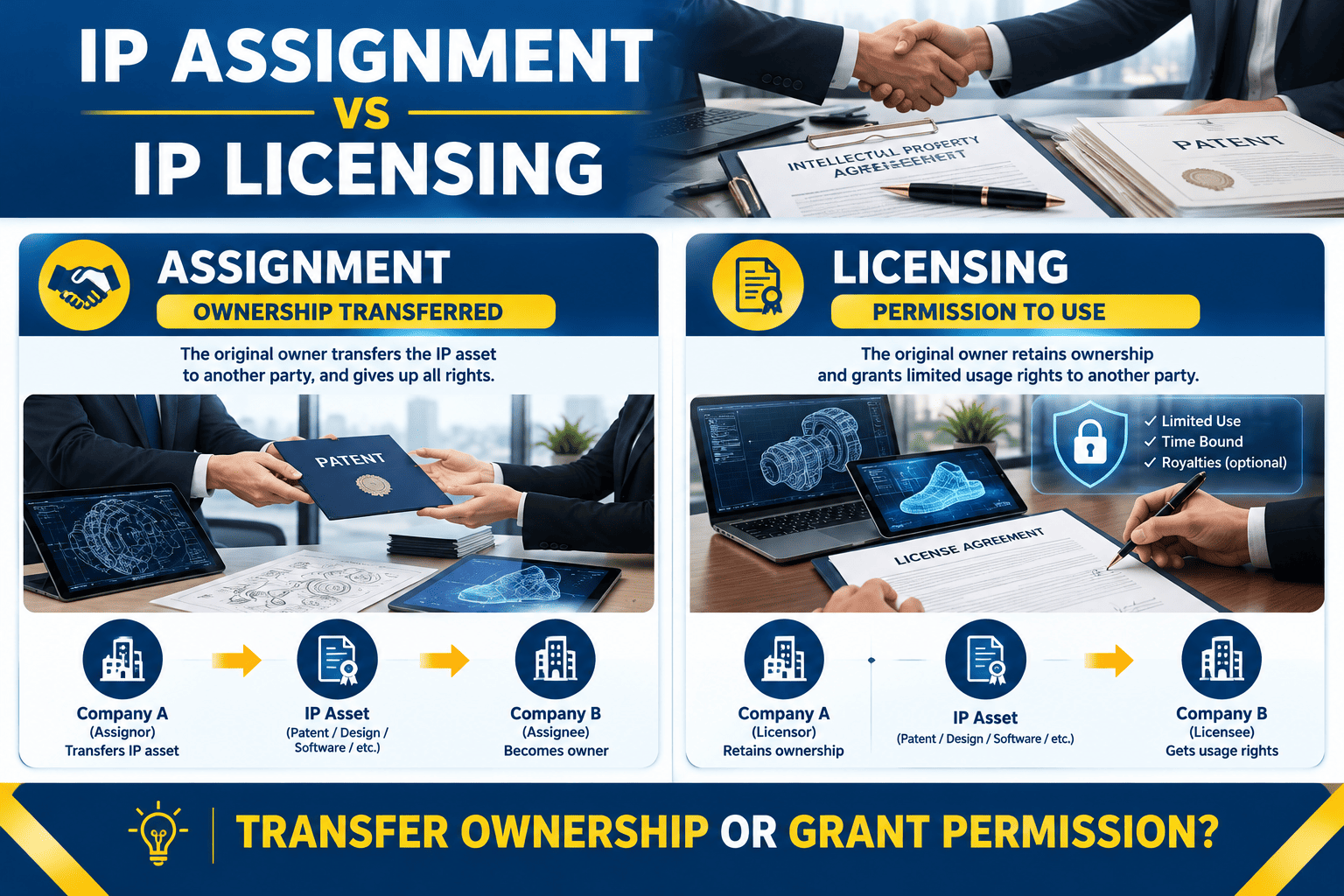
Understanding the distinction between assignment and licensing is critical for structuring IP transactions and planning for long-term value capture. Assignment results in a complete transfer of rights, while licensing grants temporary permission to use the IP.
| Aspect | IP Assignment | IP Licensing |
|---|
| Ownership | Transferred permanently from assignor to assignee | Retained by the licensor; licensee gains only the right to use |
| Nature of Transfer | Sale of the IP asset; complete transfer of right, title, and interest | Permission to use, subject to the terms and scope of the licence |
| Duration | Perpetual or for a fixed definite period, as specified | Time-limited by the licence terms; may be renewable |
| Consideration | Lump sum or royalties paid for the transfer of ownership | Royalties, lump sum, or a combination, in exchange for use rights |
| Rights of the Receiving Party | Can use, license, sell, or monetise the asset; may transfer to third parties (subject to contract) | Can only use the IP within the granted scope; cannot sell or sub-license without consent |
| Common Use Cases | M&A transactions, employee IP agreements, startup investments, business restructuring | Technology licensing, trademark licensing, franchising, joint ventures |
| Registration Requirements | Often requires registration with a national IP office to be enforceable against third parties | May require recordal, depending on jurisdiction and type of IP |
📌 Note on Flexibility
Assignment, licence, and franchising agreements are flexible documents that can be adapted to the needs of the parties. Nevertheless, most countries establish specific requirements for these agreements, such as written form, registration with a national IP office or other authority. For more information, consult your IP office or legal counsel.
Types of IP Assignment Agreements
Assignment requirements and procedures vary depending on the type of intellectual property. Each category has specific statutory requirements for validity and enforceability.
| Type | Governing Law & Key Requirements | Registration & Formalities |
|---|
| Assignment of Copyright | The deed of assignment must specify the rights assigned, the duration, the territorial extent, and the royalty payable, if any. If duration is unspecified, it is deemed to be five years; if territorial extent is unspecified, it extends to the entire territory of the country. Oral agreements are invalid — written assent is mandatory. If the assignee fails to exercise the rights within one year, the assignment may lapse. | Application for changes in registration under the applicable copyright rules, delivered by hand or post. In some jurisdictions, copyright assignment may be exempt from stamp duty. |
| Assignment of Patents | The assignment must be in writing and registered with the Controller to operate as a legally enforceable contract. The Controller may require every document giving effect to the assignment, evidence of transfer, or affecting proprietorship, along with certified true copies and other proof of title or written consent. | Registration with the Patent Office is required. The assignment must be clear and complete, and the Controller may call for additional proof of title or consent. |
| Assignment of Design | Can be obtained under the relevant copyright or design legislation. An application for registering the title must be filed within six months of the execution of the instrument of assignment. | Registration with the Design Office within the prescribed time limit. |
| Assignment of Trademark | A registered trademark can be assigned by making a request in the prescribed form, depending on whether the assignment is made to the assignee only or to the assignee along with the proprietor. The application must contain detailed particulars of the applicant’s claim to the trademark and a duly certified copy for inspection. An unregistered trademark may be assigned or transmitted without goodwill to the business that devised it. | Filing with the Trademark Registry in the prescribed form; certified copies required for inspection during application. |
Key Provisions of an IP Assignment Agreement
Essential Clauses in an IP Assignment Agreement
A clearly drafted IP assignment agreement leaves no room for misinterpretation and is a must for every organisation and individual who ventures into innovation and discovery. The following clauses are essential.
| Clause | Purpose & Key Content |
|---|
| Object and Scope of the Agreement | Identifies and specifies the exclusive rights with respect to the IP and the extent to which the assignor shall enjoy them. Defines the purposes for which the assignment can be used. The assignor can only transfer those rights he possesses or shall possess in the future as specified in the agreement. |
| The Assignment Clause | The keystone of the agreement. Specifies the transfer or conveyance of ownership of rights over the IP. Details the manner in which the transfer is shifted from assignor to assignee, including any permissions or procedures required for effectiveness. |
| Term of Assignment | Specifies the time period for which the assignment operates. Can be indefinite or for a definite period. Should specify renewal procedures; many agreements have auto-renewal clauses unless terminated in writing. |
| Territory of Assignment | Specifies the territorial limits within which the IP ownership operates. Clearly lays down the areas and boundaries within which the assignor surrenders proprietary rights. |
| Future Transfers | In perpetual assignments, the right to make future transfers should be specified. In fixed-term assignments, future transfer rights are restricted. Any future transfer by the assignee is limited to the rights acquired and the scope and territory of the original assignment. |
| Representations and Warranties | The assignor represents and warrants that it exclusively owns all right, title, and interest in the assigned property; has not granted and will not grant licences to third parties; the property is free of liens and encumbrances; and, to the best of its knowledge, the IP does not infringe third-party rights and there are no pending legal actions. |
| Confidentiality | Serves the assignor’s interests while the agreement is in operation and is a vital safeguard on termination. Prevents unauthorised access, use, or disclosure of sensitive proprietary information. Often paired with a Non-Disclosure Agreement to strengthen protection in litigation. |
| Indemnification | Protects the assignee from future losses or litigation expenses arising from misrepresentation or breach of warranties by the assignor. Covers claims, judgements, penalties, and expenses, including attorney’s fees, arising from the assignor’s breach or infringement of third-party rights. |
| Further Assurances | The assignor assures the assignee to assist in further procedural clearances or regulatory permissions, including registration of documents, defence of judicial opposition, or any other proceedings to fully complete the ownership of the IP rights. |
| Power of Attorney | Appoints the assignee as the assignor’s true and lawful attorney-in-fact to sign, acknowledge, deliver, file, or record any documents necessary to carry out the agreement if the assignor is unable to sign. This power survives death, dissolution, or legal incapacity of the assignor. |
| Remedy Provisions | Provides for injunctive relief, specific performance, or liquidated damages. Reduces the burden on parties and time for obtaining court orders at the time of Breach of Contract. Can be adjusted to provide for injunctive remedies and liquidated damages as negotiated. |
IP Assignment in Practice
Practical Use Cases in Business
IP assignment is commonly used across various business scenarios. Understanding these use cases helps organisations structure their IP strategy effectively.
| Use Case | Description |
|---|
| Mergers and Acquisitions | Transferring ownership of patents, trademarks, or copyrights as part of a transaction. In M&A, IP assignment ensures that the acquirer obtains clean title to the target’s intellectual assets, which is a key component of Asset Purchase Agreements. |
| Employee Agreements | Assigning IP created during employment to the employer. This is typically included as a clause in employment contracts or as a separate Confidentiality and Inventions Assignment Agreement (CIIAA). |
| Startup Investments | Consolidating IP ownership before funding rounds. Investors often require proof that all IP is owned by the startup before providing funding. |
| Business Restructuring | Moving IP assets between entities to optimise tax, operational, or legal structures. A startup transferring ownership of proprietary software to a parent company ensures centralised control and simplifies revenue recognition. |
| Cross-Border Transactions | In international deals, IP assignment must comply with the laws of each jurisdiction involved, including registration requirements and exchange control regulations. |
| Joint Ventures and Partnerships | Where a joint venture is undertaken and there is no agreement between the parties to cooperate, both parties can license the IP independently. A clear assignment or licensing structure avoids disputes over ownership of jointly developed IP. |
Common Risks in IP Assignment & How to Mitigate Them
⚠️
Contractors Do Not Automatically Transfer IP Rights
Mitigation: Unlike employees in some jurisdictions, contractors usually retain ownership unless a written assignment agreement exists. Always require contractors, freelancers, and collaborators to sign a written IP assignment agreement before work begins.
⚠️
Verbal Understandings Are Insufficient
Mitigation: IP ownership transfers generally must be documented in writing to be legally enforceable. A simple verbal agreement is not enough — always use a written assignment agreement that clearly defines the assigned IP and transfer terms.
⚠️
Poor IP Documentation Creates Commercial Risks
Mitigation: Ownership disputes may block product launches, licensing deals, fundraising, and future monetisation opportunities. Maintain clear IP records and chain of title to establish continuous ownership history and strengthen enforceability.
⚠️
Inadequate Scope Definition
Mitigation: The agreement should clearly define assigned IP, including patents, copyrights, trademarks, source code, trade secrets, and future developments. Vague definitions can lead to disputes about what was actually transferred. Conduct thorough Commercial Due Diligence to verify IP ownership before entering an assignment agreement.
⚠️
Failure to Register the Assignment
Mitigation: Many jurisdictions require registration with the relevant IP office to make the assignment enforceable against third parties. Failure to register can result in the assignee losing priority or being unable to enforce rights against infringers. Always check local registration requirements.
Real-World Example
Case Study: The Startup That Lost Its App
The following case study illustrates the real-world consequences of failing to secure IP assignment.
📄 Case Study: Health-Tech Startup
Background: A health-tech startup contracted a freelance developer to build its core app. They paid the invoice but never signed an IP assignment agreement.
Problem: Two years later, as the startup prepared for Series A funding, the developer refused to transfer ownership of the app’s source code without a large payment. The investor walked away.
Lesson: Had the startup used a simple intellectual property assignment agreement from day one, the dispute (and lost funding) could have been avoided. IP assignment agreements work alongside Master Services Agreements (MSAs) and Non-Disclosure Agreements to provide comprehensive IP protection.
Cross-Border Considerations
IP Assignment in Cross-Border Transactions
In international business, IP assignment agreements must address additional complexities, including compliance with local laws, registration requirements, and exchange control regulations. For businesses entering new markets, understanding these considerations is essential.
- Choice of Law: Specify the governing law and jurisdiction for the assignment agreement. Different jurisdictions have varying requirements for validity and enforceability.
- Registration Requirements: Many countries require local registration of IP assignments to be effective against third parties. For patents and trademarks, the national IP office must be involved.
- Language and Translation: In cross-border deals, agreements should be in a language understood by both parties, with certified translations where required by local law.
- Tax Implications: IP assignment may trigger tax obligations in the assignor’s or assignee’s jurisdiction. Consider transfer pricing rules for related-party assignments.
- Exchange Control: Some countries restrict the transfer of IP assets or payments across borders. Check local regulations before finalising the agreement.
- Local Legal Requirements: Some jurisdictions require mandatory terms or prohibit certain clauses. Local counsel should review the agreement before execution.
For manufacturers and exporters, IP assignment is often part of a broader Cross-Border Business Partnership or Cross-Border Manufacturing Partnership. Understanding Risk Allocation in Cross-Border Deals helps structure the assignment to protect both parties’ interests.
FAQ
Frequently Asked Questions About IP Assignment
QWhat is IP Assignment?
IP Assignment is the legal transfer of ownership rights of intellectual property from one party (the assignor) to another (the assignee). Once assigned, the receiving party gains full control over the intellectual asset, including rights to use, license, sell, or monetise it. Assignment is a permanent transfer of ownership, unlike licensing, which grants only permission to use the IP while the owner retains ownership.
QWhat is the difference between IP assignment and IP licensing?
IP assignment transfers ownership of the intellectual property permanently from the assignor to the assignee. IP licensing grants permission to use the IP while the owner retains ownership. Assignment means the assignee can use, license, sell, or monetise the asset as they wish; licensing is a temporary permission subject to the terms of the licence (which may be sole, exclusive, or non-exclusive).
QWhat are the types of IP assignment agreements?
The main types are: Assignment of Copyright (governed by the Copyright Act), Assignment of Patents (must be in writing and registered with the Controller), Assignment of Design, and Assignment of Trademark (registered trademarks are assigned via the prescribed form; unregistered trademarks may be assigned without goodwill). Each type has specific statutory requirements for validity and enforceability.
QWhy does IP assignment matter for startups?
For startups, IP is often the core of the company’s value. Without a signed IP assignment agreement, the IP created by founders, employees, and contractors may legally belong to the individual creator rather than the company. This creates serious risks: investors often require proof that all IP is owned by the startup before funding, and acquirers demand clean IP ownership records before purchase. A written IP assignment agreement ensures the company legally owns its critical code, designs, trademarks, and inventions.
QShould employees sign an IP assignment agreement?
Yes — ideally, this is included as a clause in their employment contract or as a separate Confidentiality and Inventions Assignment Agreement (CIIAA). Without it, the employee may retain ownership of IP created during employment. For contractors, a separate written assignment agreement is essential because contractors are not automatically bound by employment IP rules.
QCan I just use a verbal agreement for IP transfer?
No — IP ownership transfers typically must be in writing to be legally valid. A verbal agreement is insufficient. For patents, the assignment must be in writing and registered with the Controller. For copyright, written assent is mandatory. For trademarks, prescribed forms must be filed. Always use a written IP assignment agreement drafted with the assistance of legal counsel.
QDo I need separate assignments for each new piece of IP?
Not necessarily — agreements can cover future IP created during the engagement. A well-drafted assignment agreement can include language that assigns all IP created by the assignor during the term of the agreement, including future developments. However, the scope should be clearly defined to avoid disputes about what is included.
QWhat happens if an employee creates IP before signing an assignment agreement?
If there is no written assignment agreement, IP rights usually remain with the creator, even if they have been paid by another for creation of the said IP. Employers should ensure that assignment agreements are signed before employment begins or before any IP-creating work commences. If IP was created before the agreement, a separate assignment may be needed to transfer ownership retroactively.