Manufacturing Process Selection: How to Choose the Right Method
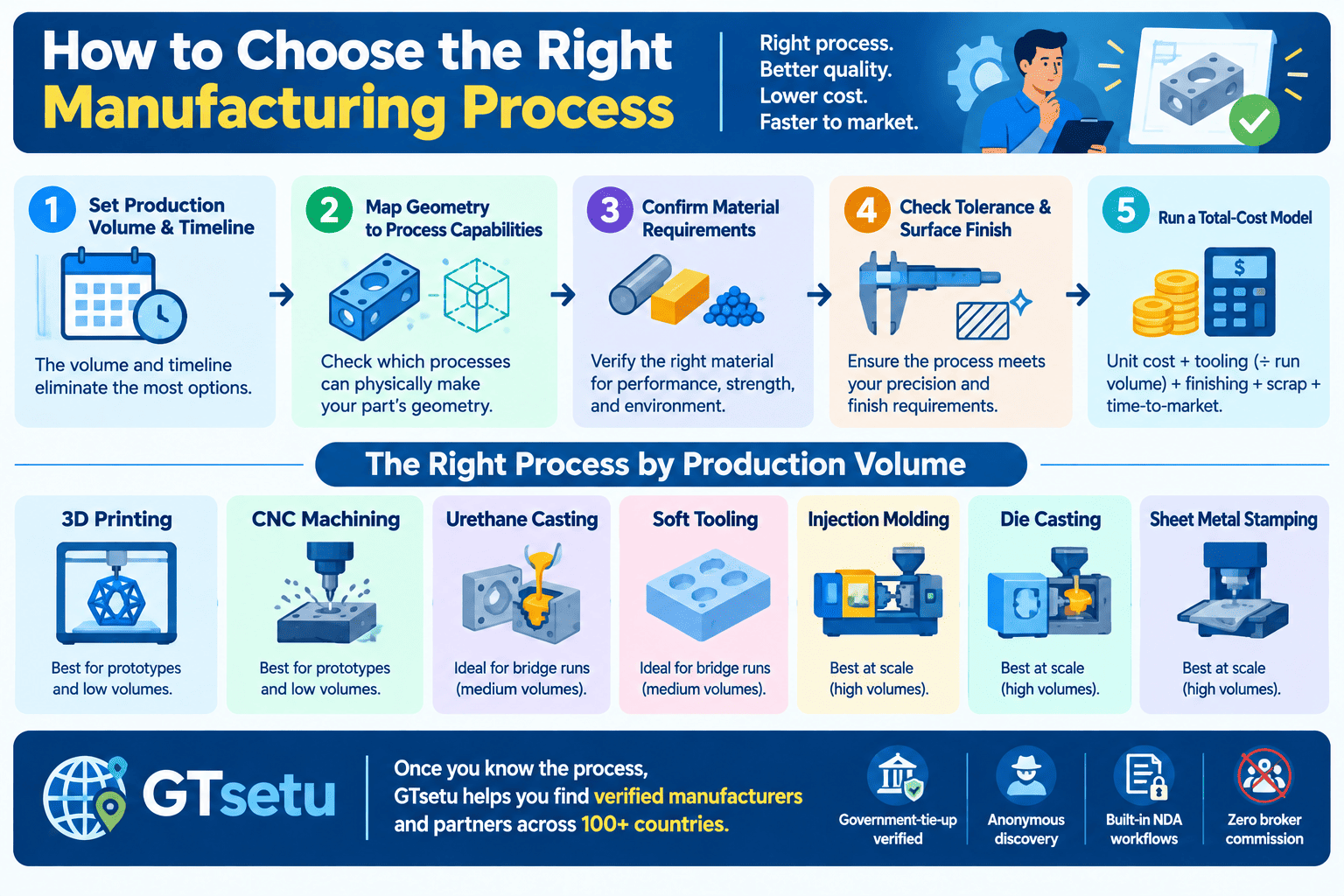
Direct Answer: To choose the right manufacturing process, work through five steps. First, set your production volume and timeline, because they eliminate the most options. Second, map your part’s geometry to what each process can physically make. Third, confirm material requirements. Fourth, check tolerance and surface finish. Fifth, run a total-cost model (unit cost plus tooling divided by run volume, plus finishing, scrap and time-to-market). As a rule of thumb, 3D printing and CNC machining suit prototypes and low volumes, urethane casting and soft tooling suit bridge runs, and injection molding, die casting and sheet metal stamping win at scale. Once you know the process, GTsetu helps you find government‑tie‑up verified manufacturers and partners across 100+ countries, with anonymous discovery, built-in NDA workflows and zero broker commission.
📅 Published October 14, 2026🔄 Updated October 14, 2026⏱ 16 min read✍️ GTsetu Editorial Team
6
Core Processes Compared
5
Step Selection Framework
100+
Countries on GTsetu
0%
Broker Commission
Almost every engineered part can be made more than one way. A simple bracket could be machined from a solid block, cast in aluminium or stamped from sheet. Each route changes the unit cost, the tooling you must pay for upfront, the tolerances you can hold and how quickly you can get a first part. Pick well and the process quietly supports your margin. Pick badly and the cost is locked in for the whole product life.
Product engineers, founders, sourcing and procurement managers, and manufacturers deciding how to make a new part or move an existing one to a more economical process. It is equally useful for suppliers who want to understand how buyers evaluate them.
⚖️ Disclaimer
Volume thresholds, tolerances, tooling costs and lead times in this guide are industry approximations meant as reference points, not quotes or guarantees. Actual values vary with part design, material, supplier and program requirements. Always confirm with qualified manufacturing engineers and get supplier quotes. Contract and trade points are general education, not legal advice; take advice from qualified counsel in the relevant jurisdictions.
SECTION 1
1 What Is Manufacturing Process Selection?
🎯 Definition
Manufacturing process selection is the decision of which fabrication method best matches a part’s geometry, material, production volume, tolerance and cost requirements. It is one of the most consequential choices in product development and works best when made during early design.
The process you choose drives design-for-manufacturability (DFM) rules, the tooling you must fund, the economics per unit and the total lead time. Choosing late carries real risk: expensive redesign, weaker material properties or per-unit costs that erode margin.
Why Getting It Right Early Matters
💰
Cost Lock-In
Tooling and process choices set your unit economics for years. Changing later means new tools and requalification.
⏱️
Time to Market
A tool that saves money but adds weeks to launch can cost more than it saves if delay hits revenue.
📐
Design Freedom
Each process imposes rules such as draft angles, wall thickness and bend radii. Designing for the process avoids rework.
🛡️
Quality & Compliance
Material, tolerance and traceability needs can rule out processes before price is even considered.
SECTION 2
2 The Six Key Selection Factors
Evaluate every candidate process against the same six variables. Treat them as filters in roughly this order, with volume and lead time first.
1
Production Volume
Usually the primary filter. A process that is brilliant at 10 parts can be ruinous at 100,000, and the reverse.
Prototype to mass production
2
Lead Time
Separate time to first part (driven by tooling) from production throughput (driven by cycle time). Both matter.
Tool-less vs tool-dependent
3
Cost Structure
Compare fixed tooling cost against variable per-unit cost across your expected run, not unit price in isolation.
Tooling ÷ volume
4
Material Requirements
A certified alloy or specific engineering polymer may dictate the process. Tooling-based methods are the most material-constrained.
Certified grades
5
Geometry & Complexity
Internal channels, undercuts, thin walls and flat profiles each favour different processes.
Physics sets the limits
6
Tolerance & Finish
If native process capability cannot meet the drawing, you need a secondary operation or a different process.
±mm and Ra
SECTION 3
3 Volume: The First Filter
Start with how many parts you need and by when. The table shows typical best-fit processes by volume band. Treat the thresholds as approximations. When your first part is needed within about two weeks, tool-less methods (CNC machining, 3D printing, laser-cut sheet metal) apply at any volume until tooling is ready.
Volume Range
Stage
Typical Best-Fit Processes
1–10 parts
Prototype / proof of concept
3D printing, CNC machining
10–10,000 parts
Low-volume production
CNC machining, soft-tooled injection molding, urethane casting, sheet metal
10,000–50,000 parts
Mid-volume production
Injection molding, die casting, sheet metal fabrication
50,000+ parts
High-volume production
Injection molding, die casting, progressive-die stamping
SECTION 4
4 The Six Core Processes at a Glance
1
CNC Machining
Subtractive: automated cutters remove material from a solid block. Excellent tolerances and almost any machinable material, but per-part cost stays high at volume and enclosed internal cavities are off limits.
Best for tight tolerances
2
Injection Molding
Molten thermoplastic is injected into a steel or aluminium mold. Very low unit cost at scale, but high tooling cost, long first-part lead time and strict rules on draft and wall thickness.
Best for plastic at volume
3
3D Printing
Additive: parts are built layer by layer from CAD. No tooling, fastest first part and unmatched geometric freedom, but limited materials, layer artefacts and unit cost that barely falls with volume.
Best for complexity & speed
4
Urethane Casting
Liquid polyurethane is cast into silicone molds made from a master pattern. Low tooling cost and production-like finish, but molds wear out after a few dozen shots and properties only approximate molded plastics.
Best for bridge runs
5
Metal Casting (Die Casting)
Molten metal, usually aluminium, zinc or magnesium, is forced into a die. Low unit cost and thin-walled net-shape parts at high volume, but heavy tooling investment and porosity to manage.
Best for metal at volume
6
Sheet Metal Fabrication
Flat sheet is cut, punched, bent, stamped and welded. Fast and flexible for enclosures, frames and brackets, but limited to uniform-thickness geometries.
Best for enclosures & frames
📌 Beyond the Six
Other routes deserve a look when the six do not fit: liquid silicone rubber molding for flexible heat-resistant parts, compression molding for thermosets and rubber, and gravity or investment casting for lower-volume or specialised-alloy metal parts.
SECTION 5
5 Side-by-Side Comparison Table
Use this matrix for a first-pass shortlist. Figures are indicative industry ranges, and your supplier’s real capability will differ.
Factor
CNC
Injection Molding
3D Printing
Urethane Casting
Die Casting
Sheet Metal
Best volume
1–5,000+
1,000–millions
1–500
1–300
10,000+
50–millions
Tooling cost
None
$5,000–$100,000+
None
$500–$2,000
$10,000–$80,000+
$500–$20,000+
Cost at volume
Moderate–high
Very low
Moderate
Moderate
Very low
Low
First-part lead time
1–5 days
2–12 weeks
1–3 days
1–2 weeks
6–12 weeks
1–5 days
Typical tolerance
±0.025 mm
±0.05–0.2 mm
±0.1–0.3 mm
±0.2–0.4 mm
±0.1–0.25 mm
±0.1–0.25 mm
Material range
Very broad
Thermoplastics
Limited, growing
PU resins
Al, Zn, Mg alloys
Formable sheet metals
Geometry
High (external)
Very high (net shape)
Exceptional
Moderate–high
High (net shape)
Sheet-form only
DFM constraints
Moderate
High (draft, walls)
Low
Low–moderate
High (draft, walls)
Moderate (bend radii)
SECTION 6
6 The 5-Step Selection Framework
🎯 The Rule
Eliminate first, optimise second. Use volume and timeline to cross off options quickly, then let geometry, material and tolerance decide between the survivors, and finish with a total-cost model instead of comparing quotes by unit price.
1
Define Volume and Timeline
Use the volume bands above to remove processes that do not fit. If you need ten functional metal parts in four days, CNC machining or metal 3D printing are the realistic routes.
2
Map Geometry Constraints
Flat, uniform profiles favour sheet metal. Internal channels favour 3D printing. Thin-walled, organic net shapes suit molding and die casting. Prismatic parts with tight features suit CNC.
3
Confirm Material Requirements
Certified metals usually point to CNC or metal 3D printing, production thermoplastics to injection molding, nonferrous structural metals to die casting, and production-like elastomers at low volume to urethane casting.
4
Check Tolerance and Surface Finish
If critical features need tolerances tighter than about ±0.05 mm, plan on CNC machining either as the main process or as a secondary operation on a cast or molded part.
5
Run the Cost Model
Compare total program cost, including tooling, scrap, secondary operations and time-to-market risk. The next section shows a worked example.
✨ GTsetu Insight
Run the framework before you ask suppliers for quotes. A supplier whose equipment is limited to one process will tend to recommend it. A neutral shortlist, followed by a structured check of candidates using our partnership evaluation criteria, protects you from advice shaped by someone else’s machines.
SECTION 7
7 The Cost Model: A Worked Example
A simple way to compare processes is to spread tooling across the run:
🧮 Formula
Total cost per part = Unit cost + (Tooling cost ÷ Run volume). Then add scrap, secondary operations such as machining, anodising or coating, and the revenue cost of any launch delay.
Consider a plastic consumer enclosure. The illustrative figures below show why the same part can need two different processes at two different stages.
Item
Bridge run: Urethane Casting
Full production: Injection Molding
Run volume
75 units (field validation)
50,000 units
Unit cost
$48.00
$1.20
Tooling
$1,500 (two silicone molds)
$28,000 (aluminium production tool)
Tooling ÷ volume
$20.00
$0.56
Total per part
$68.00
$1.76
Total program cost
$5,100
$88,000
$5,100
Cost to validate 75 units with urethane casting
$1.76
Effective unit cost at 50,000 units with injection molding
2 stages
Right process changes as the product matures
The lesson is not that one process is better. Committing to production tooling to validate only 75 units adds avoidable risk, while sticking with casting at 50,000 units would be wildly uneconomical. Also remember that a tool saving $15,000 but delaying launch by eight weeks may cost more overall.
SECTION 8
8 Process Transitions as Products Mature
The ideal process changes as volumes grow. Plan the transitions early, because parts optimised for one process rarely transfer unchanged to the next.
Transition
Typical Trigger
Watch Out For
3D printing → urethane casting
Quantities beyond roughly 10–20 parts; need for production-like finish or elastomeric features
Master pattern quality sets mold quality; casting does not validate injection-molding tool actions or gate locations
Casting / printing → injection molding
Demand beyond roughly 500–1,000 units; need for certified production thermoplastics
DFM redesign for draft, uniform walls and undercuts
CNC machining → metal casting
Volumes beyond roughly 500–2,000 parts make machining time and waste uneconomical
Cast alloys differ from wrought grades; critical features often need secondary machining
Prototype → bridge production
Need real parts while hard tooling is built or demand is unproven
Options include urethane casting, soft-tooled molding and low-volume CNC
SECTION 9
9 Common Selection Mistakes
🚩
Choosing Too Late
Selecting the process after design freeze forces expensive redesign because features optimised for one method rarely transfer.
🚩
Comparing Unit Price Only
A cheap casting that needs secondary machining and finishing may cost more than a pricier route that arrives ready to use.
🚩
Ignoring Lead Time
Tool-dependent processes add weeks before the first part. Treat lead time as a filter, not an afterthought.
🚩
Over-Tolerancing
Specifying tight tolerances everywhere can force expensive machining. Tighten only critical features.
🚩
Trusting Prototype Properties
Printed or cast prototypes may not match molded or die-cast parts, and 3D prints can be weaker along the build direction.
🚩
Supplier-Driven Advice
Vendors tend to recommend the processes they own. Form your own shortlist first.
SECTION 10
10 Quality, Certifications and Compliance
Process choice also determines what evidence buyers and regulators expect. Aerospace, medical, automotive and food-contact parts each carry their own material, traceability and inspection requirements. Our guide to manufacturing certifications for international trade explains which certifications buyers commonly ask for and how to read them.
11 Sourcing Globally: Partners, Contracts and Risk
Once the process is chosen, the next question is who will run it, and where. Many buyers source tooling-heavy or high-volume parts overseas, which adds contract, logistics and verification issues that deserve as much attention as the process itself.
Find and Qualify the Right Partner
Shortlist by capability fit, not brochure claims. Match the supplier’s actual machines, materials and quality systems to your chosen process.
Do real due diligence. Use our guide on commercial due diligence and independently verify identity, references and financial standing.
If you are also deciding which export markets to serve with the parts you make, start with global market research for manufacturers so process, volume and market plans line up.
PLATFORM
12 How GTsetu Helps You Find Manufacturing Partners
🌐 Platform Spotlight, GTsetu
Your Verified Gateway to Manufacturers & Partners
Choosing the right process is only useful if you can find a partner who actually runs it, and who exists as described. GTsetu connects manufacturers and buyers with government‑tie‑up verified distributors and partners across 100+ countries, with built-in NDA workflows and encrypted collaboration. Every company on GTsetu is verified through direct government tie‑ups across six credentials: legal name, registered address, registration number, company status, company type, and date of certificate of incorporation. GTsetu does not verify industry certifications, financial standing, sales capability or references; those must be checked directly between partners during due diligence.
✅
Government Tie‑Up Verification
6‑point verification: legal name, registered address, registration number, company status, company type, incorporation date.
📜
Certifications & Financials
GTsetu does not verify these. Exchange and validate them directly between partners.
🕵️
Anonymous Discovery
Explore partner profiles without revealing your identity until mutual interest is confirmed.
📄
Built-In NDA Workflow
Formalise confidentiality before sharing drawings, CAD files or pricing, with a full digital audit trail.
🚫
Zero Commission
No broker fees on any deal, whether a supply contract, distribution agreement or manufacturing partnership.
🔐
Encrypted Collaboration
Documents and communications encrypted in transit and at rest. Secure B2B collaboration from first contact.
🌍
100+ Countries
A verified network of distributors, importers and supply chain partners.
Manufacturing process selection is choosing the fabrication method that best matches a part’s geometry, material, production volume, tolerance and cost requirements. It is ideally done early in design, because the process determines tooling investment, unit cost, lead time and design constraints.
QWhat factors should I consider when choosing a manufacturing process?
The core factors are production volume, lead time, cost structure (tooling versus per-unit cost), material requirements, part geometry and complexity, and tolerances and surface finish. Volume and lead time usually narrow the field first, then material, geometry and tolerance decide between the remaining options.
QWhen does injection molding become cheaper than CNC machining or 3D printing?
Injection molding has high upfront tooling cost but very low per-part cost, so it typically becomes more economical once volumes reach the low thousands. CNC machining and 3D printing have little or no tooling, but their per-part cost stays relatively flat as volume grows. Always compare total program cost, not unit price alone.
QHow do I calculate the total cost of a manufacturing process?
A simple model is total cost per part = unit cost + (tooling cost divided by run volume). Then add scrap, secondary operations such as machining and finishing, and the cost of any delay to market launch. Compare candidate processes at your expected volume at each stage of the product lifecycle.
QWhat is bridge production?
Bridge production uses lower-cost, faster methods such as urethane casting, soft-tooled injection molding or low-volume CNC machining to deliver production-representative parts while final hard tooling is built or demand is validated. It reduces financial risk before committing to full production tooling.
QHow do I protect myself when sourcing manufactured parts from an overseas supplier?
Verify the supplier’s identity and capabilities independently, specify tolerances, materials and inspection methods in writing, define warranty and defect remedies, agree Incoterms and payment security, protect IP and tooling ownership, and plan termination and dispute terms with legal advice.
QHow does GTsetu help with finding manufacturing partners?
GTsetu helps manufacturers and buyers find and verify distributors and partners across 100+ countries. Every company is verified through government tie-ups on six core credentials (legal name, registered address, registration number, company status, company type, incorporation date). GTsetu offers anonymous discovery, built-in NDA workflows, encrypted collaboration and zero broker commission. GTsetu does not verify certifications, financial standing or sales capability, so those must be checked directly between partners.
Ready to Find a Verified Manufacturing Partner?
Join 500+ verified manufacturers, exporters and distributors already building cross-border partnerships on GTsetu, with government‑tie‑up verification of six core credentials, built-in NDA workflows and zero broker fees across 100+ countries.
They represents the product, and research team behind GTsetu, a global B2B collaboration platform built to help companies explore cross-border partnerships with clarity and trust. The team focuses on simplifying early-stage international business discovery by combining structured company profiles, verification-led access, and controlled collaboration workflows.
With a strong emphasis on trust, and disciplined engagement, Team GTsetu shares insights on global trade, partnerships, and cross-border collaboration, helping businesses make informed decisions before entering deeper commercial discussions.