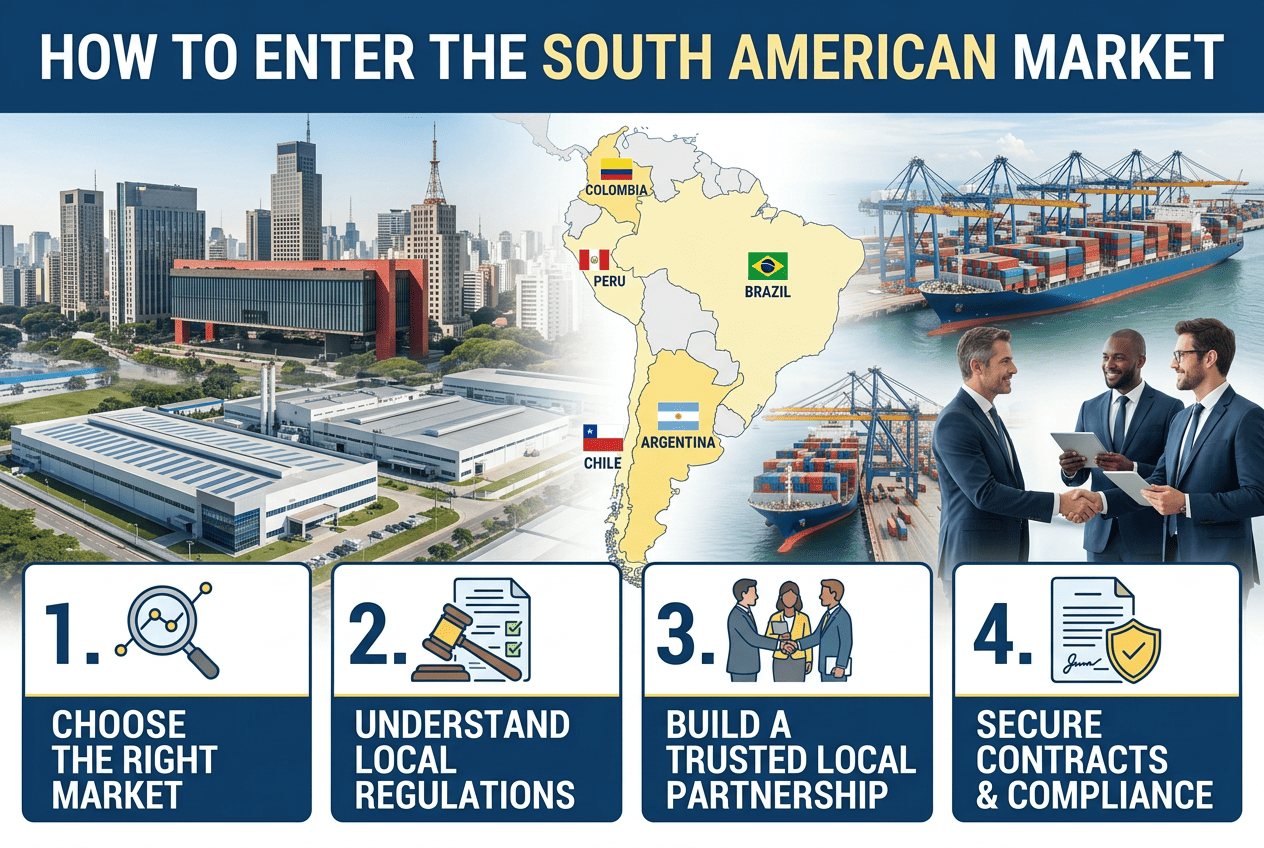
South America is home to more than 430 million people and some of the fastest-digitising consumer and industrial markets outside Asia, yet it remains one of the most commonly mismanaged regions for international market entry. Companies that succeed treat the region as a set of distinct national markets, each with its own regulatory, tax, and labour framework, not one homogeneous “Latin America” opportunity. This guide walks through the real entry strategies available, the country-level differences that actually matter, the legal and contractual groundwork to get right from day one, and how to vet a local partner before committing capital or product to the region.
📅 Published September 13, 2026⏱ 13 min read✍️ GTsetu Editorial🔄 Updated September 13, 2026
“Expanding into South America” is a phrase that hides a lot of complexity. Brazil alone operates under a tax and regulatory system considered among the most complex in the world, while Chile offers one of the most business-friendly environments in the region. Treating the continent as a single market is one of the most consistent mistakes companies make, and it is the first assumption this guide sets out to correct.
Section 1
Why South America, and Why Now
430M+
People across South America’s combined national markets
$4T+
Approximate combined GDP of South American economies
70%+
Internet penetration across major South American urban markets, driving digital commerce growth
12
Distinct national economies, each with its own legal, tax, and regulatory framework
The region’s appeal is straightforward: a large, young, increasingly urban population; growing middle-class consumption; expanding digital infrastructure; and, in several countries, deliberate government efforts to attract foreign investment and simplify business registration. The region also offers genuine industrial opportunity, from Brazil’s manufacturing base to Chile and Peru’s mining and natural resource sectors, making it relevant well beyond consumer-facing businesses, including companies evaluating cross-border manufacturing partnerships within global supply chains.
📌 The region is not one market
Currency regimes, import duties, labour protections, and ease of incorporation vary dramatically between, say, Chile and Venezuela, or Colombia and Argentina. Any market entry plan that does not treat country selection as its own distinct research exercise is working from a flawed starting assumption.
Section 2
Market Entry Strategies
Choosing Your Approach
There are several established paths into the South American market, each with a different balance of risk, control, and speed. Most companies do not choose one permanently, they start lighter-touch and evolve toward deeper local presence as the market proves itself.
1
Local Distributor or Agent
Lowest-risk way to test a market before committing capital
Lowest RiskFastest Entry
Partnering with a local distributor or sales agent who already understands the market, holds existing customer relationships, and can navigate local regulatory requirements is the most common first step into South America. It requires no local entity and limited upfront investment, trading some margin and control for speed and reduced risk.
🎯
Best for: Companies testing demand before committing to deeper investment, and those without the resources to manage a local entity from day one. Success depends heavily on choosing the right international wholesale distribution partner.
2
Joint Venture With a Local Company
Shared risk and local expertise, with shared control
Shared Risk
A joint venture pairs your product, technology, or capital with a local partner’s market knowledge, regulatory relationships, and existing infrastructure. It can meaningfully shorten the learning curve in complex markets, but requires careful structuring of ownership, decision rights, and exit terms from the outset.
🎯
Best for: Companies entering regulated or complex sectors, like manufacturing, natural resources, or financial services, where local expertise materially reduces execution risk.
3
Wholly Owned Local Entity
Full control, full commitment, and the highest setup complexity
Highest Investment
Incorporating a wholly owned local subsidiary gives full control over operations, branding, and hiring, and is often necessary for companies planning significant local employment or long-term infrastructure investment. It is also the slowest and most resource-intensive route, requiring navigation of local company formation, tax registration, and labour law from day one.
🎯
Best for: Companies with a validated market opportunity, typically after an initial distributor or joint venture phase, ready to commit to full local operations.
4
Direct Export With Local Professional Support
Minimal local footprint, maximum reliance on documentation accuracy
Export-Led
For some products, particularly where a direct buyer relationship already exists, direct export supported by local customs brokers, tax advisors, and legal counsel can work without a formal local presence at all. This route places a premium on getting trade documentation, Incoterms, and import compliance exactly right, since there is no local operational team to catch errors.
🎯
Best for: Companies with an identified buyer and straightforward product category, where the main task is executing a clean, compliant export transaction rather than building ongoing local presence.
Section 3
Country-Level Differences That Actually Matter
Before choosing an entry strategy, it is worth understanding how differently the major South American economies actually behave, since the “right” approach in Brazil can be the wrong one in Chile. Proper market research for manufacturers and other businesses should treat country selection as its own dedicated exercise.
Country
Ease of Doing Business
Notable Characteristics
Common Entry Approach
Brazil
⚠ Complex
Large domestic market, highly complex and layered tax system, strong local manufacturing base
Distributor first, local entity once validated
Chile
✓ Business-friendly
Stable regulatory environment, open to foreign investment, strong mining and export sectors
Direct entity formation is often practical early
Colombia
⚠ Moderate
Growing digital economy, improving ease of incorporation, regional logistics hub potential
Distributor or joint venture
Argentina
✗ Challenging
Currency volatility, capital repatriation restrictions, periodic regulatory change
Distributor or agent, cautious capital exposure
Peru
⚠ Moderate
Strong mining and natural resource sectors, improving trade infrastructure
Distributor first, sector-specific joint ventures common
💡 Start with one country, not the continent
Companies that try to enter three or four South American markets simultaneously typically under-resource all of them. A focused entry into one well-researched country, proven out before expanding regionally, consistently outperforms a simultaneous multi-country push on a limited budget.
Section 4
Legal and Contractual Groundwork
Whichever entry strategy you choose, the commercial relationships underpinning it, with a distributor, a joint venture partner, a supplier, or a buyer, need to be built on properly drafted agreements, not informal understandings. A handful of contractual concepts come up repeatedly in South American market entry and are worth understanding clearly before you negotiate.
📄
Master Services Agreement
Understand what a Master Services Agreement (MSA) covers before using it as the umbrella for a distributor or service relationship.
Contract foundation
⚠️
Material breach
Know what qualifies as a material breach under your agreement, and how it differs from a minor, curable one.
Understand what a warranty clause actually commits you, or your partner, to deliver.
Quality assurance
💸
Consequential damages
Know how consequential damages are defined and limited in your contract, a frequent source of cross-border disputes.
Risk ceiling
⚖️
Breach of contract remedies
Understand your remedies in the event of a breach of contract, and where disputes will actually be resolved.
Enforcement path
For transactions involving a company acquisition or asset transfer rather than a pure distribution or supply relationship, understanding what an asset purchase agreement covers becomes relevant as well. And for any physical goods crossing a border, clarity on Incoterms 2020, including terms like FCA (Free Carrier), determines exactly where risk and cost transfer from seller to buyer, a detail that causes a disproportionate share of cross-border shipping disputes when left ambiguous. Proper risk allocation in cross-border deals should be addressed explicitly in the contract, not assumed.
Section 5
Compliance and Certification Requirements
Depending on your sector, South American market entry often comes with specific compliance and certification requirements that need to be identified early, since retrofitting compliance after a product launch is far more expensive than planning for it upfront. Understanding manufacturing certifications for international trade broadly is a useful starting point, and certain certifications carry particular weight depending on your industry.
Food, beverage, and water-contact product companies should understand how to get NSF sanitation certification, which is often referenced as a quality benchmark even outside its home jurisdiction.
Companies in sectors where operational continuity matters to buyers and regulators alike should be familiar with how to get ISO 22301 certification, the international standard for business continuity management.
Beyond product-specific certifications, conducting proper commercial due diligence on the market itself, demand signals, competitive landscape, and regulatory trajectory, should happen before, not after, capital commitment.
Section 6
Vetting a Local Partner Before You Commit
Whichever entry strategy you choose, if it involves a local partner, a distributor, agent, or joint venture counterpart, the quality of that relationship will determine most of your outcomes in the market. A strong product with the wrong local partner routinely underperforms a mediocre product with the right one.
1
Verify legal standing and track record
Confirm the company’s registration, business status, and history before sharing sensitive commercial information.
2
Check references in your specific category
A distributor’s general reputation matters less than their demonstrated performance in your specific product category and target customer base.
3
Assess alignment, not just capability
Apply structured partnership evaluation criteria to confirm the partner’s incentives and growth plans genuinely align with yours, not just that they are capable on paper.
4
Formalise the relationship properly
Move from verbal agreement to a written contract covering exclusivity, territory, performance targets, and termination terms before meaningful volume flows.
🤝 For Verified Long-Term Partnerships in South America
GTsetu: Verified Discovery and Secure Engagement for Manufacturers, Distributors, and Raw Material Suppliers
Finding a credible local partner in a new region is one of the hardest parts of international expansion, and it is where most due diligence shortcuts cause the most damage later. GTsetu is built to close that gap. It is a structured partnership platform, not a directory or a general marketplace, where every company is verified on 6 government-sourced points before engagement, where discovery is anonymous until mutual interest is confirmed, where NDAs are executed digitally before any commercial information changes hands, and where document exchange happens through an encrypted workspace with a full audit trail.
GTsetu is used by manufacturers, distributors, and raw material suppliers across 100+ countries, including markets across South America, to find verified local partners and formalise cross-border business partnerships without relying solely on informal introductions or unverified directory listings.
🏛️
6-Point Government-Sourced Verification
Name, Address, Registration Number, Company Status, Company Type, and Date of Incorporation, verified using government tie-ups before any engagement.
🕵️
Anonymous Discovery
Browse verified partner profiles across 100+ countries without revealing your own identity or market entry strategy until you choose to engage.
📄
Built-In NDA Workflow
Digital NDA with timestamped signatures before any pricing, formulations, or product specs are shared.
🔐
Encrypted Document Workspace
All commercial documents shared through encrypted channels with a full access audit trail, not email attachments.
🌍
100+ Countries
Verified manufacturers and distributors across Asia, the Middle East, Europe, Africa, Australia, and the Americas.
🚫
Zero Commission
No success fee, no broker commission, ever. Your partnership economics remain entirely between you and your partner.
QWhat is the best way to expand a business into South America?
There is no single best way; the right entry strategy depends on your product, risk appetite, and how much local presence you need. Common approaches include partnering with a local distributor or agent, forming a joint venture with a local company, setting up a wholly owned local entity, or exporting directly while using local professional support for compliance. Most companies start with a distributor or agent relationship to test the market before committing to a full local entity.
QWhat are the biggest risks when expanding into South America?
Common risks include currency volatility and capital repatriation restrictions in some countries, complex and highly bureaucratic company registration and tax systems, labour law frameworks that are often more protective of employees than in North America or Europe, inconsistent enforcement of contracts and intellectual property across the region, and the risk of choosing a local partner without proper due diligence. Country-level differences are significant, so risk profiles vary considerably between markets like Brazil, Chile, and Argentina.
QDo I need a local company to do business in South America?
Not necessarily at first. Many companies begin by exporting through a local distributor or agent, which does not require a local entity, to test demand before investing in incorporation. A local entity typically becomes necessary when hiring local employees directly, holding local contracts in your own name, or when a country’s regulations require local incorporation for certain types of commercial activity.
QHow do I find a trustworthy business partner in South America?
Start with structured due diligence rather than relying on introductions alone: verify the company’s legal registration and standing, check references and track record, and confirm financial stability before sharing sensitive commercial information. Protect specifications and pricing with an NDA, and move toward a formal written agreement that addresses jurisdiction, dispute resolution, and termination terms before committing meaningful volume or investment to the relationship.
QShould I enter multiple South American countries at once?
Generally, no. Because each country in the region has its own distinct regulatory, tax, and labour framework, companies that spread limited resources across several markets simultaneously tend to under-resource all of them. A more reliable approach is to enter and prove out one well-researched country first, then use the operational and commercial lessons from that market to expand regionally with a clearer playbook.
Ready to Find a Verified Partner in South America?
GTsetu is purpose-built for manufacturers, distributors, and raw material suppliers in industrial sectors seeking verified long-term trade partnerships, across 100+ countries, with government-sourced partner verification, built-in NDA workflows, and zero commission.
They represents the product, and research team behind GTsetu, a global B2B collaboration platform built to help companies explore cross-border partnerships with clarity and trust. The team focuses on simplifying early-stage international business discovery by combining structured company profiles, verification-led access, and controlled collaboration workflows.
With a strong emphasis on trust, and disciplined engagement, Team GTsetu shares insights on global trade, partnerships, and cross-border collaboration, helping businesses make informed decisions before entering deeper commercial discussions.