Safety Stock vs Buffer Stock: What Manufacturers Should Know
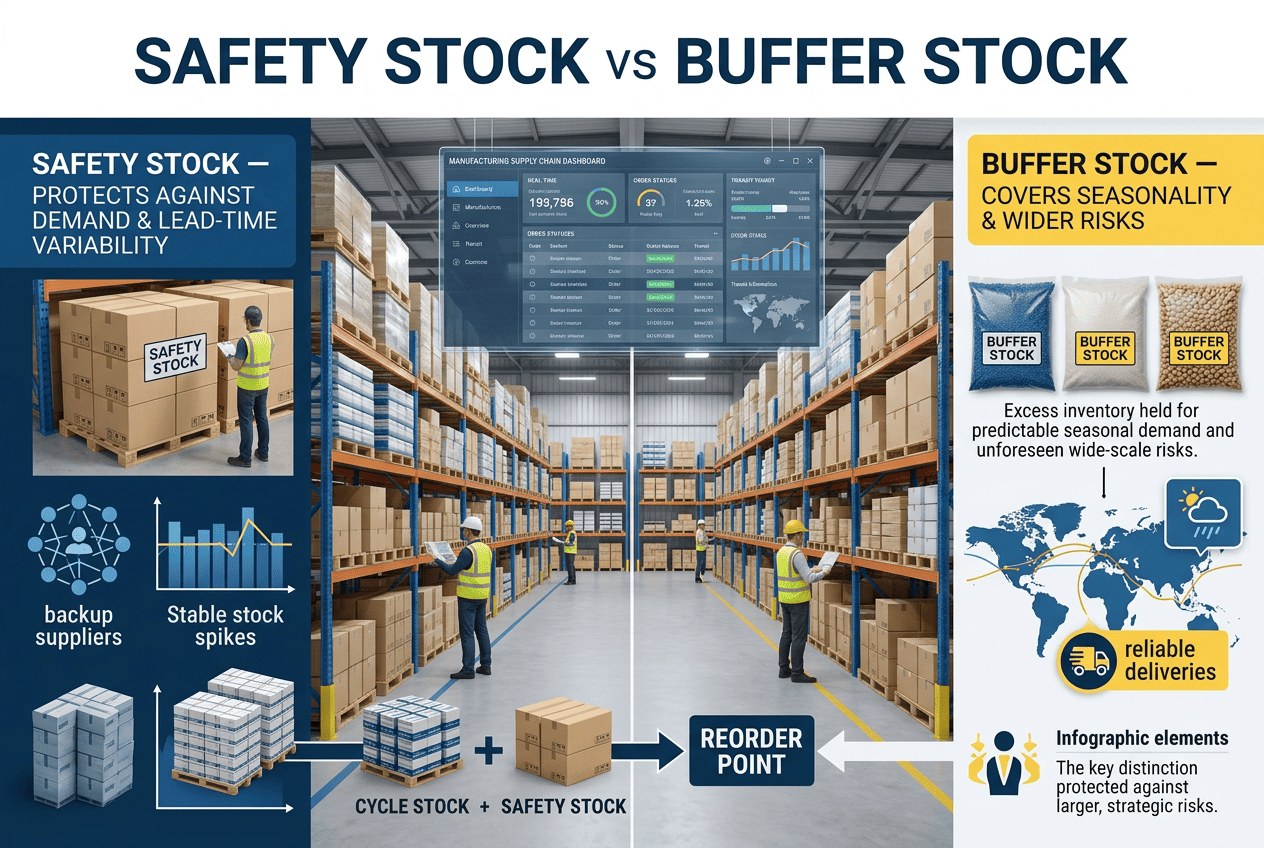
Direct Answer:Safety stock and buffer stock are both extra inventory held to prevent stockouts, and many teams use the two terms interchangeably. Where a distinction is drawn, safety stock is the calculated cushion that absorbs demand and lead-time variability, while buffer stock is a broader or more flexible reserve, often adjusted for seasonality, promotions or wider operational risk. Definitions differ between sources, so the most important step is to define the terms inside your own organisation. Both sit on top of cycle stock (the inventory you expect to use between deliveries), and both feed the reorder point, the trigger level that tells you when to order. For manufacturers, the key driver is usually supplier lead-time variability, which is why cross-border sourcing, delivery terms and supplier reliability matter so much. GTsetu helps you find government‑tie‑up verified suppliers across 100+ countries, so you can qualify backup sources and reduce single-source risk.
📅 Published October 26, 2026🔄 Updated October 26, 2026⏱ 14 min read✍️ GTsetu Editorial Team
4
Inventory Terms Explained
1.65
Z-Score for a 95% Service Level
100+
Countries on GTsetu
0%
Broker Commission
Ask three people on a planning team to define buffer stock and you will often get three different answers. One will say it is just another word for safety stock. Another will say it is a seasonal reserve. A third will call it a minimum inventory floor. For a manufacturer, where a missing component can halt an entire production line, vague vocabulary is more than an academic issue: it changes what you calculate, how much cash you tie up, and when you place orders.
Manufacturers, procurement and supply chain planners, plant and operations managers, exporters and importers, and founders setting up their first inventory policy for raw materials, components or finished goods.
⚖️ General Guidance Disclaimer
This guide offers general educational content on inventory management. Formulas are simplified, and the right method depends on your data quality, product mix and systems. It is not accounting, tax, legal or financial advice. Validate any inventory policy against your own demand and supplier data, and consult qualified professionals where needed.
SECTION 1
1 What Are Safety Stock and Buffer Stock?
🎯 Definition
Safety stock is extra inventory held beyond expected demand to protect against uncertainty, such as a demand spike or a late delivery. Buffer stock is also a protective reserve against stockouts, and the term is used either as a synonym for safety stock or, more specifically, for a broader or seasonally adjusted cushion. Both sit on top of cycle stock, the normal inventory you expect to consume between deliveries.
Think of it in layers. Cycle stock covers what you expect to use. Safety or buffer stock covers what you did not expect. A reorder point is the signal that ties them together: it tells you when to place the next order, and it is calculated using the safety stock figure.
🔄
Cycle Stock
The everyday inventory you expect to use between one delivery and the next under normal conditions.
🛡️
Safety Stock
A calculated cushion against demand and lead-time variability. The standard protection against stockouts.
🧱
Buffer Stock
A protective reserve, sometimes used interchangeably with safety stock, sometimes broader or adjusted for seasons and promotions.
🚦
Reorder Point
The trigger level at which a new order is placed. It is not a cushion; it includes one.
✨ GTsetu Insight
No formula can protect you from an unreliable supplier. Before you size your cushion, assess who is supplying you. Our partnership evaluation criteria and commercial due diligence guide show how to judge reliability before you commit volume.
SECTION 2
2 Key Inventory Terms at a Glance
Here is each term in a single view, with its job and the question it answers.
Cycle Stock
Expected use
Inventory consumed between deliveries when demand and lead times behave normally.
📊 The baseline
Safety Stock
Calculated cushion
Extra units held to absorb demand swings and supplier delays at a chosen service level.
🛡️ The cushion
Buffer Stock
Broader reserve
A protective reserve often tuned for seasonality, promotions or wider operational risk.
🧱 The wider reserve
Reorder Point
Trigger level
The stock level that signals it is time to order: usage during lead time plus safety stock.
🚦 The trigger
Service Level
Target protection
The probability of not stocking out during a replenishment cycle, for example 95%.
🎯 The target
Lead Time
Order to receipt
Days between placing an order and having stock available. Its variability is often the biggest driver.
⏱ The clock
SECTION 3
3 Safety Stock vs Buffer Stock: Where the Line Falls
The honest answer is that the dividing line moves depending on whom you ask. Published guides from inventory software vendors and supply chain educators fall into two broad conventions. Neither is wrong, but mixing them inside one company causes confusion.
Aspect
Convention A: Buffer = Broader Cushion
Convention B: Buffer = Demand-Side Reserve
Safety Stock
Precise, calculated number covering demand and lead-time variability
Fixed level per item covering supply or production emergencies such as shipping delays and shortages
Buffer Stock
Broader cushion that also covers other risks such as supplier quality issues or production delays
Flexible reserve covering demand fluctuations such as holiday sales, promotions and seasonality
Stability Over Time
Reviewed periodically as inputs change
Safety stock stays relatively fixed; buffer stock rises and falls with the calendar
Practical Takeaway
Most teams treat the two as near-synonyms in daily planning
Hold both, because each guards against a different cause of stockout
Based on public explanations from Supplymint and Peak, both of which also note that the basic calculation for the two is similar. Other sources (see Sources below) use further variations, including treating buffer stock as a strategic or minimum reserve.
📌 Our Recommendation for Manufacturers
Pick one convention, write it down, and apply it across planning, procurement and finance. A simple, defensible rule is: safety stock is the statistically calculated cushion for demand and lead-time variability on each item, and buffer stock is any additional, deliberately chosen reserve for named risks, such as a seasonal peak, a single-source supplier or a quality hold. Label each reserve with the risk it covers so it can be reviewed and released.
🧭 Quick Guide: Which Tool Solves Which Problem?
Demand varies day to day?
Size safety stock
Variability
Use usage history and a service-level target.
Supplier deliveries often late?
Include lead-time variability
Lead time
Lead-time swings can dominate the calculation for imported inputs.
Predictable seasonal peak coming?
Add a time-bound buffer
Seasonality
Build it ahead of the peak and release it afterwards.
Single-source or risky supplier?
Buffer plus a backup supplier
Supplier risk
Inventory buys time; a second source removes the dependency.
Need to know when to order?
Set the reorder point
Trigger
Usage during lead time plus safety stock.
Perishable or short shelf life?
Keep cushions lean
Expiry
Use shorter cycles and closer suppliers instead of deep stock.
SECTION 4
4 The Core Formulas
Three formulas cover most manufacturing needs. Start simple and move to the statistical versions once you have clean usage and lead-time data.
1
Basic (Max-Average) Method
Safety stock = (max daily usage × max lead time) − (average daily usage × average lead time). Quick and intuitive, but it assumes the worst case on both inputs happens together, so it tends to overstate the cushion.
Good for a first pass
2
Statistical Method (Demand Variability)
Safety stock = Z × σd × √L. Z is the service-level factor (about 1.65 for 95%), σd is the standard deviation of daily demand and L is lead time in days. Use when lead time is stable.
Safety stock = Z × √( L × σd² + d² × σL² ). Here d is average daily demand and σL is the standard deviation of lead time. Essential when suppliers, customs or freight make delivery times unpredictable.
Best for imported inputs
4
Reorder Point
Reorder point = (average daily usage × average lead time) + safety stock. When on-hand plus on-order stock falls to this level, place the next order.
The trigger
✨ GTsetu Insight
Notice that every formula depends on lead time. Anything that makes lead time shorter or more predictable, such as nearer suppliers, clearer delivery terms or better supplier performance, reduces the cushion you must hold. See Incoterms 2020 and FCA (Free Carrier) for how delivery responsibilities shape the timeline.
SECTION 5
5 A Worked Example for a Manufacturer
Imagine a manufacturer of auto components that imports a key part. The planning team has the following data for that part.
Input
Value
Average daily usage (d)
200 units
Maximum daily usage
320 units
Standard deviation of daily usage (σd)
40 units
Average lead time (L)
10 days
Maximum lead time
16 days
Standard deviation of lead time (σL)
3 days
Target service level
95% (Z = 1.65)
Method
Calculation
Safety Stock
Reorder Point
Basic (max-average)
(320 × 16) − (200 × 10) = 5,120 − 2,000
3,120 units
2,000 + 3,120 = 5,120 units
Statistical, demand only
1.65 × 40 × √10 ≈ 1.65 × 40 × 3.16
≈ 209 units
2,000 + 209 ≈ 2,209 units
Statistical, demand + lead time
1.65 × √(10 × 40² + 200² × 3²) = 1.65 × √376,000
≈ 1,012 units
2,000 + 1,012 ≈ 3,012 units
🎯 What the Example Shows
The three methods give very different answers, from about 209 to 3,120 units. The demand-only version looks comfortable until you include the three-day swing in lead time, which pushes the cushion up almost five-fold. For imported inputs, lead-time variability, not demand variability, is often the real driver. This is why improving supplier reliability can free up more working capital than fine-tuning your demand forecast.
Illustrative numbers for explanation only. Real calculations should use your own cleaned usage and lead-time history, and typically assume demand and lead time vary independently.
SECTION 6
6 Where to Hold Protection: Raw Materials, WIP, Finished Goods
Manufacturers can hold protective inventory at several points in the flow. Where you put it changes both its cost and its effectiveness.
1
Raw Materials & Components
Protects production against supplier delays. Usually the most valuable place to hold cushions for imported or single-source inputs, because one missing part can stop an entire line.
Guards against supplier risk
2
Work-in-Progress (WIP)
Decouples stages of production so one machine’s breakdown does not starve the next. Useful at known bottlenecks, but costly if overused because value has already been added.
Guards against process risk
3
Finished Goods
Protects customer service against demand spikes and production hiccups. Holding it closer to the customer improves availability but multiplies stock across locations.
Guards against demand risk
4
Spare Parts & Consumables
Keeps plant uptime high. Low-demand, high-impact items often justify a small, deliberate buffer despite slow turnover.
Guards against downtime
📌 Industry Context Matters
In electronics, a single missing component can stall a product line, so cushions on critical parts often run higher than pure maths suggests. In fast-moving consumer goods, availability at the point of sale drives revenue, so stock sits close to customers. In regulated or perishable goods, shelf life caps how much you can hold; for food-related manufacturing, see our guide on how to get NSF sanitation certification.
SECTION 7
7 What Drives How Much You Need
📈
Demand Variability
The more usage swings around its average, the larger the cushion needed for a given service level.
⏳
Lead-Time Length & Variability
Longer and less predictable lead times raise safety stock sharply, especially for imports.
🎯
Service-Level Target
Moving from 95% to 99% costs disproportionately more inventory. Set targets by item criticality, not one rate for everything.
🏭
Supplier Reliability
On-time performance and quality consistency determine how much hidden uncertainty you must cover.
📦
Minimum Order Quantities
Large MOQs raise cycle stock and can reduce the extra cushion required, but they tie up cash.
🧪
Shelf Life & Obsolescence
Perishables and fast-changing designs limit how long protective stock can sit before losing value.
✨ GTsetu Insight
Tools get better when the data does. As advanced technology ecosystems mature, from AI-led planning to emerging computing, supply chain analytics will keep improving; see our look at Maharashtra’s FTI and the future of quantum technology in Pune. The fundamentals, accurate lead times and reliable partners, will still matter most.
SECTION 8
8 Costs and Trade-Offs
Protective inventory is insurance, and like any insurance it has a premium. The goal is not the biggest cushion but the right one.
✅ Benefits of Adequate Cushions
✅Fewer Stockouts & Line Stoppages: Production and customer orders keep flowing during delays or spikes.
✅Customer Retention: Many shoppers do not wait or substitute when items are unavailable, so availability protects revenue and loyalty.
✅Negotiating Breathing Room: You are less likely to accept bad terms or expedite at premium cost under pressure.
✅Smoother Operations: Less firefighting, fewer emergency purchases and expedited shipments.
⚠️ Costs of Over-Holding
⚠️Tied-Up Working Capital: Cash sits on shelves instead of funding growth.
⚠️Storage & Handling Costs: Warehousing, insurance and labour rise with volume.
⚠️Obsolescence & Expiry Risk: Slow movers can lose value or become unsellable.
⚠️False Security: A large cushion can hide a supplier problem that should be fixed at the source.
SECTION 9
9 How to Set Levels and Avoid Common Mistakes
1
Segment Your Items
Classify by value, criticality and demand pattern. Fast-moving, high-impact items deserve the full calculation; slow, low-risk items can run on simpler rules.
2
Clean and Measure Your Data
Collect actual daily usage and actual order-to-receipt lead times, not promised ones. Record late and early deliveries.
3
Set Service-Level Targets by Criticality
Choose higher service levels for line-stopping parts and lower ones for easily substituted items.
4
Calculate Safety Stock, Then the Reorder Point
Use the statistical method once you have enough history. Always include safety stock in the reorder point, otherwise orders trigger with no cushion left.
5
Add Targeted, Time-Bound Buffers
Where a named risk exists, such as a seasonal peak or a supplier under review, add a labelled buffer with an end date and an owner.
6
Review Regularly and Fix Root Causes
Recalculate as demand and supplier performance change. If a cushion keeps growing, address the cause, such as unreliable lead times, instead of adding inventory.
Common Mistakes to Avoid
⚠️
Reorder Point Without Safety Stock
Ordering at average usage during lead time leaves zero cushion when demand spikes or deliveries slip.
⚠️
Using Promised Lead Times
Supplier quotes are not performance. Use measured receipt dates, including delays.
⚠️
Treating Cycle Stock as a Problem
Cycle stock is meant to run down before the next delivery. The cushion should still be there when it does.
⚠️
One Setting Forever
Levels set once and never reviewed drift out of line with reality as demand and suppliers change.
SECTION 10
10 Cross-Border Sourcing, Contracts & Risk
Imports lengthen and destabilise lead times, which is exactly what inflates safety stock. Three levers help: shorten the route, clarify responsibility and strengthen the supplier relationship.
Agree who handles transport, export clearance and risk at each stage using Incoterms 2020, for example FCA.
🔁
Qualify Backup Suppliers
A second source removes single-point dependence and reduces how much inventory you need to hold against one supplier’s failure. See international wholesale distributors.
The cheapest way to reduce safety stock is to reduce uncertainty at its source: reliable suppliers with predictable lead times, and a second source ready if the first falters.
🎯 The Supplier Challenge
Qualifying a new supplier abroad through trade fairs, directories and cold outreach is slow and unverified. You need a way to confirm who you are dealing with, protect your specifications, and compare options across countries before committing production volume.
🔍
Discover Verified Partners
GTsetu verifies legal name, registered address, registration number, company status, company type and incorporation date using direct government tie-ups.
🕵️
Explore Anonymously
Browse supplier and distributor profiles across countries before revealing your identity.
📄
Execute NDAs Securely
Formalise confidentiality before sharing drawings, forecasts or volumes, with a digital audit trail.
🔐
Collaborate Securely
Exchange specifications and commercial documents through encrypted channels with access controls.
🔁
Build a Second Source
Qualify alternative suppliers without broker fees and spread risk across locations.
12 How GTsetu Helps Manufacturers Reduce Inventory Risk
🌐 Platform Spotlight, GTsetu
Your Verified Gateway to Reliable Suppliers and Partners
Inventory cushions buy you time; reliable suppliers reduce how much time you need. GTsetu connects manufacturers, exporters, importers and distributors with government‑tie‑up verified partners across 100+ countries, with built-in NDA workflows and encrypted collaboration. Every company on GTsetu is verified using direct government tie‑ups across six essential credentials: legal name, registered address, registration number, company status, company type, and date of certificate of incorporation. GTsetu does not verify industry certifications, delivery performance, inventory capacity, quality or financial standing; those must be exchanged and validated directly between partners.
✅
Government Tie‑Up Verification
6‑point verification: legal name, registered address, registration number, company status, company type, incorporation date.
📜
Certifications & Performance
GTsetu does not verify these. They must be exchanged directly between partners during due diligence.
🕵️
Anonymous Discovery
Explore verified partner profiles without revealing your identity until mutual interest is confirmed.
📄
Built-In NDA Workflow
Formalise confidentiality before sharing specifications, forecasts, pricing, or proprietary information, with a full digital audit trail.
🚫
Zero Commission
No broker fees on any deal, whether a distribution agreement, supply contract, or technology partnership.
🔐
Encrypted Collaboration
All documents and communications encrypted in transit and at rest. Cross-border partnerships from first contact.
🌍
100+ Countries
Active verified network of manufacturers, distributors and supply chain partners.
QWhat is the difference between safety stock and buffer stock?
Both are extra inventory held to avoid stockouts, and many teams use the terms interchangeably. Where a distinction is drawn, safety stock is usually the calculated cushion against demand and lead-time variability, while buffer stock is a broader or more flexible reserve, often adjusted for seasonality, promotions or wider operational risk. Definitions vary between sources, so define the terms inside your own organisation.
QHow do you calculate safety stock?
A basic method is (maximum daily usage × maximum lead time) minus (average daily usage × average lead time). A statistical method is Z × standard deviation of demand × the square root of lead time, where Z reflects the target service level (about 1.65 for 95%). If lead time also varies, include its variability in the formula.
QWhat is the reorder point and how does it relate to safety stock?
The reorder point is the stock level that triggers a new order. It equals average daily usage multiplied by lead time, plus safety stock. Safety stock is a cushion; the reorder point is a trigger that includes that cushion.
QWhat is cycle stock?
Cycle stock is the normal inventory expected to be used between one replenishment and the next under ordinary conditions. Safety or buffer stock sits on top of it to absorb uncertainty.
QWhy does cross-border sourcing increase safety stock needs?
Longer, more variable lead times from customs, port congestion, freight disruption and supplier reliability increase uncertainty, and safety stock rises with lead-time variability. Nearshoring, clearer delivery terms and reliable verified suppliers can reduce the cushion required.
QCan you hold too much safety stock?
Yes. Excess safety stock ties up working capital, increases storage and handling costs, and raises the risk of obsolescence or expiry. The goal is the right level for your demand variability, lead-time variability, service-level target and the cost of a stockout.
QHow does GTsetu help manufacturers with inventory risk?
GTsetu helps manufacturers, exporters, importers and distributors find government-tie-up verified suppliers and partners across 100+ countries. Verification covers six core credentials (legal name, registered address, registration number, company status, company type, incorporation date). GTsetu also offers built-in NDA workflows, encrypted collaboration and zero broker commission, helping you qualify backup suppliers and reduce single-source risk.
Join 500+ verified manufacturers, exporters, and importers already building cross-border partnerships on GTsetu, with government‑tie‑up verification of six core credentials, built-in NDA workflows, and zero broker fees across 100+ countries. Start building a more resilient supply chain today.
They represents the product, and research team behind GTsetu, a global B2B collaboration platform built to help companies explore cross-border partnerships with clarity and trust. The team focuses on simplifying early-stage international business discovery by combining structured company profiles, verification-led access, and controlled collaboration workflows.
With a strong emphasis on trust, and disciplined engagement, Team GTsetu shares insights on global trade, partnerships, and cross-border collaboration, helping businesses make informed decisions before entering deeper commercial discussions.