How to Expand Your Business Into North America | GTsetu Blog
Home ›
Blogs ›
Expand Your Business Into North America
📋 Market Entry & Expansion Guide · 2026
How to Expand Your Business Into North America
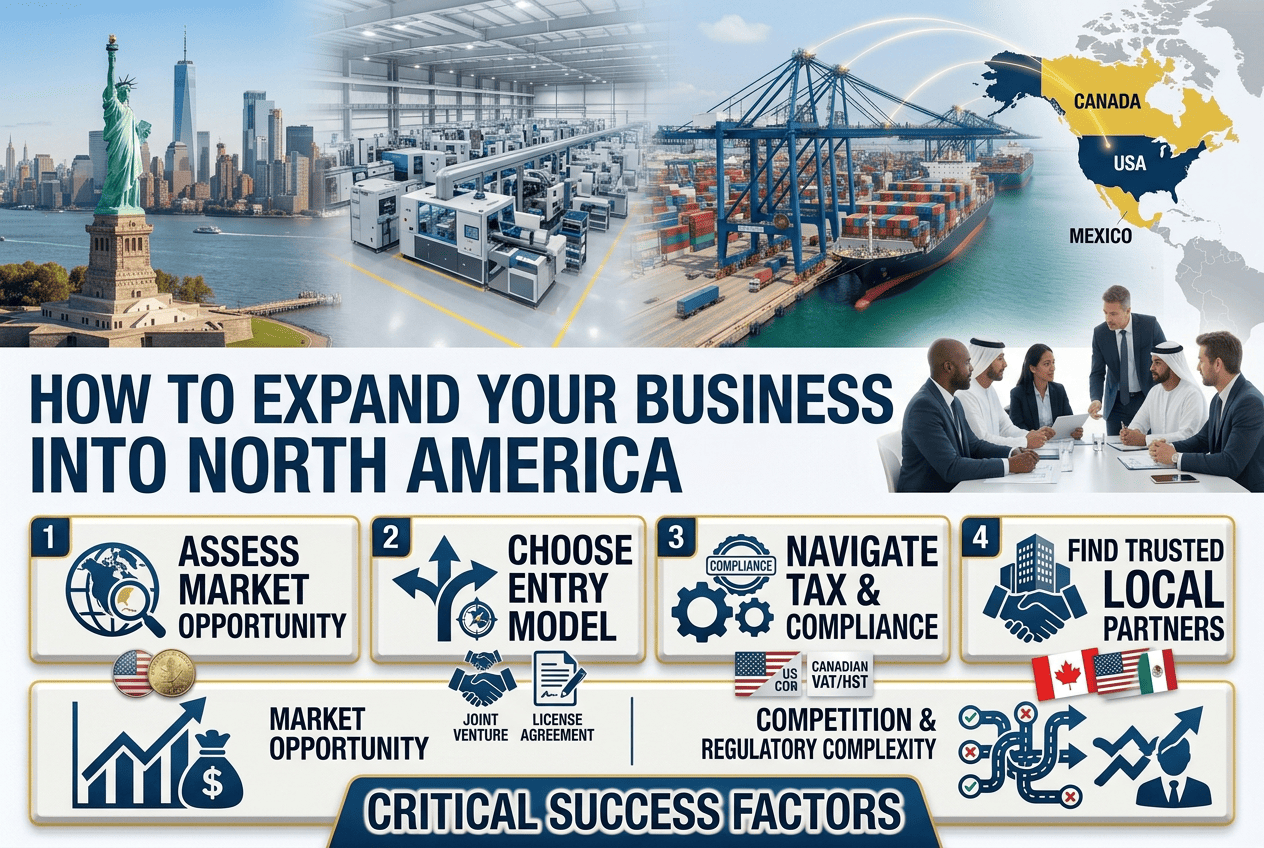
North America, and the United States in particular, offers one of the largest, wealthiest consumer markets in the world: a combined population of over 600 million, deep capital markets, and genuine funding and incentive programs for companies willing to set up shop. It is also one of the most saturated and competitive markets, with a complex, multi-layered tax and regulatory system that varies by state. This guide walks through the real decisions involved: which entry model fits your business, how to structure the legal and compliance side, and where companies get stuck trying to find trustworthy local partners without a network already in place.
📅 Published September 28, 2026⏱ 14 min read✍️ GTsetu Editorial🔄 Updated September 28, 2026
Expanding into North America is less a single decision than a sequence of them: how to enter, how to structure the entity, what compliance and certifications apply to your product, how to find a distributor or local operating partner you can actually trust, and what the contract between you and that partner needs to say. Companies that treat this as one big leap tend to either over-invest before validating demand, or under-prepare and get caught by a compliance gap or a bad partner agreement months in.
This guide breaks the process into its real components, the entry models available, the step-by-step setup process, the contract terms that will come up regardless of which path you choose, and where manual partner search runs into real limits once you need someone you can trust in a market you don’t know yet.
💡 How to read this guide
Section 2 covers how to enter, not just whether to. Section 4 is a practical glossary of the contract terms that will come up in almost any US or Canadian partnership or distribution agreement, worth bookmarking before you negotiate your first one.
Section 1
Why North America, and What Makes It Hard
The pull toward North America is straightforward: a combined market of more than 600 million people, a US GDP north of $27 trillion, deep venture and private capital markets, and a genuine culture of funding innovation through federal programs, state-level incentives, and private investment. For companies already operating in English, the shared business language removes one layer of friction that exists in many other expansion markets.
The difficulty is just as real. A few challenges come up consistently:
Market saturation. Nearly every sector already has entrenched domestic competitors and well-capitalised players, making differentiation and market share genuinely hard to win.
Higher setup and operating costs. Legal structuring, staffing, and compliance costs in the US tend to run higher than in many other markets, and vary meaningfully by state and sector.
A complex, layered tax system. Federal corporate tax is relatively straightforward at a flat rate, but individual states layer on their own taxes, credits, and filing requirements, making specialist tax advice close to essential.
A litigious business environment. Contract disputes and liability exposure are a real operating risk, which makes getting the underlying agreements right from the start more important than it might be elsewhere.
Finding a trustworthy local partner. Without an existing network, identifying a distributor, agent, or manufacturing partner you can actually verify is often the single hardest and slowest part of the whole process.
📌 Key question before you plan anything else
Are you trying to test demand with minimal commitment, or are you ready to establish a real operating presence? The honest answer determines which entry model in Section 2 fits, and how much of the step-by-step process in Section 3 you need to run upfront versus phase in over time.
Section 2
Ways to Enter the North American Market
Choosing Your Entry Model
There is no single right way to enter North America. The model you choose should match your budget, your risk tolerance, and how much control you need over the local relationship.
1
Distributor or Sales Agent Model
Lowest cost, fastest to launch, least control
Low RiskFast Entry
Working with a local distributor or sales agent lets you sell into the US or Canadian market without forming a legal entity, hiring local staff, or taking on direct liability exposure. The distributor handles local sales, often local compliance, and sometimes last-mile logistics, in exchange for margin or commission.
Strengths
No entity formation required to start generating revenue
Distributor brings existing local market knowledge and relationships
Lowest upfront capital commitment of any entry model
Limitations
Less control over pricing, branding, and customer relationships
Finding a trustworthy, capable distributor is itself a real challenge
Margin given up to the distributor can be significant over time
🎯
Best for: Companies testing demand before committing capital, or those whose product doesn’t require a direct local presence to sell effectively.
2
Direct Subsidiary / Local Entity
Full control, highest commitment, most compliance overhead
Full ControlHigher Cost
Forming a US or Canadian subsidiary gives you full control over branding, pricing, staffing, and strategy, and typically limits parent-company liability exposure. It requires a genuine investment in legal setup, state-level registration, banking, tax compliance, and often local staff from day one.
Strengths
Full operational and brand control over the local business
Access to local bank accounts, contracts, and government incentive programs
Liability generally contained within the local entity
Limitations
Significant upfront legal, registration, and operating costs
Ongoing compliance burden across federal and state requirements
Slower to launch than a distributor or licensing arrangement
🎯
Best for: Companies with validated demand, sufficient capital, and a long-term commitment to building a real operating presence in the market.
3
Licensing or Franchising
Let a local operator run under your brand or technology
Asset-Light
Licensing your brand, product design, or technology to a local operator, or franchising a proven business model, transfers most of the operational burden to a local partner while you retain royalty or licensing income. This works well when the value is in the IP or brand rather than in direct operational control.
Strengths
Minimal direct operational involvement required
Local partner absorbs most market-specific execution risk
Scales faster than a directly-operated entity in some sectors
Limitations
Brand and quality control depend entirely on the licensee’s execution
Best for: Companies whose core value is a brand, technology, or proven format rather than hands-on local execution.
4
Acquisition of an Existing US or Canadian Business
Buy your way into an existing customer base and operating infrastructure
Capital IntensiveInstant Presence
Acquiring an existing local business, through an asset purchase or a full entity acquisition, gives you immediate market presence, an existing customer base, and operational infrastructure already in place. It is the fastest route to scale, but requires significant capital and rigorous due diligence before signing.
Strengths
Immediate customer base, staff, and operating infrastructure
Can satisfy certain investor visa routes for founders relocating to the US
Integration risk if the acquired business’s culture or systems don’t align
🎯
Best for: Well-capitalised companies prioritising speed to scale over building a presence organically.
Section 3
The Step-by-Step Expansion Process
From Research to Launch
Whichever entry model you choose, most companies move through some version of the following sequence.
1
Market Research & Feasibility Study
Validate demand and understand the competitive landscape before committing
Research
Before anything else, understand the demand for your product, who the entrenched competitors are, and which states or regions offer the best fit for your sector. Proper market research at this stage prevents the most expensive mistake: building out an entity or partner network for a market that doesn’t want what you’re selling at the price you need to charge.
What it involves
Competitive landscape and pricing analysis by sector and region
State-level comparison of tax rates, incentives, and workforce availability
Initial demand validation through pilot sales or local distributor conversations
Common mistakes
Assuming success in another market translates directly to North America
Skipping state-level comparison and defaulting to the most obvious city
🎯
Why it matters: Every decision after this one gets more expensive to reverse, so this is the cheapest point to get the fundamentals right.
2
Choose a Legal Structure & Register Your Entity
If your entry model requires one, this sets your liability and tax profile
Legal Setup
If you’re forming a US or Canadian entity, choosing the right structure, and the right state of incorporation, shapes your liability exposure, tax obligations, and ability to raise local capital later. This is a decision worth making with specialist legal and tax advice rather than defaulting to whatever structure is fastest to file.
What it involves
Choosing between structures such as an LLC, C-corp, or branch office
Comparing state-level corporate tax rates and incentive programs
Registering with relevant federal and state authorities
Common mistakes
Incorporating without comparing state-level tax and regulatory differences
Choosing a structure that complicates future fundraising or exit options
🎯
Why it matters: This decision is expensive to unwind once contracts, bank accounts, and tax filings are built around it.
3
Secure Licenses, Permits & Product Certifications
Confirm what your product or service needs to legally operate
Compliance
Depending on your sector, this can include anything from general business licensing to product-specific certifications. Manufacturers and industrial suppliers in particular should confirm exactly which manufacturing certifications for international trade apply, and secure sector-specific credentials, such as sanitation or business continuity certifications, before committing to a launch date.
What it involves
General business licensing at the state and local level
Product-specific certifications where relevant, such as NSF sanitation certification for food, water, or equipment categories
Business continuity standards such as ISO 22301 certification where operational resilience matters to customers or regulators
Common mistakes
Assuming certifications from your home market transfer automatically
Discovering a required certification only after a customer or distributor asks for it
🎯
Why it matters: A missing certification can block a sale, a shipment, or a distributor relationship at the worst possible moment.
4
Open a Local Bank Account & Register for Tax
Operational infrastructure most customers and partners expect
Finance & Tax
A local bank account is close to a baseline requirement for operating credibly in most of North America, whether through a formal subsidiary or a lighter local presence. Tax registration at the federal and state level follows, and given how layered the system is, specialist local tax advice is worth the cost from the outset.
What it involves
Opening a local or multi-currency business bank account
Registering for federal and applicable state tax obligations
Setting up accounting systems that handle multi-jurisdiction compliance
Common mistakes
Delaying local banking setup and losing credibility with early customers or partners
Underestimating the complexity of state-by-state tax filing requirements
🎯
Why it matters: Financial infrastructure is table stakes for being taken seriously by local partners, landlords, and customers alike.
5
Build Your Distribution & Partner Network
The step most companies find hardest without an existing network
Partnerships
Whether you’re working with a distributor, a manufacturing partner, or a local sales agent, finding a company you can actually trust, verified, properly evaluated, and willing to formalise terms, is consistently the slowest part of expanding into a market where you don’t already have relationships. This is also where many companies learn, later than they’d like, that a handshake agreement with an unverified partner is not a substitute for a structured cross-border business partnership.
Confirming how risk is allocated between you and the local partner before signing anything
Common mistakes
Signing with the first distributor who responds, without independent verification
No clear exit terms if the partnership underperforms
🎯
Why it matters: Your entry model only works as well as the local partner executing it. This is covered in more depth in Section 5.
6
Hire, Formalise Contracts & Launch
Put the right terms in writing before the first order ships
Launch
If local hiring is part of your model, this step includes complying with local employment regulations, which differ meaningfully from most other markets. Across every entry model, this is also the point where distribution, licensing, or supply agreements get formalised in writing, with clear terms for performance, liability, and what happens if the relationship doesn’t work out. Section 4 below covers the specific contract terms worth understanding before you sign.
What it involves
Local hiring compliant with state and federal employment law, where applicable
Formal written agreements covering every partner or distributor relationship
A defined launch plan with clear, measurable early milestones
Common mistakes
Launching on informal terms with a local partner “to save time”
No shipping or trade terms defined, leading to disputes over who bears freight risk
🎯
Why it matters: Given how litigious the US market is, the quality of your written agreements is one of the best predictors of how smoothly the relationship holds up under pressure.
Section 4
Contract Terms You’ll Need to Know Before You Sign
Regardless of which entry model you choose, you’ll end up negotiating and signing contracts, distributor agreements, supply contracts, licensing terms, or an acquisition agreement. A handful of terms come up again and again, and understanding them before you’re in a negotiation puts you in a stronger position.
Incoterms 2020 define who bears cost and risk at each stage of shipping, essential in any cross-border supply or distribution agreement.
FCA (Free Carrier) is one of the most commonly used Incoterms in US and Canadian trade agreements, worth understanding specifically if you’re shipping product into the region.
Master Services Agreement (MSA) sets the overarching terms for an ongoing relationship with a local service provider, distributor, or partner, under which individual orders or statements of work sit.
Warranty clauses define what you’re promising about your product or service’s quality and performance, and for how long, something US buyers and partners will expect to see clearly stated.
Material breach defines the threshold at which a contract violation is serious enough to justify termination or damages, as opposed to a minor, correctable issue.
Breach of contract is the broader legal concept behind any failure to meet agreed terms, and understanding how it’s defined in your agreement shapes your remedies if something goes wrong.
Consequential damages cover indirect losses, like lost profits, stemming from a breach, and many US contracts explicitly limit or exclude them, worth checking closely before you sign.
Termination for convenience allows either party to exit the agreement without cause, under agreed notice terms, an important clause to negotiate carefully in any distributor or partnership agreement.
💡 A practical habit
Before signing any agreement with a North American partner, read it once specifically looking for how it handles each of the terms above. If any of them are silent or vague, that’s worth raising before signature, not after a dispute.
Section 5
Finding a US Partner: Manual Search vs. Verified Discovery
Of everything covered so far, Step 5, building a distribution and partner network, is consistently the slowest and highest-risk part of expanding into North America for companies without an existing presence. Referrals, trade shows, and cold outreach can work, but they take time, and it’s genuinely difficult to independently confirm whether a prospective distributor or partner is who they claim to be using public information alone, particularly from outside the country.
Finding a distributor through an existing industry contact
✓ Often the fastest route if you have one
⚠ Complementary, not required
Finding a distributor with no existing US network
✗ Slow, relies on cold outreach or agents
✓ Purpose-built for exactly this
Confirming a US company’s legal registration before investing time
✗ Manual, state-by-state registry checks
✓ Government-sourced verification upfront
Evaluating several candidates without tipping off the market
✗ Outreach reveals your plans early
✓ Anonymous discovery until mutual interest
Protecting product specs and pricing while evaluating candidates
⚠ Depends on ad hoc NDAs, if used at all
✓ Built-in digital NDA workflow
Expanding into Canada or Mexico alongside the US in one process
✗ Separate networks, separate searches
✓ Centralised across 100+ countries
🤝 For Finding Verified North American Partners
GTsetu: Verified Discovery for Your North American Distribution & Manufacturing Partners
GTsetu shortens the hardest part of expanding into a new market, finding a partner you can actually trust before you’ve built a local network. Every company on the platform is verified on 6 government-sourced points before you ever make contact, so the identity-confirmation work that normally slows down evaluating a new US or Canadian distributor is already done. You can browse anonymously, protect your pricing and specifications with a digital NDA, and exchange documents through an encrypted workspace, all before committing to a formal agreement.
GTsetu is used by manufacturers, distributors, and raw material suppliers across 100+ countries to find and formally engage verified partners for cross-border manufacturing partnerships, whether that means a North American distributor, a local manufacturing partner, or support from international business development consulting to structure the expansion plan itself.
🏛️
6-Point Government-Sourced Verification
Name, Address, Registration Number, Company Status, Company Type, and Date of Incorporation, verified using government tie-ups before any engagement.
🕵️
Anonymous Discovery
Browse verified partner profiles across 100+ countries without revealing your expansion plans until you choose to engage.
📄
Built-In NDA Workflow
Digital NDA with timestamped signatures before any pricing, formulations, or product specs are shared.
🔐
Encrypted Document Workspace
All commercial documents shared through encrypted channels with a full access audit trail, not email attachments.
🌍
100+ Countries
Verified manufacturers, distributors, and raw material suppliers across North America, Asia, the Middle East, Europe, Africa, and Australia.
🚫
Zero Commission
No success fee, no broker commission, ever. Your partnership economics remain entirely between you and your partner.
📌 Verification and legal structure solve different problems
GTsetu solves discovery and trust, finding and verifying the right North American partner. It doesn’t replace proper legal and tax advice for entity structure, contract drafting, or compliance, covered in Sections 3 and 4. Most companies expanding successfully use both: verified partner discovery to find who to work with, and specialist local counsel to formalise how.
Section 6
Which Approach Fits Your Situation?
Use this reference to match your next move to where you actually are in the expansion process.
🧭
You haven’t validated demand yet
You’re not sure your product or service has a real market in North America.
Market research first
🤝
You want to test the market with minimal commitment
You’re not ready to form a legal entity or hire local staff yet.
Distributor / agent model
🏢
You have validated demand and want full control
You’re ready to invest in a real, long-term local operating presence.
Direct subsidiary
🏷️
Your value is in brand or technology, not operations
You’d rather license your IP than run local operations yourself.
Licensing / franchising
💰
You’re well-capitalised and want speed over organic growth
You’d rather acquire existing market presence than build it from scratch.
Acquisition
🔍
You need a distributor or partner but have no US network
Cold outreach and trade shows feel too slow, and too risky to vet properly.
GTsetu
📜
You’re about to negotiate your first US distribution agreement
You want to understand the key terms before you’re in the room.
Review Section 4 first
🧩
You want structured help planning the whole expansion
You’re not sure where to start or which model fits your business.
QWhat is the easiest way to expand a business into North America?
There is no single easiest path, it depends on your product, budget, and risk tolerance. Working through a local distributor or sales agent is usually the lowest-cost, lowest-risk way to test the market without setting up a legal entity. Forming a US or Canadian subsidiary offers more control but requires a bigger upfront investment in legal structure, compliance, and local operations.
QDo I need a US entity to sell into the United States?
Not necessarily. Many companies sell into the US through a distributor, agent, or e-commerce model without forming a US entity, particularly in the early stages. A local entity becomes more important once you need a US bank account for day-to-day operations, want to hire local staff, or need to limit liability exposure for the parent company.
QHow much does it cost to set up a business in the US?
Setup costs vary significantly by sector and structure, but they are generally higher than in many other markets once legal, registration, licensing, and staffing costs are factored in. Costs also vary meaningfully by state, since states compete on corporate tax rates and incentive programs, which is why many foreign companies research state-level advantages before incorporating.
QWhat is the biggest challenge in expanding to North America?
Market saturation and competition are consistently cited as the biggest challenge, since nearly every sector in the US has established domestic players and well-funded competitors. A complex, multi-layered tax system across federal and state levels, and the cost of finding and vetting trustworthy local partners, are the other two most commonly cited obstacles.
QWhich US states are most business-friendly for foreign companies?
States such as Utah, Florida, and Texas are frequently cited as attractive for foreign entrepreneurs, largely due to low or zero corporate tax rates, pro-business regulatory environments, and active incentive programs for startups and small businesses. The right state ultimately depends on your sector, workforce needs, and where your target customers are concentrated, which is why state-level comparison belongs in the market research step before incorporating.
QHow do I find a trustworthy distributor in the US without an existing network?
Referrals and trade shows work but take time, and cold outreach makes it hard to independently confirm whether a prospective distributor is who they claim to be. A verified partner discovery platform such as GTsetu shortens this by confirming a company’s legal registration before you invest evaluation time, letting you apply clear partnership evaluation criteria and formalise terms, including a properly structured master services agreement, once a candidate looks right.
GTsetu shortens the hardest part of North America expansion, verified discovery of distributors and manufacturing partners you can actually trust. Government-sourced verification, built-in NDA workflows, and zero commission, across 100+ countries.
They represents the product, and research team behind GTsetu, a global B2B collaboration platform built to help companies explore cross-border partnerships with clarity and trust. The team focuses on simplifying early-stage international business discovery by combining structured company profiles, verification-led access, and controlled collaboration workflows.
With a strong emphasis on trust, and disciplined engagement, Team GTsetu shares insights on global trade, partnerships, and cross-border collaboration, helping businesses make informed decisions before entering deeper commercial discussions.