How to Find Reliable B2B Partners in Foreign Markets | GTsetu Blog
Home ›
Blogs ›
Find Reliable B2B Partners in Foreign Markets
📋 Partner Search & Due Diligence · 2026
How to Find Reliable B2B Partners in Foreign Markets
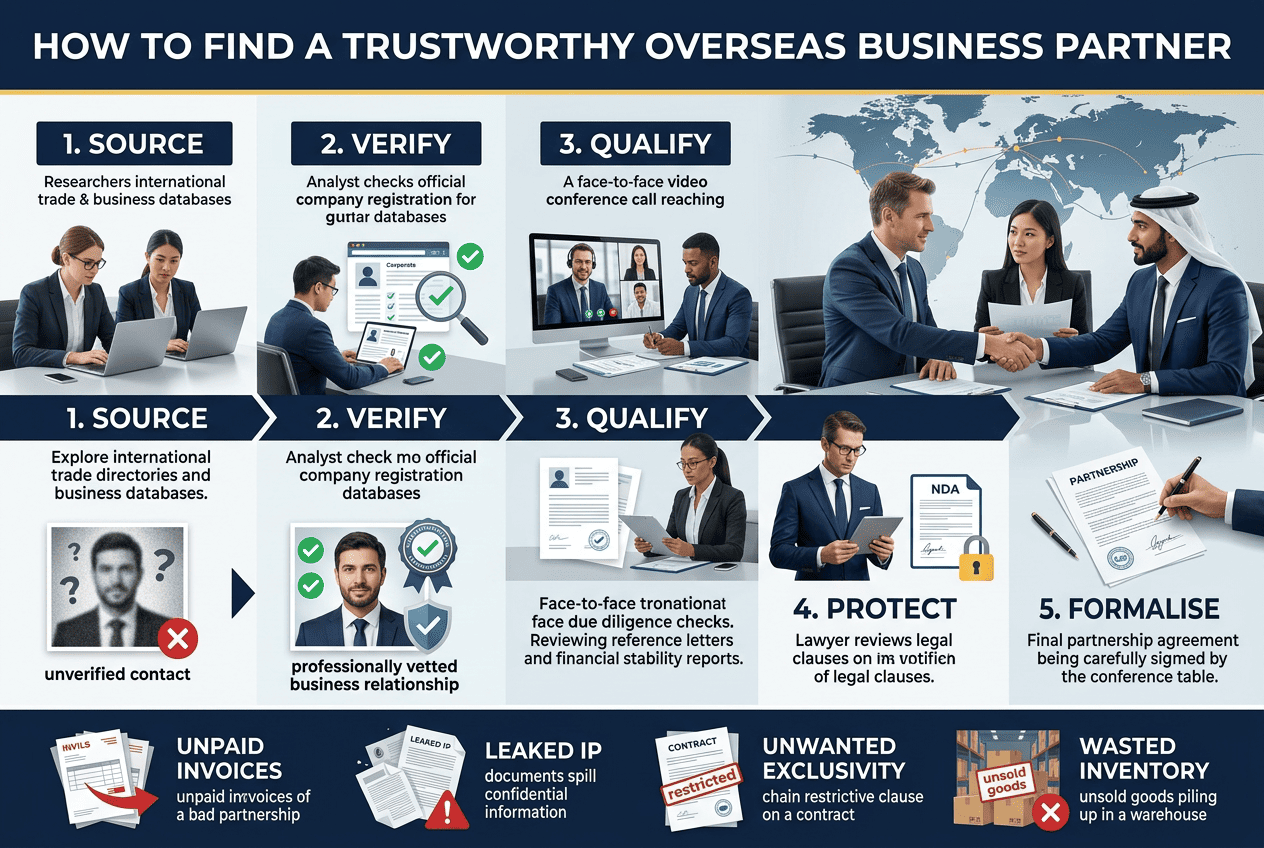
Finding a partner abroad is easy. Finding one you can trust is not. In a market where you have no existing network, anyone can look credible on a website or in a pitch, and the cost of a wrong choice, wasted inventory, a locked-in exclusive agreement, leaked specifications, or an unpaid invoice, tends to arrive months after you have committed. This guide sets out a step-by-step process for sourcing, verifying, qualifying, and formalising a reliable B2B partner overseas, and explains where manual searching stops being enough.
📅 Published October 28, 2026⏱ 15 min read✍️ GTsetu Editorial🔄 Updated October 28, 2026
A good overseas partner can give you customers, local knowledge, and operational capacity that would take years to build alone. A poor one can sit on your product line, misrepresent your brand, or tie you into an exclusive arrangement that blocks every other route to the market. The difference is rarely visible at first contact. It becomes visible only if you have a disciplined process for finding and testing candidates before you commit.
This guide walks through that process for any type of cross-border business partnership, whether you are looking for a distributor, an agent, a contract manufacturer, or a long-term supplier, and then looks at the part of it that desk research cannot solve: confirming, independently and confidentially, that the company on the other side is real, capable, and trustworthy.
💡 How to read this guide
Section 2 is the core process, in the order most companies should run it. Sections 3 and 4 give you a qualification framework and a red-flag checklist you can use immediately. Section 6 is worth reading closely if you have no existing contacts in the market and cannot easily check who is who.
Section 1
Why Finding a Reliable Partner Abroad Is Hard
The difficulty is not a lack of candidates. It is a lack of reliable information about them. Several structural problems recur across markets and sectors.
You cannot see what you cannot verify. Websites, brochures, and directory profiles are self-reported. Without independent checks, a thriving distributor and a one-person trading shell can look identical.
You lack local context. Business customs, payment norms, regulatory expectations, and what a good reference looks like all vary by country, and are hard to judge from outside.
Enthusiasm is cheap. Almost every prospective partner will say yes to almost everything at the start. What matters is capability and commitment, which only show up under scrutiny.
Recourse is limited. If a relationship goes wrong across borders, enforcing a contract or recovering money is slower and costlier than at home, which makes prevention far cheaper than cure.
Searching exposes your plans. Cold outreach to many candidates signals your strategy, pricing, and target markets before you have a single protection in place.
📌 The mindset that helps most
Treat partner selection like an important commercial hire. You would not give someone your brand and your customers on the strength of one good interview. The steps in Section 2 exist to replace first impressions with evidence.
Section 2
The Step-by-Step Process
From Search to Signed Agreement
Most companies that find reliable partners abroad work through some version of the following sequence, getting progressively more rigorous, and more costly, at each stage so that effort is only spent on candidates who have already earned it.
1
Define Your Ideal Partner Profile
Decide what “good” looks like before you start looking
Internal Step
Without a written profile, candidates end up being compared with each other rather than with the standard you actually need. Document the customers they must already serve, the geography they must cover, the portfolio that should complement yours, the financial capacity the deal requires, and any regulatory standing needed. A solid grounding in global market research makes this profile far sharper.
What it involves
Target customer segments, territory, and sales coverage required
Complementary versus conflicting product portfolios
Minimum financial capacity and compliance standing
Common mistakes
Starting the search with only a country and an industry as criteria
Describing the territory in broad terms such as “Asia-Pacific” rather than real coverage areas
🎯
Why it matters: A clear profile turns a vague search into a testable one, and makes it much easier to say no.
2
Choose the Right Partnership Model
Distributor, agent, contract manufacturer, direct sales, or a hybrid
Model Choice
Not every market needs a distributor. A distributor buys and resells, taking on commercial responsibility. An agent introduces or negotiates business on your behalf without taking ownership of the goods. Direct sales give the most control but cost more up front, and many companies blend the models, keeping strategic accounts direct while using partners for wider coverage. The legal and tax treatment of agents and distributors can differ significantly, so confirm it locally. If you are looking for international wholesale distributors, or a manufacturing partner for cross-border manufacturing, the questions you ask will differ.
What it involves
Comparing direct, distributor, agent, and hybrid models on cost, control, and speed
Deciding who owns customer relationships and who generates leads
Checking the local legal and tax difference between agency and distribution
Common mistakes
Defaulting to a distributor because it is the familiar model
Overlooking that complex, consultative sales often need more direct involvement
🎯
Why it matters: Choosing the wrong model makes even an excellent partner the wrong fit.
3
Build a Longlist From Several Channels
Never rely on a single directory, agency, or event
Combining at least three different sourcing channels
Researching how competitors already reach customers in the market
Using each channel to build a longlist, not to pick a winner
Common mistakes
Collecting business cards at an event without testing fit against your profile
Treating a directory listing or paid badge as proof of quality
🎯
Why it matters: Several sources reduce the chance that you are choosing from only the companies that happen to be loudest in one channel.
4
Independently Verify Identity and Standing
Confirm they exist, are who they claim to be, and are in good standing
Verification
Before investing serious time in any candidate, confirm their legal registration against the official registry, who owns and controls the company, and whether the registered entity matches the one that actually operates. Request customer and trade references, and check them yourself rather than relying on written testimonials. For larger commitments, proportionate commercial due diligence is worth the cost.
What it involves
Registry checks on name, address, registration number, status, and incorporation date
Ownership and control checks, and consistency of company details
Independently contacting customer and trade references
Common mistakes
Relying on the candidate’s own documents without cross-checking the registry
Skipping checks because the introduction came through a trusted-looking channel
🎯
Why it matters: This is where misrepresented or fictitious companies should be caught, but only if the checks are done rather than assumed.
5
Qualify Candidates on Consistent Criteria
Move from “looks impressive” to “can actually deliver”
Asking for evidence, not just answers, on each dimension
Verifying licences, certifications, and regulatory standing
Common mistakes
Choosing the most responsive candidate rather than the best-qualified one
Assuming certifications from the candidate’s home market meet your requirements
🎯
Why it matters: A consistent scorecard protects you from being swayed by the best salesperson rather than the best partner.
6
Run a Pilot Before You Commit
Test performance cheaply before granting exclusivity or volume
Trial Phase
A limited trial order, a short non-exclusive period, or a defined first-quarter plan shows how a partner behaves under real conditions: whether they respond promptly, report honestly, and hit agreed milestones. It is the cheapest point at which to discover that a persuasive candidate does not perform.
What it involves
A small first order or short non-exclusive trial period
Defined success metrics and a scheduled review
Observing communication, reporting, and problem-solving
Common mistakes
Granting broad exclusivity before any performance has been demonstrated
Running a pilot with no agreed measures of success
🎯
Why it matters: Real behaviour is a better predictor than any presentation or reference.
7
Formalise the Relationship and Onboard
Put the terms in writing and set an operating rhythm
Contract & Onboarding
Once a partner has passed verification, qualification, and a pilot, formalise the relationship in a written agreement that defines territory, products, pricing, reporting, performance reviews, confidentiality, and what happens on exit. Agree up front how risk is allocated in the cross-border deal, and use the first 90 days to train the partner, agree a target-account list, and hold the first formal review. The specific terms to understand are covered in Section 5.
What it involves
A written agreement with a precise territory, KPIs, and review points
Clear exit terms covering inventory, customer data, and IP
A 90-day onboarding plan with a first formal performance review
Common mistakes
Launching on informal terms “to save time”
Assuming your home jurisdiction’s law and courts are automatically the right choice
🎯
Why it matters: The quality of your written agreement is one of the best predictors of how the relationship behaves under pressure.
Section 3
Six Dimensions to Qualify a Partner
Use the same six dimensions for every candidate. The point is not to collect answers but to collect evidence you can independently check.
Dimension
Questions to Ask
Evidence to Request
1. Market reach & customer relationships
Which companies in our target segment do you already supply? What territory and sectors do you cover?
Customer references, territory coverage, sector breakdown, case studies
2. Sales capability & commitment
How many people would work on our product? How many other lines do they carry? What is your first-year plan?
Sales organisation structure, account plan, first-year business development plan
3. Financial standing
Can you meet minimum orders? How do you finance inventory? What are your payment practices?
Trade references, financial statements, credit information, bank references where appropriate
4. Regulatory & compliance standing
Are you licensed for what you do? Are there industry-specific requirements? Any past enforcement actions?
Licences, registrations, certifications, public regulatory records
5. Strategic alignment
Why do you want to represent us? What competing products do you carry? How would you prioritise us?
Go-to-market plan, target customer list, competitive portfolio information
6. Cultural & commercial fit
What does exclusivity mean to you? Who owns the customer, generates leads, and funds marketing?
Documented shared expectations, agreed review frequency, escalation process
💡 A useful rule of thumb
Scale the depth of checking to the size of the exposure. A small, non-exclusive pilot warrants lighter diligence. Exclusive rights, significant inventory, or sharing core intellectual property warrant the full process.
Section 4
Red Flags and What to Do About Them
Knowing what a good partner looks like is only half the job. You also need clear triggers to pause or walk away. Most of these are not automatic disqualifiers, they are prompts to ask harder questions.
Warning Sign
Why It Matters
What to Do
Demands broad exclusivity early
Exclusivity should follow demonstrated capability and commitment, not precede it
⚠ Tie any exclusivity to measurable targets and review dates
Opaque ownership or inconsistent company details
You must know who you are actually contracting with and who controls them
✗ Pause until registry checks resolve the inconsistency
No verifiable customer references
Claimed market access without evidence is a claim, not a fact
✗ Require independently checkable references
Unrealistic sales projections
Large first-year numbers with no pipeline, resources, or assumptions behind them
⚠ Ask which customers, what value, what timeline, who manages them
Resists reporting and performance reviews
A partner unwilling to be measured cannot be managed
⚠ Clarify why before proceeding, and agree light KPIs
Pressure to pay or ship before any checks
Urgency before verification is a classic feature of fraud
✗ Do not pay or ship until identity and standing are verified
Existing relationship with a direct competitor
Not disqualifying on its own, but conflicts of priority and confidentiality arise
⚠ Agree how conflicts and confidential information will be handled
📌 Protect yourself before you share anything
Pricing, drawings, formulations, and customer lists are often exchanged long before a contract exists. Put an NDA in place first, and avoid sending sensitive material by open email attachment. Section 6 covers how a verified platform builds this into the process.
Section 5
Contract Terms to Lock In Before You Commit
A handful of terms come up in almost every cross-border partner, distributor, or supply agreement. Understanding them before you negotiate puts you in a much stronger position, and the agreement should always be reviewed by qualified legal counsel in the relevant jurisdiction.
Master Services Agreement (MSA) sets the overarching terms for an ongoing relationship, under which individual orders or statements of work sit.
Consequential damages cover indirect losses such as lost profits, and are frequently limited or excluded.
Termination for convenience lets a party exit without cause on agreed notice, a vital clause if a partner underperforms.
Asset purchase agreements become relevant if a partnership evolves into the acquisition of a partner’s business or assets.
Beyond these, make sure the agreement addresses a precisely defined territory, pricing and payment terms, reporting and KPIs, intellectual property and confidentiality, what happens to inventory and customer data on exit, and the governing law and dispute-resolution method. Be aware that competition law in some markets restricts certain exclusivity and resale-pricing terms, so take local advice before finalising them.
💡 A practical habit
Before signing, read the draft once looking only for how it handles each term above. If any of them are silent or vague, raise it before signature, not after a dispute.
Section 6
Manual Search vs. Verified Partner Discovery: A Different Bottleneck
The process above works, but its slowest and riskiest stages are the early ones: finding candidates and confirming who they really are. Manual searching through referrals, events, and cold outreach is time-consuming, exposes your plans before you have any protection in place, and relies heavily on self-reported information. In a market where you have no network, it is hard to tell a legitimate operator from a convincing imitation using public information alone.
That is a discovery and trust problem, distinct from the qualification work that follows. Solving it earlier means you spend your diligence budget only on candidates that already exist, are in good standing, and have agreed to protect what you share.
What you need
Manual Search (referrals, events, cold outreach)
Verified Partner Platform
Finding a partner through a trusted contact you already have
✓ Often the fastest, most trusted route
⚠ Complementary, not required
Finding candidates in a market where you have no network
✗ Slow, relies on cold outreach and agents
✓ Purpose-built for exactly this
Confirming a company’s legal registration before investing time
✗ Manual, country-by-country registry checks
✓ Government-sourced verification upfront
Evaluating candidates without revealing your plans
✗ Outreach exposes your strategy early
✓ Anonymous discovery until mutual interest
Protecting specs and pricing while you evaluate
⚠ Depends on ad hoc NDAs, if used at all
✓ Built-in digital NDA workflow
Comparing candidates across several countries in one place
✗ Separate networks and searches per country
✓ Centralised across 100+ countries
🤝 For Finding Verified Partners Abroad
GTsetu: Verification Built Into Discovery, Before You Ever Make Contact
GTsetu is not a replacement for your own qualification process, it front-loads the hardest part of it. Every company on the platform is verified on 6 government-sourced points before engagement, so the identity-confirmation work that normally takes the first weeks of any overseas partner search is already done. You can browse anonymously, execute an NDA digitally before any commercial information changes hands, and exchange documents through an encrypted workspace, all before committing to the deeper checks and the pilot.
GTsetu is used by manufacturers, distributors, and raw material suppliers across 100+ countries to find and formally engage verified partners for the long term, whether that means a distributor in a new market, a contract manufacturing partner, or a dependable supplier.
🏛️
6-Point Government-Sourced Verification
Name, Address, Registration Number, Company Status, Company Type, and Date of Incorporation, verified using government tie-ups before any engagement.
🕵️
Anonymous Discovery
Browse verified partner profiles across 100+ countries without revealing your identity or commercial strategy until you choose to engage.
📄
Built-In NDA Workflow
Digital NDA with timestamped signatures before any pricing, formulations, or product specs are shared.
🔐
Encrypted Document Workspace
All commercial documents shared through encrypted channels with a full access audit trail, not email attachments.
🌍
100+ Countries
Verified manufacturers, distributors, and raw material suppliers across Asia, the Middle East, Europe, Africa, Australia, and the Americas.
🚫
Zero Commission
No success fee, no broker commission, ever. Your partnership economics remain entirely between you and your partner.
📌 Verification shortens the process, it does not replace judgement
A verified profile tells you a company is real and in good standing. It does not tell you whether they are the right fit for your product, which is why the qualification dimensions, pilot, and contract steps still apply. Most companies use verified discovery to find who to evaluate, and their own diligence and legal counsel to decide who to trust.
Section 7
Which Approach Fits Your Situation?
Use this reference to match your next move to where you actually are in the process.
📝
You haven’t defined what a good partner looks like
Every candidate seems plausible and you have no objective way to compare them.
Start with Step 1
⚖️
You’re unsure whether you need a distributor, agent, or direct sales
The right model depends on your product, sales cycle, and appetite for control.
Review Step 2
🔍
You have no network in the target market
Cold outreach feels slow and risky, and you can’t verify who is who.
GTsetu
🧾
You have a shortlist and need to choose between candidates
You want an objective, evidence-based comparison.
Use the six dimensions (Section 3)
🚩
A candidate is pushing for exclusivity or fast payment
Something feels rushed and you want to sense-check it.
Review red flags (Section 4)
🔒
You need to share specs and pricing before a contract exists
You want NDA protection and an encrypted workspace from day one.
GTsetu (built-in NDA)
📜
You’re about to negotiate the agreement
You want to understand the key terms before you’re in the room.
Review Section 5
🧭
You want structured help running the whole search
You would rather bring in outside expertise than build the process in-house.
QHow do you find reliable B2B partners in a foreign market?
Define your ideal partner profile first, then build a longlist from several channels such as trade agencies, industry associations, trade fairs, LinkedIn, and verified partner platforms. Independently verify each candidate’s legal registration and ownership, qualify them across factors like market reach, sales capability, financial standing, compliance, and strategic fit, and run a small pilot before committing to a long-term or exclusive agreement.
QHow can I verify that a foreign business partner is legitimate?
Check the company’s registration against the official registry in its country, confirm who owns and controls it, look for consistency between the registered entity and the one actually operating, request and independently check customer and trade references, and review any licences or certifications required for its sector. Platforms that verify companies against government sources can shorten this step considerably, and proportionate commercial due diligence is worth doing before significant commitments.
QWhat are the red flags when choosing an overseas partner?
Common warning signs include demanding broad exclusivity before demonstrating any capability, unclear ownership or inconsistent company details, no verifiable customer references, unrealistic sales projections without a supporting pipeline, resistance to measurable performance reviews, and pressure to pay large amounts upfront before any verification has taken place.
QShould I give a foreign distributor exclusivity?
Not automatically. Exclusivity can make sense when a distributor commits meaningfully to your business, but it should be tied to measurable performance expectations and review points rather than granted indefinitely. Competition law in some markets also limits certain exclusivity and pricing arrangements, so take local legal advice before agreeing terms, and consider how termination for convenience would work if the relationship underperforms.
QHow long does it take to find and onboard a partner abroad?
There is no universal timeline. The process involves market research, longlisting, verification, qualification, a pilot, contract negotiation, and onboarding, and the duration depends on the market, the product, regulatory requirements, and how many candidates you assess. Companies with an existing network or a verified discovery platform can move through the early stages faster, but the priority should be choosing the right partner rather than signing quickly.
QHow do I find a reliable manufacturing or supply partner rather than a distributor?
GTsetu front-loads the hardest part of finding a partner abroad, verified identity and confidential discovery, so your team can focus its diligence on fit, capability, and terms. Government-sourced verification, built-in NDA workflows, and zero commission, across 100+ countries.
They represents the product, and research team behind GTsetu, a global B2B collaboration platform built to help companies explore cross-border partnerships with clarity and trust. The team focuses on simplifying early-stage international business discovery by combining structured company profiles, verification-led access, and controlled collaboration workflows.
With a strong emphasis on trust, and disciplined engagement, Team GTsetu shares insights on global trade, partnerships, and cross-border collaboration, helping businesses make informed decisions before entering deeper commercial discussions.