Best Platforms to Find Verified International Buyers (2026 Guide) | GTsetu
Home ›
Blog ›
Best Platforms to Find Verified International Buyers
🔎 Global Trade & Exporting
Best Platforms to Find Verified International Buyers in 2026
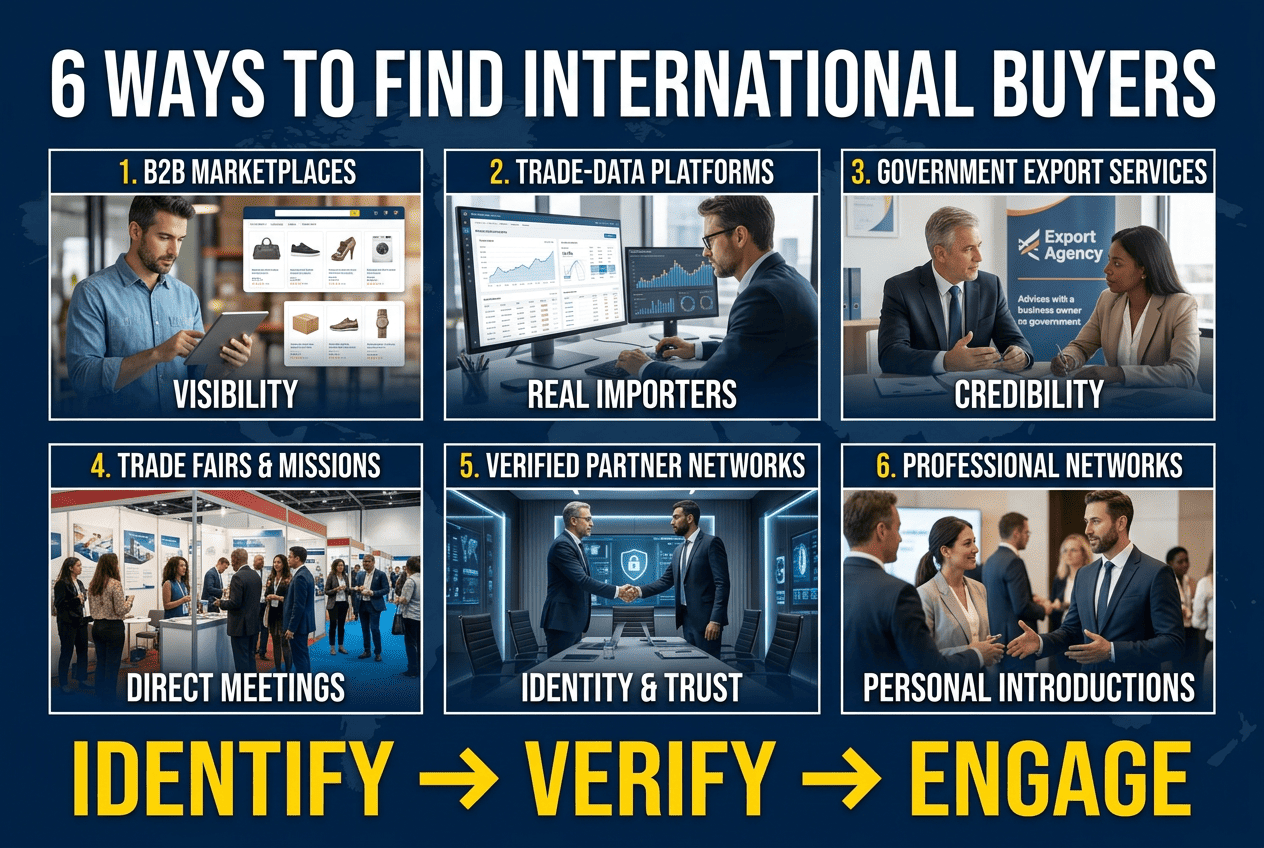
Direct Answer: There is no single best platform for finding international buyers. The main options are B2B marketplaces (Alibaba, Global Sources, IndiaMART, TradeIndia and others), trade data platforms built on shipment records, government export services, trade fairs and missions, verified partner networks such as GTsetu, and direct outreach through professional networks. Each solves a different problem: marketplaces build visibility, trade data shows who is actually importing, government services add credibility, and verified networks confirm who you are dealing with. Because “verified” means different things on different platforms, the safest approach is to combine tools in sequence (identify, verify, engage) and always run your own checks before shipping goods, sharing specifications or accepting payment terms. GTsetu connects exporters with government‑tie‑up verified partners across 100+ countries, with built-in NDA workflows and zero broker commission.
📅 Published October 28, 2026🔄 Updated October 28, 2026⏱ 15 min read✍️ GTsetu Editorial Team
6
Platform Types Compared
3
Layers: Identify, Verify, Engage
100+
Countries on GTsetu
0%
Broker Commission
Every exporter eventually asks the same question: where do I find real buyers, and how do I know they are real? The market is crowded with options. Some platforms promise inbound inquiries, others sell shipment data, others run trade missions or match you with partners. Many describe their members as “verified,” yet that single word can mean anything from a confirmed company registration to a completed profile.
Manufacturers and exporters (including Indian exporters), trading companies, small and medium businesses entering new markets, and business development teams who want a clear, honest view of where to look for overseas buyers.
⚖️ Editorial & Compliance Disclaimer
GTsetu is itself a verified partner network, so we have a commercial interest in this topic. We have tried to describe every category fairly, but platform features, pricing and verification practices change often; check each provider’s current terms. Many of the sources we draw on are vendor blogs. This guide is general commercial education, not legal, financial or compliance advice. Always run your own due diligence before shipping goods or accepting payment terms.
SECTION 1
1 What Does a “Verified” International Buyer Mean?
🎯 Definition
A verified international buyer is a company whose identity, existence or activity has been checked against evidence, rather than accepted on its own word. What is checked varies widely: it may be legal registration (confirmed against official records), real import activity (seen in customs or shipment data), or simply a completed profile. A verified status reduces risk but never replaces your own due diligence.
Before comparing platforms, it helps to separate four different things a platform might verify. They answer different questions, and most platforms cover only one or two.
🏛️
Legal Identity
Is this a real, registered company? Checks such as legal name, registration number, registered address, status and incorporation date answer this.
🚢
Trading Activity
Does it actually import your product? Customs and shipment records can show frequency, volume and current suppliers.
💳
Financial Reliability
Will it pay? Credit reports, bank references and payment history answer this. Few buyer platforms verify it.
📜
Compliance & Standards
Does it meet regulatory and certification requirements for your product category in its market?
Here is each route to international buyers in a single view, with what it does best.
B2B Marketplaces
Inbound visibility
List products and let buyers find you. Large reach, but crowded and largely passive.
🛒 Visibility
Trade Data Platforms
Who is really importing
Mine customs and shipment records to find companies already buying your product category.
📊 Targeting
Government Services
Official support
Partner searches, company profiles, matchmaking and trade missions run by export promotion bodies.
🏛 Credibility
Trade Fairs & Missions
Face-to-face
Meet many buyers in person and gauge them directly, at higher cost and effort.
🤝 Relationships
Verified Partner Networks
Identity first
Connect with companies whose legal identities are confirmed, then collaborate under NDA.
✅ Trust
Direct Outreach
LinkedIn & email
Approach decision-makers directly. Cheap and flexible, but unverified and effort-heavy.
📨 Targeted
📌 A Common Industry Insight
One trade-data vendor argues that marketplaces are passive (buyers find you), directories are self-reported, and shipment data is active (you find buyers who already import your category), and recommends using the three in that order of priority: data first, then verification, then marketplace presence for credibility. Whether or not you buy that vendor’s product, the sequencing logic is sound, and we build on it in Section 8.
SECTION 3
3 B2B Marketplaces
B2B marketplaces are online platforms where suppliers list products and buyers search, compare and send inquiries. They are the most visible option and a common first step for exporters entering a new market.
Platform
Typically Strongest In
Common Industry Fit
What to Know
Alibaba
Global, Asia-heavy
Almost all categories
Very high volume with variable buyer quality; offers transaction protection features
Global Sources
Asia to global
Electronics, fashion, home goods
Focus on verified suppliers and runs trade shows
IndiaMART
India and South Asia
Manufacturing, industrial, SMEs
Large Indian SME base with direct buyer inquiries
TradeIndia
South Asia, Middle East, Africa
Manufacturing, industrial
Strong for Indian exporters; listings and buyer-seller interface
Tradewheel
Global wholesale
Diverse wholesale categories
Emerging marketplace with inquiry management tools
EC21 / ExportHub
Global SME, Asian suppliers
Diverse
Entry-level exposure, often to emerging-market buyers
Europages
Europe
Industrial and B2B services
European buyer focus
SeeBiz
Global
Electronics, apparel, health and beauty
Bulk-oriented marketplace for manufacturers and wholesalers
Summarised from public roundups by EximPe and TradeInt. Platform descriptions are general and may be out of date; check each marketplace’s current terms, fees and verification practices.
✅ Strengths
✅Reach & Visibility: Millions of users and built-in search traffic.
✅Low Barrier to Entry: Quick to list and suitable for first-time exporters.
✅Supporting Tools: Inquiry management, analytics, promotion and sometimes payment protection.
✅Credibility Signal: A well-kept profile lets buyers independently check you.
⚠️ Limitations
⚠️Crowded & Passive: You compete with thousands of similar suppliers and depend on listing quality.
⚠️Variable Buyer Quality: Many inquiries are low intent or price-shopping.
⚠️Uneven Verification: What “verified” covers differs by platform and tier.
⚠️Ongoing Costs: Premium placement and promotion fees can add up.
✨ GTsetu Insight
To get more from marketplaces, put the correct HS code and technical specifications in listings (not only category tags), respond quickly, and list the standards you meet. For guidance on which standards buyers expect, see manufacturing certifications for international trade.
SECTION 4
4 Trade Data Platforms & Free Research Tools
Trade data platforms collect customs filings, bills of lading and port manifests to show which companies import which products, how often, in what volume and from which suppliers. Instead of waiting for inquiries, you find buyers who are already purchasing your category.
1
Paid Shipment-Data Platforms
Providers in this space include TradeInt, Descartes Datamyne, ImportGenius and Trademo, each with a different emphasis: global coverage, logistics analysis, U.S. data research or compliance and risk monitoring. Pricing is typically subscription-based and higher than marketplace entry tiers.
Best for: targeted outbound prospecting
2
Free Statistics Tools
ITC Trade Map and UN Comtrade show country-level import and export statistics by product code. They tell you that a market imports your product, not who the buyers are. Ideal for choosing target countries.
Best for: market selection
3
What to Filter For
Look for repeat importers rather than one-off buyers, order volumes that match your capacity, rising purchase trends and current suppliers whose prices or terms you can beat.
Best for: shortlisting
📌 Know the Limits
Shipment records prove that a company has imported, not that it is trustworthy, solvent or a good fit. Records can be incomplete, vary by country, and the same product may carry different codes in different markets. Use trade data to identify buyers, then verify them separately. For choosing which markets to research first, read global market research for manufacturers.
SECTION 5
5 Government Services, Trade Fairs & Missions
Export promotion agencies and trade bodies offer some of the most credible, if slower, routes to foreign buyers. Their services often include partner searches, company background reports and organised meetings.
🏛️
Partner Search & Matchmaking
Programmes such as the U.S. Commercial Service’s International Partner Search and Gold Key Service identify, vet and arrange meetings with potential partners. Many countries run comparable services through their export promotion bodies.
🔎
Company Background Reports
The U.S. International Company Profile, for example, gives background on a foreign company. Ask your own country’s trade body whether a similar report is available.
🎪
Trade Fairs
A good way to meet many potential customers in a short time, observe them in person and see competitors. Prepare targets and follow-ups in advance.
✈️
Trade Missions
Government-led missions provide visibility and on-the-ground support for entering a new country, often with pre-arranged meetings.
✨ GTsetu Insight
If you are an Indian exporter, check export promotion councils, industry associations and the commercial wings of Indian missions abroad for equivalent programmes. Regional ecosystems also create visibility; see how innovation clusters build international links in Maharashtra’s FTI and the future of quantum technology in Pune. For an example of entering a European industrial market, read the Czech Republic expansion guide.
SECTION 6
6 Verified Partner Networks & Direct Outreach
The newest category pairs discovery with identity confirmation. Rather than listing products for anyone to see, verified partner networks check who is on the platform and then let companies connect and collaborate under confidentiality.
🎯 How GTsetu Fits In
GTsetu is a verified partner network for manufacturers, exporters, importers and distributors across 100+ countries. Every company is verified through direct government tie-ups on six credentials: legal name, registered address, registration number, company status, company type and incorporation date. Members can discover profiles anonymously, sign a built-in NDA before sharing sensitive information, and collaborate through encrypted channels, with zero broker commission. GTsetu does not verify certifications, product quality, financial standing or shipment history, so you still complete those checks with each prospect.
Direct Outreach: LinkedIn, Email and Referrals
Professional networks let you approach decision-makers directly. This is flexible and inexpensive, but unverified: profiles can be fabricated, and outreach quality determines results. It works best when combined with data. A message that references a company’s actual import category and current sourcing is far more likely to get a reply than a generic introduction. Referrals from existing customers, freight forwarders and industry associations are also valuable, because they come with a trusted introduction.
The table summarises how each platform type typically compares. Actual results depend on your product, market and effort.
Platform Type
Approach
What Is Typically Verified
Typical Cost
Best For
B2B Marketplaces
Passive, inbound
Varies by platform and tier
Low to medium; premium tiers extra
Visibility and first-time exporters
Trade Data Platforms
Active, outbound
Real import activity (from records)
Medium to high
Targeting active buyers
Government Services
Assisted matchmaking
Often vetted by officials or reports
Low to medium, may be fee-based
Credibility and market entry
Trade Fairs & Missions
In person
Your own judgement
High (travel, booth)
Relationship building
Verified Partner Networks
Discovery plus collaboration
Legal identity (e.g., GTsetu: six government-sourced credentials)
Varies; GTsetu charges zero commission
Trusted, confidential first contact
Direct Outreach
Active, manual
Nothing automatically
Low, but time-intensive
Targeted prospects and referrals
SECTION 8
8 How to Choose and Combine Platforms
The most effective exporters do not pick one tool. They use several in a sensible order. Start with this quick guide, then follow the three-layer workflow.
🧭 Quick Guide: Which Platform Fits Your Situation?
First-time exporter, limited budget?
B2B marketplace + free tools
Start lean
Build visibility and use free statistics to pick markets.
Know your product and target market?
Trade data platform
Target
Find companies already importing your product code.
Worried about fraud or unknown counterparties?
Verified partner network
Trust
Confirm legal identity first, then sign an NDA.
Need credibility in a new country?
Government services
Official
Use partner searches, company profiles and missions.
Selling high-value, relationship-driven products?
Trade fairs + outreach
Relationships
Meet in person and follow up with context-rich messages.
Want distributors, not just buyers?
Verified network + marketplaces
Channel
See international wholesale distributor guidance.
The Three-Layer Buyer Discovery Workflow
1
Layer 1: Identify
Use free statistics to choose target countries by product code, then use trade data, marketplaces or government partner searches to build a long list of companies that plausibly buy what you make.
2
Layer 2: Verify
Confirm each shortlisted company’s legal identity through official registries and a verified network, cross-check trade records and professional profiles, and review reputation. See partnership evaluation criteria.
3
Layer 3: Engage
Reach out with specifics (their product category, your advantage), supported by a credible marketplace or platform profile. Sign an NDA before sharing drawings, formulas or pricing.
4
Then: Pilot, Then Scale
Start with a sample or small trial order on protected payment terms before committing volume or exclusivity.
SECTION 9
9 How to Verify a Buyer Yourself
Whatever platform you use, complete these checks before shipping goods. Most are free or inexpensive and take little time.
1
Confirm Legal Existence
Match the company’s name, registration number and registered address against the official company registry of its country. Check that its status is active and incorporation dates make sense.
Registry check
2
Check Real Activity
Look for a working website with history, consistent contact details, a physical address, shipment records where available, and a consistent professional presence.
Trading evidence
3
Request References
Ask for trade references, supplier contacts and a bank reference, and actually contact them. A credit report or background profile adds another layer.
Third-party proof
4
Meet Decision-Makers
Hold a video call with named directors or purchasing leads. Confirm their roles through independent sources, not just the details they supply.
Human verification
5
Screen for Compliance
Check sanctions and restricted-party lists and import restrictions for your product in the buyer’s country, and confirm product standards that apply. See NSF sanitation certification as an example for food-contact goods.
Regulatory screening
6
Start Small
Begin with a sample or trial order on secure terms and expand only after the buyer pays and performs as promised.
Pilot first
SECTION 10
10 Red Flags and Payment Risk
Fake or risky buyers follow recognisable patterns. Treat these signs as reasons to slow down.
🚩
Upfront Fees to “Release” an Order
Requests for sample, inspection, customs or “bank” fees before the deal is secured are a classic fraud signal.
🚩
Pressure and Urgency
Pushes to move off-platform fast, skip due diligence or ship before payment terms are agreed.
🚩
Inconsistent Details
Company name, email domain, address or signatories that do not match registry records.
🚩
Unusual Payment Requests
Unusually large first orders paired with unorthodox payment methods or refusal to use secure terms.
📌 Protect Your Payment
Prefer secured payment structures: letters of credit, escrow, partial advances with the balance against documents, or export credit insurance (for example, through a national export credit agency such as ECGC in India). Agree delivery terms clearly using Incoterms 2020; FCA (Free Carrier) is a common choice for containerised exports. Take advice from your bank and a trade finance specialist on what suits each deal.
SECTION 11
11 Contracts & Terms That Protect You
Finding a buyer is only the beginning. A clear written agreement turns a promising conversation into a protected sale.
Clause 01
Master Services Agreement
A framework for repeat business with agreed terms, pricing mechanisms and responsibilities. See the MSA guide.
Clause 02
Warranty
Defines quality commitments and remedies for defective goods. See warranty clause.
12 How GTsetu Helps Exporters Find Verified Buyers
🌐 Platform Spotlight, GTsetu
Your Verified Gateway to International Buyers and Partners
Finding buyers is easy; finding buyers you can trust is the hard part. GTsetu connects manufacturers, exporters, importers and distributors with government‑tie‑up verified partners across 100+ countries, with built-in NDA workflows and encrypted collaboration. Every company on GTsetu is verified using direct government tie‑ups across six essential credentials: legal name, registered address, registration number, company status, company type, and date of certificate of incorporation. GTsetu does not verify industry certifications, shipment history, product quality, creditworthiness or financial standing; those must be exchanged and validated directly between partners.
✅
Government Tie‑Up Verification
6‑point verification: legal name, registered address, registration number, company status, company type, incorporation date.
📜
Certifications & Credit
GTsetu does not verify these. They must be exchanged directly between partners during due diligence.
🕵️
Anonymous Discovery
Explore verified buyer, importer and distributor profiles without revealing your identity until mutual interest is confirmed.
📄
Built-In NDA Workflow
Formalise confidentiality before sharing specifications, pricing, or proprietary information, with a full digital audit trail.
🚫
Zero Commission
No broker fees on any deal, whether a distribution agreement, supply contract, or technology partnership.
🔐
Encrypted Collaboration
All documents and communications encrypted in transit and at rest. Cross-border partnerships from first contact.
🌍
100+ Countries
Active verified network of distributors, importers and manufacturers.
QWhat are the best platforms to find verified international buyers?
There is no single best platform. The main options are B2B marketplaces (such as Alibaba, Global Sources, IndiaMART and TradeIndia), trade data platforms based on shipment records, government export promotion services, trade fairs and missions, verified partner networks such as GTsetu, and direct outreach through professional networks. Most exporters get the best results by combining several in sequence.
QWhat does a verified buyer actually mean?
It depends on the platform. Verification can mean confirmed legal registration, a checked business address, evidence of real import activity in trade records, or simply a completed profile. Always ask what a platform verifies and what it does not, and complete your own checks before shipping goods or sharing sensitive information.
QHow do I verify an international buyer before shipping?
Confirm the company’s legal registration and address in official registries, check trade records for genuine import history, ask for trade and bank references, speak with decision-makers on video, start with a smaller sample or trial order, and use secure payment terms such as a letter of credit, escrow or export credit insurance rather than unsecured advance trust.
QAre B2B marketplaces good for finding international buyers?
They provide visibility and inbound inquiries, especially for exporters entering new markets, but they are largely passive and crowded, so results depend heavily on listing quality and response speed. Verification levels vary, so inquiries still need to be vetted.
QWhat are warning signs of a fake or risky buyer?
Common warning signs include requests for upfront fees or sample charges to release an order, pressure to move off-platform quickly, inconsistent company details, no verifiable registration or website history, unusually large first orders with unusual payment methods, and reluctance to use secure payment terms.
QHow should exporters combine different platforms?
A practical sequence is to identify target markets and active importers with trade data, verify shortlisted companies through registries and verified networks, and then engage through direct outreach supported by a credible marketplace or profile presence, using government services or trade fairs where in-person introductions help.
QHow does GTsetu help exporters find verified international buyers?
GTsetu connects manufacturers, exporters, importers and distributors with government-tie-up verified partners across 100+ countries. Verification covers six core credentials (legal name, registered address, registration number, company status, company type, incorporation date). GTsetu also offers anonymous discovery, built-in NDA workflows, encrypted collaboration and zero broker commission.
Join 500+ verified manufacturers, exporters, and importers already building cross-border partnerships on GTsetu, with government‑tie‑up verification of six core credentials, built-in NDA workflows, and zero broker fees across 100+ countries. Start connecting with trusted buyers today.
They represents the product, and research team behind GTsetu, a global B2B collaboration platform built to help companies explore cross-border partnerships with clarity and trust. The team focuses on simplifying early-stage international business discovery by combining structured company profiles, verification-led access, and controlled collaboration workflows.
With a strong emphasis on trust, and disciplined engagement, Team GTsetu shares insights on global trade, partnerships, and cross-border collaboration, helping businesses make informed decisions before entering deeper commercial discussions.