Best Platforms to Find Reliable Overseas Manufacturers (2026 Guide) | GTsetu
Home ›
Blog ›
Best Platforms to Find Reliable Overseas Manufacturers
🏭 Global Trade & Sourcing
Best Platforms to Find Reliable Overseas Manufacturers in 2026
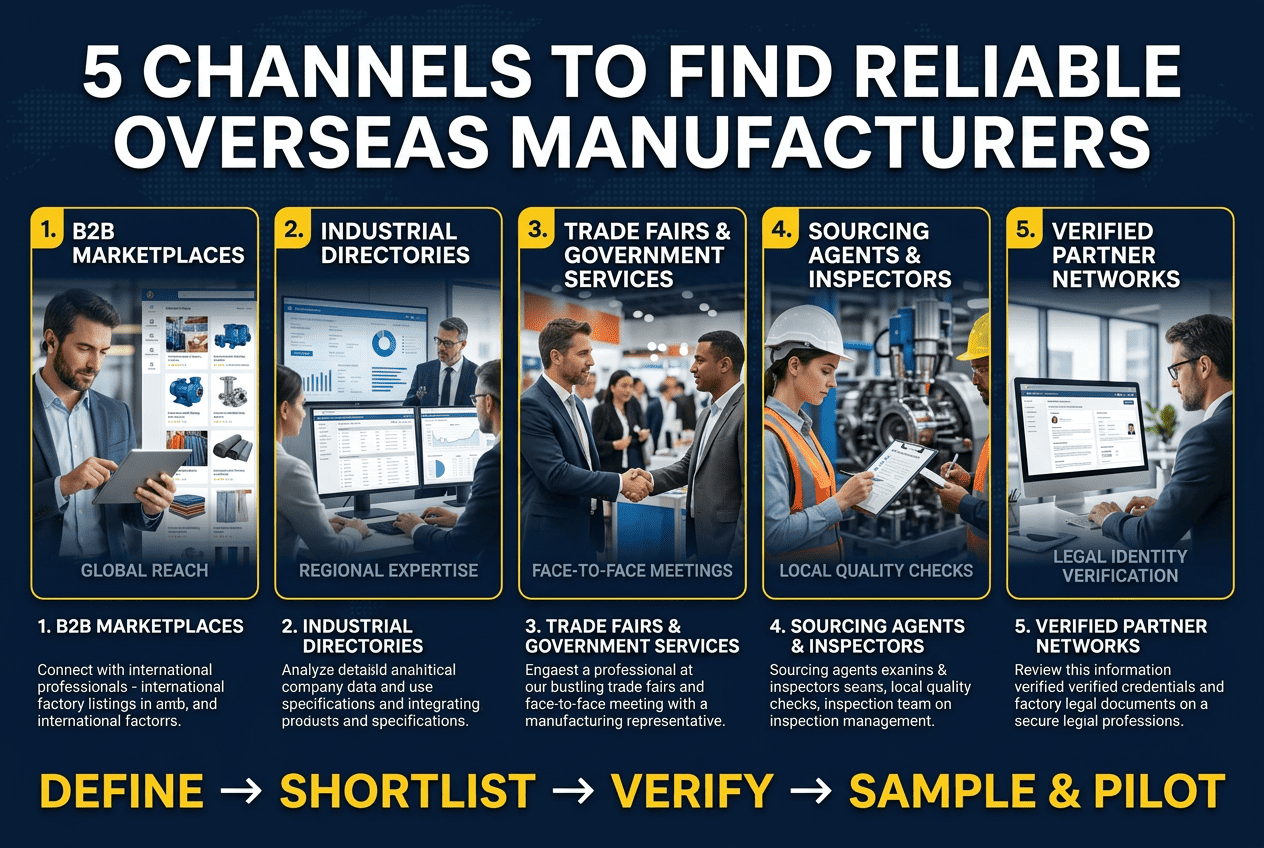
Direct Answer: No single platform is best for finding reliable overseas manufacturers. The main options are B2B marketplaces (Alibaba, Global Sources, IndiaMART, TradeIndia), regional and industrial directories (such as ThomasNet for North America and Europages for Europe), trade fairs and government export services, sourcing agents and inspection firms, and verified partner networks such as GTsetu. Marketplaces give reach, directories give regional and industrial focus, trade fairs let you judge people face to face, agents and inspectors add local eyes, and verified networks confirm who a company legally is. Because every platform only verifies part of the picture, reliable sourcing needs a repeatable process: define your specification, shortlist from several channels, verify identity and capability, then test with samples and a small order before committing volume. GTsetu connects you with government‑tie‑up verified manufacturers across 100+ countries, with built-in NDA workflows and zero broker commission.
📅 Published October 28, 2026🔄 Updated October 28, 2026⏱ 15 min read✍️ GTsetu Editorial Team
6
Sourcing Channels Compared
4
Steps: Define, Shortlist, Verify, Sample
100+
Countries on GTsetu
0%
Broker Commission
Finding a manufacturer abroad is easy. Finding one that delivers the right quality, on time, at the agreed price, order after order, is much harder. A polished profile on a sourcing website says little about whether a factory can hold tolerances, pass an audit or survive a bad quarter. And with tariffs, freight disruption and shifting costs pushing many buyers to look beyond a single country, the number of unfamiliar suppliers to evaluate keeps growing.
Brand owners, importers, product developers, procurement teams and startups sourcing finished goods, components or private-label products from overseas factories, as well as manufacturers looking for contract-manufacturing and sub-supplier partners.
⚖️ Editorial & Compliance Disclaimer
GTsetu is itself a verified partner network, so we have a commercial interest in this topic. We have tried to describe every channel fairly, but platform features, fees and verification practices change often; check each provider’s current terms. Several sources we drew on are vendor blogs. This guide is general commercial education, not legal, tax, customs or compliance advice. Always run your own due diligence before paying a deposit or placing an order.
SECTION 1
1 What Makes an Overseas Manufacturer “Reliable”?
🎯 Definition
A reliable overseas manufacturer is a legally registered producer that consistently meets your specification, quality and delivery commitments, complies with the regulations that apply to your product, communicates transparently, and remains financially and operationally stable over time. Reliability is demonstrated by evidence (audits, samples, references, performance history), not by marketing claims.
Reliability has several dimensions, and each can fail independently. A platform may help you check one or two; the rest is up to your own process.
🏛️
Legal Identity
Is it a registered company with a verifiable name, address, registration number and active status?
⚙️
Capability & Capacity
Does it have the equipment, skills and capacity to make your product at your volume and tolerance?
✅
Quality & Compliance
Does it hold the certifications and testing capability your market requires, and follow them in practice?
💬
Communication & Transparency
Does it respond quickly, answer awkward questions honestly and share real production information?
📈
Stability & Delivery Record
Can it deliver on time, repeatedly, and withstand cost or demand shocks without failing you?
🤝
Ethics & Governance
Does it follow labour, safety and environmental norms, and respect your intellectual property?
Here is each channel in a single view, with what it does best and the main thing to watch.
B2B Marketplaces
Maximum reach
Large online platforms listing thousands of suppliers across product categories and countries.
🛒 Breadth
Regional Directories
Focused search
Industrial and regional databases with filters for certifications, locations and capacity.
🗂 Focus
Trade Data
Evidence of activity
Customs and shipment records showing who actually exports a product and to whom.
📊 Proof
Trade Fairs & Government
Face to face
Exhibitions, missions and official partner-search services that put you in front of vetted suppliers.
🤝 Relationships
Agents & Inspectors
Local eyes
Sourcing agents, consultants and third-party inspection firms who check suppliers on the ground.
🔍 On the ground
Verified Networks
Identity first
Platforms that confirm legal identity before introductions and protect early collaboration with NDAs.
✅ Trust
📌 Why Buyers Are Looking Beyond One Country
One recent sourcing guide notes that rising tariffs, higher labour costs, unreliable freight in parts of Asia, demand for ethical sourcing and geopolitical tension are pushing many buyers to explore suppliers outside their traditional base. Diversification is now a mainstream strategy; see our guide on global market research for manufacturers for how to evaluate new markets.
SECTION 3
3 B2B Marketplaces
Marketplaces are the usual first stop. They offer huge supplier choice, quick comparison and built-in messaging, though depth of verification varies and you must do your own checks.
Platform
Typically Strongest In
Strengths
Watch Points
Alibaba
Global, Asia-heavy; almost all categories
Very wide choice, messaging and video calls, transaction protection features
Quality of suppliers varies and verifying them can be challenging; read reviews and request samples
Global Sources
Asian manufacturers; electronics, machinery, consumer goods
Emphasis on vetted suppliers with verification badges; filters by region and certification; trade shows
Smaller supplier pool than the largest marketplaces
Competitive pricing, post-a-requirement feature that generates supplier recommendations
Language and time-zone gaps; sellers may have less export experience
TradeIndia
India; manufacturing and industrial
Listings, buyer-seller interface and market information for Indian suppliers
Verification depth varies; vet each supplier independently
EC21 / ExportHub
Global SME, Asian suppliers
Broad categories and trade alerts
Entry-level exposure; supplier quality varies
Summarised from public roundups by EximPe, TradeInt and Sellerise. Descriptions are general and may be out of date; check each marketplace’s current terms, fees and verification practices.
✅ Strengths
✅Choice & Speed: Compare many suppliers and quotes quickly.
✅Built-in Tools: Messaging, video calls, reviews and sometimes payment protection.
✅Low Cost to Start: Buyer access is often free.
✅Good for Standard Products: Strong for catalogue and private-label goods.
⚠️ Limitations
⚠️Uneven Verification: A badge may confirm identity, not capability or quality.
⚠️Trading Companies: Many listed “manufacturers” are intermediaries.
⚠️Language & Time Zones: Communication gaps can slow problem-solving.
⚠️Less Suited to Complex Products: Custom engineering usually needs deeper vetting.
✨ GTsetu Insight
A marketplace profile shows how a supplier presents itself. To learn what standards a supplier should hold for your market, read manufacturing certifications for international trade, then ask for the actual certificates and confirm them with the issuing body.
SECTION 4
4 Regional Directories & Sourcing Hubs
If you want manufacturers in a particular region, regional and industrial directories narrow the search and often apply stricter entry standards than open marketplaces.
1
ThomasNet (North America)
A directory of North American manufacturers, distributors and service providers, particularly in industrial products, machinery and raw materials. It offers supplier discovery filters (certifications, location, capacity), side-by-side comparisons, and badges for suppliers whose business details or product catalogues have been checked. Buyer access is free.
Best for: industrial, North American
2
Europages (Europe)
A European business directory focused on industrial and B2B suppliers, useful for buyers who want European manufacturing or need to meet EU-linked requirements.
Best for: European suppliers
3
Wholesale Central (North America)
A directory of wholesalers and suppliers, primarily in North America, with a section for closeouts and surplus goods. Best for resale and bulk purchasing rather than custom manufacturing. See international wholesale distributors.
Large skilled workforce, competitive pricing, design-led products
Vietnam
Electronics, outdoor gear, footwear, furniture
Developed ports and trade agreements
Mexico
Transport equipment, machinery, electronics
Proximity to the U.S. and favourable trade conditions
Poland
Industrial goods, electronics, automotive parts
Skilled labour and efficient access to European markets
Turkey
High-quality textiles
Customs union with the EU and short lead times
Bangladesh
Garments, uniforms, private-label clothing
Cost-effective garment production at scale
Colombia
Leather goods, apparel, packaged food
Location and trade agreement with the U.S.
Based on a Sellerise sourcing guide and general market knowledge. Strengths and trade conditions change; confirm tariffs, agreements and standards for your product before choosing a country.
Shipment and customs records can show which companies actually export a product, to which buyers and how often, giving evidence of real activity. Records prove history, not quality, so use them to shortlist and cross-check, not to decide.
🎪
Trade Fairs & Exhibitions
Meet many manufacturers in a short time, see products and samples, and judge people in person. Plan your target list and follow-ups before you travel.
🏛️
Government & Trade Body Services
Export promotion agencies, chambers of commerce and commercial offices run partner searches, company background reports and matchmaking. Ask the trade body of the supplier’s country, and your own, what is available.
✈️
Factory Visits
Where practical, visiting before a large commitment is the single most informative check, and a candid look at the production floor beats any brochure.
📌 Use Evidence to Challenge Claims
If a supplier claims to export to well-known brands or to ship regularly to your market, check it. Trade records, references from named customers and third-party reports can confirm or contradict the story. For deeper checks, see commercial due diligence.
SECTION 6
6 Sourcing Agents, Inspectors & Verified Networks
Sourcing Agents and Consultants
A sourcing agent or consultant based in the supplier’s country can shortlist factories, translate, negotiate and visit sites. They add cost (often a commission or fee) and a layer of dependence, so check their independence and incentives, and make sure you can see and contact the factories they propose. For wider advisory support, see international business development consulting.
Third-Party Inspection and Audit Firms
Independent inspection firms audit factories, check samples and inspect goods before shipment. They are not a way to find manufacturers but a powerful way to verify them, especially for larger or higher-risk orders.
Verified Partner Networks
🎯 How GTsetu Fits In
GTsetu is a verified partner network for manufacturers, exporters, importers and distributors across 100+ countries. Each company is verified through direct government tie-ups on six credentials: legal name, registered address, registration number, company status, company type and incorporation date. Members can discover profiles anonymously, sign a built-in NDA before sharing drawings or specifications, and collaborate through encrypted channels, with zero broker commission. GTsetu does not verify certifications, production capacity, product quality or financial standing, so you still audit those yourself.
✨ GTsetu Insight
Beyond the first order, reliable sourcing depends on partnership quality. Our guide to cross-border manufacturing partnerships explains how to move from a transaction to a durable supply relationship.
SECTION 7
7 Head-to-Head Comparison
The table summarises how each channel typically compares. Results depend on your product, volume and effort.
Channel
Best For
What Is Typically Checked
Typical Cost
Main Limitation
B2B Marketplaces
Wide choice, standard products
Varies by badge and tier
Low to medium
Uneven verification; many intermediaries
Regional Directories
Industrial or regional supplier search
Business details and catalogue (for some badges)
Low (buyers often free)
Limited geographic and category coverage
Trade Data
Evidence of real export activity
Shipment history
Medium to high
Shows activity, not quality
Trade Fairs & Government
Relationships and credible introductions
Your own judgement; officials’ vetting in some programmes
Medium to high (travel, fees)
Time-consuming, periodic
Agents & Inspectors
On-the-ground checks and negotiation
Factory conditions, samples, shipments
Fee or commission per service
Cost and dependence; check independence
Verified Networks
Trusted, confidential first contact
Legal identity (GTsetu: six government-sourced credentials)
Varies; GTsetu charges zero commission
Does not verify capability or quality
SECTION 8
8 How to Choose and Combine Channels
Start with your product and risk level, then build a shortlist from two or three channels. Use this quick guide, then follow the four-step process.
🧭 Quick Guide: Which Channel Fits Your Situation?
Standard or private-label product?
Marketplaces + verified network
Broad search
Compare many suppliers, then verify identity and samples.
Industrial or engineered component?
Directories + trade fairs
Capability
Use certification filters, then audit capability in person or via inspectors.
Selling into North America or the EU?
Consider nearshore hubs
Proximity
Mexico, Poland or Turkey can cut lead times and ease trade rules.
No local contacts or language skills?
Agent or consultant
Local help
Choose independent, transparent support.
Large first order or high-risk product?
Audit + inspection
Assurance
Pay for a factory audit and pre-shipment inspection.
Worried about IP or fraud?
Verified network + NDA
Protection
Confirm legal identity and sign confidentiality before sharing designs.
The Four-Step Sourcing Process
1
Define
Write a clear specification: materials, tolerances, volumes, certifications, packaging, target price and delivery terms. A vague brief produces vague quotes and avoidable disputes.
2
Shortlist
Build a long list from at least two channels, such as a marketplace plus a verified network or directory, then narrow it to three to five candidates per product.
3
Verify
Confirm legal identity, capability, certifications, references and financial stability using the checklist in Section 9. Sign an NDA before sharing sensitive designs.
4
Sample, Pilot, Then Scale
Order samples, run a small pilot order on protected payment terms, inspect before shipment, and expand volume only once performance is proven.
SECTION 9
9 How to Vet a Manufacturer
Whatever channel produced the lead, complete these checks before paying a deposit.
1
Confirm Legal Existence
Match company name, registration number and registered address to the official registry of its country. Check that the company is active and incorporation dates make sense.
Registry check
2
Factory or Trader?
Ask for the business licence and scope, a live video tour of the production floor, equipment and capacity details. Traders can be legitimate, but you should know who actually makes your product.
Know the producer
3
Check Certifications
Request certificates, confirm them with the issuing body, and check scope and validity dates. For example, food-contact products may require NSF sanitation certification.
Evidence, not claims
4
Assess Resilience
Ask about backup power, raw-material sourcing, disaster plans and subcontracting. Continuity planning, such as ISO 22301 certification, signals maturity.
Continuity
5
Request References
Ask for named customers in your region or industry and actually contact them. A credit or background report adds another layer.
Third-party proof
6
Sample, Audit & Inspect
Test samples against your spec, consider a factory audit, and use pre-shipment inspection for the first orders.
Verify with your own eyes
SECTION 10
10 Red Flags and Sourcing Risks
Most sourcing failures show early warning signs. Treat these as reasons to slow down.
🚩
Large Upfront Payment Demands
Pressure to pay most of the order value before samples, inspection or any track record.
🚩
Evasive About the Factory
Refusing video tours, audits or addresses, or giving details that do not match registry records.
🚩
Prices Far Below the Market
Unusually low quotes can signal substandard materials, hidden costs or bait-and-switch.
🚩
Offers to Reroute Goods
Suggestions to route goods through third countries to avoid tariffs. This practice, often called transshipment or circumvention, carries legal risk.
📌 Protect Your Payment
Prefer staged payments tied to milestones, letters of credit, escrow or platform protection, with the balance released after pre-shipment inspection. Agree who bears cost and risk in transit using Incoterms 2020, for example FCA (Free Carrier). Take advice from your bank and a trade finance specialist on what suits each order.
SECTION 11
11 Contracts, Quality & Logistics Terms
A written agreement turns a good conversation into protected supply. These provisions matter most in manufacturing and supply contracts.
Clause 01
Master Services Agreement
A framework for repeat orders with agreed terms, specifications and service levels. See the MSA guide.
Clause 02
Warranty
Defines quality commitments and remedies for defects. See warranty clause.
Sharing drawings without an NDA, and clear ownership and tooling terms, exposes your designs.
⚠️
Spec Ambiguity
Vague specifications and acceptance criteria are the root of most quality disputes.
⚠️
Single-Source Dependence
One factory for a critical product leaves you exposed; qualify a second source early.
⚠️
Unclear Delivery Terms
Without agreed Incoterms, damage and delay disputes are hard to resolve.
✨ GTsetu Insight
Decide in advance who carries which risk. Our guide on risk allocation in cross-border deals explains how to allocate responsibility for delays, defects and policy shocks.
SECTION 12
12 How GTsetu Helps Buyers Find Reliable Manufacturers
🌐 Platform Spotlight, GTsetu
Your Verified Gateway to Overseas Manufacturers and Partners
Finding manufacturers is easy; finding ones you can trust is the hard part. GTsetu connects manufacturers, exporters, importers and distributors with government‑tie‑up verified partners across 100+ countries, with built-in NDA workflows and encrypted collaboration. Every company on GTsetu is verified using direct government tie‑ups across six essential credentials: legal name, registered address, registration number, company status, company type, and date of certificate of incorporation. GTsetu does not verify industry certifications, production capacity, product quality or financial standing; those must be exchanged and validated directly between partners.
✅
Government Tie‑Up Verification
6‑point verification: legal name, registered address, registration number, company status, company type, incorporation date.
📜
Certifications & Capacity
GTsetu does not verify these. They must be exchanged directly between partners during due diligence.
🕵️
Anonymous Discovery
Explore verified manufacturer profiles without revealing your identity until mutual interest is confirmed.
📄
Built-In NDA Workflow
Formalise confidentiality before sharing drawings, specifications, pricing, or proprietary information, with a full digital audit trail.
🚫
Zero Commission
No broker fees on any deal, whether a supply contract, distribution agreement, or technology partnership.
🔐
Encrypted Collaboration
All documents and communications encrypted in transit and at rest. Cross-border partnerships from first contact.
🌍
100+ Countries
Active verified network of distributors, manufacturers and supply chain partners.
QWhat are the best platforms to find reliable overseas manufacturers?
There is no single best platform. Common options include B2B marketplaces (Alibaba, Global Sources, IndiaMART, TradeIndia), regional and industrial directories (such as ThomasNet for North America and Europages for Europe), trade fairs and government export services, sourcing agents and inspection firms, and verified partner networks such as GTsetu. Most buyers combine several and verify manufacturers independently.
QHow do I know if a manufacturer is reliable?
Confirm the company’s legal registration, check that it is a real factory rather than a trading intermediary if that matters to you, review certifications and quality systems, request references, order samples, consider a factory audit or third-party inspection, and start with a small trial order on protected payment terms.
QHow can I tell a factory from a trading company?
Ask for the business licence and the scope of production, request photos or a live video tour of the production floor, check equipment and capacity details, and verify the registered address. Trading companies can be legitimate, but you should know whether you are dealing with the producer or an intermediary because it affects price, control and accountability.
QIs Alibaba a reliable way to find overseas manufacturers?
Alibaba offers huge reach and tools such as messaging, video calls and transaction protection, but supplier quality varies and verification of suppliers can be challenging. Read reviews, request samples and run independent checks before placing large orders.
QWhich countries are alternatives to China for manufacturing?
Commonly cited alternatives include India (textiles, engineering goods, electronics, pharmaceuticals), Vietnam (electronics, footwear, furniture), Mexico (nearshoring for North America), Poland (industrial goods and automotive parts), Turkey (textiles), Bangladesh (garments) and Colombia (leather goods and packaged food). The right choice depends on product, cost, quality, tariffs and logistics.
QWhat payment terms are safest when working with a new overseas manufacturer?
Avoid paying large amounts upfront to a new supplier. Consider staged payments tied to milestones, letters of credit, escrow or platform protection, and pre-shipment inspection before releasing the balance. Take advice from your bank or a trade finance specialist on what suits each deal.
QHow does GTsetu help find reliable overseas manufacturers?
GTsetu connects manufacturers, exporters, importers and distributors with government-tie-up verified partners across 100+ countries. Verification covers six core credentials (legal name, registered address, registration number, company status, company type, incorporation date). GTsetu also offers anonymous discovery, built-in NDA workflows, encrypted collaboration and zero broker commission.
Join 500+ verified manufacturers, exporters, and importers already building cross-border partnerships on GTsetu, with government‑tie‑up verification of six core credentials, built-in NDA workflows, and zero broker fees across 100+ countries. Start sourcing from trusted partners today.
They represents the product, and research team behind GTsetu, a global B2B collaboration platform built to help companies explore cross-border partnerships with clarity and trust. The team focuses on simplifying early-stage international business discovery by combining structured company profiles, verification-led access, and controlled collaboration workflows.
With a strong emphasis on trust, and disciplined engagement, Team GTsetu shares insights on global trade, partnerships, and cross-border collaboration, helping businesses make informed decisions before entering deeper commercial discussions.