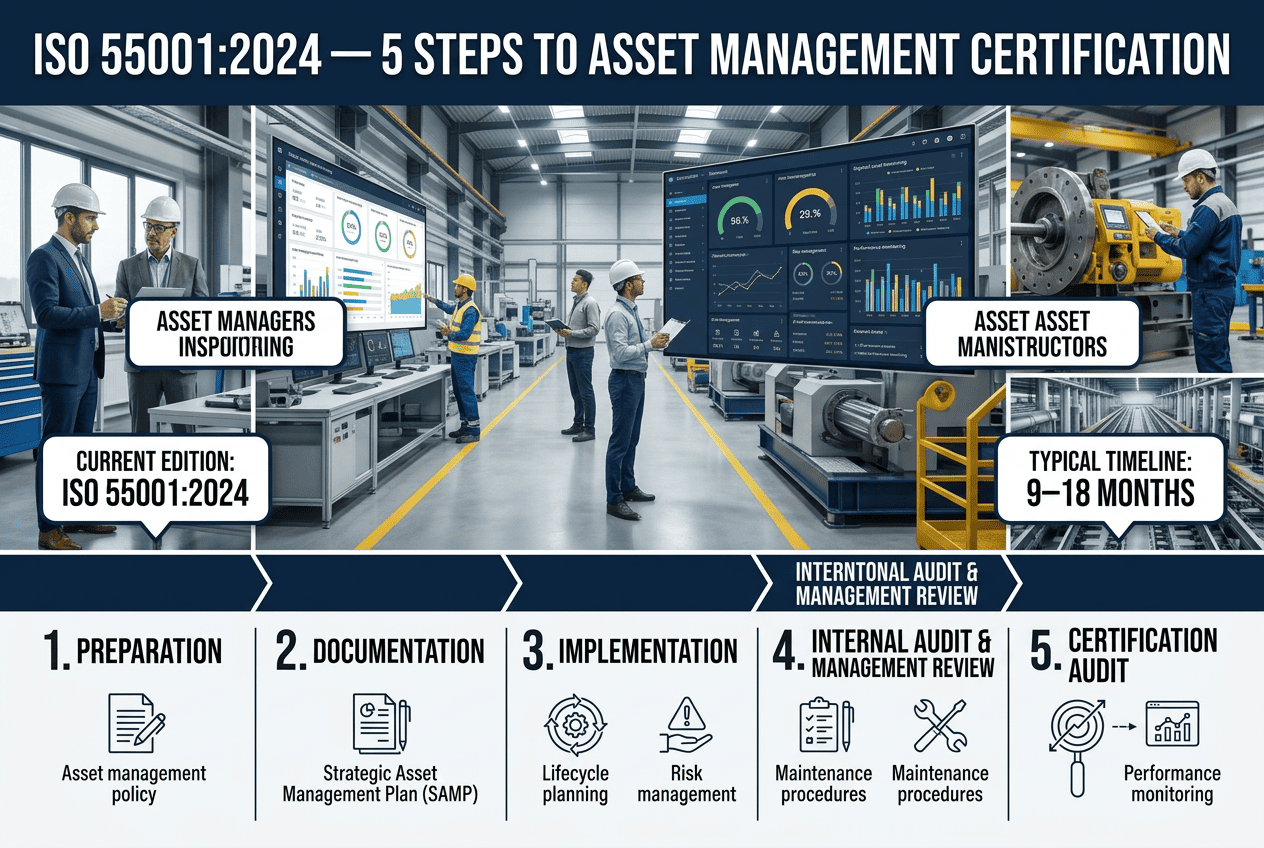
Direct Answer: ISO 55001 is the international standard for Asset Management Systems (AMS). It helps organisations realise value from their assets across the whole life cycle. Getting certified involves a 5-step process: Preparation (leadership buy-in, scope, stakeholder analysis, gap analysis), Documentation (asset management policy, Strategic Asset Management Plan, objectives, asset management plans), Implementation (life cycle processes, risk management, competence, management of change), Internal Audit & Management Review (verifying conformity and effectiveness), and Certification Audit (two-stage audit by an accredited certification body). The process typically takes 9–18 months depending on size and asset maturity, and the current edition is ISO 55001:2024, published in July 2024. This guide walks you through every step.
📅 November 2, 2026⏱ 16 min read✍️ GT Setu Editorial Team🔄 Updated regularly
2024
Current Edition (Published July 2024)
5
Key Steps to Certification
9–18
Months (Typical Timeline)
0%
GTsetu Broker Commission
ISO 55001 is the international standard that specifies requirements for an Asset Management System. Developed by ISO Technical Committee 251 (Asset Management), it gives organisations a structured way to manage physical, financial, information and human assets so that they deliver value in line with organisational objectives. Unlike a purely maintenance-focused approach, ISO 55001 connects strategy, risk, cost and performance across the entire asset life cycle, from acquisition and operation through to renewal and disposal.
For manufacturers, utilities, energy and infrastructure operators, and any asset-intensive business, ISO 55001 certification signals disciplined, risk-based stewardship of critical equipment and infrastructure. It also strengthens supplier and partner credibility. This guide covers the complete certification process, the changes introduced by ISO 55001:2024, and practical advice for a smooth journey. If you already run a quality system, see our guide on how to get ISO 9001 certification, since both standards share the same high-level structure and can be integrated.
📋 Who Is This Guide For?
This guide is written for asset managers, maintenance and reliability leaders, operations directors, plant heads, and business owners responsible for implementing or maintaining an Asset Management System. It covers both the DIY approach (using internal teams and templates) and the consultant-led route. It is equally relevant for manufacturers seeking to demonstrate asset discipline to customers and for distributors and suppliers who want to show capability to their principals. For related partnership structures, see our guides on supplier collaboration platforms and distributors and manufacturers.
SECTION 1
1 What Is ISO 55001 & Why Get Certified?
⚙️ The Standard Explained
ISO 55001 specifies the requirements for establishing, implementing, maintaining and improving an Asset Management System. It is the certifiable standard in the ISO 55000 family, alongside ISO 55000 (overview, principles and terminology) and ISO 55002 (guidelines for applying ISO 55001). The first edition was published in 2014; the current edition, ISO 55001:2024, was published in July 2024 and follows the harmonised high-level structure used by other ISO management system standards. Its core idea is value realisation: aligning asset-related decisions with organisational objectives, managing risk and opportunity, and continually improving performance across the asset life cycle.
🌐
Internationally Recognised Framework
ISO 55001 gives asset owners, operators, regulators and customers a common language for asset management, replacing fragmented, site-by-site practices with one coherent system.
🏭
Built for Asset-Intensive Industries
Manufacturing, energy, utilities, transport, mining, water, oil and gas and facilities management all depend on reliable assets. Certification shows that assets are managed deliberately, not reactively.
🔄
Life Cycle Value Focus
The standard looks beyond maintenance cost to total value over the asset life cycle, balancing cost, risk and performance in investment, operation and renewal decisions.
📈
Stakeholder Confidence
Independent certification gives customers, investors, insurers and regulators confidence that asset risks are understood and controlled.
SECTION 2
2 Key Benefits of ISO 55001 Certification
ISO 55001 delivers operational, financial and strategic benefits. The size of the gain depends on how deeply the system is embedded into decision-making rather than treated as a documentation exercise.
3
Documents in the ISO 55000 family: ISO 55000, 55001 and 55002
10
Clauses in the harmonised structure, with requirements in Clauses 4–10
2014 → 2024
Edition update adding climate change, decision-making and data emphasis
🏷️
Enhanced Credibility with Customers & Regulators
Certification provides third-party evidence of disciplined asset stewardship, supporting tenders, concessions and regulated-sector relationships.
Commercial
💰
Better Capital & Maintenance Spending
Risk-based prioritisation helps direct capital and maintenance budgets to the assets and activities that matter most to objectives.
Financial
🔗
Reliability & Reduced Unplanned Downtime
Structured life cycle planning, condition monitoring and failure analysis improve availability and reduce reactive firefighting.
Operational
📊
Data-Driven Decision Making
The standard expects confidence in asset information and a defined framework for decisions, replacing intuition and silo-based choices.
Analytical
👥
Cross-Functional Alignment
Finance, operations, maintenance, engineering and procurement work to a shared asset strategy and shared definitions of value.
People
📋
Risk, Safety & Sustainability
Asset risks, including safety, environmental and climate-related risks, are identified, assessed and treated within one management system.
Compliance
SECTION 3
3 ISO 55000 Fundamentals & the 55000 Family
ISO 55000 describes the fundamentals that underpin asset management. Understanding them helps you build a system that creates real value rather than one that only meets the minimum wording of ISO 55001.
💎
1. Value
Assets exist to provide value to the organisation and its stakeholders. Value is defined by the organisation and may be financial, social, environmental or reputational.
🎯
2. Alignment
Asset management translates organisational objectives into technical and financial decisions, plans and activities, keeping everyone pulling in the same direction.
🏛️
3. Leadership
Leadership and workplace culture determine whether value is realised. Top management must own the asset management policy, strategy and resourcing.
✅
4. Assurance
Asset management gives assurance that assets will fulfil their required purpose. Monitoring, audit and review provide evidence that this is true.
Standard
Purpose
Certifiable?
ISO 55000
Overview, principles and terminology of asset management.
No
ISO 55001
Specifies the requirements for an Asset Management System.
Yes
ISO 55002
Guidelines for applying ISO 55001, with practical interpretation of each clause.
No
SECTION 4
4 Step 1: Preparation — Foundation & Planning
🏗️ Building the Foundation
The preparation phase sets the foundation for your ISO 55001 project. The goal is to confirm scope, secure leadership commitment and understand how far your current practices are from the standard. This phase typically takes 4–8 weeks, depending on the number of sites and asset classes.
1.1
Get Trained on ISO 55000, 55001 & 55002
Build baseline knowledge of the standard and its vocabulary. Implementer or lead auditor courses are widely available, and ISO 55002 helps interpret clause intent. If you already hold an older certificate, review the transition material for the 2024 edition.
1.2
Secure Executive Support
Top management must own the asset management policy and fund the system. Present a concise business case linking asset performance, risk and cost to organisational objectives. See our guide on company global expansion for context on how disciplined operations support growth.
1.3
Define Context, Stakeholders & Scope
Determine internal and external issues (including whether climate change is relevant), identify stakeholders and their requirements, and define which assets, sites and activities fall within the scope of the AMS. Be explicit about boundaries; auditors will check them.
1.4
Build an Asset Register Baseline
You cannot manage what you cannot identify. Establish which assets are critical, where their data lives and how reliable it is. Perfect data is not required at this stage, but you should know the gaps.
1.5
Conduct a Gap Analysis
Compare current practices with each requirement of ISO 55001 and rate maturity. Existing maintenance, quality, safety and risk processes often cover more than expected, so reuse them. Related systems such as ISO 45001 and ISO 14001 can be integrated.
1.6
Plan the Project & Appoint Owners
Create a simple plan with milestones and responsibilities, and appoint an asset management system lead. Communicate early with engineering, maintenance, finance and operations teams so the project is seen as a business initiative, not a paperwork exercise.
💡 Pro Tip: Start with Critical Assets
If your portfolio is large, pilot the system on your most critical asset classes or one site, then scale. This limits risk and gives you proof of value before wider rollout. The same principle applies when building a B2B network: start focused and scale.
SECTION 5
5 Step 2: Documentation — Building Your AMS
ISO 55001 does not prescribe a fixed manual. It requires documented information that is necessary for the effectiveness of the system, in a volume appropriate to your organisation. The centrepiece is the Strategic Asset Management Plan (SAMP), which links organisational objectives to asset management objectives and plans.
Document Type
Description
Key Consideration
Asset Management Policy
A top-management statement of intent for asset management, consistent with the organisational plan and the needs of stakeholders.
Keep it short, specific and communicated to all relevant people.
AMS Scope
Defines the boundaries and applicability of the asset management system: assets, sites, processes and exclusions.
A key document for the auditor. Be clear about what is in and out of scope.
Strategic Asset Management Plan (SAMP)
Documents how organisational objectives translate into asset management objectives, the approach to developing asset management plans, and the role of the AMS.
Should be traceable to the organisational strategic plan and reviewed regularly.
Asset Management Objectives
Measurable objectives consistent with the policy and SAMP, covering performance, risk, cost and sustainability.
Define owners, measures, timeframes and resources.
Asset Management Plans
Plans for asset classes or systems covering activities, resources, responsibilities, timelines, risks and performance measures across the life cycle.
Show how plans deliver objectives and how risks and opportunities are addressed.
Decision-Making Framework
The approach used to weigh options, value, risk and cost when making asset-related decisions (reinforced in the 2024 edition).
Define criteria, authorities and how trade-offs are documented.
Procedures & Work Instructions
Operational controls for acquisition, operation, maintenance, change, outsourcing and disposal.
Reuse existing maintenance and engineering procedures where they already meet the requirement.
Records
Evidence of competence, monitoring results, audits, management reviews, nonconformities and corrective actions.
Records must be controlled, legible and retrievable. They are central to audits.
💡 Documentation Best Practices
DO: Reuse existing CMMS, engineering and risk documents. Use your organisation’s own terminology. Prefer diagrams, matrices and registers over long prose.
DON’T: Write documents only to satisfy a clause. Create a SAMP that is disconnected from real budgets and plans. Duplicate content across multiple documents.
Consider using templates for the policy, SAMP and plans, then tailor them. This approach also works when drafting manufacturer-distributor contracts: start with a proven structure and customise.
SECTION 6
6 Step 3: Implementation — Rolling Out Your AMS
Implementation turns documents into daily practice. This phase embeds life cycle thinking, risk-based decisions and performance monitoring into the way people plan, operate and maintain assets.
📢
Communicate Policy & Strategy
Top management communicates the policy, SAMP and objectives so that staff understand how their work contributes to value.
Leadership
🎓
Build Competence & Awareness
Define competence for asset management roles, close training gaps and keep records. Include managers and contractors who influence asset decisions.
Training
⚠️
Embed Risk & Opportunity Management
Assess asset-related risks, set criticality, define treatments and link them to asset management plans. Include climate-related risks where relevant.
Risk
🔄
Operate Life Cycle Processes
Apply controls across acquisition, commissioning, operation, maintenance, renewal and disposal, with clear criteria for investment and retirement.
Operations
🔀
Manage Change & Outsourcing
Assess planned changes for their effect on asset management objectives, and keep control over outsourced activities and external providers.
Control
🗄️
Govern Asset Information
Define what asset data is needed, its quality and ownership, and how it supports decisions. Align with ISO 27001 where information security matters.
Data
📣
Show Early Wins
Share early improvements such as reduced downtime or better prioritisation. Visible results strengthen buy-in and justify continued investment.
Momentum
SECTION 7
7 Step 4: Internal Audit & Management Review
🔍 Verifying Your AMS
Internal audits and management reviews are mandatory under ISO 55001. Internal audits check that the system conforms to the standard and to your own requirements and is effectively implemented. Management review is where top management evaluates performance and decides on improvements and resources. Both should be completed, with findings addressed, before the certification audit.
📋
Plan the Audit Programme
Schedule audits based on the importance of processes and past results, covering every clause and all in-scope sites and asset classes.
👤
Use Objective Auditors
Auditors must be impartial and must not audit their own work. Consider cross-site auditors or an external provider if internal independence is limited.
🎓
Train Your Auditors
Auditors need knowledge of ISO 55001 and of asset management practice so they can test decisions, not just documents.
🔄
Close Nonconformities
Use root-cause analysis and track corrective actions to completion. Auditors will check whether earlier findings were genuinely resolved.
📊
Hold a Management Review
Review performance against objectives, risks, audit results, stakeholder needs and resource adequacy, and record decisions and actions.
📄
Consider a Pre-Assessment
An optional external readiness review can reveal blind spots and build confidence before the formal audit.
💡 Internal Audit as a Management Tool
Treat internal audits as a source of improvement ideas, not a checkbox. Audits that test how decisions were actually made will expose weak data, unclear criticality and misaligned budgets. The same mindset applies to partnership evaluations.
SECTION 8
8 Step 5: Certification Audit — Getting Certified
The certification audit is carried out by an independent, accredited certification body. It follows a two-stage process, and a successful outcome results in a certificate typically valid for three years, subject to surveillance audits.
Audit Stage
What Happens
Key Focus
Stage 1 Audit (Readiness Review)
The auditor reviews documented information, scope, the SAMP and your state of preparation, and plans Stage 2.
Adequacy of documentation and readiness. Any gaps must be fixed before Stage 2.
Stage 2 Audit (Implementation Audit)
The auditor visits your sites, interviews staff, observes practice and samples records to verify the AMS is implemented and effective.
Evidence that asset decisions follow the framework, plans are delivered and objectives are monitored.
Audit Report & Decision
Findings are reported. Major nonconformities must be corrected before certification is granted; minor ones need agreed action plans.
Overall conformity decision by the certification body.
Surveillance Audits
Periodic audits (commonly annual) during the certificate cycle confirm the AMS is maintained and improving.
Ongoing conformity and effectiveness.
Recertification Audit
Before the certificate cycle ends, a fuller audit reassesses the whole system.
Sustained performance and evolution of the AMS.
💡 Preparing for the Certification Audit
Prepare your people: Brief asset owners, planners, engineers and finance contacts on what to expect. Auditors often ask, “How was this investment decision made?” and “How do you know this asset’s risk is acceptable?” Staff should be able to answer from real practice and show evidence.
Select your certification body: Confirm ISO 55001 is within its accreditation scope and that it has auditors with experience in your sector. See partnership evaluation criteria for a framework that also works for selecting a registrar.
SECTION 9
9 What Changed in ISO 55001:2024
ISO 55001:2024 is an evolution of the 2014 edition rather than a rewrite, so organisations with a working AMS should find their system broadly aligned. Even so, several updates need attention, and certified organisations should confirm the transition arrangements and deadlines with their certification body.
Area
Update in 2024 Edition
What to Do
Climate Change (Clauses 4.1 & 4.2)
Organisations must determine whether climate change is a relevant issue, and consider that stakeholders may have climate-related requirements.
Document your determination and link relevant risks to asset plans.
Asset Management Decision-Making (Clause 4.5)
A new emphasis on a framework for asset management decision-making that weighs value, risk and information confidence over the life cycle.
Define and document your decision criteria and authorities.
Leadership & Planning
Refined requirements on leadership commitment, the SAMP and planning for objectives.
Review SAMP content and management accountability.
Asset Information & Data
Greater focus on the quality, availability and governance of asset-related information.
Assign data ownership and test data confidence for key decisions.
Alignment with Other Standards
Updated terminology and harmonised structure improve integration with other ISO management systems.
Integrate audits and reviews with existing management systems.
📋 Transition Timing
Certification bodies typically set transition deadlines for existing certificates after a revised standard is published. Check the exact cut-off date and audit requirements with your certification body, and confirm which edition new certifications are being issued against. For climate-related risk and environmental alignment, see our guide on ISO 14001 certification.
SECTION 10
10 Costs & Timeline: What to Expect
Cost and timeline vary widely with size, number of sites, asset complexity and starting maturity. The figures below are indicative planning ranges, not quotes; always obtain written proposals from several accredited certification bodies.
More asset classes and critical systems increase planning effort and audit days
Larger portfolios extend documentation and implementation
Existing Maturity
Organisations with mature maintenance, risk and quality systems spend less on remediation
Strong foundations can shorten the project significantly
Asset Data Quality
Poor registers and records require data clean-up and tooling investment
Data remediation is a common source of delay
Industry & Risk Level
Regulated or high-consequence sectors may require more audit time
More audit days can extend scheduling
Consultant Involvement
Consultant support can add a substantial amount to budget; DIY lowers fees but needs internal capacity
Experienced consultants can accelerate gap closure
Integration with Other Systems
Combined audits with ISO 9001, 14001 or 45001 can reduce duplicated effort
Shared processes shorten documentation and audit preparation
📋 Budget for Ongoing Costs
Beyond initial certification, plan for surveillance audits during the certificate cycle, recertification, internal audit resources, training, asset data and software upkeep, and time for management reviews. When evaluating consultants or digital tools, apply the same partnership evaluation criteria you would use for any B2B engagement.
SECTION 11
11 How to Choose a Certification Body
The certification body (registrar) conducts your audits and issues the certificate. Its credibility directly affects how your certification is perceived by customers and regulators. Major international bodies such as TÜV SÜD and ABS Quality Evaluations publish information on ISO 55001 services, so compare several options.
🏛️
Accreditation Status
Choose a body accredited by a national accreditation body that is an IAF MLA signatory (e.g. UKAS, ANAB, DAkkS, JAS-ANZ, NABCB), and confirm ISO 55001 is explicitly in the accreditation scope.
🏭
Sector Experience
Auditors who understand your asset types, whether plant, networks or fleets, will test the right things and give more useful findings.
📋
Market Recognition
Check that your customers, regulators or tender requirements recognise the certification body, especially for export markets.
💰
Cost & Value
Compare audit days, travel, surveillance fees and transition terms. The cheapest quote rarely delivers the best value.
🌐
Multi-Site Capability
If you operate across several locations or countries, select a body that can audit consistently across all sites.
🤝
Relationship & Support
Look for responsive communication and a collaborative approach. A good auditor helps you improve, not just find faults.
💡 Registrar Selection Checklist
Ask: Is ISO 55001 in your accreditation scope? How many audit days do you allocate for an organisation like mine? Which auditors would be assigned and what is their sector experience? What is included in the fee? How do you handle nonconformities and certificate issuance? What are your ISO 55001:2024 transition arrangements? Can you provide references? Combine the answers with your partnership evaluation criteria.
SECTION 12
12 Common Mistakes & How to Avoid Them
🔧
Treating It as a Maintenance Project
Handing ISO 55001 to the maintenance team alone misses finance, strategy and operations, and the standard is about organisation-wide value.
Avoid: Form a cross-functional team and anchor the AMS in organisational objectives.
📚
A SAMP That Sits on a Shelf
A strategic plan that is not linked to budgets, plans and decisions will not survive an audit that asks how it is used.
Avoid: Trace objectives through to plans, budgets and monitored results.
🏛️
Lack of Leadership Commitment
Without visible leadership, asset management stays a compliance task and funding stalls.
Avoid: Secure sponsorship early and involve top management in reviews.
🗄️
Ignoring Asset Data Quality
Decisions based on unreliable registers or condition data undermine the credibility of the whole system.
Avoid: Prioritise data for critical assets and define ownership and quality checks.
🔄
Certification as the End Goal
Building a system only to pass the audit leads to decay after certification.
Avoid: Use internal audits and management reviews to drive real improvement. Consider structured partner programmes such as global partner service for ongoing support.
⚠️
Weak Risk & Change Control
Failing to link risk assessments and change management to asset plans leaves gaps auditors readily find. See risk allocation principles for related thinking.
Avoid: Integrate risk registers, criticality and management of change into the planning cycle.
SECTION 13
13 Related ISO Standards & Integration
Because ISO 55001 follows the harmonised structure, it integrates naturally with other management system standards. Many organisations combine audits to save time and avoid duplicated documentation. Explore the related guides below.
Relevant for automotive suppliers whose production assets must support safety-critical output.
SECTION 14
14 How GTsetu Supports Your ISO 55001 Certification Journey
🔗 GTsetu — Verified B2B Platform
Connect with Verified Partners & Build Reliable Supply Chains
ISO 55001 shows that you manage your own assets with discipline. GTsetu complements that by connecting you with verified manufacturers, distributors and suppliers, including equipment, spares and service partners that support your asset base. Our platform provides:
✅
Verified Company Profiles
Every company on GTsetu is verified on 6 key data points (Name, Address, Registration Number, Company Status, Company Type, Date of Incorporation) using government tie-ups, complementing your supplier due diligence.
🕵️
Anonymous Discovery
Browse verified partner profiles without revealing your identity until you’re ready to engage, protecting your sourcing strategy and commercial confidentiality.
📄
Built-In NDA Workflow
Digital mutual NDA with timestamped signatures, activated before any sensitive commercial or technical data is exchanged, supporting confidentiality around asset specifications and maintenance data.
🔐
Encrypted Document Workspace
AES-256 encryption at rest, TLS in transit, role-based access controls, and full audit trail, ensuring the secure exchange of technical documentation, specifications and contracts with partners.
🚫
Zero Broker Commission
GTsetu charges zero commission on any partnership formed. All commercial value stays between you and your verified partner, supporting life cycle cost objectives.
🌏
Global Network of Verified Partners
Access verified manufacturers, distributors and suppliers across 100+ countries, helping you source reliable equipment and service partners.
QWhat is ISO 55001 certification and why is it important?
ISO 55001 is the international standard that specifies requirements for an Asset Management System (AMS). It helps organisations realise value from their assets (physical, financial, information and human) across the whole asset life cycle, aligning asset decisions with organisational objectives. Certification demonstrates, through an independent audit, that your organisation manages assets in a systematic, risk-based and continually improving way. It is especially valued in asset-intensive sectors such as manufacturing, utilities, energy, transport, mining and infrastructure, and it is a useful element of partnership evaluation by potential clients.
QWhat are the 5 main steps to get ISO 55001 certified?
The 5 main steps are: (1) Preparation: secure leadership support, define the scope, identify stakeholders and conduct a gap analysis. (2) Documentation: develop the asset management policy, SAMP, objectives, asset management plans and procedures. (3) Implementation: roll out the system, build competence, apply life cycle processes, risk management and management of change. (4) Internal Audit & Management Review: verify conformity and effectiveness. (5) Certification Audit: undergo a two-stage audit by an accredited certification body and receive your certificate. This structured approach is similar to building any distributor network: start with a solid foundation and build methodically.
QHow long does it take to get ISO 55001 certification?
Timelines depend on size, asset complexity and existing maturity. As a general guide, small or single-site organisations with mature maintenance and risk practices may take 6–9 months, mid-sized organisations 9–15 months, and large multi-site or asset-heavy organisations 12–24 months. The AMS needs enough operating history (records, an internal audit and a management review) before the certification audit, so allow time for the system to run before you book the auditor.
QHow much does ISO 55001 certification cost?
Cost depends on the number of sites, asset portfolio complexity, headcount, audit days required by the certification body and whether you use consultants. Indicative budgets are often in the range of $8,000–$30,000 or more for initial certification of a small to mid-sized organisation, plus annual surveillance audits and internal resource time. Large, multi-site operations can be considerably higher. Always obtain written quotes from several accredited certification bodies.
QWhat documents are required for ISO 55001 certification?
Key documented information includes the asset management policy, AMS scope, Strategic Asset Management Plan (SAMP), asset management objectives, asset management plans, the framework for asset management decision-making, risk and opportunity records, competence records, operational controls, monitoring results, internal audit reports, management review outputs and corrective action records. ISO 55001 does not prescribe a fixed manual; the extent of documentation should suit your organisation. Using templates can reduce effort, much like using a business partnership contract template saves time in legal drafting.
QHow do I choose an ISO 55001 certification body?
Choose a certification body accredited by a national accreditation body that is a signatory to the IAF Multilateral Recognition Arrangement (for example UKAS, ANAB, DAkkS, JAS-ANZ or NABCB), and confirm that its accreditation scope explicitly covers ISO 55001. Compare quotes, auditor experience in your sector and recognition by your customers or regulators. Apply the same rigour you would use with partnership evaluation criteria when selecting any business partner.
QWhat is the difference between ISO 55001:2014 and ISO 55001:2024?
ISO 55001:2024 is an evolution of the 2014 edition. It follows the harmonised structure and adds explicit consideration of climate change in Clauses 4.1 and 4.2, a stronger emphasis on a framework for asset management decision-making, refined leadership and planning requirements, and greater attention to asset information. Organisations with an existing certificate should confirm the transition deadline and requirements with their certification body. See also our guide on ISO 14001 for environmental management alignment.
Connect with verified manufacturers, distributors and suppliers on GTsetu: compliance-backed verification, anonymous discovery, built-in NDA workflows, and zero broker commissions. Find partners who share your commitment to asset reliability and quality.
They represents the product, and research team behind GTsetu, a global B2B collaboration platform built to help companies explore cross-border partnerships with clarity and trust. The team focuses on simplifying early-stage international business discovery by combining structured company profiles, verification-led access, and controlled collaboration workflows.
With a strong emphasis on trust, and disciplined engagement, Team GTsetu shares insights on global trade, partnerships, and cross-border collaboration, helping businesses make informed decisions before entering deeper commercial discussions.