Best Platforms for Finding International Business Partners in 2026 | GTsetu Blog
Home ›
Blogs ›
Best Platforms for Finding International Business Partners
📋 B2B Partner Discovery Comparison · 2026
Best Platforms for Finding International Business Partners
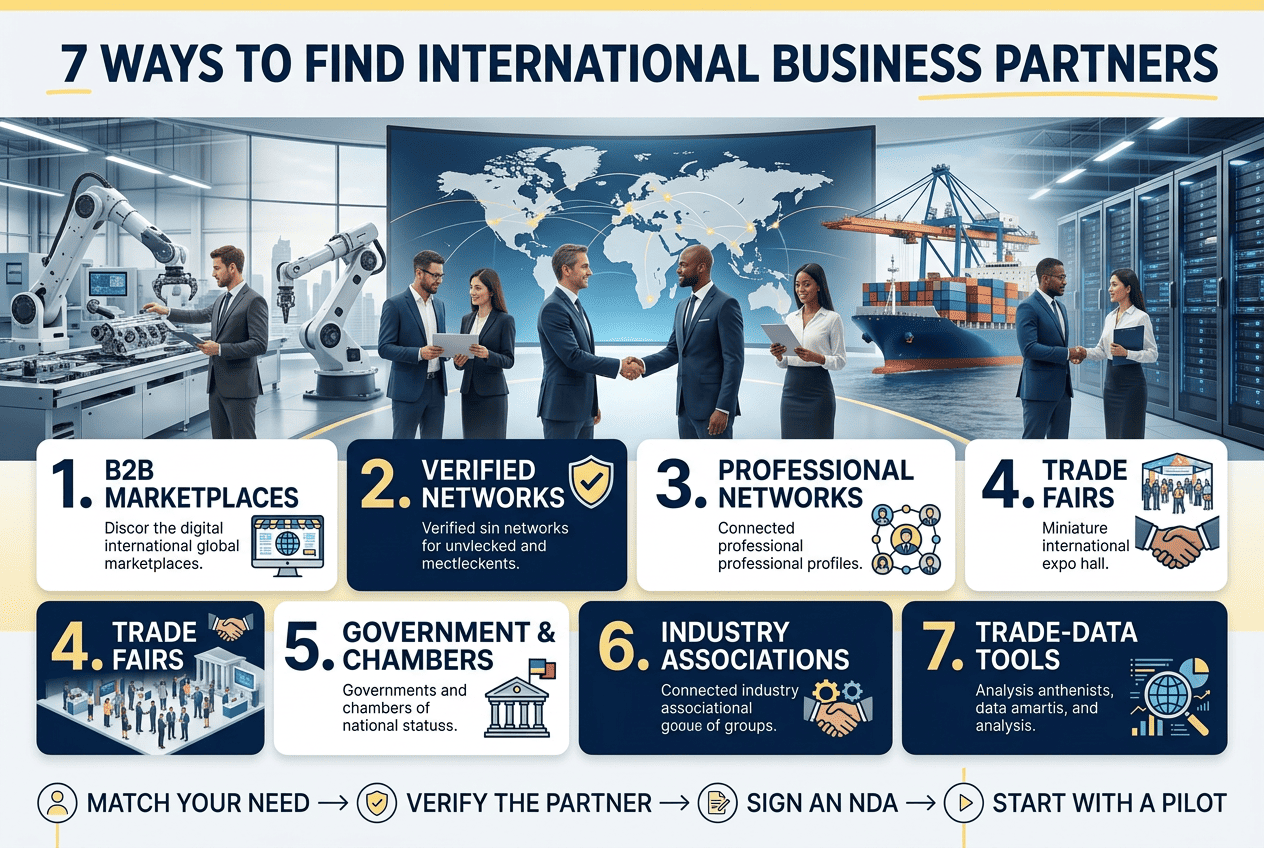
There is no shortage of places to look for an overseas partner: government trade agencies, chambers of commerce, trade shows, LinkedIn, B2B marketplaces, sales-intelligence tools, and online communities. The harder question is which of them give you verified, confidential, long-term-ready relationships rather than a long list of unvetted names. This guide compares every major channel honestly, shows where each one is strongest and where it falls short, and explains when a purpose-built partner platform is the better fit.
📅 Published October 28, 2026⏱ 15 min read✍️ GTsetu Editorial🔄 Updated October 28, 2026
Finding a business partner in another country is a different problem from finding a customer. A customer can be won transaction by transaction. A partner, a distributor who will represent your brand, a manufacturer who will build to your specification, a raw material supplier you will depend on for years, has to be trusted with your reputation, your intellectual property, and often your cash flow. That raises the bar for how you find them, and exposes how differently the available channels perform against it.
This guide covers the channels companies actually use, grouped into institutional and event-based routes and digital platforms and directories, and then looks at a distinct gap that most of them leave open: forming a verified, confidential, formal cross-border business partnership rather than just generating contacts.
💡 How to read this guide
Sections 2 and 3 cover the established channels one by one. Section 4 puts them in a single comparison table. Section 5 explains the gap those channels leave for long-term partnerships, and is worth reading closely if you keep ending up with long lists of contacts but few partners you would actually trust.
Section 1
What to Look for in a Partner-Finding Platform
Most platforms were built to solve a neighbouring problem, sales prospecting, supplier sourcing, networking, or event marketing, and have been adapted for partner discovery. That is why a channel can look impressive on volume and still perform poorly on the things that decide whether a partnership works. Six criteria are worth holding every option up against.
Verification. Does the platform independently confirm that a company is legally registered and operating as described, or does it accept whatever a profile says?
Partnership intent. Can you tell who is actually seeking a partner, and what kind, or are you cold-contacting companies with no signal at all?
Confidentiality. Can you explore without revealing your strategy, and protect pricing, drawings, and specifications before a relationship exists?
International reach. Does it cover the specific countries you need, with genuinely local depth rather than a thin global directory?
Cost and time to first useful conversation. How many hours, and how much money, before you are talking to a qualified prospect?
Support for formalising the relationship. Does the platform help you move from introduction to agreement, or does it stop at the introduction?
📌 A useful first question
Are you looking for many leads quickly, or for a few partners you can trust for years? Volume-oriented channels and trust-oriented channels are built differently. The answer determines which sections of this guide matter most for you, and proper market research before you start will sharpen it further.
Section 2
Institutional & Event-Based Channels
Agencies, Chambers, Shows & Advisors
These channels rely on institutions or live events to create introductions. They tend to carry more credibility than open directories, but they are slower, more manual, and often tied to specific countries or regions.
1
Government Trade Agencies & Support Networks
Export promotion bodies, commercial services, and SME partnering networks
High CredibilityCountry-Specific
Most trading nations run an export-promotion body or commercial service that helps domestic companies find overseas buyers, agents, and partners. Examples include the U.S. Commercial Service through trade.gov, the Department for Business and Trade in the UK, and the EU-backed Enterprise Europe Network, which supports cross-border partnering for SMEs. These services typically combine market guidance with some form of introductions or matchmaking, and the institutional backing carries real weight with prospective partners abroad. Regional ecosystems also matter, for example how Maharashtra’s FTI is positioning Pune in quantum technology shows how a regional initiative can open partnership doors that national agencies don’t surface.
Strengths
Institutional credibility that opens doors with foreign counterparts
Market intelligence and guidance bundled with introductions
Often subsidised or low-cost compared with private advisors
Useful for navigating regulations and standards in the target market
Limitations
Coverage and quality vary widely by country and sector
Introductions are manual and can take weeks or months
Usually limited to companies from, or connected to, the agency’s home country
No built-in NDA, secure document-sharing, or verification infrastructure
🎯
Best for: Companies entering a specific market who value institutional backing and can wait for a curated, relationship-led introduction process.
2
Chambers of Commerce & Industry Associations
Bilateral chambers, sector bodies, and member networks
Member NetworksTrusted Introductions
Bilateral chambers of commerce and sector associations connect members with counterparts in a specific country or industry. Membership signals seriousness, and introductions through an association often arrive with built-in context. They are especially useful when you need local knowledge of business customs and regulation, such as the practicalities covered in our guide to expanding an industrial automation business into the Czech Republic.
Strengths
Warm, context-rich introductions rather than cold outreach
Strong local knowledge of business customs and regulation
Networking events that build relationships over time
Limitations
Membership costs and reliance on who happens to be a member
Narrow reach, usually one country pair or one sector
Membership alone does not verify a company’s legal standing
🎯
Best for: Targeting a single country or sector where an active bilateral chamber or association already exists.
Face-to-face meetings with pre-scheduled counterparts
Face-to-FaceHigh Cost
Trade shows and organised B2B matchmaking events concentrate many potential partners in one place and time, and nothing builds trust faster than meeting in person and seeing a company’s products and people first-hand. Many events now run pre-scheduled meeting programmes, and virtual formats lower the travel barrier, though they rarely match the depth of an in-person encounter. Sector knowledge helps you choose the right events, which is where solid global market research for manufacturers pays off.
Strengths
Strongest relationship-building of any channel
Many qualified counterparts concentrated in one place
You can see products, facilities, and people first-hand
Limitations
Substantial travel, booth, and time cost per event
Infrequent, often annual, so discovery is slow
Follow-up discipline decides whether contacts become partners
Exhibitors are self-selected, with no independent verification
🎯
Best for: Building relationships with a small number of high-priority prospects you have already shortlisted, rather than for first-pass discovery.
Consultancies that run a bespoke partner search on your behalf
Done-for-YouPremium Cost
A number of consultancies and international B2B service firms will run a partner search for you: defining your ideal partner profile, researching candidates, making introductions, and sometimes supporting negotiations. It saves internal time and brings local knowledge, but it is the most expensive route, and quality depends heavily on the individual advisor. For many companies it works best as a complement to a platform, as part of broader international business development consulting.
Strengths
Hands-on, tailored search to your specific partner profile
Local expertise and language capability
Frees your team from the research and outreach workload
Limitations
Fees can be significant, often retainer- or project-based
Quality varies and results depend on the advisor’s own network
Typically a one-off search rather than an ongoing discovery capability
🎯
Best for: Companies with budget and limited internal bandwidth who need a bespoke search for one specific, high-value partner.
Section 3
Digital Platforms & Directories
Networks, Marketplaces & Tools
Digital channels trade institutional depth for speed, scale, and reach. They are the fastest way to generate a long list of names, and generally the weakest at telling you which names are worth trusting.
1
LinkedIn
The default professional network for identifying decision-makers
Global ReachManual Effort
LinkedIn is where most partnership conversations begin: you can find business-development and partnership leads at almost any company, see their activity, and use shared connections for warm introductions. It is excellent for researching and approaching a specific target, but it is not built to tell you who is actively seeking a partner, and it relies entirely on self-reported profiles.
Strengths
Direct access to decision-makers across almost every country
Warm introduction paths through shared connections
Visibility into a company’s activity, hires, and announcements
Limitations
No signal on who is genuinely seeking a partner
Profiles are self-reported and unverified
Outreach is manual and does not scale to dozens of markets
No confidentiality tools, and approaches are public by nature
🎯
Best for: Researching and warming up specific, already-identified prospects. A strong complement to other channels, rarely a standalone solution.
2
B2B Marketplaces & Trade Directories
Alibaba, Global Sources, IndiaMART, Kompass, ThomasNet and similar
High VolumeTransactional
B2B marketplaces and directories are the fastest way to see a wide range of suppliers or buyers and to request quotations. They are built around transactions and shared enquiries, so they work well for sourcing, and especially for finding international wholesale distributors at the first-pass stage. They are less suited to forming a long-term relationship, since verification is limited, enquiries are shared across competing responders, and there is no framework for confidential information.
Strengths
Large supplier and buyer pools searchable in minutes
Quick RFQ and quotation workflows
Regional and category specialists for different markets
Limitations
Verification varies and is often limited to paid badges
Shared-enquiry model pushes competition on price
No NDA or secure document-sharing workflow
Designed for transactions, not long-term partnership formation
🎯
Best for: Volume discovery and quotation requests where price and speed matter more than relationship depth.
3
Sales-Intelligence & Company-Database Tools
Apollo, ZoomInfo, Cognism and similar contact databases
Large DatabasesBuilt for Sales
Sales-intelligence tools let you filter millions of company records by industry, size, location, and technology, and export contact details for outreach. They are powerful for building a target list, but they were designed for sales prospecting, not partnership development, so they say nothing about whether a company wants a partner, and all contact is cold.
Strengths
Very large, filterable databases of companies and contacts
Efficient for building a long target list quickly
Exportable data that plugs into outreach workflows
Limitations
No indication of partnership intent or readiness
Coverage and data quality are weaker outside major markets
All outreach is cold, with typically low response rates
No verification of legal standing and no confidentiality features
🎯
Best for: Companies with an outbound team that need a large, filterable prospect list and are prepared to qualify every name themselves.
4
Online Communities & Forums
Reddit, Quora, industry Slack and Discord groups, professional forums
Peer AdviceUnverified
Entrepreneur forums and industry communities are popular first stops for advice on where to find partners, and they are genuinely useful for learning from other people’s experience and hearing which channels have worked. As a way of actually finding and vetting a partner, they are the least reliable option here: identities are anonymous or self-declared, recommendations are anecdotal, and scams and unsolicited offers are common.
Strengths
Free, immediate peer experience and practical tips
Useful for niche niches and unexpected leads
Good for learning which channels others trust
Limitations
Anonymous or unverifiable participants
Anecdotal, sometimes biased recommendations
Higher exposure to scams and low-quality offers
No structure for vetting or formalising a relationship
🎯
Best for: Research and advice, not for finding or committing to a partner. Treat any lead from here as unverified until proven otherwise.
Section 4
Side-by-Side Comparison
The table below compares every channel covered above, along with GTsetu, across the dimensions that matter most when the goal is a real partnership rather than a list of contacts.
Channel
Best For
Verification
Confidentiality Tools
International Reach
Typical Cost / Speed
Government trade agencies
Institution-backed market entry
⚠ Curated, not systematic
✗ None built in
⚠ Country-specific
Low cost, slow
Chambers & associations
Single-country or sector introductions
⚠ Membership only
✗ None built in
⚠ Narrow
Membership fee, slow
Trade shows & matchmaking events
Face-to-face relationship building
⚠ Self-selected exhibitors
✗ None built in
⚠ Event-dependent
High cost, periodic
Paid advisory services
Bespoke single-partner search
⚠ Advisor-dependent
⚠ Contractual only
⚠ Advisor’s network
Premium cost, moderate
LinkedIn
Researching and approaching targets
✗ Self-reported
✗ None
✓ Global
Low cost, manual
B2B marketplaces & directories
Volume discovery and quotes
⚠ Mostly paid badges
✗ None
✓ Broad
Subscription, fast
Sales-intelligence tools
Building large prospect lists
✗ None
✗ None
⚠ Strongest in major markets
Subscription, fast
Online communities
Peer advice and research
✗ None
✗ None
⚠ Unstructured
Free, unreliable
GTsetu
Verified, long-term industrial partnerships
✓ Government-sourced, 6 points
✓ Anonymous discovery, NDA, encrypted workspace
✓ 100+ countries
Free to explore, zero commission
💡 Pattern to notice
Every channel above is good at one stage of the process, whether that is introductions, face-to-face trust, reach, or list-building. Almost none verify a company independently or protect your information while you evaluate it. That is the gap the next section explains.
Section 5
Why Most Channels Fall Short for Long-Term Partnerships
Most partner-discovery channels share an architecture: they help you find names. What decides whether a partnership works is what happens after you find a name, confirming the company is real and in good standing, being able to talk openly without exposing your pricing or intellectual property, and moving from introduction to a formal, enforceable agreement. On those points the general channels leave you largely on your own.
This is especially true for manufacturers, distributors, and raw material suppliers, where a partnership may involve technical specifications, exclusive territories, minimum volumes, and years of mutual dependence, and where a bad match is expensive to unwind. It is a structurally different need from collecting quotations, and it is the reason cross-border manufacturing partnerships tend to succeed or fail on the quality of the initial verification and the terms agreed up front.
What a long-term partnership needs
General Channels (Marketplaces, LinkedIn, Events)
Purpose-Built Partner Platform
Independent confirmation a company is legally registered
✗ Self-reported or paid badges
✓ Government-sourced verification
Browsing without revealing your strategy
✗ Identity exposed from first contact
✓ Anonymous until mutual interest
NDA before sharing pricing, drawings, or formulations
✗ Ad hoc, if used at all
✓ Built-in digital NDA workflow
Secure document exchange with an audit trail
✗ Email attachments or open links
✓ Encrypted workspace, full audit trail
Discovery across many countries in one place
⚠ Fragmented across separate channels
✓ Centralised across 100+ countries
No fee on the partnerships you form
⚠ Subscriptions, premium listings, retainers
✓ Zero commission, no success fee
🤝 For Verified, Long-Term Industrial Partnerships
GTsetu: Purpose-Built for Manufacturers, Distributors, and Raw Material Suppliers Seeking Verified Partners Abroad
GTsetu is not a directory and not a marketplace. It is a structured partnership platform where every company is verified on 6 government-sourced points before engagement, discovery is anonymous until mutual interest is confirmed, NDAs are executed digitally before any commercial information changes hands, and all document exchange happens through an encrypted workspace.
It is used by industrial manufacturers, distribution companies, and raw material suppliers across 100+ countries to find, vet, and formally engage trade partners they intend to work with for the long term, from a first anonymous search through to a signed agreement, rather than to generate quotation volume.
🏛️
6-Point Government-Sourced Verification
Name, Address, Registration Number, Company Status, Company Type, and Date of Incorporation, verified using government tie-ups before any engagement.
🕵️
Anonymous Discovery
Browse verified partner profiles across 100+ countries without revealing your own identity or commercial strategy until you choose to engage.
📄
Built-In NDA Workflow
Digital NDA with timestamped signatures before any pricing, formulations, or product specs are shared.
🔐
Encrypted Document Workspace
All commercial documents shared through encrypted channels with a full access audit trail, not email attachments.
🌍
100+ Countries
Verified manufacturers and distributors across Asia, the Middle East, Europe, Africa, Australia, and the Americas.
🚫
Zero Commission
No success fee, no broker commission, ever. Your partnership economics remain entirely between you and your partner.
📌 GTsetu works alongside the other channels, not instead of them
Many companies keep using trade shows for relationship building, LinkedIn for research, and a marketplace for quotations, and use GTsetu for the verified, confidential step in the middle. A trade-show contact can be checked against a verified profile, and a LinkedIn lead can be moved onto a platform with NDA protection before any real information is shared. Each channel covers a different stage.
Section 6
After You Find a Partner: Vetting and Contract Terms
Whichever channel produces the introduction, the work that protects you starts afterwards. A short, disciplined process separates partners who look good from partners who are good.
Evaluate against consistent criteria. Score every candidate on the same factors, financial stability, capacity, track record, market access, cultural fit, rather than choosing the most responsive one. Our guide to partnership evaluation criteria sets out a workable framework.
Run proper diligence. Independently confirm registration, ownership, and standing, and for anything involving an acquisition or significant commitment, carry out commercial due diligence. If a deal involves buying a business’s assets, understand what an asset purchase agreement covers.
Start small. A pilot order or trial period shows how a partner actually performs before you commit to exclusivity or volume.
Finally, put the relationship in writing. A handful of contract terms come up in almost every cross-border partner agreement, and understanding them before you negotiate puts you in a stronger position:
Consequential damages cover indirect losses such as lost profits, and are frequently limited or excluded.
Termination for convenience lets a party exit without cause on agreed notice, a vital clause if the partnership underperforms.
💡 A practical habit
Before you sign anything with a new overseas partner, read it once looking only for how it handles each term above. If any are silent or vague, raise them before signature, not after a dispute.
Section 7
Which Platform Fits Your Goal?
Use this reference to match your objective to the channel best suited to it. Most companies with more than one goal use two or three channels in combination.
🏛️
Enter one specific country with institutional backing
You value credibility and are happy to wait for curated introductions.
Trade agency or chamber
🎪
Build face-to-face trust with a shortlist of prospects
You already know who you want to meet and want to deepen the relationship.
Trade shows & missions
🛒
Generate many supplier or buyer quotes quickly
Speed and price matter more than relationship depth for this purchase.
B2B marketplaces
🔗
Research and approach a specific named company
You know the target and want to reach the right decision-maker.
LinkedIn
📇
Build a large outbound prospect list
You have a team to qualify and contact every name on the list.
Find a verified long-term distributor or manufacturer abroad
You need a serious partner for years, not a quotation lead.
GTsetu
🔒
Share sensitive specs and pricing safely before committing
You need NDA protection and an encrypted workspace from the first conversation.
GTsetu (built-in NDA)
FAQ
Frequently Asked Questions
QWhat is the best platform for finding international business partners?
It depends on what kind of partner you need. Government trade agencies and chambers of commerce are strong for institutional credibility and introductions. Trade shows are strong for face-to-face relationship building. LinkedIn and B2B marketplaces are strong for volume and reach. For verified, confidential, long-term partnerships with manufacturers, distributors, or raw material suppliers across borders, a purpose-built platform such as GTsetu, with government-sourced verification, anonymous discovery, and NDA workflows, serves a need the general channels do not.
QHow do you find a reliable business partner in another country?
Combine more than one channel, verify each candidate’s legal registration and standing independently, check references, evaluate them against consistent criteria, and run a small pilot before committing. Using a platform that verifies companies upfront reduces the time spent confirming that a prospective partner actually exists and operates as described. See our partnership evaluation criteria for a practical framework.
QAre B2B marketplaces good for finding long-term international partners?
B2B marketplaces are good for discovering many suppliers or buyers quickly and requesting quotes, but they are built around transactions and shared enquiries rather than long-term relationships. They typically offer limited verification and no built-in confidentiality tools, so they work better for sourcing than for forming a lasting distribution or manufacturing partnership.
QIs it safe to find international business partners online?
It can be, if you verify before you trust. Confirm the company’s legal registration, check it is operating as described, protect sensitive information with an NDA before sharing pricing or specifications, and avoid large prepayments to unverified counterparties. Platforms that verify companies against government sources and provide NDA and secure document-sharing tools reduce the main risks, and a clear understanding of how risk is allocated in cross-border deals reduces the rest.
QHow many channels should I use to find an overseas partner?
Most companies do best with two or three working together: one to generate candidates, such as a platform or marketplace, one to build trust, such as LinkedIn research or a trade event, and one to verify and formalise, such as a verified partner platform plus proper legal and due-diligence steps. Relying on a single channel usually leaves a gap, whether in verification, reach, or confidentiality.
QWhat should I check before signing a partnership agreement abroad?
Check the partner’s registration and standing, the certifications your market requires, and how the contract treats warranties, breach, consequential damages, shipping terms under Incoterms 2020, and exit rights such as termination for convenience. For larger commitments, commercial due diligence and legal advice in both jurisdictions are worth the cost.
Looking for Verified Partners, Not Just More Contacts?
GTsetu is purpose-built for manufacturers, distributors, and raw material suppliers seeking verified long-term trade partnerships, across 100+ countries, with government-sourced partner verification, built-in NDA workflows, and zero commission.
They represents the product, and research team behind GTsetu, a global B2B collaboration platform built to help companies explore cross-border partnerships with clarity and trust. The team focuses on simplifying early-stage international business discovery by combining structured company profiles, verification-led access, and controlled collaboration workflows.
With a strong emphasis on trust, and disciplined engagement, Team GTsetu shares insights on global trade, partnerships, and cross-border collaboration, helping businesses make informed decisions before entering deeper commercial discussions.