Centralised vs Decentralised Procurement: Which Model Fits? (2026) | GTsetu
Home › Blog › Centralised vs Decentralised Procurement
📦 Procurement & Supply Chain
Centralised vs Decentralised Procurement: Which Model Fits Your Business?
Direct Answer: In centralised procurement, one central team controls purchasing decisions, contracts and supplier relationships for the whole organisation, which delivers volume leverage, consistency and control. In decentralised procurement, business units, sites or departments buy independently, which delivers speed, flexibility and local responsiveness. Neither is universally better. Most growing organisations land on a hybrid (centre-led) model: central teams own strategic categories, policy and contracts, while local teams handle tactical, location-specific buying. The right choice depends on your size, geographic spread, spend profile, risk exposure and systems maturity. GTsetu supports either model by helping procurement teams discover government‑tie‑up verified suppliers and partners across 100+ countries.
📅 Published October 14, 2026🔄 Updated October 14, 2026⏱ 11 min read✍️ GTsetu Editorial Team
3
Procurement Operating Models
6
Decision Factors
100+
Countries on GTsetu
0%
Broker Commission
Every organisation that buys at scale eventually faces the same structural question: who decides what to buy, from whom, and on what terms? The answer shapes cost, speed, compliance and supplier relationships. It also determines how well you handle cross-border sourcing, where distance, regulation and currency add complexity.
Procurement heads, CPOs, supply chain and operations managers, finance leaders and founders of growing manufacturers or distributors deciding how to structure purchasing across teams, plants or countries.
⚖️ Disclaimer
This guide provides general business education, not legal, financial or consulting advice. Outcomes vary by organisation and industry. Consult qualified professionals before restructuring procurement or signing supplier contracts.
SECTION 1
1 What Is Centralised vs Decentralised Procurement?
🎯 Definitions
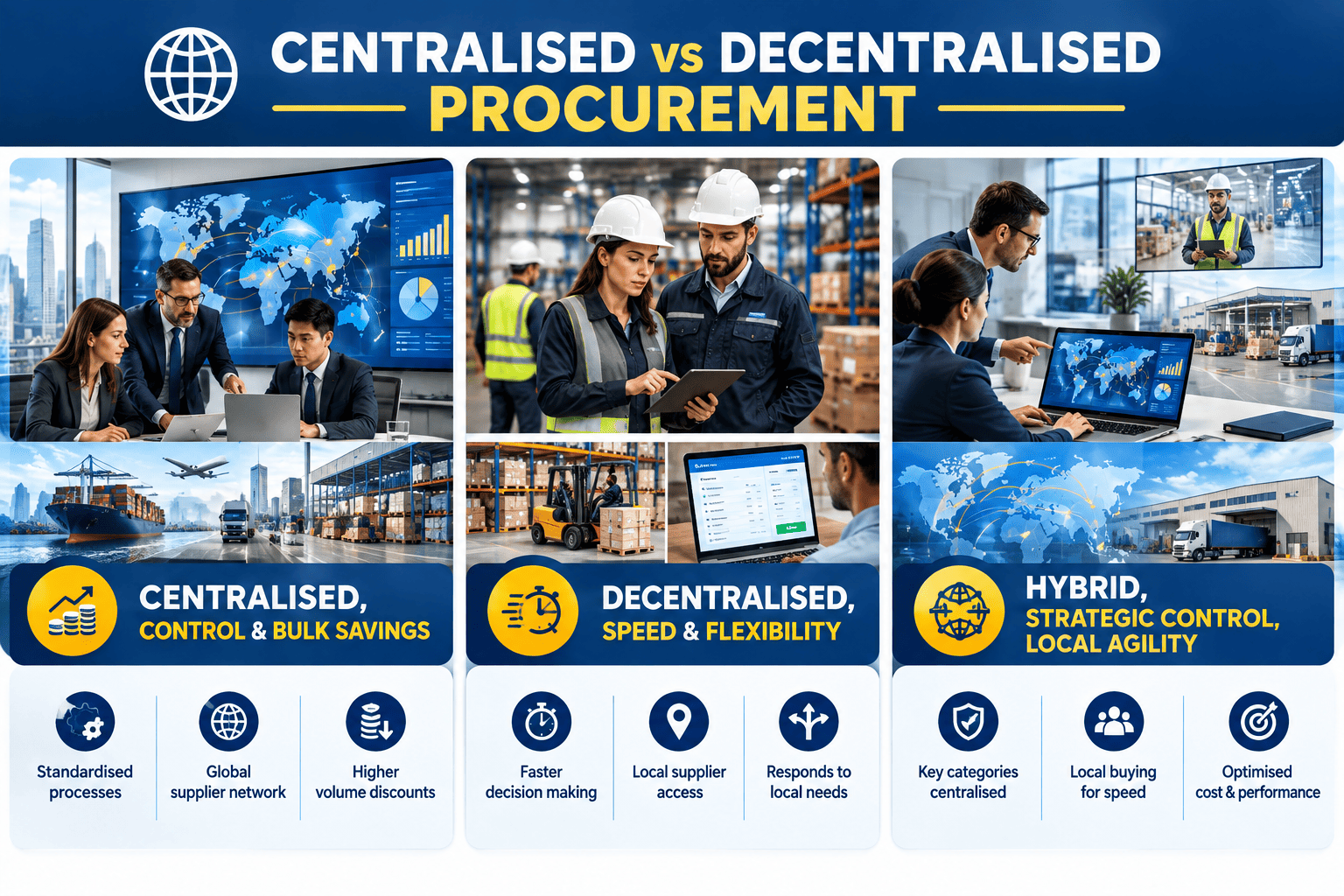
Centralised procurement concentrates purchasing authority in a single function that sets policy, negotiates contracts and manages suppliers for the entire organisation. Decentralised procurement distributes that authority to individual business units, sites or departments, which source what they need independently. Hybrid procurement splits responsibility between the two.
Centralised
One Central Team
Central team owns sourcing strategy, supplier selection, contracts and policy for all units.
🏢 Control & Leverage
Decentralised
Local Autonomy
Each unit, plant or department buys on its own, choosing local suppliers and terms.
⚡ Speed & Flexibility
Hybrid
Centre-Led / Federated
Centre manages strategic categories and policy; local teams run tactical purchases within guardrails.
⚖️ Balance
SECTION 2
2 Side-by-Side Comparison
Dimension
Centralised
Decentralised
Hybrid
Decision authority
Central procurement team
Business units / sites
Shared by category and value
Purchasing leverage
High, through volume consolidation
Lower, fragmented volumes
High on strategic categories
Speed
Slower, due to approval layers
Fast, decided locally
Fast for tactical, structured for strategic
Spend visibility
Strong, single view
Weak, scattered data
Good with shared systems
Compliance & risk control
Strong, consistent policy
Variable by unit
Policy set centrally, applied locally
Local responsiveness
Can be limited
Strong
Strong where it matters
Supplier relationships
Consistent, strategic
Many, often duplicated
Strategic plus local partners
Best suited to
Standardised, high-volume categories
Local, urgent or specialised needs
Multi-site, multi-category organisations
SECTION 3
3 Centralised Procurement: Pros & Cons
✅ Advantages
✅ Volume leverage: consolidated demand strengthens negotiating power on price and terms.
✅ Standardisation: common processes, templates and policies reduce errors.
✅ Spend visibility: one view of what is bought, from whom and at what price.
✅ Compliance and risk control: easier to enforce approved-supplier lists and contract standards.
✅ Specialist expertise: category managers build deep market knowledge.
⚠️ Disadvantages
⚠️ Slower decisions: approvals and queues can delay urgent buys.
⚠️ Distance from the need: the central team may miss local requirements.
⚠️ Internal friction: units may bypass the process (“maverick” or tail spend).
⚠️ Concentration risk: heavy reliance on few suppliers or a single team.
⚠️ Upfront investment: requires systems, talent and change management.
SECTION 4
4 Decentralised Procurement: Pros & Cons
✅ Advantages
✅ Speed and agility: those closest to the need decide quickly.
✅ Local fit: easier to use regional suppliers and adapt to local regulation and markets.
✅ Ownership: units are accountable for their own budgets and outcomes.
✅ Lower central overhead: smaller central function needed.
⚠️ Disadvantages
⚠️ Lost leverage: fragmented volumes mean weaker pricing and terms.
⚠️ Duplication: multiple units contract with the same supplier separately.
⚠️ Poor visibility: hard to see total spend or supplier risk.
⚠️ Inconsistent compliance: practices and contract quality vary by unit.
✨ GTsetu Insight
Decentralised teams often find suppliers on their own, which makes verification the first control to centralise. Use consistent partnership evaluation criteria across all units so every new supplier is checked the same way.
SECTION 5
5 The Hybrid Model
Most organisations end up in the middle. In a hybrid, or centre-led, model, the central team owns what benefits from scale and control, while local teams own what benefits from proximity and speed.
🏢
Centre Owns
Strategic and high-spend categories, master agreements, supplier policy, approved-supplier lists, systems and analytics.
📍
Local Owns
Low-value, urgent, site-specific or locally sourced purchases within defined limits and templates.
One system of record for spend, suppliers and contracts, so the centre sees what local teams buy.
SECTION 6
6 How to Choose: A Decision Framework
1
Analyse Your Spend
Classify spend by category, value and criticality. Standardised, high-volume categories favour central control; specialised, local or urgent ones favour local autonomy.
2
Assess Size and Geography
Single-site businesses can centralise easily. Multi-site, multi-country organisations face currency, regulatory and logistics differences that favour a hybrid.
Centralisation only works with the tools and category expertise to support it. If these are missing, start with a limited scope.
5
Pilot, Measure, Adjust
Start with a few categories, track savings, cycle time and compliance, then expand or rebalance. Revisit the model as you grow, acquire or enter new markets. If you buy a business or its assets, see what is an asset purchase agreement.
SECTION 7
7 Cross-Border Sourcing Considerations
Cross-border buying amplifies the trade-offs. Central teams gain leverage with international suppliers but may lack local market insight; local teams move faster but may take on unverified counterparties or inconsistent terms.
Whichever model you choose, supplier contracts are where cost savings are protected or lost. Centralised templates reduce inconsistency; local teams should know when to escalate. Before awarding major volume, run commercial due diligence.
Control
Why It Matters
Reference
Warranty terms
Defines remedies for defective goods across all units
Verified Supplier Discovery for Any Procurement Model
Whether purchasing is centralised, decentralised or hybrid, every new supplier relationship starts with trust. GTsetu connects manufacturers, exporters, distributors and buyers across 100+ countries. Every company is verified through direct government tie‑ups across six credentials: legal name, registered address, registration number, company status, company type, and date of certificate of incorporation. GTsetu does not verify industry certifications, product quality or financial standing; these must be validated directly between partners.
✅
Government Tie‑Up Verification6‑point identity verification.
🕵️
Anonymous DiscoveryBrowse supplier profiles without revealing your identity.
📄
Built-In NDA WorkflowFormalise confidentiality before sharing specifications or volumes.
🚫
Zero CommissionNo broker fees on any deal.
🔐
Encrypted CollaborationDocuments and messages encrypted in transit and at rest.
QWhat is the difference between centralised and decentralised procurement?
In centralised procurement, a single central team makes purchasing decisions, negotiates contracts and manages suppliers for the whole organisation. In decentralised procurement, individual business units, sites or departments buy independently to meet their own needs.
QWhat are the advantages of centralised procurement?
Greater purchasing leverage through volume consolidation, standardised processes, better spend visibility, stronger compliance and risk control, and more consistent supplier relationships.
QWhat are the advantages of decentralised procurement?
Speed and flexibility, closer alignment with local needs, easier use of local suppliers, and faster decisions by the people who understand the requirement best.
QWhat is hybrid procurement?
A hybrid, or centre-led, model combines both. A central team manages strategic categories, contracts and policy, while local teams handle tactical or location-specific purchases within agreed guardrails.
QHow do I choose between the models?
Consider the size and geographic spread of your organisation, spend profile and category mix, need for local responsiveness, regulatory and risk exposure, and available systems and talent. Many organisations adopt a hybrid model and revisit it as they grow.
QHow does GTsetu help with procurement and supplier discovery?
GTsetu helps procurement teams discover and engage government-tie-up verified suppliers and partners across 100+ countries, verifying six core credentials, with built-in NDA workflows, encrypted collaboration and zero broker commission.
Join 500+ verified manufacturers, exporters and importers building cross-border partnerships on GTsetu, with government‑tie‑up verification of six core credentials, built-in NDA workflows and zero broker fees across 100+ countries.
They represents the product, and research team behind GTsetu, a global B2B collaboration platform built to help companies explore cross-border partnerships with clarity and trust. The team focuses on simplifying early-stage international business discovery by combining structured company profiles, verification-led access, and controlled collaboration workflows.
With a strong emphasis on trust, and disciplined engagement, Team GTsetu shares insights on global trade, partnerships, and cross-border collaboration, helping businesses make informed decisions before entering deeper commercial discussions.