How Can Companies Reduce Supplier Dependency? | GTsetu Blog
Home ›
Blogs ›
How Companies Reduce Supplier Dependency
📋 Supply Chain Risk & Resilience · 2026
How Can Companies Reduce Supplier Dependency?
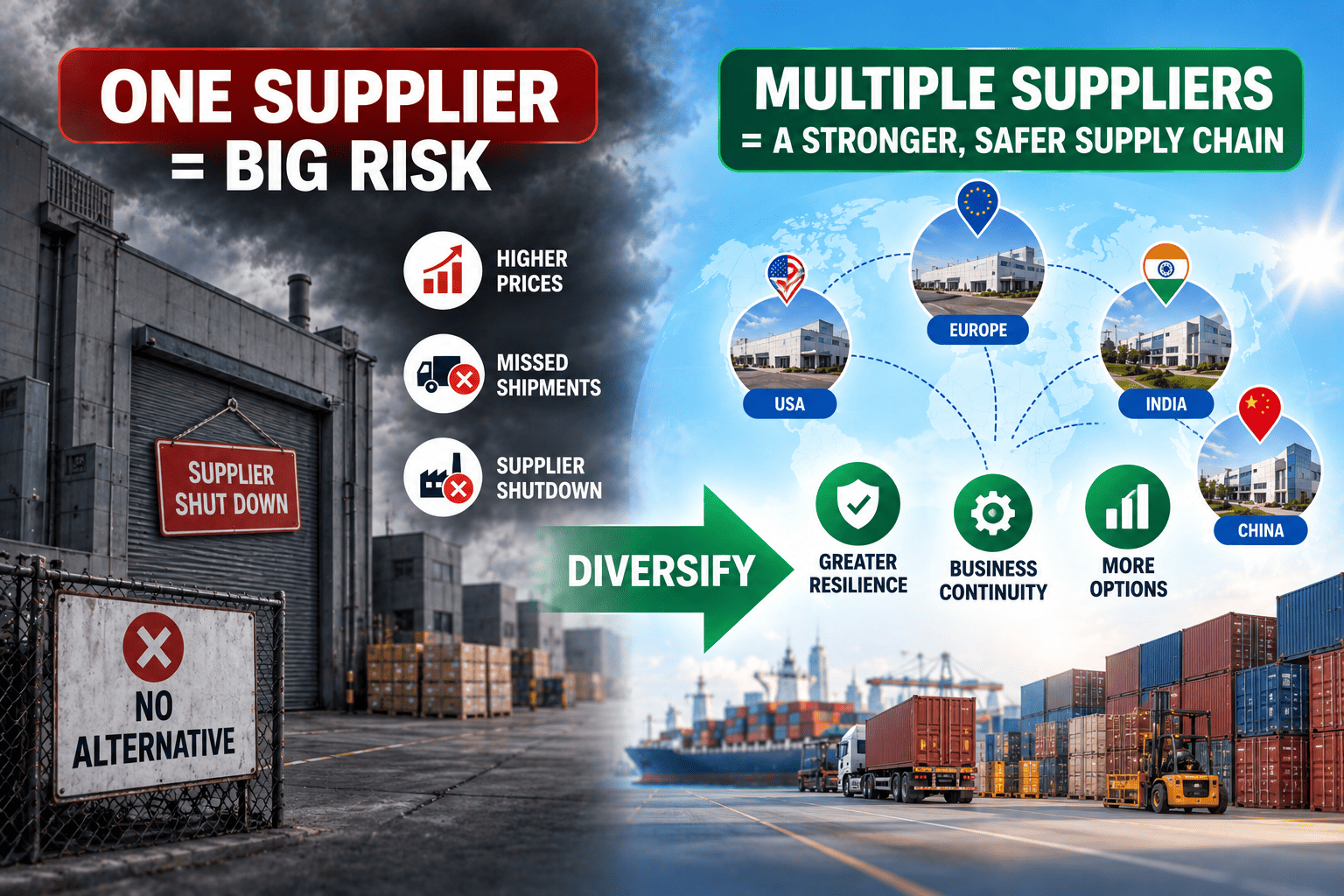
Relying on one supplier for a critical component or material feels efficient right up until that supplier raises prices, misses a shipment, or shuts down entirely, and there is no fallback in place. Reducing supplier dependency is not about abandoning good relationships, it is about building enough visibility, redundancy, and geographic spread that a single disruption cannot stop your business. This guide covers the practical strategies companies use, the trade-offs each one involves, and where manual diversification efforts run into real limits when the backup supplier needs to be found in an unfamiliar country.
📅 Published September 21, 2026⏱ 13 min read✍️ GTsetu Editorial🔄 Updated September 21, 2026
Supplier dependency builds up quietly. A company picks one vendor because the price is right or the relationship is easy, keeps sending it more volume because switching feels disruptive, and a few years later that vendor holds outsized control over a critical part of the business without anyone having decided that outcome on purpose. Recent years of geopolitical instability, tariff shifts, and regional disruptions have pushed procurement and operations teams to treat this as a resilience problem worth solving deliberately, not an efficiency trade-off worth ignoring.
This guide walks through how companies actually reduce that exposure: what to map first, which diversification strategies work, and how the effort changes when the backup supplier you need is not down the road but in a country where you have no existing supply chain partner network to draw on.
💡 How to read this guide
Section 2 covers the core strategies in order of where most companies should start. Section 5 is worth reading closely if your diversification plan depends on finding and trusting a new supplier in a country you haven’t sourced from before.
Section 1
Why Supplier Dependency Is a Real Risk
Single-source dependency remains one of the most common and most avoidable vulnerabilities in modern supply chains. It tends to accumulate through legacy design decisions, cost-driven consolidation, or supplier relationships that simply evolved over time without anyone reassessing the risk.
No fallback during disruption. A factory fire, a port closure, a geopolitical event, or a sudden material shortage at your one supplier becomes your production stoppage, with no alternative to lean on while it’s resolved.
Weakened negotiating position. A supplier who knows you have no alternative can raise prices, extend lead times, or deprioritise your orders during a shortage, with little consequence.
Quality and compliance blind spots. Dependency discourages switching even when a supplier’s quality or compliance standards slip, because the cost of qualifying a replacement under pressure feels worse than tolerating the decline.
Concentrated geographic exposure. A supplier base clustered in one region means a single regional shock, a lockdown, a natural disaster, a tariff change, hits your entire supply at once rather than a fraction of it.
Component obsolescence risk. When a sole-source component reaches end-of-life or is discontinued without warning, a company with no qualified alternative faces an emergency redesign under a deadline it didn’t choose.
📌 The core trade-off
Consolidating volume with one supplier usually earns better pricing and a simpler relationship to manage. Diversifying costs more upfront and takes real effort to qualify additional sources. The right balance depends on how critical the item is, how available real alternatives are, and how much a disruption would actually cost you if it happened tomorrow.
Section 2
Strategies to Reduce Supplier Dependency
Building Resilience, Step by Step
Companies that successfully reduce supplier dependency tend to work through some version of the following sequence, adjusting depth based on how critical the component or category is.
Before diversifying anything, get full visibility into which components, materials, or services are tied to a single supplier, and which suppliers are concentrated in the same region. Many companies still rely on spreadsheets or siloed systems, making it genuinely difficult to answer this question quickly when it matters.
What it involves
Linking approved supplier lists directly to the product bill of materials or service catalogue
Flagging every single-source item and its criticality
Mapping regional concentration across the full supplier base
Common mistakes
Only mapping Tier 1 suppliers and missing dependency at Tier 2 or Tier 3
Treating this as a one-time exercise rather than an ongoing view
🎯
Why it matters: Every other strategy on this list depends on first knowing exactly where your concentration risk actually sits.
2
Qualify Secondary & Backup Suppliers
Dual sourcing for anything classified as high-risk
Dual Sourcing
For components flagged as high-risk in Step 1, qualify at least one additional supplier capable of meeting the same quality, lead time, and capacity requirements. Volume can be split between them, or the second source can be held in reserve, monitored and periodically tested, ready to scale up if the primary supplier fails.
What it involves
Running the same qualification rigour on the backup as on the primary supplier
Deciding between active volume-splitting and a monitored reserve source
Periodically re-testing the backup so it’s ready, not just qualified on paper
Common mistakes
Qualifying a backup once and never revisiting whether it’s still capable
Choosing a backup with lower standards than the primary, defeating the purpose
🎯
Why it matters: A backup supplier that isn’t actually ready to scale up on short notice provides false confidence, not real resilience.
3
Diversify Across Regions and Tiers
Guard against a single geography taking down your entire supply
Geographic Spread
Overreliance on suppliers concentrated in one region, even across multiple companies, still leaves you exposed to the same regional shock. A genuinely resilient base balances nearshore, onshore, and offshore suppliers, and extends diversification beyond Tier 1 to the Tier 2 and Tier 3 sources those suppliers themselves depend on.
What it involves
Tracing sub-supplier dependency, not just your direct suppliers
Balancing nearshore, onshore, and offshore sourcing deliberately
Running proper market research before entering a new sourcing region
Common mistakes
Assuming two suppliers in neighbouring countries counts as real diversification
Ignoring where your Tier 1 supplier’s own inputs actually come from
🎯
Why it matters: A wide geographic footprint is one of the most effective cushions against localised disruption, but only if the diversification is genuine at every tier.
4
Build Alternative Parts & Specs Into Design Early
A “shift-left” approach that avoids costly redesigns later
Design Phase
Incorporating alternative components or materials during the design phase, rather than scrambling when a shortage hits, keeps sourcing flexible throughout the product’s life. This means qualifying form-fit-function equivalents early, checking their compliance and certification status, and validating them with the same rigour as the primary spec.
What it involves
Evaluating alternative parts for form-fit-function alignment during design
Validating alternates with the same testing standards as the primary component
Common mistakes
Only considering alternatives after a shortage forces an emergency redesign
Approving a substitute without full compliance and quality validation
🎯
Why it matters: Flexibility designed in upfront is far cheaper than flexibility improvised under deadline pressure.
5
Adopt Strategic Inventory & Scenario Planning
Buffer stock for high-risk items, contingency plans for the rest
Buffer & Planning
Just-in-time inventory models struggle when lead times become unpredictable. For components already flagged as high-risk, a just-in-case approach, holding buffer stock sized to the actual cost-to-risk trade-off, provides a cushion while a longer-term fix is worked out. Alongside this, scenario planning, modelling supplier shutdowns, tariff changes, or logistics bottlenecks, builds a ready contingency plan rather than a scramble.
What it involves
Sizing safety stock based on genuine cost-to-risk analysis, not a flat rule
Modelling “what-if” scenarios for your most critical suppliers
Documenting clear contingency actions tied to each scenario
Common mistakes
Applying the same buffer stock policy to low-risk and high-risk items alike
Writing a contingency plan once and never testing whether it still works
🎯
Why it matters: Buffer stock buys you time. Scenario planning is what you actually do with that time when a disruption hits.
Reducing supplier dependency touches engineering, quality, operations, and procurement all at once. Engineering decides whether an alternative part is acceptable, quality signs off on a new supplier’s standards, operations manages the transition, and procurement negotiates terms. Without shared visibility across these functions, diversification efforts stall or get quietly abandoned when one team wasn’t consulted.
What it involves
Shared systems and workflows across engineering, quality, and procurement
Clear ownership of who approves an alternative supplier or part
Regular cross-functional review of supplier risk, not just annual sign-off
Common mistakes
Treating supplier diversification as a purchasing-only initiative
Engineering blocking a qualified alternative late in the process due to lack of early input
🎯
Why it matters: A diversification strategy that only lives in procurement rarely survives contact with engineering’s actual constraints.
7
Treat Backup Suppliers as Strategic Partners, Not Just Insurance
A backup supplier you never invest in isn’t really a backup
Relationship Depth
A qualified backup supplier that receives no volume, no forecast sharing, and no relationship investment tends to be slow and unreliable exactly when you need it fast. Treating secondary suppliers as genuine partners, sharing forecasts, aligning on quality expectations, formalising terms in a proper partnership contract, keeps them ready and responsive rather than qualified in name only.
What it involves
Sharing forecasts and demand signals with secondary suppliers, not just the primary
Formal agreements that include force majeure and disruption-response terms
Periodic performance reviews for backup suppliers, same as primary ones
Common mistakes
Only contacting the backup supplier during an actual crisis
No clear evaluation criteria for whether the backup relationship is still fit for purpose
🎯
Why it matters: The more integrated a backup supplier is with your team before a crisis, the more effectively it can actually absorb the shock when one occurs.
Section 3
What Gives a Supplier Too Much Bargaining Power
Reducing dependency is, in large part, about reducing a supplier’s bargaining power over you. A few conditions consistently hand suppliers outsized leverage, and each one maps directly to a strategy above.
Few alternative suppliers exist. If only one or two companies can produce what you need, switching costs are inherently high regardless of how well you plan.
Switching costs are high. Custom tooling, proprietary integrations, or long requalification timelines make leaving a supplier expensive even when the relationship sours.
Your order volume is small relative to the supplier’s business. A supplier who barely notices if you leave has little incentive to prioritise your orders during a shortage.
The supplier’s input is highly differentiated. Unique formulations, patented processes, or specialised capacity reduce the number of credible substitutes available to you.
Forward integration is plausible for the supplier. A supplier capable of competing directly in your market has less reason to protect the relationship on favourable terms.
💡 A useful reframe
Every strategy in Section 2 is, in effect, an attempt to lower one of these five factors: more qualified alternatives, lower switching costs, better relative volume leverage, less differentiation dependency, or a stronger negotiating position overall.
Section 4
Single-Sourcing vs. Dual-Sourcing vs. Diversified Networks
Different sourcing models carry different trade-offs between cost efficiency and resilience. The table below summarises how they compare across the factors that matter most.
Manual Diversification vs. Verified Partner Discovery: A Different Bottleneck
Every strategy in Section 2 assumes you can actually find a qualified alternative supplier when you need one. In practice, that’s often the hardest part, not the qualification process itself, but simply knowing which companies in a new region are legitimate, capable, and worth the time to evaluate. Manual diversification through referrals, trade shows, and cold outreach works, but it is slow, and it is slowest exactly when a disruption has made speed urgent.
This is a discovery problem more than a qualification problem, and it compounds when the backup supplier you need is in a country where you have no existing network, making it hard to distinguish a legitimate manufacturer from an unverified listing using public information alone.
Finding a backup supplier in a country you already know well
✓ Existing network usually gets you there
⚠ Complementary, not required
Finding a backup supplier in a country you’ve never sourced from
✗ Slow, no existing network to lean on
✓ Purpose-built for exactly this
Confirming a new company’s legal identity before investing time
✗ Manual, jurisdiction-dependent
✓ Government-sourced verification upfront
Evaluating candidates without tipping off your primary supplier
✗ Outreach and trade-show visibility exposes your plans
✓ Anonymous discovery until mutual interest
Protecting specs and pricing while evaluating a new backup
⚠ Depends on ad hoc NDAs, if used at all
✓ Built-in digital NDA workflow
Building a diversified network across 100+ countries efficiently
✗ Fragmented, one relationship at a time
✓ Centralised, purpose-built for this
🤝 For Building a Resilient, Diversified Supplier Base
GTsetu: Verified Discovery for the Backup Suppliers You Haven’t Found Yet
Reducing supplier dependency ultimately requires finding real alternatives, and finding them fast enough to matter. GTsetu shortens that discovery step by verifying every company on 6 government-sourced points before you ever make contact, so the identity-confirmation work that normally slows down evaluating a new supplier in an unfamiliar country is already done. You can browse anonymously, protect your specifications with a digital NDA, and exchange technical documents through an encrypted workspace, all before committing time to a full qualification cycle.
GTsetu is used by manufacturers, distributors, and raw material buyers across 100+ countries to build resilient cross-border manufacturing partnerships, diversify a distributor network, or line up verified backup suppliers before a disruption forces the search under pressure.
🏛️
6-Point Government-Sourced Verification
Name, Address, Registration Number, Company Status, Company Type, and Date of Incorporation, verified using government tie-ups before any engagement.
🕵️
Anonymous Discovery
Browse verified supplier profiles across 100+ countries without revealing your diversification strategy to your current supplier.
📄
Built-In NDA Workflow
Digital NDA with timestamped signatures before any pricing, formulations, or product specs are shared.
🔐
Encrypted Document Workspace
All commercial documents shared through encrypted channels with a full access audit trail, not email attachments.
🌍
100+ Countries
Verified manufacturers, distributors, and raw material suppliers across Asia, the Middle East, Europe, Africa, Australia, and the Americas.
🚫
Zero Commission
No success fee, no broker commission, ever. Your sourcing economics remain entirely between you and your partner.
A backup supplier is only as useful as your confidence in them, and that confidence often erodes fastest in cross-border relationships where trust breaks down in global deals for reasons that have nothing to do with capability, miscommunication, unclear terms, or simply never having verified who you’re actually dealing with. Solving discovery and verification upfront removes one of the most common reasons diversification plans stall before they start.
Section 6
Which Approach Fits Your Situation?
Use this reference to match your next move to the situation you’re actually in. Most companies run several of these in parallel across different parts of their supplier base.
🗺️
You don’t yet know where your concentration risk sits
Start by mapping single-source exposure across your bill of materials or service catalogue.
Visibility mapping (Step 1)
🏭
You’ve identified a high-risk single-source component
You need a genuine, tested fallback ready to scale on short notice.
Qualify a dual source (Step 2)
🌏
Your supplier base is concentrated in one region
A single regional shock currently puts your entire supply at risk.
Geographic diversification (Step 3)
🔬
You’re designing a new product with a sole-source input
Build flexibility in now, before the design is locked and switching gets expensive.
Alternative specs at design stage (Step 4)
🌍
You need a backup supplier in a country you’ve never sourced from
No existing network to lean on, and time matters.
GTsetu, then qualify
🔒
You need to evaluate alternatives without alerting your current supplier
Your diversification plan needs to stay confidential until it’s decided.
GTsetu (anonymous discovery)
🤝
You’ve qualified a backup but the relationship is dormant
A backup that only hears from you during a crisis won’t respond quickly when you need it.
Formalise the relationship (Step 7)
🧭
You want structured help building out a diversification strategy
You’re not sure where to start or which categories to prioritise first.
Supplier dependency risk is the exposure a company faces when it relies heavily, or entirely, on a single supplier for a critical component, material, or service. If that supplier faces a disruption, a price increase, a quality failure, or goes out of business, the buyer has no fallback and production or delivery stops until an alternative is found and qualified.
QWhat is the difference between dual sourcing and single sourcing?
Single sourcing means relying on one supplier for a given component or material, often to secure better pricing or simplify management. Dual sourcing means qualifying and maintaining at least two capable suppliers for the same item, splitting volume between them or holding a second supplier in reserve, so a disruption at one does not stop production entirely.
QDoes reducing supplier dependency always mean higher costs?
Diversifying suppliers can raise short-term costs, since consolidated volume with a single supplier typically earns better pricing, and qualifying a second or third source takes time and money. But the long-term cost of a single-source disruption, a full production stoppage, expedited freight, lost sales, or a scramble to qualify a replacement supplier under pressure, is usually far higher than the premium paid for a diversified base.
QHow many suppliers should a company have for a critical component?
There is no universal number. It depends on the component’s criticality, the availability of qualified alternatives, and the cost of maintaining multiple relationships. Many manufacturers aim for at least two qualified suppliers for anything classified as high-risk or safety-critical, with a third held as a monitored backup for the most strategically important items.
QHow does geographic diversification actually reduce risk?
A supplier base spread across multiple regions means a localised disruption, a lockdown, a natural disaster, a sudden tariff change, affects only part of your supply rather than all of it. This requires diversifying not just your direct Tier 1 suppliers but understanding where their own Tier 2 and Tier 3 inputs originate, since hidden concentration further up the chain can undermine diversification that looks solid on paper. It’s also worth reviewing how a global expansion strategy and sourcing diversification can support each other rather than being planned separately.
QWhat’s the fastest way to find a qualified backup supplier in a new country?
Referrals and trade shows work but take time, and cold outreach in an unfamiliar market makes it hard to distinguish a legitimate manufacturer from an unverified listing. A B2B matchmaking tool built around independent verification, such as GTsetu, shortens this by confirming a company’s legal identity and registration before you invest evaluation time, and lets you review partnership evaluation criteria and formalise terms once a candidate looks right, including through a proper wholesale distribution arrangement where relevant.
GTsetu shortens the hardest part of supplier diversification, verified discovery in unfamiliar markets, so your team can focus its effort on qualification and terms. Government-sourced verification, built-in NDA workflows, and zero commission, across 100+ countries.
They represents the product, and research team behind GTsetu, a global B2B collaboration platform built to help companies explore cross-border partnerships with clarity and trust. The team focuses on simplifying early-stage international business discovery by combining structured company profiles, verification-led access, and controlled collaboration workflows.
With a strong emphasis on trust, and disciplined engagement, Team GTsetu shares insights on global trade, partnerships, and cross-border collaboration, helping businesses make informed decisions before entering deeper commercial discussions.