How Do You Build a Multi Supplier Sourcing Strategy?
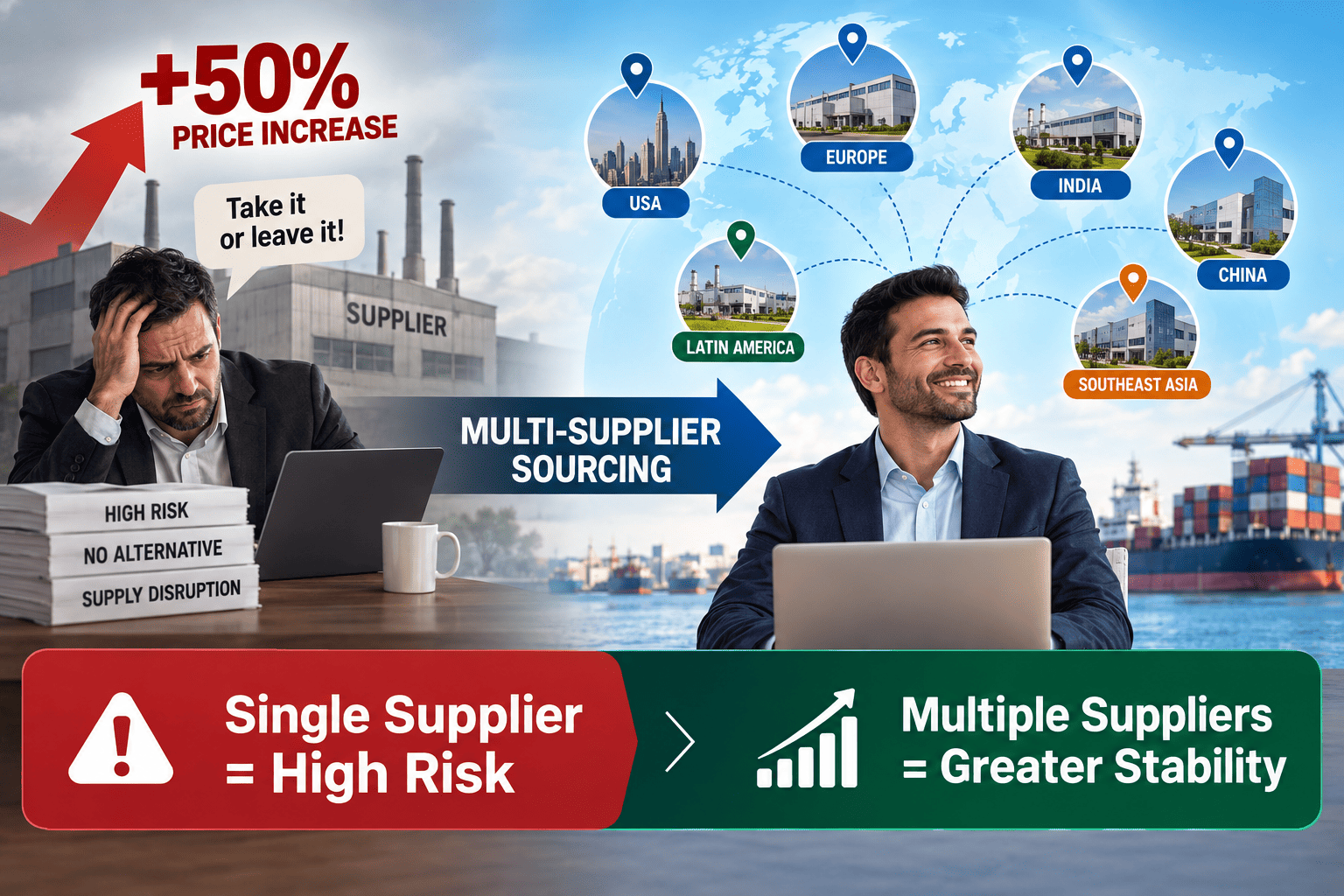
A single supplier asks for a 40 to 50 percent price increase with no warning, and there’s no real leverage to push back because there’s nowhere else to turn. That scenario is exactly what a multi supplier sourcing strategy is built to prevent. Building one isn’t about adding vendors for the sake of it; it’s a structured process of segmenting spend by risk, mapping and vetting alternatives, weighing total cost rather than price alone, and deliberately constructing a supplier mix that balances resilience against the real administrative cost of managing more relationships. This article walks through that process end to end, including where dual sourcing beats single sourcing, where it doesn’t, and how to formalize the resulting supplier mix into cross-border business partnerships that actually hold up.
📅 Published July 16, 2026⏱ 12 min read✍️ GTsetu Editorial🔄 Updated September 8, 2026
Multi-sourcing is a procurement strategy where a company obtains goods or services from multiple suppliers rather than depending solely on one source. It sounds simple in that one sentence. In practice, doing it well is a structured, ongoing discipline, not a one-time decision to “add a backup supplier” and move on.
Section 1
Why Companies Move to Multi Supplier Sourcing
Esker’s research on strategic sourcing captures why this has become a board-level concern rather than a back-office task: market volatility, supply chain disruptions, inflation, skills shortages, and pressure on sustainability and compliance are redefining what procurement leaders have to plan for. A sourcing strategy built around a single supplier per category simply doesn’t absorb that much uncertainty.
10–20%
savings an effective strategic sourcing approach can generate, according to BCG research cited by Esker
95%
of procurement decision-makers believe their process has significant room for optimization, per Amazon Business’s 2024 State of Procurement Report
2 weeks
vs. the standard four-week shipping interval, the shorter cadence dual sourcing can enable by staggering supplier shipments, per GEP
40–50%
the kind of unilateral price increase a single supplier can impose when a buyer has no real backup option, per GEP’s research
Procurement Tactics frames the core mechanism plainly: multiple sourcing allows a company to have an alternative source of suppliers when an uncertain event occurs, spreading risk so that one supplier’s difficulties don’t halt the whole operation. It’s the same logic that underpins market research for manufacturers before committing to any single region or partner: concentration is a risk, whether it’s geographic or supplier-based.
💡 Multi-sourcing is a leverage strategy, not just a backup plan
When a supplier knows they aren’t the only option, they have a direct incentive to stay competitive on price, quality, and service. Multi-sourcing isn’t only insurance against disruption, it’s also how a buyer keeps ongoing negotiating power instead of losing it the moment a single supplier becomes indispensable.
Section 2
Building the Strategy: A Step-by-Step Framework
A Structured, Iterative Process
Esker’s guidance lays out a seven-step process for building a strategic sourcing strategy that applies directly to multi supplier sourcing. Each step exists to answer a specific question before money or commitment is on the line.
1
Analyze Business Needs and Segment Categories
Not every category deserves the same level of supplier diversification
Foundation
Start by understanding real organizational needs, not just past spend, then apply a segmentation model such as the Kraljic matrix to classify each category by risk and economic impact. High-risk, high-impact categories deserve serious multi-sourcing investment; low-risk, low-spend categories usually don’t need the same rigor.
🎯
Why it matters: Diversifying every category equally wastes effort on ones that don’t need it and can dilute attention from the categories where a disruption would actually hurt.
2
Map Potential Suppliers and Assess Total Cost
Look past the headline price to logistics, dependency risk, and reliability
Total Cost
Actively scout the market, including suppliers outside your current base, through trade shows, competitive analysis, and digital scouting. Then evaluate total cost of ownership rather than price alone, factoring in hidden costs, logistics efficiency, supply continuity, and dependency risk. The lowest quote is frequently misleading once those factors are counted.
🎯
Why it matters: A supplier mix built on unit price alone tends to concentrate risk right back where a diversification strategy was supposed to remove it.
Translate the strategy into transparent, shared scorecards that weigh multiple criteria beyond price, so decisions are replicable rather than opaque. Depending on the category, different tender tools apply: detailed RFPs for complex supplies, RFQs for standardized purchases, or eAuctions for highly competitive categories.
🎯
Why it matters: Consistent, documented criteria are what let a buyer compare suppliers fairly and defend the selection later, whether internally or to the suppliers themselves.
Section 3
Constructing the Right Supplier Mix
Esker’s research calls this the heart of a strategic sourcing strategy: balancing the supplier portfolio to avoid risky concentration while creating operational flexibility. That balance comes from segmenting suppliers by role, not treating every relationship the same way.
Supplier Type
Role in the Mix
How to Manage Them
Strategic Suppliers
Long-term partners, often involved in co-development or business-critical categories
Support recurring operational needs, often high volume and low margin
Focus on continuity of service and efficiency
Emerging / Innovative Suppliers
Smaller or more specialized; test new technologies or cover niche needs
Controlled pilots and gradual integration
This diversification is essential to managing geopolitical risk, price volatility, and ESG transitions, and it directly improves overall negotiating position. Regularly reassessing each supplier’s dependency, financial stability, and compliance, and maintaining a share of local or alternative suppliers, keeps the mix responsive rather than fixed. That ongoing reassessment is also where proper manufacturing certifications for international trade get re-verified, not just checked once at onboarding.
📌 The historical-supplier trap
Esker’s research flags a specific failure pattern: relying on a limited number of well-known, responsive, “historical” suppliers feels safe, but that very familiarity can create fragility. Depending on only a few partners exposes a company to interruptions, unilateral price increases, or unpredictable delays with no real fallback in place.
Section 4
Single Sourcing vs. Dual Sourcing: The Real Trade-Offs
Before committing to a multi-supplier structure for a given category, it’s worth being honest about what single sourcing does well. Procurement Tactics notes that single sourcing carries a reduced risk of opportunistic behavior and builds a partnership based on cooperation and high trust, while GEP adds that dual sourcing, engaging two suppliers for a critical component, becomes valuable precisely where that single-supplier trust isn’t enough insurance against disruption.
Factor
Single Sourcing
Dual / Multi-Sourcing
Risk of disruption
High; one point of failure
Lower; other suppliers absorb volume if one is disrupted
Supplier relationship depth
Deep, cooperative, high-trust; suited to co-investment
Shallower per supplier, but sustains healthy competitive pressure
Pricing dynamics
Strong volume-based negotiating position, but limited leverage if terms sour
Competing suppliers vie for business, often yielding better pricing and terms
Administrative load
Lower; one relationship, one set of terms to manage
Higher; more negotiations, more inventory coordination, more overhead
Best fit for
Non-critical categories, or ones needing deep collaboration and IP protection
Critical components, geopolitically exposed categories, or capacity-constrained demand
GEP’s research adds a geographic dimension worth planning for directly: engaging suppliers in distinct regions and segmenting the areas each one serves can optimize shipping costs and even provide tariff benefits by minimizing imports and promoting local production, an approach particularly valuable for companies pursuing global expansion across multiple markets at once.
Section 5
Managing the Complexity Multi-Sourcing Creates
Multi-sourcing isn’t free. Both Procurement Tactics and GEP are candid about the trade-offs a buyer takes on in exchange for resilience.
More negotiations, doubled effort per relationship. Engaging two suppliers instead of one significantly increases workload; the decision should be justified by the resilience or savings gained, not treated as automatically better.
Discrepancies in process and quality. Even carefully selected suppliers operate with slight variations in their processes, so buyers need to ensure each one runs effectively and stays consistent with the others.
Harder inventory and logistics coordination. Managing products sourced from multiple suppliers requires effective inventory systems to track where stock actually is and retrieve it efficiently.
Diluted control and diminished bargaining power. Indiscriminately multiplying suppliers creates administrative complexity and can reduce negotiating leverage rather than increase it, if growth in the supplier base isn’t disciplined.
Increased overhead costs. More vendor relationships can mean more staff or more third-party coordination needed just to manage them all effectively.
⚠️ The point isn’t “more” or “less” suppliers
The goal is using the right suppliers for the right purpose, not maximizing supplier count. A supplier mix that’s too concentrated is fragile; one that’s too fragmented is expensive and hard to control. Both failure modes are avoidable with clear segmentation and governance from the start.
Section 6
From Supplier Mix to Formal Partnerships
A well-designed supplier mix on paper is only as strong as the agreements behind each relationship. Sourcing doesn’t end with signing; Esker’s guidance stresses clear governance, KPI monitoring, and periodic assessment as ongoing work, and that discipline starts with how each supplier relationship gets formalized in the first place.
🏛️
Verify each supplier’s legal standing before committing volume
A diversified supplier mix is only as resilient as the weakest verified link in it. Confirm registration and standing for every supplier, not just the primary one.
Government-sourced verification
📄
Put each relationship into a formal agreement
Translate scorecard-based selection into an actual business partnership contract for each supplier, with roles and cost contributions clearly specified.
Contract-first engagement
📜
Confirm certifications across the whole mix, not just one supplier
Different suppliers in the same category can vary in what they actually hold. Verify certifications individually rather than assuming parity across the mix.
Certification audit
⚖️
Build disruption terms into every contract, not just the backup
Cover force majeure in global trade for each supplier individually; the whole point of the mix fails if only one contract accounts for disruption.
Contingency terms
🔬
Validate the mix against independent market research
Cross-check assumptions about capacity, pricing, and reliability with proper market research for manufacturers before scaling any one supplier’s share.
Location-level research
🤝
Get expert support when building a mix in an unfamiliar market
🤝 For Verified Long-Term Manufacturing Partnerships
GTsetu: Verified Discovery and Secure Engagement for Manufacturers, Distributors, and Raw Material Suppliers
A multi supplier strategy is only as strong as the trust behind each relationship in it, and trust in global deals tends to break down at exactly the moments a diversified sourcing strategy depends on: unclear identity, unverified capacity claims, and specifications shared before any real protection is in place. GTsetu is built to close that gap for every supplier in the mix, not just the primary one. It is a structured partnership platform, not a directory or a general marketplace, where every company is verified on 6 government-sourced points before engagement, where discovery is anonymous until mutual interest is confirmed, where NDAs are executed digitally before any commercial information changes hands, and where document exchange happens through an encrypted workspace rather than email attachments.
GTsetu is used by industrial manufacturers, distributors, and raw material suppliers across 100+ countries to build and diversify exactly this kind of supplier mix, whether the goal is expanding a distributor network, sourcing international wholesale distribution partners, or forming a technology partnership meant to last for years, not a single order cycle. It complements the sourcing process rather than replacing it, but it removes much of the identity and documentation risk before any supplier, primary or backup, is added to the mix.
🏛️
6-Point Government-Sourced Verification
Name, Address, Registration Number, Company Status, Company Type, and Date of Incorporation, verified using government tie-ups before any engagement.
🕵️
Anonymous Discovery
Browse and compare verified manufacturer and distributor profiles across 100+ countries without revealing your identity or sourcing strategy until you choose to engage.
📄
Built-In NDA Workflow
Digital NDA with timestamped signatures before any pricing, formulations, or product specs are shared with a new supplier in the mix.
🔐
Encrypted Document Workspace
Scorecards, contracts, and specifications for every supplier stored through encrypted channels with a full access audit trail.
🌍
100+ Countries to Build a Mix Across
Verified manufacturers and distributors across Asia, Europe, the Middle East, Africa, Australia, and the Americas, ready to diversify against.
🚫
Zero Commission
No success fee, no broker commission, ever, across any number of suppliers in your mix.
A disciplined multi-sourcing approach also travels well across regions. A supply chain partner chosen in one market should be evaluated with the same rigor as one considered anywhere else, using consistent partnership evaluation criteria throughout. A platform built for B2B matchmaking across countries, rather than one tied to a single geography, makes it far easier to run that comparison consistently, whether the aim is a cross-border manufacturing partnership or simply a second qualified supplier for an already-critical category.
FAQ
Frequently Asked Questions
QHow do you build a multi supplier sourcing strategy?
Start by segmenting spend categories by risk and business impact, then map potential suppliers for each category, assess total cost of ownership rather than price alone, define weighted selection criteria, and deliberately construct a supplier mix of strategic, tactical, and emerging suppliers. The strategy isn’t finished at signing; it needs ongoing performance management and periodic rebalancing as risks and priorities shift.
QWhat is the difference between multi-sourcing and single sourcing?
Single sourcing means relying on one supplier for a given need, which allows deeper collaboration, trust, and often better pricing through committed volume, but creates a single point of failure. Multi-sourcing spreads the same need across several suppliers, trading some of that depth and simplicity for resilience, competitive pricing pressure, and protection against one supplier’s disruption stopping your operations.
QWhat is dual sourcing and how is it different from multi-sourcing?
Dual sourcing specifically means using two suppliers for a critical component or category, and is often the minimum viable step away from single sourcing. Multi-sourcing is the broader term and can involve more than two suppliers across one or many categories. In practice, the two terms are frequently used interchangeably, since dual sourcing is simply multi-sourcing at its smallest scale.
QWhat are the main challenges of a multi supplier sourcing strategy?
The biggest challenges are the added administrative and negotiation workload of managing several relationships instead of one, inconsistency between suppliers in process and quality standards, more complex inventory and logistics coordination, and the risk of diluted bargaining power if the supplier base grows without discipline. These are manageable with clear governance, but they are real costs that should be weighed against the resilience multi-sourcing buys.
Ready to Build a Verified, Diversified Supplier Mix?
GTsetu is purpose-built for manufacturers, distributors, and raw material suppliers in industrial sectors seeking verified long-term trade partnerships, across 100+ countries, with government-sourced partner verification, built-in NDA workflows, and zero commission.
They represents the product, and research team behind GTsetu, a global B2B collaboration platform built to help companies explore cross-border partnerships with clarity and trust. The team focuses on simplifying early-stage international business discovery by combining structured company profiles, verification-led access, and controlled collaboration workflows.
With a strong emphasis on trust, and disciplined engagement, Team GTsetu shares insights on global trade, partnerships, and cross-border collaboration, helping businesses make informed decisions before entering deeper commercial discussions.