How Do You Evaluate the Financial Stability of a Business Partner? | GTsetu Blog
Home ›
Blogs ›
Evaluate Financial Stability of a Business Partner
💼 Due Diligence & Risk Management · 2026
How Do You Evaluate the Financial Stability of a Business Partner?
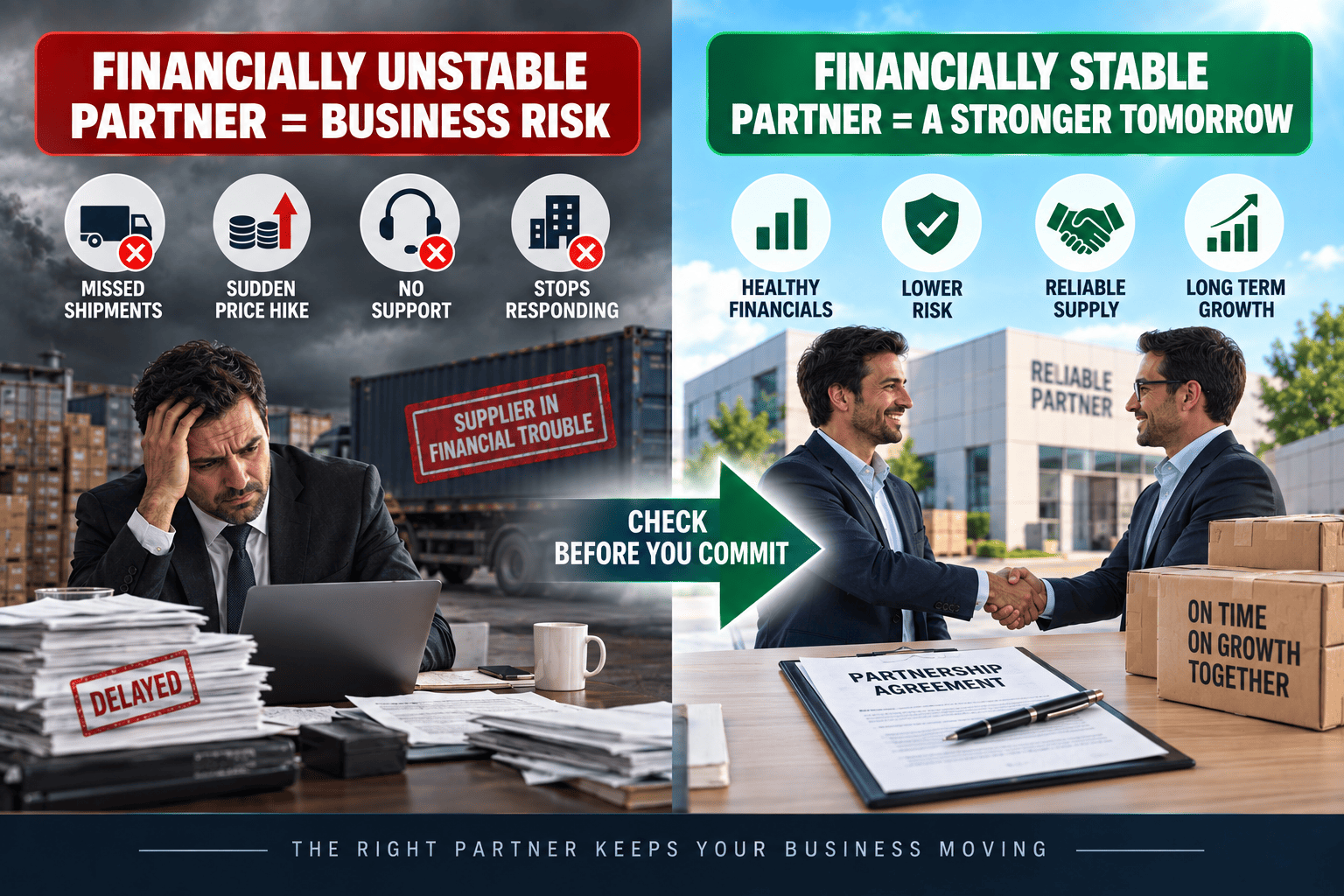
A partner’s financial trouble rarely announces itself. It shows up as a missed shipment, a sudden price increase, a support team that goes quiet, or a company that simply stops answering, and by the time any of that happens, it has already become your problem too. Evaluating a prospective partner’s financial stability before signing anything is what catches this earlier, through the same documents, ratios, and behavioural signals that lenders, auditors, and procurement teams have relied on for decades. This article walks through what to actually review, the ratios worth calculating, the red flags that matter most, and how to move from a financially sound partner to a properly formalised business partnership contract.
📅 Published September 11, 2026⏱ 12 min read✍️ GTsetu Editorial🔄 Updated September 11, 2026
Most partnership evaluations focus on capability: can this company make what we need, deliver on time, meet the specification. Financial stability is a different question entirely, and it is easy to skip because it feels like someone else’s job, a bank’s problem, an auditor’s problem, not a sourcing or partnership decision. But a capable partner who runs out of cash mid-contract creates exactly the same disruption as an incapable one, which is why financial due diligence belongs alongside partnership evaluation criteria from the start, not as an afterthought once the relationship is already underway.
Section 1
Why Financial Stability Deserves Its Own Due Diligence
A partner’s financial health is a leading indicator for almost every other risk in the relationship. Poor financial stability tends to show up first as a decline in service levels, then as reduced investment in quality or capacity, then as staff turnover, and eventually as an outright failure to deliver or, in the worst case, the partner exiting the business entirely. Each of those stages costs more to catch than the one before it.
3
Core financial statements every serious evaluation reviews: balance sheet, income statement, and cash flow statement
4
Typical financial stability rating tiers used in due diligence: confident, satisfactory, needs monitoring, and intense monitoring
1x
Minimum recommended frequency for reviewing a critical partner’s financials: at least annually, more often if risk is elevated
0
Financial statements that tell the full story in isolation; balance sheet, income, and cash flow only make sense read together
None of this requires a finance department of your own. It requires knowing which documents to ask for, which numbers in them actually matter, and which patterns are worth escalating. That discipline holds regardless of whether the partner sits down the road or across an ocean, though cross-border relationships add a layer of complexity, since financial reporting standards, disclosure norms, and the ease of verifying documents all vary significantly by country.
💡 Why this matters for trust, not just risk
Financial due diligence isn’t just about avoiding a bad outcome. It’s one of the clearest, most objective ways two companies build genuine confidence in each other early on, before either side has much else to go on. Skipping it doesn’t remove the risk; it just means trust breaks later, usually at a worse moment, once real money and real deadlines are on the line.
Section 2
The Core Financial Documents to Review
What to Ask For
Three documents, reviewed together rather than in isolation, give a genuinely complete picture of a company’s financial position. Public companies typically disclose these through statutory filings; private companies should be asked to provide them directly as a normal part of due diligence, ideally audited or at minimum professionally reviewed.
1
The Balance Sheet
A snapshot of what the company owns and owes at a single point in time
Position
The balance sheet shows total cash, accounts receivable, current and total assets, current and total debt, current and total liabilities, and overall net worth position. It answers a simple question: if this company had to settle everything it owes right now, using everything it owns, where would it land.
🎯
What to look for: A widening gap between current assets and current liabilities, or a net worth position propped up mostly by intangible assets rather than cash and receivables, both deserve a closer look before proceeding.
2
The Income Statement
Whether the core business actually makes money
Profitability
The income statement shows total revenue alongside gross, operating, and net income and margin percentages, revealing how the company generates revenue and whether that revenue translates into actual profit once costs are accounted for. A company can be growing revenue quickly and still be losing money on every sale.
🎯
What to look for: Margins that have compressed over several consecutive periods, or revenue growth that isn’t converting into operating income, both suggest a business under pressure even if the top line still looks healthy.
3
The Cash Flow Statement
Where cash actually comes from, and where it actually goes
Liquidity
The cash flow statement tracks cash generated from operations against capital expenditure, and is the clearest indicator of whether a company can sustain its current operations without relying on new borrowing or outside funding. Profit on paper and cash in the bank are not the same thing, and this statement is where that difference becomes visible.
🎯
What to look for: Consistently negative operating cash flow, even alongside reported profit, is one of the more reliable early warning signs that a company’s financial position is weaker than its income statement alone would suggest.
📌 Get a qualified opinion
These documents can be genuinely difficult to interpret correctly without accounting expertise, particularly across different national accounting standards. Where the relationship is significant enough to matter, it is worth having an accountant or financial analyst review the documents rather than relying solely on an internal read, especially for a first engagement with an unfamiliar international partner.
Section 3
The Ratios That Actually Predict Trouble
Raw numbers on a financial statement are hard to compare across companies of different sizes. Ratios solve that problem by expressing financial health in relative terms, which is what makes them genuinely useful for evaluation rather than just informative.
Ratio
What It Measures
What a Weak Number Suggests
Debt-to-Worth
Total debt relative to net worth, a measure of leverage
Heavy reliance on borrowing, limited buffer against a downturn
Current Ratio
Current assets divided by current liabilities
Difficulty meeting short-term obligations as they come due
Gross & Net Margin
Profitability at the product level and after all costs
Thin or shrinking margins leave little room for disruption
Tangible Net Worth
Net worth excluding goodwill and other intangible assets
Reported worth may not convert into real liquidity if needed
Operating Cash Flow
Cash generated from core operations, independent of financing activity
Business may depend on new borrowing to keep functioning
No single ratio tells the whole story, and a weak number in one area is not automatically disqualifying; a company early in a capital-intensive expansion might show a high debt-to-worth ratio and still be a perfectly sound partner. The value of these ratios comes from looking at them together, over several periods, to see the direction things are moving rather than judging a single snapshot in isolation.
Section 4
Beyond the Numbers: Qualitative Signals
Financial statements tell you where a company has been. A few qualitative checks help confirm where it is headed, and they are often easier to gather early in a relationship than a full set of audited accounts, particularly useful during initial market research for manufacturers evaluating an unfamiliar region.
🏦
Bank and trade references
Ask for references from the company’s bank and from other suppliers or customers who have transacted with them over time.
Third-party verification
📈
Payment history with other parties
A pattern of chronic late payments to other suppliers is often visible well before it shows up in a formal financial statement.
Behavioural signal
👥
Staff turnover and leadership stability
Unusually high turnover, especially in finance or operations roles, can be an early sign of internal financial pressure.
Organisational signal
Willingness to share documentation📄
A company confident in its financial position is generally willing to share it. Reluctance or evasiveness is itself informative.
Transparency check
🏛️
Legal registration and standing
Confirm the company is legally registered and in good standing, verified against government sources rather than self-reported claims.
Finding a red flag during evaluation is not automatically a reason to walk away. It is a reason to ask more specific questions and, if the relationship still makes sense, to structure the partnership with that risk explicitly in mind.
Declining revenue or margins across several periods. A single weak quarter can be noise; a multi-period trend in the same direction is a pattern worth understanding before committing.
Rising debt without matching growth in assets or revenue. Debt taken on to fund genuine expansion looks very different from debt taken on to cover operating shortfalls, and the difference matters enormously.
Heavy reliance on goodwill and intangible assets. A net worth figure that looks solid on paper but is mostly intangible may not convert into real liquidity if the company needs it quickly.
Reluctance to share financial documentation. A legitimate reason sometimes exists, but persistent evasiveness on financial questions is one of the more reliable warning signs in the entire evaluation process.
Chronic late payments to other parties. A pattern of stretching payment terms with other suppliers or partners tends to precede more serious financial distress, not follow it.
When a red flag surfaces, the useful responses are usually to request additional documentation addressing the specific concern, build financial reporting or performance clauses directly into the business partnership contract, increase the frequency of ongoing monitoring, or, where the relationship is critical, keep evaluating an alternative supply chain partner in parallel rather than committing exclusively while questions remain open.
🤝 For Verified Long-Term Partnerships
GTsetu: Verified Discovery and Secure Engagement for Manufacturers, Distributors, and Raw Material Suppliers
Financial statements tell you whether a company is stable. They do not tell you whether the company is who they claim to be in the first place, which is a separate, foundational layer of due diligence that has to happen before financial documents are even worth requesting. That is what GTsetu is built to close. It is a structured partnership platform, not a directory or a general marketplace, where every company is verified on 6 government-sourced points before engagement, where discovery is anonymous until mutual interest is confirmed, where NDAs are executed digitally before any commercial information changes hands, and where document exchange, including sensitive financial documentation, happens through an encrypted workspace rather than email attachments.
GTsetu is used by industrial manufacturers, distributors, and raw material suppliers across 100+ countries to build out a distributor network, source international wholesale distribution partners, or find manufacturing and technology partnership relationships worth this level of scrutiny in the first place. It complements, rather than replaces, financial due diligence, but it removes much of the identity and documentation risk before that deeper diligence even begins.
🏛️
6-Point Government-Sourced Verification
Name, Address, Registration Number, Company Status, Company Type, and Date of Incorporation, verified using government tie-ups before any engagement.
🕵️
Anonymous Discovery
Browse verified manufacturer and distributor profiles across 100+ countries without revealing your own identity or sourcing strategy until you choose to engage.
📄
Built-In NDA Workflow
Digital NDA with timestamped signatures before any pricing, financials, or specifications are shared. No sensitive information exposed without protection.
🔐
Encrypted Document Workspace
All commercial documents shared through encrypted channels with a full access audit trail, not email attachments.
🌍
100+ Countries
Verified manufacturers and distributors across Asia, the Middle East, Europe, Africa, Australia, and the Americas. Built for cross-border partnership formation, not one-off quotes.
🚫
Zero Commission
No success fee, no broker commission, ever. Your partnership economics remain entirely between you and your partner.
From a Sound Balance Sheet to a Formal Partnership
A financially sound partner still needs a properly structured agreement, and the due diligence findings should feed directly into it. That means building in the right reporting cadence, such as an annual requirement to share updated financials, defining what happens if agreed financial thresholds are breached, and addressing how force majeure and disruption scenarios are handled if the partner’s financial position changes materially during the life of the contract.
For relationships that cross borders, financial due diligence sits alongside the broader work of building trust in a cross-border business partnership, where verifying registration, standing, and financial health in an unfamiliar jurisdiction is often harder than doing the same work domestically. Companies expanding into new markets as part of a wider global expansion or cross-border manufacturing partnership strategy often benefit from international business development consulting to navigate unfamiliar reporting standards, and from a consistent B2B matchmaking process that surfaces already-vetted partners as part of thorough international sourcing. Getting the financial due diligence right at the outset is what makes everything that follows, pricing, delivery, quality, worth relying on.
FAQ
Frequently Asked Questions
QWhat financial documents should you review to evaluate a business partner?
The core documents are the balance sheet, income statement, and cash flow statement, ideally audited or at minimum reviewed. Public companies typically disclose these through annual filings; private companies should be asked to provide them directly as part of due diligence, along with any available bank references or credit reports.
QWhat financial ratios matter most when assessing a potential partner’s stability?
The most useful ratios include the debt-to-worth ratio, which shows how leveraged the company is; liquidity ratios such as the current ratio, which show whether short-term obligations can be met; profit margins, which show whether the core business is actually profitable; and tangible net worth, which strips out goodwill and intangibles to show what the company would actually be worth if wound down.
QWhat are red flags that suggest a business partner may be financially unstable?
Common red flags include declining revenue or margins over consecutive periods, rising debt without a corresponding increase in assets or revenue, chronic late payments to other suppliers, high staff turnover, reluctance to share financial documentation, and a heavy reliance on goodwill or intangible assets rather than tangible, liquid ones.
QWhat should you do if a prospective partner shows signs of financial instability?
Request additional documentation to address the specific concern, build financial performance clauses and reporting requirements into the partnership contract, increase the frequency of financial monitoring going forward, or consider structuring the relationship with smaller initial commitments and contingency plans until confidence improves. In some cases the right response is to keep the company on a shortlist while actively evaluating an alternative partner in parallel.
QHow often should you re-check a partner’s financial stability once the relationship is underway?
At minimum, an annual review is standard practice for any partner of material importance, with the frequency increasing for higher-risk relationships or once any red flags have already surfaced. Continuous or semi-annual monitoring is common for critical partners where a financial failure would seriously disrupt operations.
GTsetu is purpose-built for manufacturers, distributors, and raw material suppliers in industrial sectors seeking verified long-term trade partnerships, across 100+ countries, with government-sourced partner verification, built-in NDA workflows, and zero commission.
They represents the product, and research team behind GTsetu, a global B2B collaboration platform built to help companies explore cross-border partnerships with clarity and trust. The team focuses on simplifying early-stage international business discovery by combining structured company profiles, verification-led access, and controlled collaboration workflows.
With a strong emphasis on trust, and disciplined engagement, Team GTsetu shares insights on global trade, partnerships, and cross-border collaboration, helping businesses make informed decisions before entering deeper commercial discussions.