What Are the Top 10 Manufacturing Companies in the World? (2026) | GTsetu
Home ›
Blog ›
Top 10 Manufacturing Companies in the World
🏭 Global Trade & Manufacturing
What Are the Top 10 Manufacturing Companies in the World?
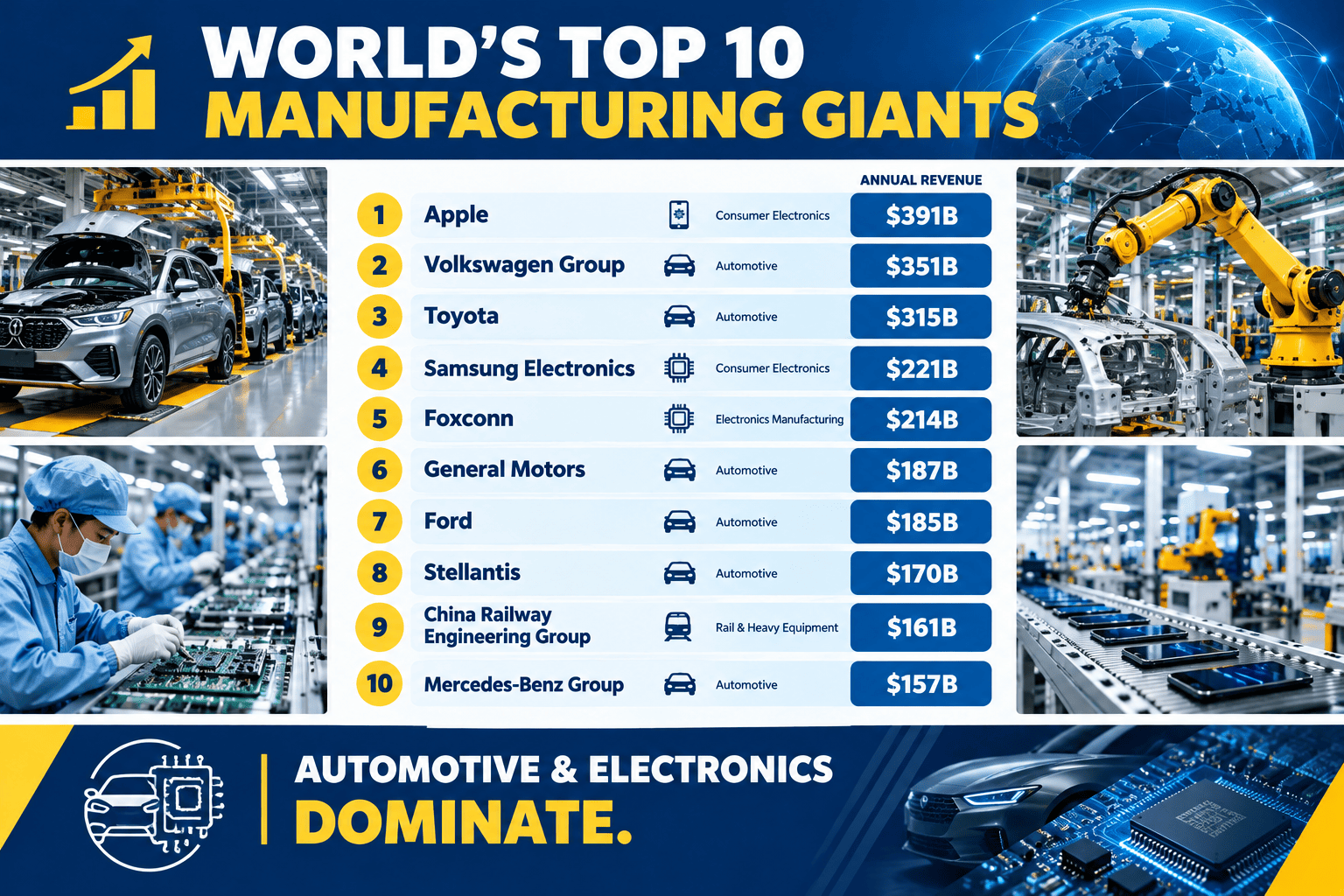
Direct Answer: Ranked by annual revenue using Fortune Global 500 figures, the top 10 manufacturing companies in the world are Apple (about US$391 billion), Volkswagen Group (US$351 billion), Toyota (US$315 billion), Samsung Electronics (US$221 billion), Foxconn (US$214 billion), General Motors (US$187 billion), Ford (US$185 billion), Stellantis (US$170 billion), China Railway Engineering Group (US$161 billion) and Mercedes-Benz Group (US$157 billion). Automotive and electronics dominate the list. Exact placings vary by source, year and how conglomerates are classified. GTsetu helps manufacturers of every size find government‑tie‑up verified partners across 100+ countries, with built-in NDA workflows and zero broker commission.
📅 Published October 12, 2026🔄 Updated October 12, 2026⏱ 12 min read✍️ GTsetu Editorial Team
10
Companies Ranked
~$2.35T
Combined Revenue
7
HQ Countries
0%
GTsetu Broker Commission
Manufacturing still anchors the global economy. A small group of companies turns raw materials and components into the cars, phones, chips and machinery the world runs on, and their sourcing decisions shape supply chains in dozens of countries. If you want to understand who sits at the top, and what that means for your own business, this guide ranks the top 10 manufacturing companies in the world and explains what each one does.
Manufacturers, exporters, procurement teams and business development professionals who want a clear picture of the world’s largest manufacturers, and who are considering supplying, distributing for, or partnering with companies in this ecosystem. It is also useful for students and analysts researching the industry.
⚖️ Data & Disclaimer
Revenue figures are rounded and drawn from Fortune Global 500 data as compiled on Wikipedia’s list of largest manufacturing companies by revenue. Rankings change every year and differ between publications depending on whether they rank by revenue, market capitalisation, or reputation. This guide is for general education, not investment, legal or business advice. Verify current figures with the companies’ own filings.
SECTION 1
1 How the World’s Largest Manufacturers Are Ranked
🎯 Short Answer
Most “largest manufacturer” lists rank companies by annual revenue, usually taken from the Fortune Global 500. Other lists rank by market capitalisation, employer reputation, or innovation in advanced manufacturing. Because large groups often mix manufacturing with services or resource extraction, no ranking is definitive.
Different questions produce different “top 10” lists. A company can be enormous by revenue yet rank lower on market value, and a smaller firm can lead on smart-factory technology or workplace quality. Here is how the common approaches differ.
💰
By Revenue
The most common method. Total annual sales, typically from the Fortune Global 500. This is the basis of the ranking in this article.
📈
By Market Capitalisation
Ranks by stock market value. High-margin technology and semiconductor makers often rise here, while low-margin, high-volume producers fall.
🤖
By Advanced Manufacturing
Focuses on automation, robotics, industrial IoT and smart-factory capability rather than size alone.
🏆
By Workplace Quality
Employer-rating and “best workplaces” lists reward culture and employee experience, not scale. Useful for hiring, not for sizing the industry.
✨ GTsetu Insight
Size is only one lens. When choosing a manufacturing partner, look at identity, certifications and reliability as well as scale. Our partnership evaluation criteria give you a practical framework.
SECTION 2
2 The Top 10 at a Glance
The table below ranks the ten largest manufacturers by revenue, in billions of US dollars, using Fortune Global 500 figures as listed on Wikipedia.
Rank
Company
Industry
Revenue (US$ bn)
Headquarters
1
Apple
Electronics
391.0
United States
2
Volkswagen Group
Automotive
351.1
Germany
3
Toyota
Automotive
315.1
Japan
4
Samsung Electronics
Electronics
220.6
South Korea
5
Foxconn
Electronics
213.7
Taiwan
6
General Motors
Automotive
187.4
United States
7
Ford
Automotive
185.0
United States
8
Stellantis
Automotive
169.7
Netherlands
9
China Railway Engineering Group
Engineering
161.3
China
10
Mercedes-Benz Group
Automotive
157.5
Germany
SECTION 3
3 Company Profiles: Who They Are and What They Make
Each of these companies runs a different manufacturing model, from vertically integrated car makers to design-led brands that outsource assembly to contract specialists.
1
Apple · United States
Consumer electronics led by the iPhone, Mac and iPad. Designs its products in-house and relies on a global network of contract manufacturers for assembly.
📱 Electronics
2
Volkswagen Group · Germany
One of the world’s largest automakers, operating a portfolio of passenger and commercial vehicle brands across many countries.
🚗 Automotive
3
Toyota · Japan
A global automaker known for lean production and quality systems that have influenced manufacturers in every sector.
🚗 Automotive
4
Samsung Electronics · South Korea
A major maker of smartphones, displays, home appliances and semiconductors, with deep vertical integration across components.
💾 Electronics
5
Foxconn · Taiwan
The world’s best-known electronics contract manufacturer, assembling devices for many global brands at very large scale.
🏭 Contract Mfg
6
General Motors · United States
A major US automaker producing cars, trucks and SUVs, with a growing focus on electric vehicles.
🚗 Automotive
7
Ford · United States
A long-established automaker known for trucks and mass-market vehicles, with a global manufacturing and supplier network.
🚗 Automotive
8
Stellantis · Netherlands
A multinational automaker formed from a merger of European and American manufacturers, with many vehicle brands under one group.
🚗 Automotive
9
China Railway Engineering Group · China
A state-owned engineering group. It appears on manufacturing lists because of its engineering and equipment activities alongside construction.
🏗️ Engineering
10
Mercedes-Benz Group · Germany
A premium automaker producing luxury cars and vans, with a global network of plants and suppliers.
🚗 Automotive
📌 A Note on Classification
Some entries, such as China Railway Engineering Group, sit on “manufacturing” lists because of how Fortune classifies large conglomerates. Wikipedia itself cautions that placings should not be treated as definitive. Companies such as Nvidia, TSMC and BYD rank just outside the top 10 by revenue but lead on market value or technology.
SECTION 4
4 What the Top 10 Tell Us About Global Manufacturing
✅ Key Patterns
✅Automotive dominates: six of the ten are car makers, reflecting the scale and complexity of vehicle production.
✅Electronics leads at the top: Apple, Samsung and Foxconn show how design, components and assembly each create huge businesses.
✅Asia and Europe lead: only three of the ten are US-headquartered, and Germany and the United States each appear more than once.
✅Supplier ecosystems are vast: each giant depends on thousands of component makers and distributors.
Foxconn shows that being excellent at one stage of the value chain can build a very large business. Identify the process or component where you are hard to replace.
Large manufacturers buy from suppliers, license technology and appoint distributors. Winning that business means doing due diligence and agreeing clear contracts, because the stakes are high on both sides.
🔎
Commercial Due Diligence
Verify who you are dealing with and how sound the opportunity is before committing. Read commercial due diligence.
Trust is the real constraint in cross-border manufacturing. Verified identities and signed NDAs before any exchange of drawings, pricing or specifications protect both sides. Read more in our guide to cross-border manufacturing partnerships.
SECTION 7
7 How GTsetu Helps Manufacturers
🌐 Platform Spotlight, GTsetu
Your Verified Gateway to Manufacturing Partners Worldwide
You may not be competing with the top 10, but you can supply them, distribute alongside them, or build the partnerships that make your business globally competitive. GTsetu connects manufacturers with government‑tie‑up verified partners across 100+ countries, with built-in NDA workflows and encrypted collaboration. Every company on GTsetu is verified using direct government tie‑ups across six essential credentials: legal name, registered address, registration number, company status, company type, and date of certificate of incorporation. GTsetu does not verify industry certifications, quality standards or financial standing; those must be exchanged and validated directly between partners.
✅
Government Tie‑Up Verification6‑point verification: legal name, registered address, registration number, company status, company type, incorporation date.
📜
Certifications & ComplianceGTsetu does not verify these. They must be exchanged directly between partners during due diligence.
🕵️
Anonymous DiscoveryExplore verified partner profiles without revealing your identity until mutual interest is confirmed.
📄
Built-In NDA WorkflowFormalise confidentiality before sharing specifications, pricing, or proprietary information, with a full digital audit trail.
🚫
Zero CommissionNo broker fees on any deal, whether a distribution agreement, supply contract, or technology partnership.
🔐
Encrypted CollaborationAll documents and communications encrypted in transit and at rest, from first contact.
🌍
100+ CountriesActive verified network of manufacturers, distributors, and supply chain partners.
The ranking above uses revenue figures from the first source. The others offer different lenses (market capitalisation, advanced manufacturing, workplace quality) and are worth reading alongside it.
QWhat are the top 10 manufacturing companies in the world?
Ranked by revenue using Fortune Global 500 figures, the top 10 manufacturing companies are: Apple, Volkswagen Group, Toyota, Samsung Electronics, Foxconn, General Motors, Ford, Stellantis, China Railway Engineering Group and Mercedes-Benz Group. Rankings shift with the year and with how conglomerates are classified.
QWhich is the largest manufacturing company in the world?
By revenue, Apple tops the Fortune Global 500-based list with roughly US$391 billion, followed by Volkswagen Group at about US$351 billion and Toyota at about US$315 billion. Apple designs its products and relies heavily on contract manufacturers such as Foxconn for assembly.
QHow are the largest manufacturing companies ranked?
Most lists rank by annual revenue, usually drawn from the Fortune Global 500. Others rank by market capitalisation, employee count, or workplace quality. Because large groups often span manufacturing, services and resource extraction, placements are not definitive and differ between sources.
QWhich countries are home to the largest manufacturers?
The top 10 are headquartered in the United States, Germany, Japan, South Korea, Taiwan, the Netherlands and China. The United States and Germany each have multiple entries.
QCan smaller manufacturers work with global giants?
Yes. Large manufacturers rely on thousands of component makers, contract manufacturers and distributors. Smaller suppliers win business by proving identity, quality, certifications and reliability, and by agreeing clear contract terms before sharing sensitive information.
QHow does GTsetu help manufacturers find partners?
GTsetu helps manufacturers find and verify partners across 100+ countries. With government-tie-up verification of six core credentials (legal name, registered address, registration number, company status, company type, incorporation date), built-in NDA workflows, and zero broker commission, GTsetu supports trusted cross-border manufacturing partnerships.
Ready to Build Your Own Global Manufacturing Network?
Join verified manufacturers, exporters, and importers already building cross-border partnerships on GTsetu, with government‑tie‑up verification of six core credentials, built-in NDA workflows, and zero broker fees across 100+ countries.
They represents the product, and research team behind GTsetu, a global B2B collaboration platform built to help companies explore cross-border partnerships with clarity and trust. The team focuses on simplifying early-stage international business discovery by combining structured company profiles, verification-led access, and controlled collaboration workflows.
With a strong emphasis on trust, and disciplined engagement, Team GTsetu shares insights on global trade, partnerships, and cross-border collaboration, helping businesses make informed decisions before entering deeper commercial discussions.