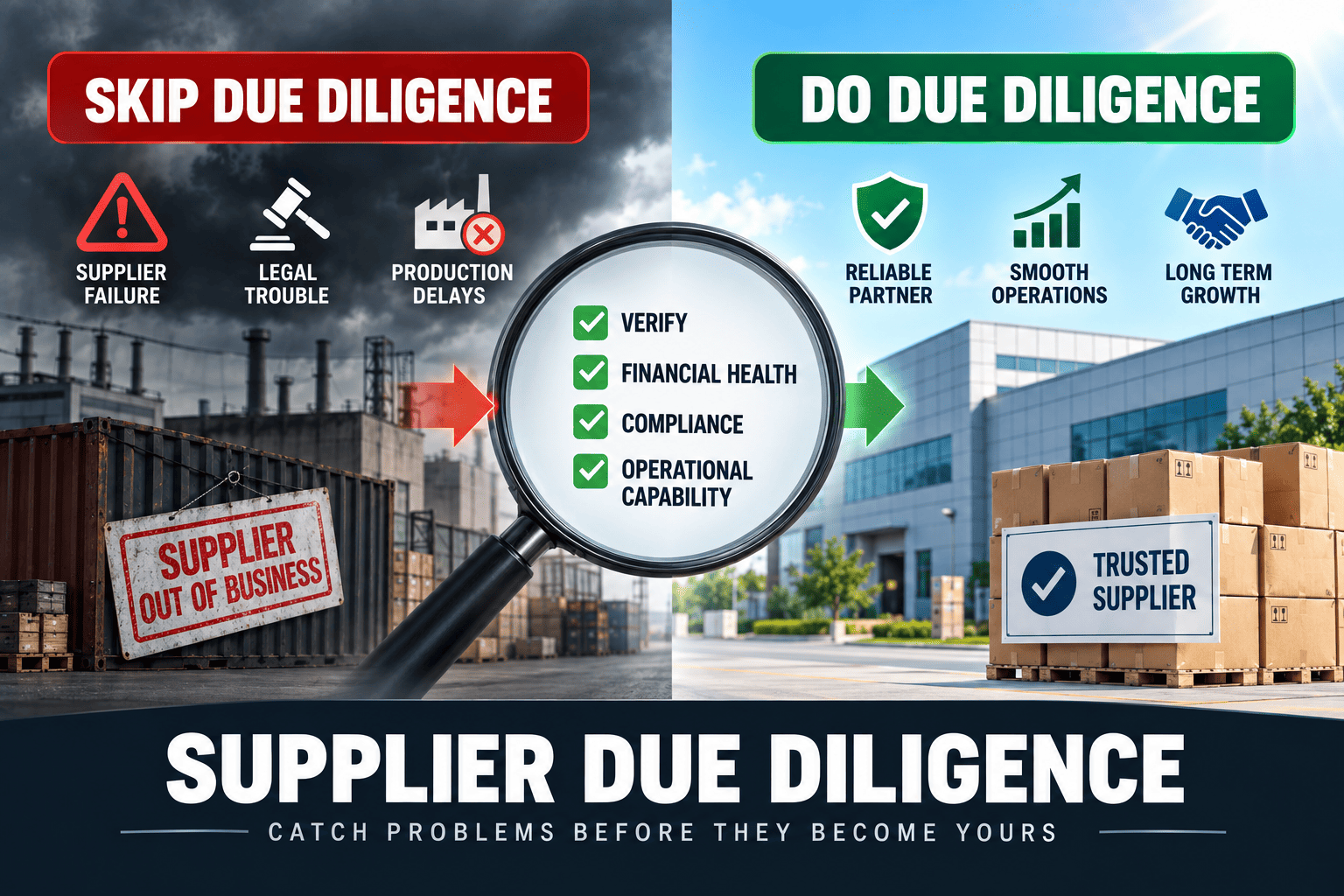
What Is Supplier Due Diligence and Why Does It Matter?
Supplier due diligence is the process of verifying that a company you plan to depend on, for materials, components, manufacturing capacity, or distribution, actually is who it says it is, is financially stable enough to deliver, and is not carrying legal, compliance, or operational risk that will eventually become your risk too. It is easy to treat due diligence as a formality, a box to check before a purchase order goes out. In practice, it is the single biggest lever a company has for avoiding the kind of supplier failure that shows up not as a bad quarter, but as a lawsuit, a stalled production line, or a customs seizure. This guide explains what supplier due diligence actually covers, why it has become more important rather than less, and how to build a process that catches problems before they become yours.
📅 Published September 11, 2026⏱ 12 min read✍️ GTsetu Editorial🔄 Updated September 11, 2026
Every supplier relationship starts with a degree of trust extended before it has been earned, you cannot fully verify a company until you start working with them. Due diligence is how that gap gets narrowed to something manageable: a structured, repeatable way of gathering evidence about a supplier’s legitimacy and stability before you commit meaningful volume, sensitive information, or operational dependency to the relationship. Done well, it is a foundation for durable cross-border business partnerships. Done poorly, or skipped entirely, it is one of the most common reasons those partnerships eventually fail.
Section 1
What Supplier Due Diligence Actually Means
Supplier due diligence is the structured investigation and verification of a prospective or existing supplier’s legal standing, financial health, operational capability, and compliance record, carried out before entering into a business relationship and, ideally, at intervals throughout it. It is distinct from a basic capability check or a sales conversation in one key way: due diligence is specifically designed to surface the things a supplier would not volunteer, financial distress, past legal disputes, sanctions exposure, or compliance gaps, rather than simply confirming what the supplier claims about itself.
📌 Due diligence vs. supplier evaluation
The two are related but not identical. Supplier evaluation typically asks “can this supplier do what we need?”, covering capability, quality, and price. Due diligence asks a different question: “is this supplier safe to depend on?”, covering legitimacy, financial stability, legal exposure, and compliance. A supplier can pass evaluation with flying colours and still fail due diligence, and the reverse is also possible. A complete partnership evaluation needs both.
Section 2
Why It Matters More Than Ever
The Business Case
Supplier due diligence has moved from a specialist compliance function to a mainstream sourcing discipline, driven by a handful of converging pressures that make skipping it increasingly costly.
1
Supply Chains Have Become More Interdependent, Not Less
A single supplier’s failure now travels further, faster
Operational Risk
Global supply chains have grown longer and more specialised, which means a disruption at a single tier-one or tier-two supplier can halt production for every buyer that depends on it, sometimes with very little warning. A financial collapse, a regulatory shutdown, or a quality failure at one supplier no longer stays contained to that one relationship.
🎯
Why it matters: Due diligence on financial stability and operational resilience is now directly tied to a company’s own continuity planning, not a separate compliance exercise, and connects closely with how supply chain partners are chosen in the first place.
2
Regulatory Liability Increasingly Flows Upstream to Buyers
“We didn’t know” is a weakening legal defence
Legal Exposure
A growing body of due diligence legislation, sanctions enforcement, and anti-money-laundering requirements now expects buyers to actively verify who they are transacting with, not passively accept a supplier’s self-declared status. Sanctions screening, beneficial ownership checks, and anti-bribery verification have moved from optional good practice to, in many jurisdictions, a legal expectation.
🎯
Why it matters: A buyer that cannot demonstrate it performed reasonable due diligence is in a materially weaker position if a supplier is later found in violation of sanctions, labour law, or anti-corruption rules.
3
Trust Between Distant Parties Doesn’t Form on Its Own
Especially true across borders, languages, and legal systems
Relationship Risk
Domestic supplier relationships benefit from shared legal systems, easier verification, and cultural familiarity. Cross-border relationships lack most of that scaffolding by default, which is a large part of why trust breaks down in global deals that skip proper verification. Due diligence is the structured substitute for the informal trust-building that happens naturally in more familiar, local relationships.
🎯
Why it matters: The less familiar the counterpart, geographically, culturally, or legally, the more deliberate the verification process needs to be to reach the same level of confidence.
Section 3
The Categories of Risk Due Diligence Is Designed to Catch
Effective due diligence covers several distinct categories of risk, each requiring a different type of verification. A process that only checks one or two of these leaves real exposure unaddressed.
Supplier insolvency mid-contract, leaving orders unfulfilled and deposits unrecovered
Operational & quality
Production capacity, quality systems, track record, sub-tier supplier mapping
Inflated capacity claims, inconsistent quality, hidden dependency on unvetted subcontractors
Regulatory & certification
Industry-specific licences, quality certifications, compliance history
Products that cannot legally be sold in target markets, or certifications that have lapsed
Labour & ethical practice
Wage compliance, working conditions, forced or child labour risk
Reputational damage, import bans, and legal liability tied to labour violations
Cybersecurity & data
Data handling practices, system security, prior breach history
A supplier’s compromised systems becoming an entry point into the buyer’s own data or network
💡 Scale the depth to the risk
Not every supplier warrants the same depth of diligence. A low-volume, easily replaced vendor and a sole-source manufacturer producing a critical component carry very different risk profiles, and the diligence process should reflect that difference rather than applying one uniform checklist regardless of stakes.
Section 4
What a Supplier Due Diligence Checklist Covers
Translated into a practical checklist, most thorough supplier due diligence processes work through the following, roughly in order of how early each check can reasonably be performed.
🏛️
Confirm legal existence and registration
Verify the company is legally registered, in good standing, and that the entity you’re dealing with matches its official registration.
Government-sourced verification
👤
Identify beneficial ownership
Understand who actually controls the company, not just the name on the letterhead, particularly relevant for sanctions and anti-corruption screening.
Ownership transparency
💰
Assess financial stability
Review available credit information, payment history, and any signs of financial distress before committing volume.
Knowing what to check matters less than having a repeatable process that actually gets followed under commercial pressure, when a promising deal is moving fast and diligence can start to feel like friction. The process below is built to hold up under that pressure.
1
Tier your suppliers by risk and criticality
Not every supplier needs the same depth of review. Rank suppliers by how critical they are to your operations and how much risk their category typically carries, and scale diligence effort accordingly.
2
Verify identity and legal standing before any sensitive exchange
Confirm registration and business status before sharing specifications, pricing, or entering serious negotiation, protected by an NDA from the point sensitive information starts flowing.
3
Run category-specific checks
Apply the relevant checks from the categories above, financial, regulatory, labour, cybersecurity, based on what actually matters for that supplier’s role in your supply chain.
4
Document findings and decisions
Keep a record of what was checked, what was found, and why a decision was made to proceed or not, both for internal accountability and to demonstrate reasonable diligence if ever challenged.
Set a cadence for revisiting key checks, financial standing, certifications, sanctions status, rather than treating diligence as complete once onboarding ends.
Section 6
Why Due Diligence Doesn’t End at Onboarding
A supplier that passed every check at onboarding can still deteriorate months or years later, financial trouble can develop quietly, certifications can lapse without notice, and ownership can change hands in ways that alter risk exposure entirely. Treating due diligence as a one-time gate at the start of the relationship, rather than an ongoing discipline, is one of the most common gaps in otherwise well-run sourcing programmes.
This matters just as much for relationships that started well but have simply run for a long time without review as it does for brand-new suppliers. A distributor relationship built out through careful distributor network development, or an international wholesale distribution partnership formed years ago, deserves the same periodic scrutiny as a brand-new manufacturing relationship, particularly as the volume or scope of the relationship grows.
🤝 For Verified Long-Term Business Partnerships
GTsetu: Verification and Secure Engagement Built Into the Platform, Not Bolted On Afterward
Everything above describes what a company needs to check and how to check it, work that traditionally happens manually, and often inconsistently, across spreadsheets, emails, and one-off background checks. GTsetu is built to make the first and most important layer of that diligence a default part of discovery, not a separate project. It is a structured partnership platform, not a directory or a general marketplace, where every company is verified on 6 government-sourced points before engagement, where discovery is anonymous until mutual interest is confirmed, where NDAs are executed digitally before any commercial information changes hands, and where document exchange happens through an encrypted workspace with a full audit trail.
GTsetu is used by manufacturers, distributors, and raw material suppliers across 100+ countries to find pre-verified partners for cross-border manufacturing partnerships, technology partnership arrangements, and distribution relationships, removing much of the identity and documentation risk before deeper, category-specific diligence even begins. It complements a company’s own financial and compliance checks rather than replacing them, but it closes the gap that causes the most damage: engaging deeply with a counterpart whose basic legitimacy was never actually confirmed.
🏛️
6-Point Government-Sourced Verification
Name, Address, Registration Number, Company Status, Company Type, and Date of Incorporation, verified using government tie-ups before any engagement.
🕵️
Anonymous Discovery
Browse verified partner profiles across 100+ countries without revealing your own identity or sourcing strategy until you choose to engage.
📄
Built-In NDA Workflow
Digital NDA with timestamped signatures before any pricing, formulations, or product specs are shared.
🔐
Encrypted Document Workspace
All commercial and compliance documents shared through encrypted channels with a full access audit trail.
🌍
100+ Countries
Verified manufacturers, distributors, and suppliers across Asia, the Middle East, Europe, Africa, Australia, and the Americas.
🚫
Zero Commission
No success fee, no broker commission, ever. Your partnership economics remain entirely between you and your partner.
Whether you are sourcing raw materials, formalising a manufacturing relationship internationally, or planning a broader global expansion, supplier due diligence is not a step to rush past on the way to a signed contract. It is the work that determines whether the contract is worth signing in the first place. Companies without an in-house function for this can also lean on international business development consulting or a purpose-built B2B matchmaking platform to apply a consistent standard across every new relationship, rather than reinventing the process each time.
FAQ
Frequently Asked Questions
QWhat is supplier due diligence?
Supplier due diligence is the process of investigating and verifying a prospective or existing supplier’s legal standing, financial health, operational capability, compliance record, and risk exposure before and during a business relationship. It goes beyond a basic capability check to confirm that a supplier is legitimate, stable, and safe to depend on, covering categories like legal registration, financial solvency, quality systems, regulatory compliance, labour practices, and cybersecurity posture.
QWhy does supplier due diligence matter?
Supplier due diligence matters because a company’s exposure to legal, financial, operational, and reputational risk increasingly flows through its suppliers, not just its own operations. A supplier’s financial collapse can disrupt production, a supplier’s compliance violation can create legal liability for the buyer, and a supplier’s data breach can compromise the buyer’s own systems. Due diligence is how these risks are identified and managed before they become the buyer’s problem, rather than being discovered only after something goes wrong.
QWhat does a supplier due diligence checklist typically include?
A typical checklist covers legal and corporate verification, such as registration, ownership, and litigation history, financial health checks including credit ratings and payment history, quality and operational capability assessment, relevant certifications and regulatory compliance, labour and ethical practice review, data security and cybersecurity posture, and sanctions or watchlist screening. The exact scope depends on the supplier’s risk level and criticality to the buyer’s operations.
QIs supplier due diligence a one-time process?
No. Effective supplier due diligence is an ongoing process, not a one-time check performed only at onboarding. A supplier’s financial health, compliance status, and risk profile can change significantly over the life of a relationship, so leading practice includes periodic re-verification, monitoring for adverse news or sanctions changes, and reassessment when the scope or volume of the relationship changes materially.
QHow much due diligence is enough for a small or low-risk supplier?
Due diligence should scale to the supplier’s risk and criticality, not follow one fixed checklist for every relationship. A low-volume, easily replaced vendor supplying a non-critical input typically needs a lighter check, basic registration and reputation verification, while a sole-source manufacturer producing a critical component or a supplier handling sensitive data warrants the full depth of review across financial, legal, operational, and compliance categories.
Start Every Partnership With Verification Built In
GTsetu is purpose-built for manufacturers, distributors, and raw material suppliers in industrial sectors seeking verified long-term trade partnerships, across 100+ countries, with government-sourced partner verification, built-in NDA workflows, and zero commission.
They represents the product, and research team behind GTsetu, a global B2B collaboration platform built to help companies explore cross-border partnerships with clarity and trust. The team focuses on simplifying early-stage international business discovery by combining structured company profiles, verification-led access, and controlled collaboration workflows.
With a strong emphasis on trust, and disciplined engagement, Team GTsetu shares insights on global trade, partnerships, and cross-border collaboration, helping businesses make informed decisions before entering deeper commercial discussions.