What Is the Most Profitable Manufacturing Business? 12 High-Potential Ideas for 2026 | GTsetu
Home ›
Blog ›
Most Profitable Manufacturing Business
🏭 Manufacturing & Growth
What Is the Most Profitable Manufacturing Business? 12 High-Potential Ideas for 2026
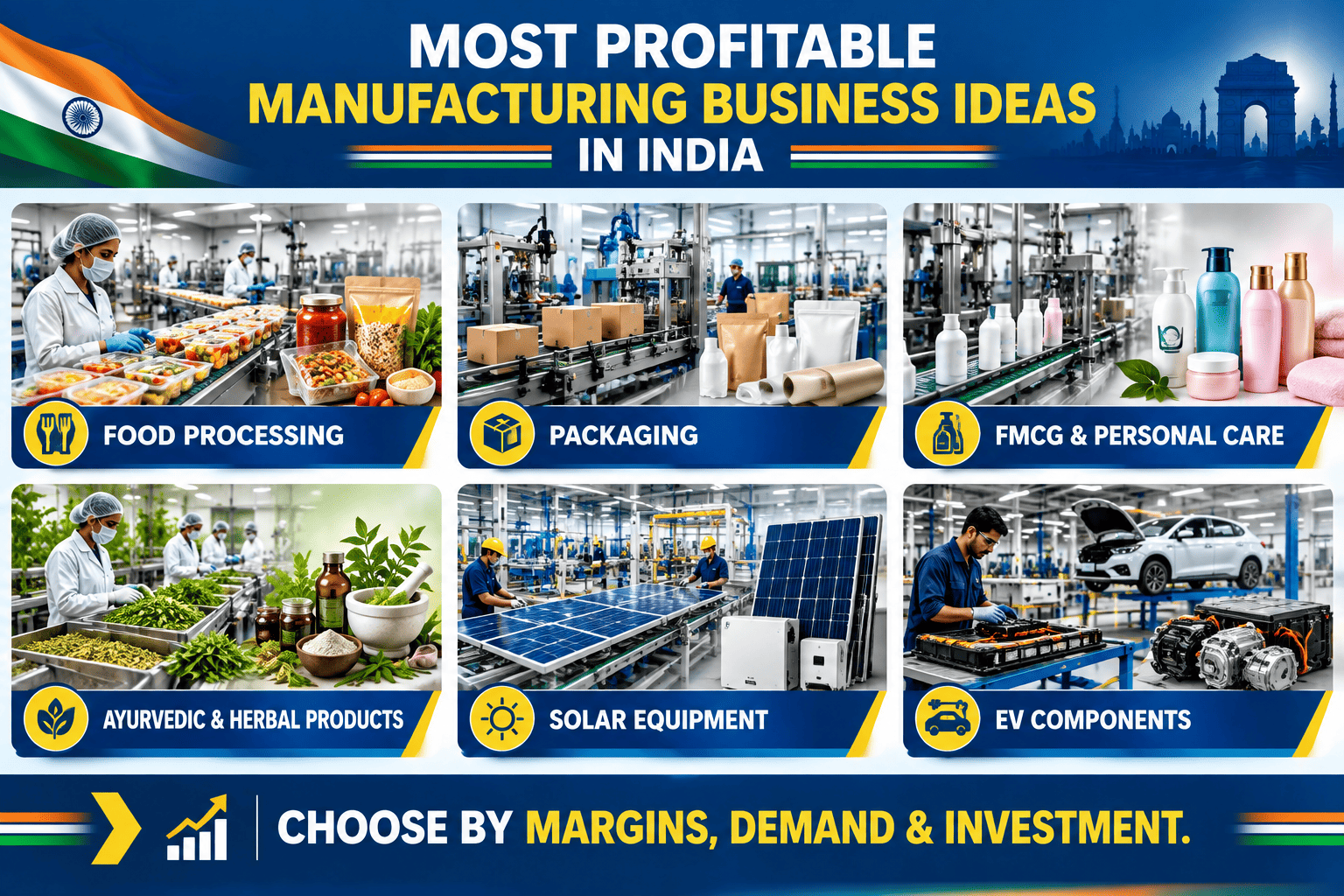
Direct Answer: There is no single most profitable manufacturing business, because profit depends on demand, raw-material cost, capital needs, competition and execution. In India, food processing, packaging, FMCG and personal care, Ayurvedic and herbal products, and fast-growing segments such as solar and EV components are the ideas most often cited as high-potential. Small units like soap, agarbatti or snacks can start with modest capital, while solar, ethanol and foundries need far more. Pick by comparing six factors (margin, demand, capital, competition, compliance and scalability), then model your own unit economics before you invest. Once you are producing, GTsetu helps manufacturers find government‑tie‑up verified distributors and partners across 100+ countries, with anonymous discovery, built-in NDA workflows and zero broker commission.
📅 Published October 13, 2026🔄 Updated October 13, 2026⏱ 14 min read✍️ GTsetu Editorial Team
12
Business Ideas Compared
6
Profitability Factors
100+
Countries on GTsetu
0%
Broker Commission
Search for the “most profitable manufacturing business” and you will find a dozen different answers. That is because profit is not a property of an industry; it is the result of how well a specific product fits a specific market, produced at a specific cost. A well-run namkeen unit can outperform a poorly planned solar plant, and the reverse is also true.
First-time entrepreneurs choosing a manufacturing venture, MSME owners looking to add a product line, and existing manufacturers deciding where to invest next. It is also useful for distributors and buyers who want to understand which sectors are growing.
⚖️ Disclaimer
This guide provides general commercial education and is not financial, legal or tax advice. Market figures are drawn from publicly available industry sources and projections, which change over time. Margins and investment amounts are indicative and vary by location, scale and execution. Verify current numbers, licences and incentives with qualified advisers before investing.
SECTION 1
1 What Makes a Manufacturing Business Profitable?
🎯 Definition
A profitable manufacturing business is one where the selling price comfortably exceeds the full cost of making and delivering the product, repeatedly and at scale. Profit comes from steady demand, controlled raw-material and labour costs, efficient production, a defensible brand or niche, and reliable sales channels.
Manufacturing has structural advantages that make it attractive. Because you control the production process, you can optimise cost and quality directly. Demand for everyday and industrial goods is steady, and a business can start small and scale as orders grow. India’s policy environment also supports the sector. According to figures cited by Kinara Capital, MSMEs contributed about 35.4% of India’s manufacturing output in FY22 and about 45.7% of exports in FY24.
35.4%
MSME share of India’s manufacturing output (FY22)
45.7%
Share of exports from MSME products (FY24)
$1T
Manufacturing output target for India by 2025-26, cited by IBEF
SECTION 2
2 12 High-Potential Manufacturing Business Ideas
These ideas appear repeatedly across lender, industry and advisory sources. Market figures below are published projections, not guarantees of profit for any individual unit.
1
Food Processing
Convenience, packaged and health-focused foods keep demand strong. India’s food processing market was valued at about INR 28,027.5 billion in 2023, with growth of around 8.8% a year projected to 2032.
Needs FSSAI
2
Packaging (Paper & Bioplastic)
Every product needs packaging. Bioplastics in India are projected to reach about US$761.9 million by 2030, growing near 20% a year, as brands shift away from conventional plastic.
Sustainability-led demand
3
Textiles & Technical Textiles
Indian textiles and apparel are projected to grow near 10% a year toward US$350 billion by 2030. Niches such as digital printing and technical textiles can beat commodity cloth on margin.
Niche beats commodity
4
Ayurvedic, Herbal & Personal Care
The Ayurveda products market is projected to reach about US$16.27 billion by FY28, growing around 15% a year. Brand and quality compliance matter more than machinery.
GMP & brand-driven
5
Solar Panels & Components
Renewable energy demand supports solar manufacturing. The Indian solar market is projected to grow around 9.4% a year from 2024 to 2030, but capital and technology needs are high.
Capital-intensive
6
EV Components
Batteries, motors, controllers and telematics are expanding as e-mobility grows. Success usually depends on partnering with vehicle makers and meeting strict quality specifications.
OEM relationships
7
Metal Casting & Foundry
Castings supply automotive, construction and industrial customers. India’s foundry market is estimated at about US$21.5 billion in 2025, projected to reach roughly US$35 billion by 2030.
B2B, precision-led
8
Ethanol Production
India’s fuel-blending policy, including a 20% blending target, has made ethanol a strategic sector. It needs distillation equipment, steady feedstock and strong environmental compliance.
Policy-dependent
9
Custom Furniture
Urbanisation and demand for personalised interiors support made-to-order furniture. Relationships with architects, interior designers and hospitality buyers drive repeat orders.
Design & delivery edge
10
Leather Goods
Bags, shoes and accessories benefit from craftsmanship and export demand. India’s leather goods market is projected to grow around 7.7% a year to 2030.
Skill & design heavy
11
Drones & Components
Agriculture, logistics, surveillance and defence applications are opening up, supported by government policy. Regulatory approvals and technical expertise are the main hurdles.
Deep-tech & regulated
12
Everyday FMCG (Soap, Agarbatti, Candles, Paper Bags)
Simple products with low entry cost and local demand. Margins depend on distribution reach and branding because competition is intense and barriers are low.
3 Quick Comparison: Capital, Demand and Compliance
Use this table for a first-pass filter. Capital tiers are indicative: Low means up to a few lakh rupees, Medium means tens of lakhs, and High means significant plant, technology or feedstock investment.
Business
Capital Tier
Main Demand Driver
Typical Compliance Focus
Food processing
Low to Medium
Convenience and health trends
FSSAI, hygiene, packaging rules
Paper / bioplastic packaging
Low to Medium
Brand sustainability goals
Environmental and plastic regulations
Textiles
Medium
Domestic and export apparel demand
Quality, labour and environmental norms
Ayurvedic / personal care
Medium
Wellness and natural-product demand
GMP, product licensing, labelling
Custom furniture
Medium
Urban housing and offices
Factory and timber-sourcing rules
Leather goods
Medium
Fashion and export demand
Effluent and tanning regulations
Metal casting
Medium to High
Automotive and industrial buyers
Safety, emissions, quality systems
Solar manufacturing
High
Renewable energy demand
Product standards, testing
EV components
High
E-mobility adoption
OEM quality and safety standards
Ethanol
High
Blending mandates
Pollution control, feedstock licences
Drones
High
Agriculture, logistics, defence
Aviation and drone-rule approvals
Soap, agarbatti, candles, paper bags
Low
Everyday local demand
Basic registrations, local permits
SECTION 4
4 Low-Investment Manufacturing Ideas
If capital is tight, start with a product that needs simple machinery and little specialised knowledge. Bajaj Finserv’s guide lists the following indicative startup costs. Treat them as starting points, because machinery, rent, raw materials and licences change the real figure.
Idea
Indicative Startup Cost
Skills Needed
Candle making
₹10,000 – ₹50,000
Basic craft and moulding
Soap and detergent
₹50,000 – ₹2 lakh
Basic chemistry and production knowledge
Agarbatti (incense sticks)
₹50,000 – ₹1 lakh
No specialised skills required
Snacks and namkeen
₹1 lakh – ₹3 lakh
Food safety and hygiene
Paper bags
₹1 lakh – ₹5 lakh
Basic machine operation
📌 Low Cost Does Not Mean Low Competition
Easy-entry products attract many competitors, which compresses margins. Plan your edge up front: a regional brand, a niche (for example, organic or premium), better packaging, or a dependable distribution network.
SECTION 5
5 The Six-Factor Profitability Framework
🎯 The Rule
Do not pick a business because a list called it “most profitable”. Score each candidate on six factors using your costs and your market. For a structured approach to testing assumptions, see our guide on commercial due diligence.
💰
1. Margin Structure
Calculate unit cost (raw material, labour, power, packaging, logistics, wastage) against realistic selling price. Include distributor and retailer margins.
📈
2. Demand Strength
Is demand steady, seasonal or policy-driven? Validate with buyer conversations, not only market-size headlines.
🏗️
3. Capital Intensity
Machinery, premises and working capital decide how long it takes to break even and how much a slow quarter can hurt.
⚔️
4. Competition & Differentiation
What stops buyers from switching? Quality, brand, certification, relationships or technology all count; price alone rarely does.
📜
5. Compliance Burden
Licences, certifications and environmental rules add cost and time, but also act as barriers that protect established, compliant players.
🚀
6. Scalability & Reach
Can you grow volumes without proportional cost increases, and can you reach new regions or export markets through partners?
SECTION 6
6 How to Choose the Right Idea for You
The best business is the one where your resources and strengths line up with real demand. Use this quick guide as a starting filter.
🧭 Which Direction Fits You?
If your capital is limited
Start lean
Low-Investment FMCG
Soap, agarbatti, candles, paper bags or snacks. Prove demand, then reinvest.
If you have domain or technical skill
Build on expertise
Specialised B2B
Castings, components, technical textiles or EV parts, where know-how is the moat.
If you can build a brand
Differentiate
Branded Consumer
Herbal, personal care, specialty foods and premium packaging reward brand building.
If you can fund large projects
Go big, carefully
Capital-Intensive
Solar, ethanol or drones. Secure offtake contracts and approvals before building.
SECTION 7
7 Licences, Certifications and Compliance
Requirements depend on your product, state and scale, but most Indian manufacturers deal with a similar core set.
Requirement
Applies To
Udyam (MSME) registration
Most small and medium manufacturers; supports access to schemes and credit
GST registration
Taxation of goods; required above applicable thresholds and for inter-state supply
Factory licence & local approvals
Premises, labour and safety compliance under state and municipal rules
Pollution-control consent
Industries with emissions, effluent or waste, such as leather, ethanol and metal casting
Most manufacturing failures come from ordinary operational and commercial risks, not from choosing the “wrong” industry. Plan for these before you commit.
🚩
Raw-Material Price Swings
Input costs can move faster than your selling price. Diversify suppliers and build price-adjustment terms where possible.
🚩
Working-Capital Squeeze
Paying suppliers upfront while buyers pay in 60 to 90 days drains cash. Many profitable units fail on cash flow.
🚩
Customer Concentration
Relying on one or two large buyers gives them pricing power over you. Widen your customer and channel mix early.
🚩
Quality & Warranty Claims
Defects erode brand and margin. Define product responsibilities clearly; see our explainer on the warranty clause.
🚩
Regulatory Change
Incentives, import duties and environmental rules shift. Policy-led sectors like ethanol and solar are especially exposed.
🚩
Weak Contracts
Verbal supply or distribution deals invite disputes. Understand what counts as a material breach and when a breach of contract gives you remedies.
✅ Protect Your Margins
✅Model unit economics first: test best, expected and worst-case scenarios.
✅Secure working capital: plan for slow-paying customers.
✅Put terms in writing: price, payment, delivery and quality.
⚠️Copying a trending idea without checking local demand or competition.
⚠️Underestimating licences and approval timelines.
⚠️Ignoring liability exposure: consider how consequential damages are treated in contracts.
⚠️No exit terms: know how a termination for convenience clause works before you sign long-term supply deals.
SECTION 9
9 How to Start: A 7-Step Plan
1
Research the Market and Finalise the Idea
Find a product with real demand and manageable competition in your area. Our guide to global market research for manufacturers shows how to size demand and compare markets.
2
Write a Business Plan and Cost Model
Cover target customers, pricing, unit economics, break-even point and a marketing plan. Lenders will expect this.
3
Arrange Funding
Options include bank and NBFC loans, MSME and MUDRA schemes, SIDBI support and personal capital. Budget for land or rent, machinery, raw materials and working capital.
4
Choose a Location and Register
Pick an industrial area with access to suppliers and logistics. Choose your structure (proprietorship, LLP or private limited) and obtain Udyam, GST and other licences.
5
Source Machinery and Raw Materials
Buy from trusted suppliers, and compare outsourcing against in-house production if you want to limit upfront investment.
6
Set Up the Plant and Hire the Team
Install equipment, put quality checks in place and train staff. Document processes early so you can scale without losing consistency.
7
Launch, Sell and Build Distribution
Combine direct sales, local distributors and online channels. Evaluate every partner carefully using our partnership evaluation criteria.
SECTION 10
10 Scaling Beyond Your Home Market
Many of the highest-earning manufacturers grow by adding export and partner channels once their domestic operation is stable. That brings new opportunities and new risks, so prepare in layers.
Get delivery terms right. Name the rule, version and place, for example Incoterms 2020. A rule such as FCA (Free Carrier) gives a clear handover point for many containerised exports.
Profit is not only about what you make; it is about who buys it and how reliably. Verified, well-matched distributors and buyers protect your margin from the costs of failed partnerships, unpaid invoices and disputes.
PLATFORM
11 How GTsetu Helps Manufacturers Grow
🌐 Platform Spotlight, GTsetu
Turn Your Production Into Global Sales With Verified Partners
Making a good product is only half of profit. The other half is reaching reliable buyers and distributors without losing margin to intermediaries or risky introductions. GTsetu connects manufacturers with government‑tie‑up verified distributors and partners across 100+ countries, with built-in NDA workflows and encrypted collaboration. Every company on GTsetu is verified through direct government tie‑ups across six credentials: legal name, registered address, registration number, company status, company type, and date of certificate of incorporation. GTsetu does not verify industry certifications, financial standing, sales capability or references; those must be checked directly between partners during due diligence.
✅
Government Tie‑Up Verification
6‑point verification: legal name, registered address, registration number, company status, company type, incorporation date.
📜
Certifications & Financials
GTsetu does not verify these. Exchange and validate them directly between partners.
🕵️
Anonymous Discovery
Explore buyer and distributor profiles without revealing your identity until mutual interest is confirmed.
📄
Built-In NDA Workflow
Formalise confidentiality before sharing pricing, specifications or formulations, with a full digital audit trail.
🚫
Zero Commission
No broker fees on any deal, whether a distribution agreement, supply contract or manufacturing partnership.
🔐
Encrypted Collaboration
Documents and communications encrypted in transit and at rest. Secure B2B collaboration from first contact.
🌍
100+ Countries
A verified network of distributors, importers and supply chain partners.
QWhat is the most profitable manufacturing business?
There is no single most profitable manufacturing business, because profit depends on demand, raw-material costs, capital needs, competition and execution. In India, food processing, packaging, FMCG and personal care, Ayurvedic and herbal products, and fast-growing segments such as solar and EV components are frequently cited as high-potential. Choose the one that matches your skills, budget and local demand.
QWhich manufacturing business needs the lowest investment?
Candle making, soap and detergent production, agarbatti (incense stick) making, snacks and namkeen, and paper bags are commonly cited low-investment options, with indicative startup costs ranging from tens of thousands of rupees to a few lakh. Actual costs depend on scale, location, machinery and licences.
QWhich manufacturing business has the highest profit margin?
Margins vary widely by product, scale and brand strength. Branded, differentiated products such as personal care, herbal and specialty foods can earn healthy margins, while capital-intensive sectors such as solar, EV components and ethanol depend on volume, incentives and contracts. Build a unit-economics model before committing capital.
QWhat licences are needed to start a manufacturing business in India?
Common requirements include Udyam (MSME) registration, GST registration, a factory licence and pollution-control consent where applicable, FSSAI for food products, and an Import Export Code (IEC) if you plan to trade internationally. Exact requirements depend on your product, state and scale, so confirm with local authorities and advisers.
QCan I start a manufacturing business from home?
Yes, for products that do not need heavy machinery or industrial infrastructure, such as candles, soaps, agarbatti, paper bags or some food items. You must still follow applicable licensing, safety and local rules, which can restrict home-based production.
QHow can a small manufacturer export or find international distributors?
Start with market research, obtain the required export registrations and certifications, shortlist partners, verify them independently and sign a written distribution agreement covering territory, pricing, Incoterms, IP and termination. Platforms such as GTsetu help manufacturers discover government-tie-up verified distributors and partners across 100+ countries.
QHow does GTsetu help manufacturers grow?
GTsetu helps manufacturers find and verify distributors and partners across 100+ countries. Every company is verified through government tie-ups on six core credentials (legal name, registered address, registration number, company status, company type, incorporation date). GTsetu offers anonymous discovery, built-in NDA workflows, encrypted collaboration and zero broker commission. GTsetu does not verify certifications, financial standing or sales capability, so those must be checked directly between partners.
Ready to Take Your Manufacturing Business Global?
Join 500+ verified manufacturers, exporters and distributors already building cross-border partnerships on GTsetu, with government‑tie‑up verification of six core credentials, built-in NDA workflows and zero broker fees across 100+ countries.
They represents the product, and research team behind GTsetu, a global B2B collaboration platform built to help companies explore cross-border partnerships with clarity and trust. The team focuses on simplifying early-stage international business discovery by combining structured company profiles, verification-led access, and controlled collaboration workflows.
With a strong emphasis on trust, and disciplined engagement, Team GTsetu shares insights on global trade, partnerships, and cross-border collaboration, helping businesses make informed decisions before entering deeper commercial discussions.