Which Manufacturing Is in Demand in India? Top Sectors for 2026 | GTsetu
Home ›
Blog ›
Which Manufacturing Is in Demand in India?
🏭 Global Trade & Manufacturing
Which Manufacturing Is in Demand in India? Top Sectors for 2026
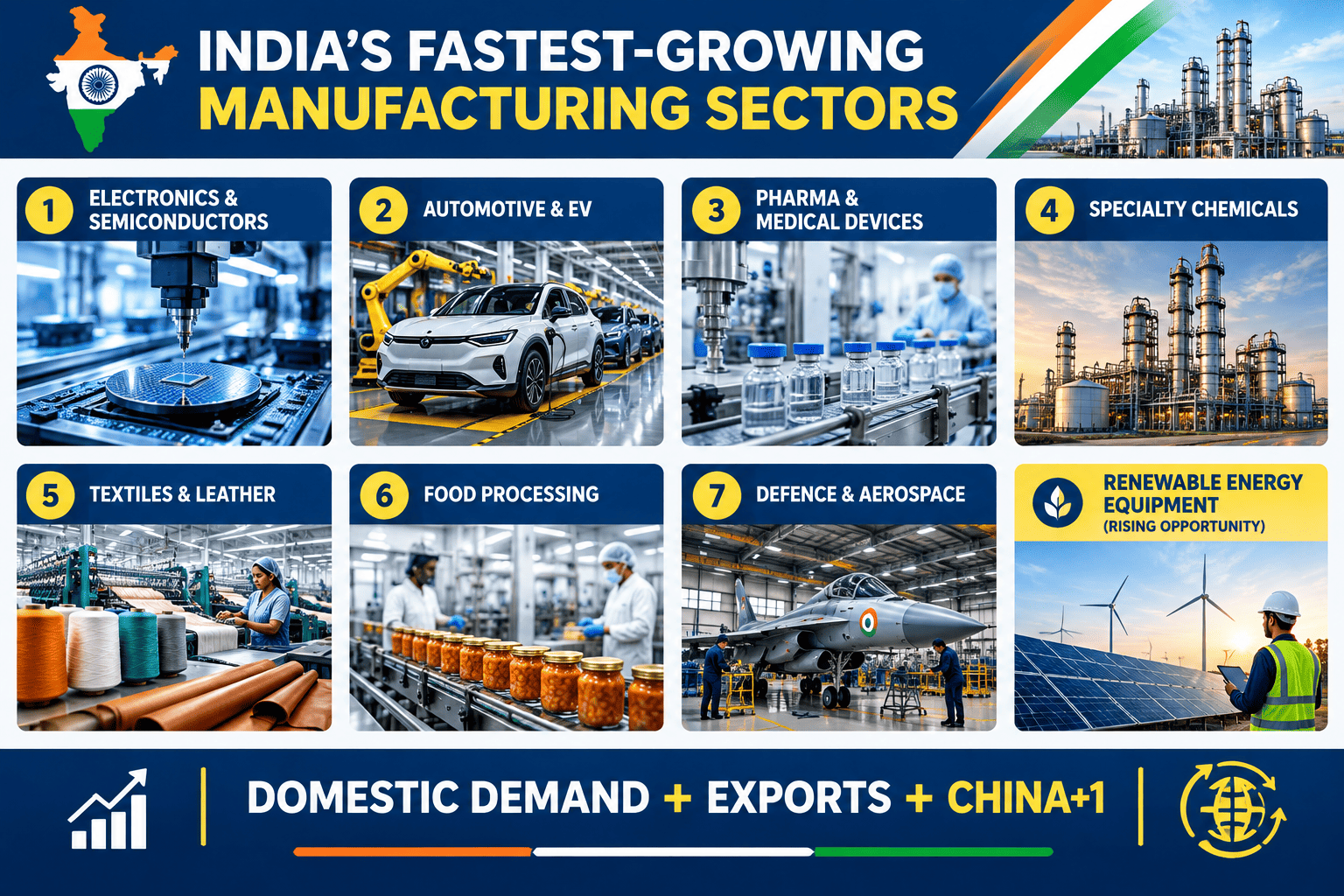
Direct Answer: The manufacturing sectors in strongest demand in India are electronics and semiconductors, automobiles, electric vehicles and auto components, pharmaceuticals and medical devices, specialty chemicals, textiles and leather, food processing, and defence and aerospace, with renewable energy equipment also gaining ground. Demand comes from three directions at once: a large and growing domestic market, rising exports, and the global China+1 shift in supply chains. Government support, led by the Production Linked Incentive (PLI) scheme across 14 sectors and the National Manufacturing Mission, which targets a 25% GDP share for manufacturing by 2035, adds further momentum. Manufacturing contributes around 17% of India’s GDP, and manufacturing GVA grew 11.6% in FY2025-26. For buyers, investors and entrepreneurs, the key is matching a sector to your capital, compliance capability and partner network. GTsetu helps you find government‑tie‑up verified manufacturers, distributors and partners across 100+ countries, with built-in NDA workflows and zero broker commission.
📅 Published October 12, 2026🔄 Updated October 12, 2026⏱ 17 min read✍️ GTsetu Editorial Team
~17%
Manufacturing Share of GDP
11.6%
Manufacturing GVA Growth, FY26
14
PLI Scheme Sectors
25%
GDP Share Target by 2035
India is no longer just an import-dependent consumer market. It is rapidly becoming a production base for the world. Smartphones, pharmaceuticals, auto components, specialty chemicals, textiles and defence equipment are all being made in India at growing scale, for both domestic customers and export markets. If you are a global buyer, an investor, an exporter or an entrepreneur asking which manufacturing is in demand in India, the answer depends on which signals you follow: export data, policy incentives, foreign investment or domestic consumption.
Global buyers and sourcing teams evaluating Indian suppliers, foreign manufacturers considering India as a production base, Indian entrepreneurs choosing a sector to enter, and distributors looking for high-demand product categories to represent.
⚖️ Disclaimer
This guide provides general commercial education based on publicly available sources, including IBEF and industry publications. Market figures, projections and scheme details change often and should be verified against official sources before you make investment, sourcing or compliance decisions. It does not constitute legal, tax, financial or regulatory advice.
SECTION 1
1 What “In Demand” Means for Indian Manufacturing
🎯 Definition
A manufacturing sector is in demand in India when it shows sustained growth in domestic consumption, exports, investment and policy backing at the same time. The sectors that tick all four boxes today are electronics, automobiles and EVs, pharmaceuticals, chemicals, textiles, defence and food processing.
According to IBEF, manufacturing contributes around 17% of India’s GDP, manufacturing Gross Value Added grew 11.6% in FY2025-26 (up from 8.3% the year before), and the manufacturing PMI has stayed in expansion territory since March 2023. The government’s National Manufacturing Mission, announced in Budget 2025-26, aims to lift manufacturing’s share of GDP to 25% by 2035 and create 143 million jobs.
The Four Forces Behind Manufacturing Demand
🛒
Domestic Consumption
A large population and a growing middle class create built-in demand for phones, vehicles, medicines, appliances and processed food. IBEF projects India’s middle class will hold the second-largest share of global consumption by 2030.
🚢
Export Growth
India’s total exports (goods and services) reached a record US$ 860 billion in FY2025-26. Engineering goods, electronics, pharmaceuticals, textiles and gems are key drivers.
🌏
China+1 Supply Chains
Global manufacturers diversifying away from single-country dependence are adding India to their sourcing and production footprint, helped by lower labour costs and a large engineering workforce.
🏛️
Policy Incentives
PLI schemes, Make in India, semiconductor programmes and industrial corridors reduce the cost and risk of setting up production in priority sectors.
SECTION 2
2 Top Manufacturing Sectors in India at a Glance
Here are the six clusters of demand that appear most consistently across government data and industry research. Each is explored in detail below.
1
Electronics & Semiconductors
Smartphones, components, EMS and chip projects. Electronics rose from 3% to 10% of India’s exports between FY15 and FY25.
📱 Fastest Climber
2
Auto, EV & Components
Passenger vehicles, EV platforms, batteries and component supply for domestic OEMs and export programmes.
🚗 PLI-Backed
3
Pharma & Medical Devices
Generics, APIs, biologics and affordable diagnostics, supported by PLI and the new Biopharma SHAKTI scheme.
💊 Export Strength
4
Chemicals & Materials
Specialty chemicals, chemical parks and critical-mineral supply chains benefiting from China+1 diversification.
⚗️ China+1
5
Textiles, Leather & Food
Labour-intensive sectors with PM MITRA parks, extended export timelines and rising processed-food demand.
🧵 Job Creators
6
Defence, Aerospace & Energy
Record defence exports, aerospace joint ventures, wind and solar equipment, and railway manufacturing.
🛡️ Strategic
✨ GTsetu Insight
Choosing a sector is only half the decision. Success depends on finding the right manufacturing, distribution or technology partner within it. GTsetu lets you evaluate partners against clear criteria before you commit capital or share designs.
SECTION 3
3 Electronics & Semiconductors
Electronics is the standout growth story in Indian manufacturing. According to IBEF, electronics accounted for 10% of India’s total exports in FY25, compared with 3% in FY15, with exports rising from about US$ 4.49 billion to US$ 38.68 billion. Domestic value addition has climbed from roughly 30% to 70%, with a projection of 90% by FY27. Around 99% of mobile phones sold in India are now made domestically.
10%
Share of India’s exports from electronics in FY25 (3% in FY15)
70%
Domestic value addition in electronics, up from about 30%
10
Semiconductor projects approved, with roughly US$ 18 billion of investment
₹40,000 cr
Revised outlay of the Electronics Components Manufacturing Scheme
What Is in Demand Within Electronics
Smartphone and consumer electronics assembly: under the smartphone PLI scheme, cumulative production reached about US$ 75 billion, well above target.
Electronic components: India is shifting from assembly toward high-value components. IBEF notes Apple’s India-based vendors exported US$ 2.5 billion of components to China in FY26.
Semiconductors and display ecosystem: projects led by Tata Electronics and others in Gujarat and Assam, plus Micron’s plant in Gujarat, anchor the new chip supply chain.
Contract manufacturing (EMS): global brands increasingly use Indian electronics manufacturing services partners, which makes verified partner selection critical. Contract terms such as a master services agreement (MSA) and a clear warranty clause protect both sides.
India is one of the world’s largest automotive markets, and the sector is both export-oriented and policy-backed. IBEF reports that the automobile industry has attracted cumulative FDI equity inflows of about US$ 40.5 billion between January 2000 and March 2026, and that the PLI scheme for automobiles and auto components had drawn investments of about US$ 4.2 billion and 48,974 jobs as of September 2025. Maruti Suzuki began shipping Made-in-India SUVs to Japan, a sign of India’s growing role as an export base for passenger vehicles.
Segment
Why It Is in Demand
Opportunity for Partners
Passenger Vehicles
Strong domestic demand, SUV shift, growing export programmes
Tier 1 and Tier 2 component suppliers, tooling, testing
Electric Vehicles
Incentives, DPIIT partnerships with EV startups, and a growing battery and power-electronics value chain
India’s pharmaceutical manufacturing base is a global supplier of generics and active ingredients. IBEF reports that under the PLI scheme for pharmaceuticals, cumulative sales crossed ₹2.63 lakh crore (about US$ 31 billion), including exports of about US$ 20 billion, with domestic value addition reaching 83.74% as of March 2025. Drugs and pharmaceuticals have also drawn cumulative FDI equity inflows of about US$ 25.4 billion.
Budget 2026-27 added Biopharma SHAKTI, a ₹10,000 crore, five-year programme to make India a global hub for biologics and biosimilars, including new NIPER institutes and a network of 1,000+ clinical trial sites. Medical devices, from portable diagnostics to wearables, are another fast-growing niche supported by Make in India and demand for affordable healthcare.
💊
Generics & APIs
Large-volume formulations and active pharmaceutical ingredients for regulated and emerging markets.
🧬
Biologics & Biosimilars
Backed by Biopharma SHAKTI, this segment targets higher-value, complex manufacturing.
🩺
Medical Devices
Diagnostics, disposables and monitoring devices with strong demand for affordability and local production.
🌿
Herbal & Ayurvedic
Wellness and Ayush products exported to Europe and North America, with government programmes promoting international recognition.
Beyond the headline sectors, several others show strong and steady demand.
1
Specialty Chemicals
India is positioned as a beneficiary of China+1 diversification. Budget 2026-27 supports three chemical parks under a cluster model. IBEF notes cumulative FDI of about US$ 24 billion in chemicals (excluding fertilisers).
Chemical parks, process control
2
Textiles & Technical Textiles
PM MITRA mega textile parks and integrated textile programmes support scale. Technical textiles for defence, sportswear and healthcare are an emerging premium niche.
PM MITRA parks, export timelines
3
Leather & Footwear
The Council for Leather Exports reported a 25% rise in leather, non-leather footwear and products exports to about US$ 5.7 billion in FY25. Budget 2026-27 extended export timelines and duty-free inputs for shoe uppers.
Labour-intensive, export-led
4
Food Processing
Urban convenience, organised retail and export demand drive processed food. Hygiene and food-safety standards are central to winning global buyers. See NSF sanitation certification.
Packaged foods, spices, beverages
5
Defence & Aerospace
India’s defence exports hit a record ₹38,424 crore (about US$ 4.35 billion) in FY2025-26, up 62.7% year on year, with a target of ₹50,000 crore by 2029. Aerospace joint ventures are expanding.
Private and public sector exports
6
Renewable Energy Equipment
IBEF says India could serve around 10% of global wind energy demand by 2030 through wind component manufacturing, and solar module and equipment manufacturing continues to attract incentives.
Wind, solar, storage
7
Metals, Steel & Heavy Engineering
Infrastructure spending sustains demand for steel and capital goods. Exporters to the EU should also track the carbon cost implications covered in our CBAM guide for Indian manufacturers.
Steel, castings, capital goods
8
Drones, Additive & Advanced Manufacturing
Industry sources project strong drone-sector growth by 2030, and IBEF reports that India’s additive manufacturing ecosystem has trained 1.54 lakh people and supported 56 start-ups as the government prepares NSAM 2.0.
3D printing, UAVs
✨ GTsetu Insight
Demand in these sectors will also increase pressure on supply chains. Building resilience early, including continuity planning aligned to standards such as ISO 22301, helps manufacturers keep delivery commitments to global buyers.
SECTION 7
7 Small-Scale Manufacturing Ideas in Demand
Not every opportunity needs a large plant. Industry guides frequently highlight low-to-medium investment manufacturing ideas for entrepreneurs and SMEs. The figures below are indicative estimates published by Kladana and should be treated as starting points for your own feasibility study, not guarantees.
Business Idea
Indicative Investment
Indicative Margin
Why It Is in Demand
Incense Sticks (Agarbatti)
₹5–10 lakh
25–40%
Steady everyday and religious use; strong export base in Karnataka and Tamil Nadu
Textiles
₹10–20 lakh
25–45%
Global interest in natural fabrics; PM MITRA park infrastructure
Biodegradable Bags
₹10–20 lakh
20–40%
Plastic restrictions and retailer demand for eco-friendly packaging
Herbal & Ayurvedic Products
₹15–30 lakh
30–50%
Global wellness trend; export growth to Europe and North America
Food Processing
₹20–60 lakh
25–50%
Convenience food demand and government support for processing units
Kitchen Utensils
₹10–30 lakh
25–40%
Large middle-income base seeking durable, affordable steel and cookware
Concrete & AAC Blocks
₹30–80 lakh
20–35%
Shift from bricks to lighter, insulating building materials
Other ideas commonly cited include LED lighting, detergents and cleaning products, toys, mobile accessories, solar equipment, disposable medical supplies, fitness equipment, smart home devices, pet products and auto parts. Many of these need strong distribution to succeed. If you plan to sell beyond your home market, read our guide on international wholesale distributors, and use the right trade terms when you ship. See Incoterms 2020 and FCA (Free Carrier) for a practical starting point for export shipments.
📌 Licences to Check
Requirements vary by product but typically include Udyam (MSME) registration, GST registration, a factory licence for larger units and pollution control board clearance. Food, pharma and cosmetic products may also need FSSAI, CDSCO or Ayush approvals. Confirm with your local authority or a compliance professional.
SECTION 8
8 Government Policy Driving Demand
Policy is one of the clearest demand signals in Indian manufacturing, because incentives follow priority sectors. These are the main programmes behind today’s momentum, according to IBEF.
Programme
What It Does
Sectors Benefiting
Production Linked Incentive (PLI)
Outlay of ₹1.91 lakh crore across 14 strategic sectors; by December 2025 it had generated investments above ₹2.16 lakh crore and over 14.39 lakh jobs
Electronics, pharma, auto, and others
National Manufacturing Mission
Targets 25% GDP share, 143 million jobs and US$ 1.2 trillion merchandise exports by 2035
All manufacturing, with sector-specific work on textiles, toys and leather
Electronics Components Manufacturing Scheme
Supports component manufacturing; outlay raised to ₹40,000 crore
Electronics
Semiconductor Mission 2.0
Focus on equipment, full-stack IP, resilient supply chains and R&D
Semiconductors, displays
Biopharma SHAKTI
₹10,000 crore over five years for biologics and biosimilars
Pharma, biotech
Legacy Cluster Rejuvenation & Chemical Parks
Revive 200 legacy industrial clusters; support three chemical parks
Engineering, chemicals, MSMEs
PM GatiShakti & National Logistics Policy
Integrated infrastructure planning and logistics data platforms
All sectors
Budget 2026-27 also introduced tax and customs measures, including exemptions and safe harbour provisions for non-residents engaged in toll manufacturing and component warehousing in bonded zones, a deferred duty payment window for trusted manufacturers, and longer export timelines for leather and textile products. For small units, a ₹10,000 crore SME Growth Fund was announced.
✨ GTsetu Insight
Incentives change quickly, and eligibility rules can be detailed. Treat scheme benefits as inputs to your business case, not the whole case. Our international business development consulting guide explains when to bring in specialist advisers.
SECTION 9
9 Where Manufacturing Is Concentrated
IBEF identifies seven states as key manufacturing clusters. Location affects talent, logistics, supplier depth and incentives, so it deserves as much attention as the sector itself.
Electronics, automobiles and components; Chennai gateways handle electronics and mobile manufacturing cargo efficiently.
🔬
Gujarat
Semiconductor projects, chemicals, pharma and the emerging Dholera industrial hub.
💻
Karnataka
Engineering, aerospace, electronics and auto, with large new manufacturing investments announced.
🧪
Telangana & Andhra Pradesh
Pharma, life sciences, electronics and growing industrial corridors.
🏭
Uttar Pradesh
Electronics manufacturing corridors, including Greater Noida, and expanding industrial parks.
📌 Emerging Hubs
IBEF notes that industrial corridor cities such as Dholera and Greater Noida have seen over 350 industrial plots allotted, backed by investments of about ₹2.02 lakh crore. Textile parks under PM MITRA and semiconductor zones in Gujarat are also reshaping the map.
SECTION 10
10 Challenges & How to Enter Safely
High demand does not mean easy execution. Logistics providers and consultants consistently warn that foreign and first-time manufacturers underestimate India’s operating complexity.
🛃
Customs & Trade Compliance
Duty rates and valuation rules vary by product and incentive scheme, and clearance can differ by port.
🏛️
Multiple Approvals
Setting up a factory can require approvals from several state and local departments covering land, utilities, environment and labour.
🚚
Logistics Gaps
India ranked 38th in the World Bank Logistics Performance Index cited by Dimerco. Infrastructure is improving but uneven.
📉
Over-Commitment Risk
Locking into a long lease or capacity on a single customer contract can leave you exposed if volumes fall.
🧾
Contract & Quality Disputes
Unclear specifications, warranty terms and termination rights are a common source of disputes.
🗣️
Language & Local Practice
Local administration varies by state and language, which can slow problem-solving from abroad.
A Phased Approach to Entering Indian Manufacturing
1
Test the Market
Start with limited inventory or contract manufacturing through a local partner, using bonded or free trade warehousing where appropriate, before committing to a legal entity or factory. Do your global market research first.
2
Set Up a Local Trading Entity
Create a subsidiary to handle domestic invoicing, tax filings and customer service. Run commercial due diligence on suppliers and customers before scaling.
3
Choose Build, Partner or Acquire
Decide between a greenfield plant, a manufacturing partnership or buying an existing unit. If you acquire assets, understand what an asset purchase agreement is and what it must cover.
4
Protect Yourself in the Contract
Define quality, warranty, liability and exit terms. Include a fair termination for convenience right so a changing market does not trap you in unviable commitments.
The “best” sector is the one that fits your goals, capital and capabilities. Use this quick guide as a starting point and validate it with real market data.
Which Sector Fits Your Situation?
If you have
Large capital and a global OEM customer
Electronics, Auto/EV
Strong PLI support and deep supply chains, but long qualification cycles and high compliance demands.
If you have
Technical expertise and regulatory capability
Pharma, Med Devices
Strong export demand, but certifications and quality systems are non-negotiable.
If you have
Process know-how and China+1 customers
Specialty Chemicals
Growing demand from diversifying buyers, with environmental compliance as a key factor.
If you have
Moderate capital and workforce access
Textiles, Leather, Food
Job-creating sectors with export incentives and park infrastructure.
If you have
Small capital and local market access
Small-Scale Units
Start with one focused product, validate demand, then scale with strong distribution.
If you have
Engineering depth and long-term horizon
Defence, Aerospace, Energy
Rising exports and strategic backing, with demanding approvals and long sales cycles.
Your Verified Gateway to Indian Manufacturers & Global Partners
Once you know which manufacturing sector is in demand, the next question is who to work with. GTsetu connects manufacturers, buyers, distributors and technology partners with government‑tie‑up verified companies across 100+ countries, with built-in NDA workflows and encrypted collaboration. Every company on GTsetu is verified using direct government tie‑ups across six essential credentials: legal name, registered address, registration number, company status, company type, and date of certificate of incorporation. GTsetu does not verify industry certifications, product quality, emissions data or financial standing; those must be exchanged and validated directly between partners.
✅
Government Tie‑Up Verification
6‑point verification: legal name, registered address, registration number, company status, company type, incorporation date.
📜
Certifications & Quality
GTsetu does not verify these. They must be exchanged directly between partners during due diligence.
🕵️
Anonymous Discovery
Explore verified manufacturer and partner profiles without revealing your identity until mutual interest is confirmed.
📄
Built-In NDA Workflow
Formalise confidentiality before sharing designs, specifications, pricing or proprietary information, with a full digital audit trail.
🚫
Zero Commission
No broker fees on any deal, whether a contract manufacturing agreement, distribution agreement or technology partnership.
🔐
Encrypted Collaboration
All documents and communications encrypted in transit and at rest. Secure B2B collaboration from first contact.
🌍
100+ Countries
Active verified network for distributors, manufacturers and supply chain partners.
The manufacturing sectors in strongest demand in India are electronics and semiconductors, automobiles, electric vehicles and auto components, pharmaceuticals and medical devices, specialty chemicals, textiles and leather, food processing, defence and aerospace, and renewable energy equipment. Demand is driven by domestic consumption, export growth, the China+1 supply chain shift and government schemes such as the Production Linked Incentive (PLI) scheme.
QWhich manufacturing sector is growing fastest in India?
Electronics is among the fastest-growing sectors. According to IBEF, electronics made up 10% of India’s exports in FY25 compared with 3% in FY15, and domestic value addition in electronics has risen from around 30% to around 70%. Semiconductors, EVs, pharmaceuticals and defence exports are also growing quickly.
QWhich small-scale manufacturing business is in demand in India?
Commonly cited low-to-medium investment ideas include food processing, packaging, biodegradable bags, herbal and Ayurvedic products, textiles, kitchen utensils, concrete blocks, LED lighting, detergents, mobile accessories and auto components. Actual returns depend on location, scale, quality and distribution, so validate demand before investing.
QWhat government schemes support manufacturing in India?
Key schemes include Make in India, the Production Linked Incentive (PLI) scheme covering 14 sectors, the National Manufacturing Mission announced in Budget 2025-26, the Electronics Components Manufacturing Scheme, Semiconductor Mission programmes, PM MITRA textile parks, PM GatiShakti and MSME support schemes.
QWhich Indian states are the main manufacturing hubs?
IBEF lists Maharashtra, Tamil Nadu, Gujarat, Telangana, Andhra Pradesh, Karnataka and Uttar Pradesh among India’s key manufacturing clusters. Industrial corridor hubs such as Dholera and Greater Noida are also emerging.
QWhat are the main challenges of manufacturing in India?
Common challenges include complex customs and trade compliance, approvals from multiple state and local departments, logistics infrastructure gaps, supply chain complexity and regulatory requirements that vary by product. A phased market entry and strong local partners reduce risk.
QHow can global buyers find verified Indian manufacturers?
Global buyers can use a verified B2B platform such as GTsetu, which checks company identity through government tie-ups on six credentials, offers anonymous discovery, built-in NDA workflows and encrypted collaboration. Buyers should still verify certifications, quality systems and financial standing directly with the manufacturer.
QHow does GTsetu help with manufacturing partnerships in India?
GTsetu helps manufacturers, buyers and distributors find verified partners across 100+ countries. Companies are verified using government tie-ups on six credentials (legal name, registered address, registration number, company status, company type, incorporation date), with built-in NDA workflows and zero broker commission.
Ready to Find Verified Manufacturing Partners?
Join 500+ verified manufacturers, exporters, and importers already building cross-border partnerships on GTsetu, with government‑tie‑up verification of six core credentials, built-in NDA workflows, and zero broker fees across 100+ countries. Start building your sourcing or manufacturing network today.
They represents the product, and research team behind GTsetu, a global B2B collaboration platform built to help companies explore cross-border partnerships with clarity and trust. The team focuses on simplifying early-stage international business discovery by combining structured company profiles, verification-led access, and controlled collaboration workflows.
With a strong emphasis on trust, and disciplined engagement, Team GTsetu shares insights on global trade, partnerships, and cross-border collaboration, helping businesses make informed decisions before entering deeper commercial discussions.