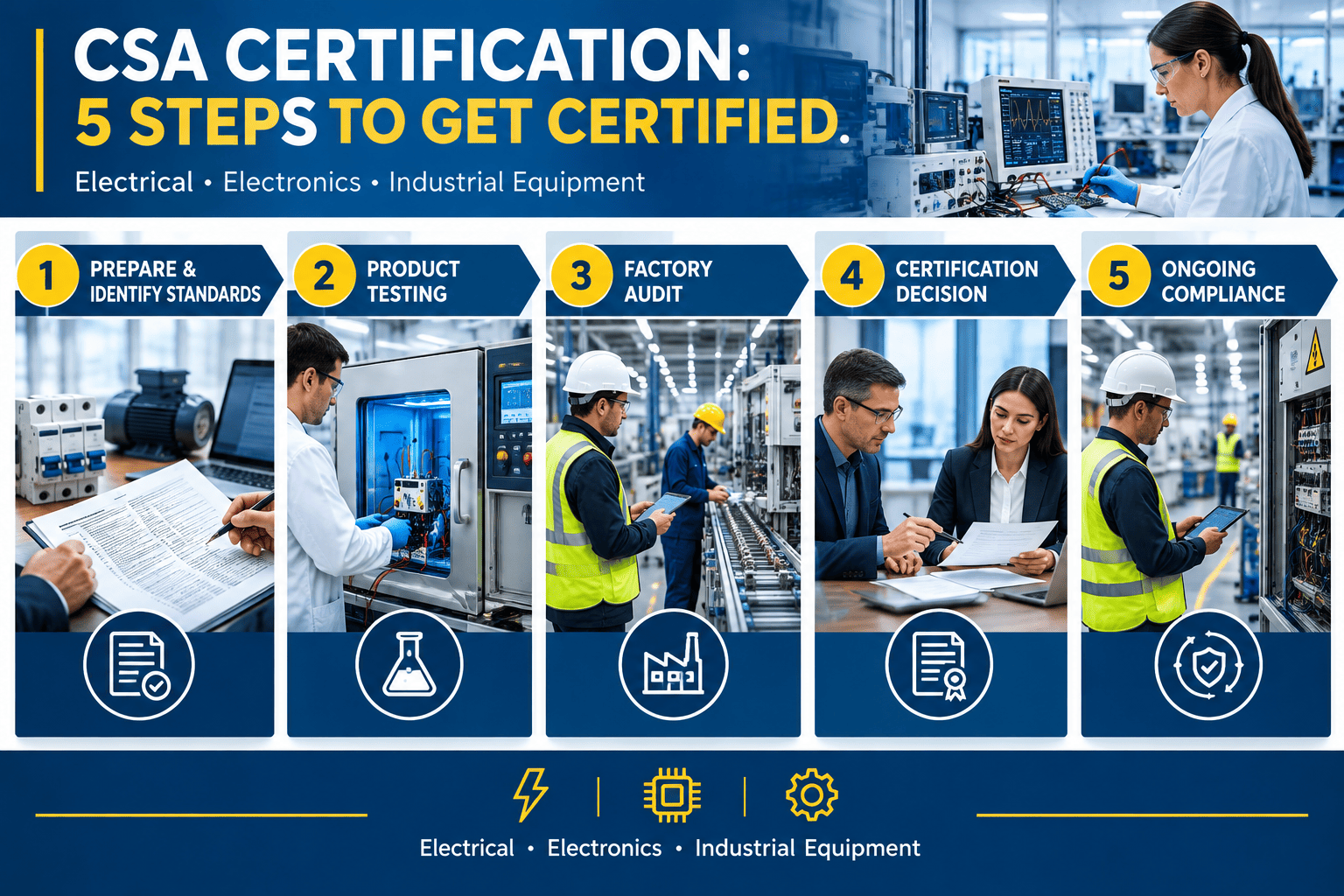
Direct Answer: CSA certification is a product safety certification issued by CSA Group (formerly the Canadian Standards Association). It verifies that a product has been independently tested and certified to meet recognized standards for safety or performance. Getting certified involves a 5-step process: Preparation (identify applicable standards, determine certification scheme, scope the project), Product Testing & Evaluation (submit samples and technical documentation for laboratory testing), Facility Audit (on-site audit of your manufacturing facility to verify quality systems), Certification Decision (CSA reviews all evidence and issues the certificate), and Ongoing Compliance (annual surveillance audits and periodic product testing). The process typically takes 8–16 weeks for standard products, with costs ranging from $5,000–$25,000+ for initial certification. This guide walks you through every step, with practical tips for a smooth certification journey for electrical, electronic, medical, and industrial equipment manufacturers.
📅 May 12, 2026⏱ 16 min read✍️ GT Setu Editorial Team🔄 Updated regularly
140+
International Markets Accepted
5
Key Steps to Certification
8–16
Weeks (Typical Timeline)
0%
GTsetu Broker Commission
CSA certification is a product safety certification that verifies a product has been independently tested and certified to meet recognized standards for safety or performance. Issued by CSA Group (formerly the Canadian Standards Association), the CSA mark is one of the most recognized certification marks in North America, accepted by governments, regulators, and Authorities Having Jurisdiction (AHJs) across Canada and the United States. With over 100 years of experience and recognition in 140+ international markets, CSA Group is a trusted third-party certification body for manufacturers seeking market access and product safety validation.
For manufacturers of electrical, electronic, medical, industrial, and consumer products, CSA certification is often a prerequisite for market access, regulatory approval, and doing business with large retailers and distributors. It signals that your organization has implemented robust processes for product safety, quality control, and manufacturing consistency. This guide covers the complete certification process, from initial preparation through to the final certification decision, and provides practical, actionable advice for a smooth journey. See our related guides on NSF sanitation certification and ISO 22301 business continuity to understand how product safety and management system certifications integrate.
⚡ Who Is This Guide For?
This guide is written for product managers, quality managers, regulatory affairs professionals, business owners, and anyone responsible for obtaining or maintaining CSA certification for their products. It covers both the DIY approach (using templates and internal resources) and the consultant-led route. It is equally relevant for electrical equipment manufacturers, electronics companies, medical device makers, and industrial equipment suppliers who require CSA certification for market access. For related partnership structures, see our guides on manufacturing certifications for international trade and global market research for manufacturers.
SECTION 1
1 What Is CSA Certification & Why Get Certified?
⚡ The Standard Explained
CSA certification is a product safety certification issued by CSA Group (formerly the Canadian Standards Association), an independent, third-party certification body and testing agency. It verifies that a product has been independently tested and certified to meet recognized standards for safety or performance. The CSA registered mark shows that a product has been independently tested and certified to meet recognized standards for safety or performance. CSA Group develops standards in 57 areas and is accredited by the Standards Council of Canada. CSA certification is mandatory for many electrical and electronic products sold in Canada, where all provinces have adopted CSA electrical standards, and is recognized in over 140 markets worldwide. Certification demonstrates that your product meets stringent safety requirements, ensuring consumer protection and regulatory compliance.
🌐
Globally Recognized Mark
The CSA mark is recognized in over 140 countries, with acceptance by governments, regulators, and Authorities Having Jurisdiction (AHJs) across North America and beyond.
⚖️
Legal Requirement & Market Access
CSA certification is mandatory for many electrical products installed in Canada. All Canadian provinces have adopted CSA electrical standards, making certification essential for market access.
🛡️
Product Safety & Consumer Protection
CSA certification focuses on preventing electrical shock, fire hazards, and product failures. It ensures products are safe, reliable, and fit for their intended use.
📈
Consumer Trust & Brand Reputation
69% of North American consumers say they are more likely to purchase products with the CSA mark. Certification signals safety and quality, building trust and strengthening your brand.
SECTION 2
2 Key Benefits of CSA Certification
CSA certification delivers tangible benefits across market access, regulatory compliance, consumer confidence, and commercial differentiation. For manufacturers in regulated product categories, CSA certification is not just a certification, it is a license to operate in North American markets.
69%
Of North American consumers are more likely to purchase products with the CSA mark
140+
International markets where CSA certification is accepted for market access
100+
Years of CSA Group experience in standards development and certification
🏷️
Enhanced Market Credibility
CSA certification signals to customers, partners, and regulators that you have a validated system for managing product safety and quality. This credibility opens doors to new business opportunities with retailers and distributors who require certified suppliers.
Commercial
💰
Cost Reduction & Efficiency Gains
By systematically identifying and eliminating the root causes of product failures and inefficiencies, certified organizations reduce recalls, warranty claims, and non-conformance costs. The process-focused approach drives operational efficiency.
Operational
🔗
Supply Chain Integration
CSA certification provides a common framework for product safety across supply chains, enabling smoother collaboration with partners, easier audits, and more consistent quality throughout the value chain.
Partnership
📊
Data-Driven Decision Making
The certification process requires organizations to collect and analyze product safety data, enabling evidence-based decisions. This reduces reliance on intuition and improves the quality of operational and strategic decisions.
Analytical
👥
Employee Engagement & Clarity
Clear processes, defined responsibilities, and documented procedures improve employee understanding of their roles and how their work contributes to product safety objectives, increasing engagement and reducing ambiguity.
People
📋
Regulatory & Risk Management
The risk-based approach embedded in CSA certification helps organizations proactively identify and mitigate product safety risks, reducing exposure to regulatory non-compliance, product liability, and recalls.
Compliance
SECTION 3
3 CSA vs UL vs ETL: What’s the Difference?
A common question when exploring CSA certification is how it relates to other North American product safety certifications like UL and ETL. While all three are recognized certification marks, they are issued by different organizations and have different market recognition and acceptance profiles. Understanding the distinction is crucial for a successful compliance strategy.
AspectCSAUL / ETL
Issuing Body
✓ CSA Group
✓ UL / Intertek
Standard Development
✓ Develops CSA standards
✓ Develops UL standards
Canadian Market
✓ Mandatory in many provinces
✓ Accepted where equivalent
US Market
✓ Accepted by AHJs
✓ Widely accepted
Global Recognition
✓ 140+ markets
✓ 100+ markets
Consumer Recognition
✓ 69% purchase preference
✓ High recognition
CE Marking Support
✓ Notified Body (EMCD, RED, MID, ATEX)
◐ Limited
💡 The Relationship Explained
CSA tells you WHAT standards apply: CSA Group develops standards in 57 areas and certifies products against them. It is a standards organization AND a certification body.
UL and ETL are alternative certification marks: UL (Underwriters Laboratories) and ETL (Intertek) are competing certification bodies. Products certified by any recognized body are generally accepted by AHJs, provided the certification is to an equivalent standard.
Practical approach: Many manufacturers pursue CSA certification for Canadian market access and UL or ETL for US market access. Some products may carry multiple marks. CSA Group also offers certification to UL standards, and vice versa, providing flexibility for global market access.
SECTION 4
4 Step 1: Preparation, Foundation & Planning
🏗️ Building the Foundation
The preparation phase sets the foundation for your entire CSA certification project. The goal is to ensure you have the knowledge, resources, and support in place before beginning the detailed work of documentation and testing. This phase typically takes 2–4 weeks for a small organization, longer for larger or more complex products.
1.1
Identify Applicable Standards
Determine which CSA, UL, or ANSI standards apply to your product category. CSA Group tests and certifies compliant products to over 400 U.S. standards, including those from ANSI and UL. Review the standard’s requirements for electrical safety, fire hazard, and performance. If your product does not neatly fit into a single standard, engage with CSA early to determine the applicable scope.
1.2
Select the Appropriate Certification Scheme
Choose the certification scheme based on your product scope and target markets. Options include CSA certification for Canada, CSA-US for the United States, or combined North American certification. For products destined for Europe, CE marking may also be required, and CSA Group is a Notified Body under the EMCD, RED, MID, and ATEX directives.
1.3
Secure Executive Support
Top management commitment is critical. They must “walk the talk” by allocating resources, supporting the project, and communicating its importance. Provide executives with a concise overview of CSA certification’s role in the business and the benefits certification will deliver, including market access, regulatory compliance, and risk reduction. For related legal considerations, see our guide on risk allocation in cross-border deals.
1.4
Define Your Product Scope
Clearly define the products, models, and variations you intend to certify. Certification covers specific models, each model may require separate testing. Consider whether to certify a single model or a product line. For the same design but different sizes/voltages, CSA may use a “family” approach to reduce testing costs. See our guide on partnership evaluation criteria for a framework that also applies to scope definition.
1.5
Conduct a Gap Analysis
Assess how compliant your product and manufacturing processes already are with CSA requirements and identify gaps. This helps you prioritize efforts and create a more accurate project plan. You can do this internally or with a consultant. A thorough gap analysis should cover product design, materials, manufacturing processes, and documentation systems.
1.6
Engage with CSA Group Early
Contact CSA Group to discuss your certification project. They will provide guidance on the applicable standards, testing requirements, costs, and timelines. Early engagement helps avoid misunderstandings and ensures you are working toward the correct requirements from the start. CSA Group can help you with your CE marking project from beginning to end, providing a one-stop-shop for North American and European market access.
💡 Pro Tip: Start with a Product Design Assessment
Before beginning documentation, conduct a thorough assessment of your product design. CSA certification requires that products are designed to prevent electrical shock, fire hazards, and other safety risks. Design changes identified late in the process are often the most time-consuming and costly part of CSA certification, so identifying these needs early is critical. This is also a good time to review your warranty clauses for component purchases and breach of contract provisions for supplier agreements.
SECTION 5
5 Step 2: Documentation, Building Your Technical File
Documentation is often considered the most challenging phase of CSA certification. It requires aligning documents with certification requirements while tailoring them to your company’s unique context and needs. The goal is to create a documentation set that is useful, practical, and compliant, not a bureaucratic burden. CSA documentation is critical for demonstrating control over your processes and ensuring traceability.
Document Type
Description
Key Consideration
Technical File / Product Master File (TCF)
A comprehensive document describing your product, including design drawings, specifications, materials of construction, and component data.
It should provide complete traceability from design to production.
Product Testing Reports
Reports from laboratory testing of product samples against the applicable standard(s).
Testing must be performed by an accredited laboratory; results must demonstrate compliance.
System Manual
A high-level document describing your quality management system, including quality policy, objectives, and organizational structure.
It should outline the scope of the QMS and how it meets CSA requirements.
System Procedures
Detailed procedures for all critical processes, from design control to production and quality testing.
Procedures must be written by subject matter experts, approved, version-controlled, and followed exactly.
Quality Policy & Objectives
A statement of your organization’s commitment to quality and product safety, approved by top management.
It must be communicated to and understood by all employees.
Plant Master File
A document providing specific information about the manufacturer’s quality management policies, production activities, and facility details.
Required by many certification bodies as part of the certification process.
Standard Operating Procedures (SOPs)
Detailed, step-by-step instructions for performing all routine operations, from equipment calibration to final product testing.
SOPs must be written by subject matter experts, approved, version-controlled, and followed exactly.
Checklists & Forms
Tools for recording data, capturing evidence, and guiding work during production and quality testing.
Create forms where they save time and effort in meeting CSA requirements. Avoid creating forms for their own sake.
Records
Evidence that you meet the requirements stated in your policies, procedures, and work instructions.
Records must be retained for a defined period and be legible, identifiable, and retrievable. They are a key focus of audits.
💡 Documentation Best Practices
DO: Look for the simplest way to meet a requirement and adapt it to your business. Use your company’s vernacular and avoid vague language. Use diagrams and flowcharts to simplify complex processes. Ensure all documents are version-controlled, approved, and retrievable.
DON’T: Include time-consuming references to other documents. Include bureaucratic requirements that are not suitable for your company’s circumstances or culture. Create documents that don’t add value to your operations.
Consider using documentation templates, pre-written documents designed to be tailored to your company’s needs. They save time, reduce errors, and provide a reliable starting point. Ensure they come with detailed customisation instructions. This approach is also effective when drafting Master Services Agreements (MSAs) and other commercial contracts.
SECTION 6
6 Step 3: Product Testing & Evaluation
Product testing and evaluation is the core of CSA certification. It involves submitting product samples and technical documentation to CSA’s laboratory for comprehensive testing against the requirements of the applicable standard. Testing covers key areas including electrical safety, fire hazard, mechanical safety, and performance.
Testing Area
What Is Evaluated
Key Criteria
Electrical Safety
Insulation, grounding, dielectric strength, leakage current, and protection against electrical shock.
Products must meet minimum electrical safety requirements defined in the applicable standard.
Fire Hazard
Flammability of materials, temperature rise, and protection against fire initiation and propagation.
Materials must meet flammability ratings; temperature rise must not exceed safe limits.
Mechanical Safety
Enclosure strength, stability, sharp edges, moving parts, and resistance to mechanical stress.
Products must be robust enough for intended use and not present mechanical hazards.
Performance
Equipment must perform as claimed and meet minimum performance requirements.
Must meet minimum performance standards defined in the applicable standard.
EMC (Electromagnetic Compatibility)
Emissions and immunity, evaluating whether products cause or are affected by electromagnetic interference.
Products must comply with EMC requirements for their intended market and application.
Functional Safety
Safety-related control functions of machines and equipment, including electrical, electronic, and programmable systems.
Validates that the system’s functionality is dependable enough for the level of risk it controls.
💡 Design for Certification from the Start
The most successful CSA certification projects are those where safety is built into the product from the beginning, not retrofitted after the design is finalized. Key design principles include: use of certified components where possible; adequate insulation and grounding; flame-retardant materials; proper enclosure design; and compliance with EMC requirements. This proactive approach is similar to the design control requirements in NSF sanitation certification—anticipating requirements from the start saves time and cost.
The facility audit is an essential component of CSA certification. A CSA auditor visits your manufacturing facility to verify that quality control systems, production processes, and manufacturing documentation ensure that the products you produce match the samples that were tested and certified. The audit confirms that your manufacturing operations are capable of consistently producing certified products.
📋
Quality Management System Review
The auditor reviews your quality management system, including incoming material inspections, in-process inspections, final product testing, and control of non-conforming products.
🏭
Production Process Verification
Verifies that the products you manufacture match the samples tested for certification. This includes checking materials of construction, component suppliers, and manufacturing processes.
📄
Documentation & Traceability
Reviews your documentation to ensure that production records, supplier certifications, and material traceability are maintained and available for audit.
🔄
On-Site Inspection
The auditor conducts an on-site inspection of your manufacturing facility, observing processes, interviewing staff, and verifying that quality controls are implemented and effective.
📊
Corrective Action Review
If any non-conformities are identified during the audit, you will need to implement corrective actions and provide evidence to CSA. This is similar to the corrective action requirements in quality management systems.
✅
Audit Report & Findings
Following the audit, CSA provides a detailed report outlining findings. If no major non-conformities are found, or if corrective actions are successfully implemented, the audit is considered successful.
💡 Internal Audit as a Management Tool
Many organizations view internal audits purely as a certification requirement, but they are a powerful management tool. Use them to identify process improvements, uncover hidden inefficiencies, and engage employees in quality thinking. A well-conducted internal audit provides valuable insights that go far beyond compliance. This same principle applies to commercial due diligence and other business assessments.
Once product testing and the facility audit are complete, CSA reviews all evidence, test reports, audit findings, and any corrective actions, to make the certification decision. If all requirements are met, CSA issues the certification and authorizes your use of the CSA certification mark. Certification is typically valid for a defined period (e.g., 5 years, depending on the certification scheme), with annual surveillance audits to maintain compliance.
Certification Stage
What Happens
Key Focus
Review of All Evidence
CSA reviews all test reports, audit findings, technical documentation, and corrective action evidence. This is a thorough technical review to ensure that every requirement of the applicable standard has been met.
Completeness and adequacy of documentation. Identification of any gaps or non-conformities that must be addressed.
Certification Issuance
If all criteria are met, CSA issues the certification and authorizes your use of the CSA certification mark. You will receive a certification agreement, certificate, and listing on CSA’s online public listings.
Overall conformity assessment. The certificate is valid for the defined period from the date of issue.
Public Listing & Market Access
Your certified product is listed in CSA’s online public listings, viewed by AHJs, retailers, specifiers, and buyers around the world. This listing provides market exposure and verification of your certification.
Market recognition and access. The listing demonstrates your commitment to product safety and quality.
Surveillance Audits
During the certificate validity period, CSA conducts periodic surveillance audits to ensure your quality system remains compliant and effective.
Ongoing compliance. The auditor checks that the quality system is being maintained and that continuous improvement is taking place.
Recertification Audit
After the certificate expires, you must undergo a recertification audit to renew your certificate. This is typically a more comprehensive audit than surveillance audits.
Full system re-assessment. You must demonstrate that your quality system remains effective and has evolved to meet changing requirements.
💡 Preparing for the Certification Audit
Prepare your facility and staff: Ensure all areas are clean, organized, and inspection-ready. All documents should be current and retrievable. Staff should be prepared for the auditor’s questions and should answer truthfully without volunteering additional information. Conduct mock inspections to identify and address any gaps.
Select your certification body: For Canadian and US markets, CSA Group is the most recognized certification body. However, other accredited bodies (UL, Intertek, TUV) can also certify to CSA standards. Choose a body that is accredited by a recognized accreditation body (SCC in Canada, ANAB in the US), has experience in your product category, and is recognized by the relevant Authorities Having Jurisdiction (AHJs). See our guide on due diligence for a framework that also applies to certification body selection.
SECTION 9
9 Costs & Timeline: What to Expect
The cost and timeline for CSA certification vary significantly based on product type, number of models, testing complexity, and the current state of your quality management system. Understanding these variables upfront helps in planning and budget setting.
Each model may require separate testing. Family approach can reduce costs for similar models.
Additional models add testing and documentation time
Facility Audit
$2,000–$5,000 depending on facility size, location, and auditor time
Facility audit typically adds 1–2 weeks to the timeline
Annual Licensing & Renewal Fees
$1,000–$5,000 annually for maintaining certification and listing
Ongoing compliance requirement
Use of Templates / Digital Tools
Reduces consultant fees and internal time, significantly lowering cost
Can cut timeline by 30–50% by streamlining documentation and implementation
Consultant Involvement
Full consultant support: adds $5,000–$20,000+ to cost; DIY with templates: lower cost
Consultant can accelerate timeline by providing expertise and templates
Certification Body Fees
Inspection fees vary by certification body and product category
Certification body timelines are outside your control
📋 Digital & Low-Cost Certification Options
Several providers offer digital documentation platforms that significantly reduce cost and timeline. Subscription-based models can include document management, training tracking, and audit management tools. These digital solutions can bring CSA compliance within reach for small organizations that might otherwise find the traditional consultant-led route prohibitive. When evaluating such options, use the same commercial due diligence you would apply to any B2B engagement.
SECTION 10
10 How to Choose a Certification Body
The certification body is the independent organization that will conduct your audit and issue your CSA certificate. Choosing the right certification body is a critical decision that affects the cost, timeline, and market recognition of your certification. For Canadian and US markets, CSA Group is the most recognized certification body, but other accredited bodies can also certify to CSA standards.
🏛️
Accreditation Status
Ensure the certification body is accredited by a recognized national or international accreditation body (e.g., SCC in Canada, ANAB in the US). For Canadian market access, the certification body must be recognized by the relevant provincial authorities.
🏭
Industry Experience
Choose a certification body with auditors who have experience in your specific industry and product type. They will understand your products, terminology, and risks, leading to a more relevant and valuable audit.
📋
Market Recognition
Consider whether your customers or industry bodies recognize the certification body’s certificate. In some industries, specific certification bodies are preferred or required. If you are exporting to a specific region, a certification body with local recognition may be advantageous.
💰
Cost & Value
Compare quotes from multiple certification bodies. The cheapest option is not always the best, consider the value of the audit, the auditor’s expertise, and the certification body’s reputation. Ensure you understand what is included in the quoted fee.
🌐
Global Capability
If you have or plan to have multiple sites in different countries, choose a certification body that can audit all sites consistently. This simplifies the management of your certification across locations.
🤝
Relationship & Support
Choose a certification body you feel comfortable working with. The relationship should be collaborative, not adversarial. A good auditor will help you improve your quality system, not just find faults. Assess their responsiveness and communication during the quoting process.
💡 Certification Body Selection Checklist
When evaluating certification bodies, ask: Are you accredited by a recognized national or international accreditation body? Do you have auditors with experience in my industry and product type? What is your audit process and how many days do you typically allocate for my organization type? What is included in your fee and are there additional costs? How do you handle non-conformities and what is the process for issuing the certificate? Can you provide references from clients in my industry? How do you conduct surveillance audits? Use this information alongside your due diligence framework to make an informed decision.
SECTION 11
11 Common Mistakes & How to Avoid Them
📋
Over-Documentation & Bureaucracy
Creating excessive documentation that adds no operational value and makes the system difficult to maintain. This creates employee resentment and audit fatigue.
Avoid: Focus on what is necessary to control your processes and demonstrate compliance. Use the simplest approach that meets the requirements. Ask: “Does this document add value?”
🏛️
Lack of Management Commitment
When leadership does not actively support the certification, it becomes a compliance exercise for employees rather than a strategic initiative, leading to poor implementation and audit failures.
Avoid: Secure top management commitment from the start. Ensure they understand the business case for certification and communicate their support visibly to the organization.
📖
“CSA Language” Instead of Your Language
Using regulatory jargon instead of your company’s natural language makes procedures confusing and difficult for employees to follow and maintain.
Avoid: Write procedures in your company’s everyday language. Use diagrams and illustrations. Make them user-friendly and practical for the people who will use them.
🔄
Treating Certification as the End Goal
Focusing solely on passing the audit rather than building a quality system that improves operations. This leads to a system that is maintained only for the auditor, not for business performance.
Avoid: Design your quality system to solve real operational problems. Use the internal audits and management reviews for genuine improvement, not just audit readiness.
🎓
Inadequate Staff Training
Employees who do not understand the quality system or how their role contributes to it will not follow procedures consistently, leading to non-conformities and audit findings.
Avoid: Invest in training at all levels. Explain the “why” behind the procedures. Make training engaging and relevant to employees’ daily work. Consider using MSA principles for structured training programmes.
📊
Ignoring the Internal Audit Results
Failing to address internal audit findings before the certification audit, or treating internal audits as a tick-box exercise without taking corrective action.
Avoid: Use internal audits as a genuine check on your system. Address all findings promptly. Conduct root cause analysis and implement corrective actions that prevent recurrence. See our guide on material breach for related risk management.
SECTION 12
12 How GTsetu Supports Your CSA Certification Journey
🔗 GTsetu, Verified B2B Platform
Connect with Verified Partners & Build Quality Supply Chains
CSA certification is a powerful tool for demonstrating product safety and quality to customers and partners. GTsetu complements your certification by connecting you with verified manufacturers, distributors, and suppliers who meet rigorous quality standards. Our platform provides:
✅
Verified Company Profiles
Every company on GTsetu is verified on 6 key data points (Name, Address, Registration Number, Company Status, Company Type, Date of Incorporation) using government tie-ups, complementing your CSA due diligence.
🕵️
Anonymous Discovery
Browse verified partner profiles without revealing your identity until you’re ready to engage, protecting your sourcing strategy and commercial confidentiality.
📄
Built-In NDA Workflow
Digital mutual NDA with timestamped signatures, activated before any sensitive commercial or technical data is exchanged, supporting your IP protection and confidentiality commitments under CSA.
🔐
Encrypted Document Workspace
AES-256 encryption at rest, TLS in transit, role-based access controls, and full audit trail, ensuring the secure exchange of quality documentation, specs, and contracts with partners.
🚫
Zero Broker Commission
GTsetu charges zero commission on any partnership formed. All commercial value stays between you and your verified partner, supporting the cost management objectives of your QMS.
🌏
Global Network of Verified Partners
Access verified manufacturers, distributors, and suppliers across 100+ countries, supporting your supply chain quality objectives and enabling you to build a network of CSA-aligned partners.
QWhat is CSA certification and why is it important?
CSA certification is a product safety certification issued by CSA Group (formerly the Canadian Standards Association). It verifies that a product has been independently tested and certified to meet recognized standards for safety or performance. It is mandatory for many electrical and electronic products sold in Canada and the United States, and is recognized in over 140 markets worldwide. Certification provides market access, regulatory acceptance, consumer trust, and a competitive advantage. For related legal considerations, see our guide on warranty clauses.
QWhat are the 5 main steps to get CSA certified?
The 5 main steps are: (1) Preparation, identify the applicable standard, determine the certification scheme, and scope the project. (2) Product Testing & Evaluation, submit samples and technical documentation for laboratory testing. (3) Facility Audit, undergo an on-site audit of your manufacturing facility to verify quality systems. (4) Certification Decision, CSA reviews all evidence and issues the certificate. (5) Ongoing Compliance, annual surveillance audits and periodic product testing to maintain certification. This structured approach is similar to building any Master Services Agreement, start with a solid foundation and build methodically.
QHow long does it take to get CSA certification?
The timeline varies by product type, complexity, and the readiness of your documentation and manufacturing processes. For standard electrical and electronic products, the process typically takes 8-16 weeks from application to certificate issuance. Complex products, products requiring multiple standards, or facilities with significant quality system gaps may take 6-12 months. The timeline includes application, testing, facility audit, and certification decision. Using templates or digital tools can significantly reduce the time to certification.
QHow much does CSA certification cost?
The cost varies significantly based on product type, number of models, testing complexity, and facility location. Factors include: application and administration fees, product testing fees, facility audit fees, annual licensing and renewal fees, and optional consultant support. For a single product model, initial costs may range from $5,000 to $25,000+, excluding ongoing compliance. Bundling similar models using a family approach and engaging early with CSA can reduce costs. For related cost considerations, see our guide on consequential damages.
QWhat documents are required for CSA certification?
Key required documents include: Technical File/Product Master File, product specifications and design drawings, materials of construction, component data sheets, test reports, system manual and procedures, quality policy and objectives, plant master file, Standard Operating Procedures (SOPs), forms, formats, checklists, and records. All documentation must be controlled, versioned, and retained according to certification requirements. Using templates can help ensure completeness and reduce the burden of starting from scratch, much like using an Asset Purchase Agreement template saves time in M&A transactions.
QWhat is the difference between CSA certification and CSA standards?
CSA standards are the technical documents developed by CSA Group that define requirements for products, services, and systems. CSA certification is the independent verification process, conducted by CSA Group or another accredited certification body, that confirms a product meets those standards. CSA Group develops the standard AND certifies against it, but other bodies can also certify to CSA standards. CSA Group is not a government body and cannot make standards law, however, many jurisdictions reference CSA standards in their building and electrical codes, effectively making compliance mandatory. The selection process should mirror the rigor you would apply when using due diligence criteria to choose any business partner.
QHow do I choose a CSA certification body?
For Canadian and US markets, CSA Group is the most recognized certification body. However, other accredited bodies (UL, Intertek, TUV) can also certify to CSA standards. Choose a body that is accredited by a recognized accreditation body (SCC in Canada, ANAB in the US), has experience in your product category, is recognized by the relevant Authorities Having Jurisdiction (AHJs), and can provide efficient service across your target markets. For global market access, consider a certification body with international capability. The selection process should mirror the rigor you would apply when using Incoterms 2020 to allocate risk in any international transaction.
Ready to Build a Quality-Driven Supply Chain?
Connect with verified manufacturers, distributors, and suppliers on GTsetu, compliance-backed verification, anonymous discovery, built-in NDA workflows, and zero broker commissions. Find partners who share your commitment to quality.
They represents the product, and research team behind GTsetu, a global B2B collaboration platform built to help companies explore cross-border partnerships with clarity and trust. The team focuses on simplifying early-stage international business discovery by combining structured company profiles, verification-led access, and controlled collaboration workflows.
With a strong emphasis on trust, and disciplined engagement, Team GTsetu shares insights on global trade, partnerships, and cross-border collaboration, helping businesses make informed decisions before entering deeper commercial discussions.