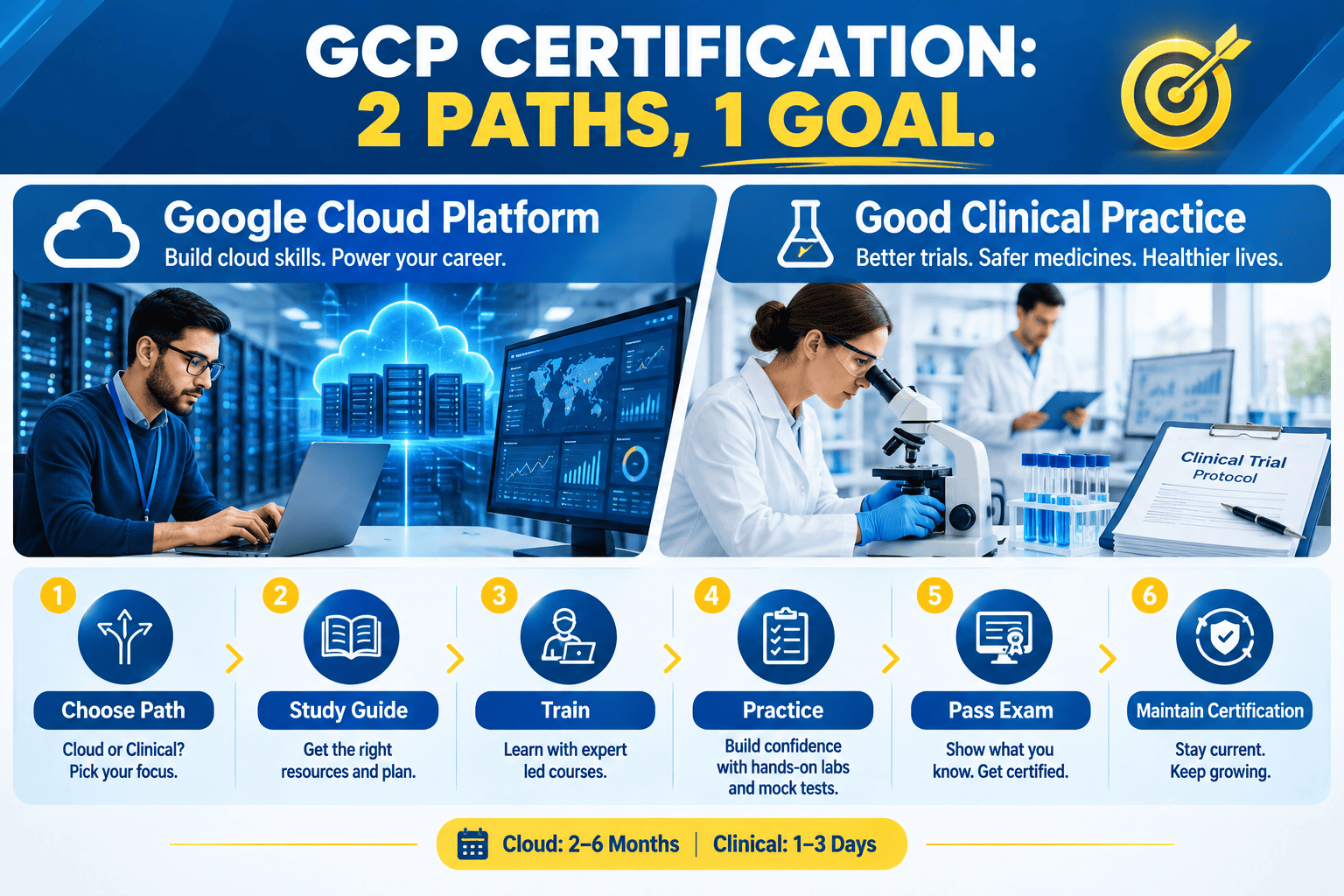
Direct Answer: GCP certification can refer to two distinct credentials: Google Cloud Platform (GCP) certification, which validates technical proficiency in Google Cloud services, and Good Clinical Practice (GCP) certification, which validates knowledge of international ethical and scientific quality standards for clinical trials. Getting certified involves a multi-step process: Choose your certification path (cloud computing or clinical research), Review the exam guide and learning objectives, Complete training courses and self-study, Gain hands-on experience, Register for and pass the certification exam, and Maintain your certification through continuing education. Preparation typically takes 2–6 months for Google Cloud certifications and 1–3 days for Good Clinical Practice certification, with costs ranging from $125–$1,000+ depending on the certification type. This guide walks you through every step, with practical tips for a smooth certification journey.
📅 May 5, 2026⏱ 16 min read✍️ GT Setu Editorial Team🔄 Updated regularly
2
Major GCP Certification Paths
5
Key Steps to Certification
2–6
Months (Typical Timeline)
0%
GTsetu Broker Commission
GCP certification is one of the most valuable credentials in today’s technology and clinical research job markets. But “GCP” can mean two very different things depending on your profession: Google Cloud Platform (GCP) certification for cloud computing professionals, or Good Clinical Practice (GCP) certification for clinical research professionals. Both credentials validate expertise, demonstrate commitment to professional standards, and can significantly enhance career prospects and earning potential.
For IT professionals, Google Cloud certifications validate technical proficiency in cloud infrastructure, data engineering, machine learning, and application development. For clinical research professionals, Good Clinical Practice certification validates knowledge of international ethical and scientific quality standards for designing, conducting, recording, and reporting clinical trials. This guide covers both certification paths — from initial preparation through to the final exam — and provides practical, actionable advice for a smooth certification journey. See our related guides on global market research, manufacturing certifications for international trade, and cross-border business partnerships to understand how professional certifications integrate with broader business frameworks.
📋 Who Is This Guide For?
This guide is written for IT professionals, cloud engineers, data scientists, clinical research associates, regulatory affairs professionals, and anyone considering GCP certification. It covers both the Google Cloud and Good Clinical Practice certification paths, including exam preparation, costs, and maintenance requirements. It is equally relevant for professionals seeking to advance their careers, and for organisations looking to build certified teams. For related partnership structures, see our guides on risk allocation in cross-border deals, international wholesale distributors, and partnership evaluation criteria.
SECTION 1
1 What Is GCP Certification & Why Get Certified?
📋 The Certification Explained
GCP certification can refer to two distinct credentials. Google Cloud Platform (GCP) certification is a professional credential offered by Google Cloud that validates technical proficiency in designing, developing, and managing applications and infrastructure on Google Cloud. It is available at Associate, Professional, and Expert levels, covering areas such as cloud architecture, data engineering, machine learning, and security. Good Clinical Practice (GCP) certification is a professional credential that validates knowledge of the international ethical and scientific quality standard for designing, conducting, recording, and reporting clinical trials that involve the participation of human subjects. It is based on the ICH-GCP guideline and is essential for anyone involved in clinical research. Both certifications demonstrate expertise, commitment to professional standards, and can significantly enhance career prospects.
🌐
Globally Recognised Credential
Google Cloud certifications are recognised globally as a benchmark for cloud expertise. Good Clinical Practice certification is required by regulatory authorities and sponsors worldwide for clinical research professionals.
🏛️
Career Advancement & Market Access
Certified professionals are often preferred by employers, can command higher salaries, and have access to more job opportunities. Certification demonstrates commitment to professional development and industry best practices.
🔄
Continuous Learning Framework
Certification requires ongoing learning and recertification, ensuring professionals stay current with evolving technologies and regulations. This continuous improvement mindset is essential for career growth.
📈
Customer Trust & Credibility
Certification signals to clients, employers, and partners that you have validated expertise and a commitment to meeting professional standards, building trust and strengthening relationships.
SECTION 2
2 Key Benefits of GCP Certification
GCP certification delivers tangible benefits across career, financial, and professional dimensions. While the certification process requires investment, the return on that investment is well-documented across industries.
25%
Average salary increase reported by certified cloud professionals (Global Knowledge IT Skills Report)
80%
of organisations prefer certified professionals for cloud roles (Google Cloud Survey)
3x
More job opportunities for certified clinical research professionals (Industry survey)
🏷️
Enhanced Career Credibility
GCP certification signals to employers, clients, and partners that you have validated expertise and a commitment to professional development. This credibility opens doors to new career opportunities and advancement.
Career
💰
Higher Earning Potential
Certified professionals typically command higher salaries than their non-certified counterparts. The salary premium reflects the validated expertise and the value that certification brings to employers.
Financial
🔗
Professional Network Access
Certification connects you to a global community of certified professionals, providing access to networking opportunities, knowledge sharing, and collaboration with peers in your field.
Network
📊
Validated Expertise
Certification validates your knowledge and skills against industry-recognised standards, providing independent verification of your expertise. This is particularly valuable when changing jobs or entering new markets.
Validation
👥
Employer Recognition
Many employers require or prefer GCP certification for certain roles. Certification can be a prerequisite for promotion, a requirement for specific projects, or a differentiator in competitive hiring processes.
Recognition
📋
Regulatory Compliance
In clinical research, Good Clinical Practice certification is required by regulatory authorities (FDA, EMA) and sponsors. Certification demonstrates compliance with international standards for clinical trials.
Compliance
SECTION 3
3 GCP Certification Types & Paths
GCP certification offers two distinct paths depending on your profession. Understanding the differences is essential for choosing the right certification for your career goals.
☁️Cloud Computing
Google Cloud Platform (GCP) Certification
Validates technical proficiency in Google Cloud services. Available at Associate, Professional, and Expert levels, covering cloud architecture, data engineering, machine learning, security, and more.
☁️ Cloud Engineers, Architects, Data Scientists
🏥Clinical Research
Good Clinical Practice (GCP) Certification
Validates knowledge of international ethical and scientific quality standards for clinical trials. Based on ICH-GCP guidelines, essential for clinical research professionals.
🔬 Clinical Research, Pharma, Medical Devices
Google Cloud Certification Levels
Level
Certifications
Best For
Prerequisites
Foundational
Cloud Digital Leader
Non-technical professionals, business leaders, sales teams
None
Associate
Associate Cloud Engineer
Cloud engineers, system administrators, DevOps professionals
6+ months hands-on experience with Google Cloud
Professional
Professional Cloud Architect, Professional Data Engineer, Professional Cloud Developer, Professional Cloud Security Engineer, Professional Cloud Network Engineer, Professional Machine Learning Engineer
Senior cloud professionals, architects, data engineers, ML engineers
3+ years industry experience, 1+ year Google Cloud experience
Expert
Google Cloud Certified Fellow
Distinguished cloud architects, technical leaders
Multiple Professional certifications, significant industry contributions
Good Clinical Practice Certification Types
Certification
Provider
Best For
Validity
ICH-GCP Certification
CITI Program, NIDA CTN, TransCelerate
Clinical research coordinators, CRAs, investigators, site staff
2-3 years, then refresher required
Good Clinical Practice (GCP) Training
Various providers (ACRP, SOCRA, local institutions)
Clinical research professionals at all levels
2-3 years depending on provider
Advanced GCP Certification
ACRP (Association of Clinical Research Professionals), SOCRA
Experienced clinical research professionals seeking advanced credentials
2-3 years, with continuing education requirements
💡 Choosing Your Certification Path
If you work in IT, cloud computing, or software development, Google Cloud certification is likely the right path for you. If you work in clinical research, pharmaceuticals, medical devices, or healthcare, Good Clinical Practice certification is essential. Some professionals pursue both if their role spans both domains, such as clinical research informatics. See our related guides on global market research and manufacturing certifications for international trade for more context on professional credentials.
SECTION 4
4 Step 1: Preparation — Foundation & Planning
🏗️ Building the Foundation
The preparation phase sets the foundation for your entire GCP certification project. The goal is to ensure you have the knowledge, resources, and support in place before beginning the detailed work of training and exam preparation. This phase typically takes 1–2 weeks and is critical for avoiding wasted effort on the wrong certification or preparation path.
1.1
Choose Your Certification Path
Determine whether Google Cloud certification or Good Clinical Practice certification aligns with your career goals. If pursuing Google Cloud, choose the level (Foundational, Associate, Professional) and specialization (Architect, Data Engineer, Developer, etc.) that matches your experience and career objectives. If pursuing Good Clinical Practice, choose the certification type (ICH-GCP, advanced certification) that meets your role requirements.
1.2
Review the Exam Guide
Download and review the official exam guide for your chosen certification. The exam guide outlines the domains covered, their relative weight, and the specific knowledge and skills required. This is your roadmap for preparation.
1.3
Assess Your Current Knowledge
Conduct a self-assessment against the exam guide domains. Identify your strengths and weaknesses. This helps you prioritize your study time and focus on the areas where you need the most improvement.
1.4
Create a Study Plan
Develop a realistic study schedule that fits around your work and personal commitments. Allocate time for training courses, self-study, hands-on practice, and practice exams. Set target dates for completing each phase of preparation.
1.5
Gather Learning Resources
Collect the learning resources you will need: official training courses, study guides, documentation, practice exams, and online communities. Google Cloud Skills Boost provides comprehensive learning paths for Google Cloud certifications. CITI Program and other providers offer ICH-GCP training. See our guide on international business development consulting for context on professional development.
1.6
Secure Support
Inform your employer or manager about your certification goals. Many employers support certification through reimbursement, study time, or recognition. If self-funding, ensure you have the financial resources for training and exam fees. Consider joining study groups or finding a study partner for accountability.
💡 Pro Tip: Start with the Exam Guide
The exam guide is your most important resource. It tells you exactly what will be tested and how much each domain contributes to your score. Use it to prioritize your study and avoid wasting time on topics that are not covered. The same principle applies when evaluating potential partners — start with clear criteria and focus on what matters most.
SECTION 5
5 Step 2: Training — Building Your Knowledge
Training is the core of your certification preparation. It involves completing structured learning programs, reading documentation, and engaging with the material through courses, labs, and self-study. The goal is to build comprehensive knowledge of the exam domains and practical skills that you can apply in real-world scenarios.
Training Type
Description
Best For
Typical Cost
Official Training Courses
Instructor-led or self-paced courses from Google Cloud or accredited providers. Comprehensive coverage of exam domains.
Structured learners who want comprehensive coverage and expert instruction.
Free – $1,500+
Google Cloud Skills Boost
Google’s official learning platform with hands-on labs, courses, and learning paths. Free tier and subscription options available.
All Google Cloud certification candidates. Essential for hands-on practice.
Free – $29/month
Third-Party Training
Coursera, Udemy, Pluralsight, and other platforms offer GCP certification training courses.
Self-paced learners looking for flexible, affordable options.
$20 – $500
Study Guides & Books
Official study guides and third-party books covering exam domains and practice questions.
Self-study learners who prefer reading and reference materials.
$30 – $100
Hands-On Labs & Projects
Practical exercises using Google Cloud console and services. Qwiklabs provides real-world scenarios.
All learners. Hands-on experience is critical for Professional certifications.
Included in Skills Boost
ICH-GCP Training
Training on Good Clinical Practice guidelines, provided by CITI Program, NIDA CTN, and other providers.
Clinical research professionals requiring GCP certification.
$50 – $500
💡 Training Best Practices
DO: Start with the official training path for your certification. Complete hands-on labs to build practical skills. Use multiple resources (courses, documentation, practice exams) to reinforce learning. Join study groups or online communities for support and knowledge sharing.
DON’T: Rely solely on reading without hands-on practice. Skip the official documentation — it’s the source of truth for exam content. Underestimate the time required for preparation. Try to memorize without understanding concepts.
Consider using study templates — structured schedules and study plans can help you stay on track. The same approach applies when preparing for manufacturing certifications — start with a proven framework and customize.
Hands-on experience is where your training becomes reality. For Google Cloud certifications, this means working directly with Google Cloud services, building solutions, and solving real-world problems. For Good Clinical Practice, this means applying GCP principles in clinical trial settings. The goal is to develop the practical skills that the exam will test and that employers value.
☁️
Google Cloud Console Practice
Work directly in the Google Cloud Console to deploy and manage resources. Practice creating VMs, configuring networks, setting up storage, and deploying applications. Hands-on experience is essential for Professional-level certifications.
Practical
🔬
Qwiklabs & Hands-On Labs
Complete Google Cloud Qwiklabs and Skills Boost labs. These provide real-world scenarios with step-by-step guidance, helping you build confidence and practical skills in a safe environment.
Labs
🏗️
Build Real Projects
Apply your skills to real projects. Whether it’s a personal project, work assignment, or open-source contribution, building something end-to-end reinforces learning and demonstrates your capabilities.
Projects
🏥
Clinical Trial Experience
For Good Clinical Practice certification, practical experience in clinical trial settings is essential. Apply GCP principles in your daily work, understand the roles of sponsors, investigators, and IRBs, and practice documentation and reporting.
Clinical
📋
Case Study Analysis
Study real-world case studies and scenarios. For Google Cloud, review reference architectures and customer case studies. For GCP, study clinical trial case studies and regulatory inspection findings.
Analysis
👥
Mentorship & Community
Find a mentor or join a community of certified professionals. Learning from experienced practitioners provides insights that study materials alone cannot offer. Google Cloud Community and clinical research associations are valuable resources.
Community
💡 Hands-On Experience is Non-Negotiable
For Professional-level Google Cloud certifications, hands-on experience is not optional — it’s essential. The exam tests practical knowledge that can only be gained through working with the platform. Similarly, Good Clinical Practice certification requires understanding of how GCP principles apply in real clinical trial settings. Invest time in practical application, not just theoretical study. This same principle applies to cross-border manufacturing partnerships — practical experience is essential for success.
SECTION 7
7 Step 4: Exam Preparation — Readiness Assessment
🔍 Assessing Your Readiness
Exam preparation is the final phase before taking the certification exam. It involves reviewing your knowledge, taking practice exams, identifying gaps, and building confidence. This phase is critical for ensuring you are ready to pass the exam on your first attempt. Practice exams are your most valuable tool for assessing readiness.
📋
Take Practice Exams
Practice exams simulate the actual exam experience, including time limits and question formats. They help you identify knowledge gaps and build exam-taking skills. Aim for consistent scores of 80%+ before scheduling your exam.
📖
Review Weak Areas
Use practice exam results to identify your weakest domains. Focus your remaining study time on these areas. Don’t neglect your strengths, but prioritize where you need the most improvement.
🎓
Join Study Groups
Study groups provide accountability, different perspectives, and the opportunity to teach others (which reinforces your own learning). Look for study groups in your area or online.
📝
Review Official Documentation
Go back to the official documentation for any concepts you find challenging. The exam is based on official documentation, so it’s your most reliable source of truth.
⏱️
Practice Time Management
Practice exams under timed conditions help you develop time management skills. Learn to pace yourself and allocate time appropriately across questions.
✅
Schedule Your Exam
Once you are consistently scoring well on practice exams and feel confident, schedule your exam. Scheduling creates a deadline and commitment that can boost your preparation focus.
💡 Practice Exam Strategy
Take at least 3-5 full-length practice exams before scheduling your real exam. Review every question you get wrong, understanding not just the correct answer but why the other options are incorrect. Track your scores over time to measure improvement. If you’re consistently scoring above 80%, you’re likely ready. If not, focus on your weak areas and try again. This same data-driven approach applies to partnership evaluation — measure, analyze, and improve.
SECTION 8
8 Step 5: Certification Exam — Getting Certified
The certification exam is the final step in obtaining your GCP certification. It is conducted by an independent testing provider (for Google Cloud) or an accredited training provider (for Good Clinical Practice). Successful completion results in the issuance of your certification, which is valid for a defined period and requires maintenance to remain active.
Exam Aspect
Google Cloud Certification
Good Clinical Practice Certification
Exam Format
Multiple choice and multiple select, 50-60 questions, 2 hours
Multiple choice, 50-100 questions, 1-2 hours depending on provider
Delivery Method
Online proctored or in-person at testing centers
Online or in-person depending on provider
Passing Score
Varies by exam, typically around 70%
Varies by provider, typically 70-80%
Exam Fee
$125-$200 depending on certification level
$50-$500 depending on provider and depth
Validity Period
2-3 years depending on certification
2-3 years depending on provider
Recertification
Retake exam or complete continuing education
Refresher training or retake exam
💡 Exam Day Tips
Prepare your environment: For online exams, ensure a quiet, well-lit room with a stable internet connection and a working webcam. Have your ID ready for verification.
Manage your time: Read each question carefully, but don’t spend too long on any single question. If you’re unsure, mark it and come back to it. Answer all questions — there’s no penalty for guessing.
Stay calm and confident: You’ve prepared thoroughly. Trust your knowledge and experience. Take deep breaths if you feel anxious. Remember, you can retake the exam if needed (though there may be a waiting period and additional fee).
SECTION 9
9 Costs & Timeline: What to Expect
The cost and timeline for GCP certification vary significantly based on certification type, level, and your existing knowledge. Understanding these variables upfront helps in planning and budgeting.
Certification
Exam Fee
Training Cost
Preparation Time
Total Investment
Google Cloud Digital Leader
$99
Free – $500
1-2 months
$99 – $600
Associate Cloud Engineer
$125
Free – $800
2-4 months
$125 – $925
Professional Cloud Architect
$200
$500 – $1,500
3-6 months
$700 – $1,700
Professional Data Engineer
$200
$500 – $1,500
3-6 months
$700 – $1,700
ICH-GCP Certification
$50 – $200
$50 – $500
1-3 days
$100 – $700
Advanced GCP Certification (ACRP/SOCRA)
$300 – $500
$200 – $1,000
2-6 months
$500 – $1,500
📋 Employer Reimbursement & Support
Many employers offer reimbursement for certification costs, including exam fees, training, and study materials. Some employers also provide paid study time, mentorship, and recognition for certified employees. Before investing in certification, check with your employer about available support. This is particularly common in technology companies and clinical research organisations. See our guide on international business development consulting for context on professional development investments.
SECTION 10
10 How to Maintain Your Certification
GCP certification is not a one-time achievement — it requires ongoing maintenance to remain valid. Recertification ensures that certified professionals stay current with evolving technologies and regulations, maintaining the value and credibility of the certification.
🔄
Recertification Cycle
Google Cloud certifications are valid for 2-3 years. Good Clinical Practice certifications typically require refresher training every 2-3 years. Mark your recertification deadline and plan ahead.
📚
Continuing Education
Many certifications require continuing education credits (CEUs) for renewal. Attend conferences, complete online courses, and stay current with industry developments.
📝
Retake Exam
For Google Cloud certifications, you can recertify by retaking the exam. This ensures your knowledge is up-to-date with the latest platform features and best practices.
🎓
Refresher Training
For Good Clinical Practice, refresher training is typically required for recertification. This ensures you stay current with regulatory updates and best practices.
📊
Track Your Progress
Keep records of your continuing education activities, certifications, and recertification dates. This helps you stay organized and ensures you don’t miss deadlines.
🌐
Stay Engaged with Community
Participate in professional communities, attend meetups, and contribute to discussions. This keeps your knowledge fresh and connects you with other certified professionals.
💡 Make Recertification a Habit
Don’t wait until the last minute to recertify. Mark the date on your calendar and plan your recertification activities well in advance. Many professionals find that ongoing learning and engagement with their professional community makes recertification a natural part of their career development. This continuous improvement approach is similar to the requirements for ISO 22301 certification — maintain, improve, and evolve.
SECTION 11
11 Common Mistakes & How to Avoid Them
📋
Underestimating Preparation Time
Many candidates schedule their exam too soon and fail because they haven’t allowed enough time for thorough preparation. Professional-level certifications require significant hands-on experience.
Avoid: Create a realistic study plan. Give yourself at least 2-3 months for Associate-level and 3-6 months for Professional-level certifications. Be honest about your available study time.
📖
Focusing Only on Theory
Reading documentation and watching videos is not enough. The exams test practical knowledge and problem-solving skills that can only be developed through hands-on experience.
Avoid: Spend at least 50% of your preparation time on hands-on labs and real-world practice. Build projects, solve problems, and work directly with the technology.
📊
Ignoring Practice Exams
Practice exams are the best way to assess your readiness and identify knowledge gaps. Skipping them means you’re going into the exam blind.
Avoid: Take multiple practice exams under realistic conditions. Review every answer, understand your mistakes, and track your progress over time.
🎓
Choosing the Wrong Certification
Selecting a certification that doesn’t align with your experience level or career goals leads to wasted time and effort. Associate certifications are not “entry-level” — they require real experience.
Avoid: Review the prerequisites and exam guides carefully. Choose a certification that matches your current knowledge and career aspirations. It’s okay to start with a Foundational certification and work your way up.
⏰
Poor Time Management on Exam Day
Running out of time or spending too long on difficult questions can cause you to fail even if you know the material.
Avoid: Practice time management during your practice exams. Learn to pace yourself, skip and return to difficult questions, and leave time at the end for review.
🔄
Forgetting About Recertification
Certifications expire. Failing to recertify means losing your credential and having to start over. Many professionals forget about recertification until it’s too late.
Avoid: Mark your recertification date as soon as you get certified. Stay engaged with continuing education and plan your recertification activities well in advance.
SECTION 12
12 How GTsetu Supports Your Certification Journey
🔗 GTsetu — Verified B2B Platform
Connect with Verified Partners & Build Certified Teams
GCP certification is a powerful tool for demonstrating professional expertise. GTsetu complements your certification by connecting you with verified manufacturers, distributors, and suppliers who meet rigorous quality and compliance standards. Our platform provides:
✅
Verified Company Profiles
Every company on GTsetu is verified on 6 key data points (Name, Address, Registration Number, Company Status, Company Type, Date of Incorporation) using government tie-ups — complementing your professional due diligence.
🕵️
Anonymous Discovery
Browse verified partner profiles without revealing your identity until you’re ready to engage — protecting your sourcing strategy and commercial confidentiality.
📄
Built-In NDA Workflow
Digital mutual NDA with timestamped signatures — activated before any sensitive commercial or technical data is exchanged, supporting your IP protection and confidentiality commitments.
🔐
Encrypted Document Workspace
AES-256 encryption at rest, TLS in transit, role-based access controls, and full audit trail — ensuring the secure exchange of certification documentation, specs, and contracts with partners.
🚫
Zero Broker Commission
GTsetu charges zero commission on any partnership formed. All commercial value stays between you and your verified partner — supporting the cost management objectives of your business.
🌏
Global Network of Verified Partners
Access verified manufacturers, distributors, and suppliers across 100+ countries — supporting your business development objectives and enabling you to build a network of certified partners.
QWhat is GCP certification and why is it important?
GCP certification can refer to two distinct credentials: (1) Google Cloud Platform certification, which validates technical proficiency in Google Cloud services, and (2) Good Clinical Practice certification, which validates knowledge of international ethical and scientific quality standards for clinical trials. Both are valuable credentials in their respective fields, demonstrating expertise and commitment to professional standards. For IT professionals, Google Cloud certification validates cloud skills and can enhance career prospects. For clinical research professionals, Good Clinical Practice certification is often required by regulatory authorities and sponsors. See our related guides on global market research and manufacturing certifications for more context.
QWhat are the main steps to get GCP certified?
The main steps are: (1) Choose your GCP certification path (Google Cloud or Good Clinical Practice). (2) Review the exam guide and learning objectives. (3) Complete training courses and self-study. (4) Gain hands-on experience or practical knowledge. (5) Register for and pass the certification exam.(6) Maintain your certification through continuing education or recertification. This structured approach is similar to building any cross-border manufacturing partnership — start with a solid foundation and build methodically.
QHow long does it take to get GCP certification?
The timeline varies by certification type and prior experience. For Google Cloud certifications, preparation typically takes 2-6 months depending on the certification level (Associate vs Professional) and your existing cloud experience. For Good Clinical Practice certification, training courses typically take 1-3 days, with certification exams completed shortly after. The timeline includes study, hands-on practice, and exam scheduling. Using structured study plans and practice exams can help you prepare more efficiently.
QHow much does GCP certification cost?
Costs vary by certification type. Google Cloud certification exams typically cost $125-$200 per exam, with training courses ranging from free (Google Cloud Skills Boost) to $1,500+ for instructor-led training. Good Clinical Practice certification courses typically range from $50-$500 depending on the provider and depth of training. Recertification and maintenance fees may apply. Many employers reimburse certification costs as part of professional development. See our guide on international business development consulting for context on professional development investments.
QWhat is the difference between Google Cloud GCP and Good Clinical Practice GCP?
Google Cloud Platform (GCP) certification validates technical skills in cloud computing, including infrastructure, data, machine learning, and application development on Google Cloud. Good Clinical Practice (GCP) certification validates knowledge of ethical and scientific quality standards for designing, conducting, recording, and reporting clinical trials involving human subjects. They are entirely different credentials for different professions — one for IT/cloud professionals, one for clinical research professionals. Both are valuable in their respective fields, and some professionals pursue both if their role spans both domains.
QHow do I prepare for the GCP certification exam?
Preparation involves: (1) Reviewing the official exam guide and learning objectives. (2) Completing recommended training courses.(3) Getting hands-on experience with the relevant platform or domain. (4) Taking practice exams to identify knowledge gaps. (5) Joining study groups or online communities. (6) Reviewing documentation and best practices. For Google Cloud, Google Cloud Skills Boost provides comprehensive learning paths. For Good Clinical Practice, CITI Program and other providers offer ICH-GCP training. Using templates and structured study plans can help ensure completeness, much like using a warranty clause template saves time in legal drafting.
Connect with verified manufacturers, distributors, and suppliers on GTsetu — compliance-backed verification, anonymous discovery, built-in NDA workflows, and zero broker commissions. Find partners who share your commitment to quality and professional excellence.
They represents the product, and research team behind GTsetu, a global B2B collaboration platform built to help companies explore cross-border partnerships with clarity and trust. The team focuses on simplifying early-stage international business discovery by combining structured company profiles, verification-led access, and controlled collaboration workflows.
With a strong emphasis on trust, and disciplined engagement, Team GTsetu shares insights on global trade, partnerships, and cross-border collaboration, helping businesses make informed decisions before entering deeper commercial discussions.