How to Assess Demand for Your Products in a New Country: A Practical Framework (2026) | GTsetu
Home ›
Blog ›
How to Assess Demand for Your Products in a New Country
📊 Global Trade & Market Research
How to Assess Demand for Your Products in a New Country
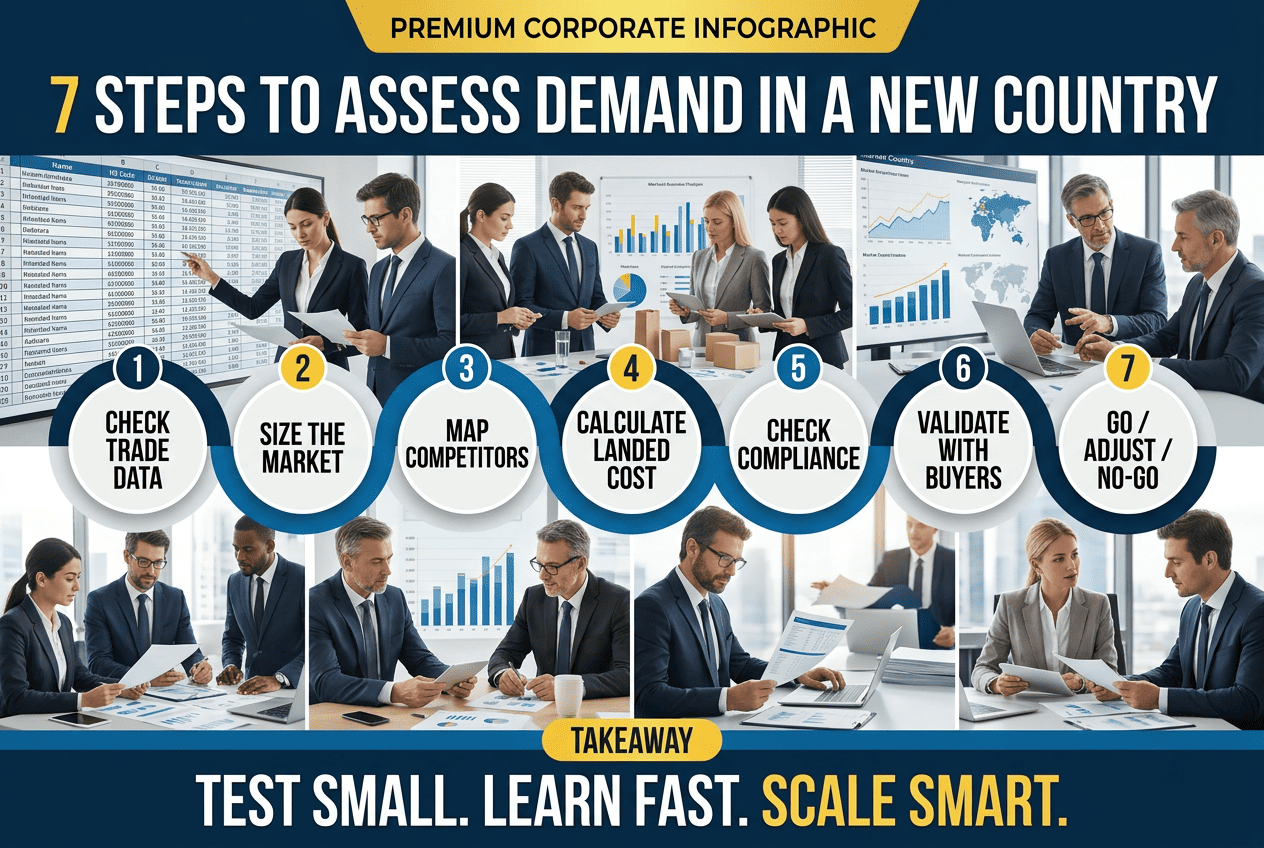
Direct Answer: To assess demand for your product in a new country, combine desk research with real-world validation in seven steps. First, check your product’s trade and production data by HS code. Second, size the market top-down and bottom-up (TAM, SAM, SOM). Third, map competitors, substitutes and prices. Fourth, calculate landed cost and margin. Fifth, check regulation, certification and channel access. Sixth, validate with real buyers through interviews, samples, quotes and a small pilot order, looking for commitment, not polite interest. Seventh, score the market on a go / adjust / no-go scorecard with thresholds set in advance. Spend small amounts to learn fast before you commit large budgets. GTsetu helps you find government‑tie‑up verified distributors, importers and manufacturers across 100+ countries so you can test demand with real counterparties, with anonymous discovery, built-in NDA workflows and zero broker commission.
📅 Published October 27, 2026🔄 Updated October 27, 2026⏱ 15 min read✍️ GTsetu Editorial Team
7
Steps to Assess Demand
6
Scorecard Criteria
100+
Countries on GTsetu
0%
Broker Commission
The most expensive export mistakes are not failed shipments. They are market entries built on assumed demand: new certifications, inventory, partners and marketing budgets committed before anyone has proven that buyers in the target country will pay for the product at a profitable price.
Manufacturers, exporters, product and business development teams, and founders evaluating one or more foreign markets for physical products, equipment, components or related services.
⚖️ General Information Disclaimer
This guide provides general commercial education. Market data, tariffs, standards and regulations vary by country and change often. Always confirm current requirements with official sources and qualified local advisers before committing to a market.
SECTION 1
1 Why Demand Assessment Comes Before Expansion
🎯 Definition
Demand assessment is the process of estimating how many buyers in a target country need your product, what they will pay, who they currently buy from and what it will cost you to serve them, then testing those estimates with real buyers before a full launch. It answers one question: will this market buy enough of this product, at a margin that works, within a timeframe you can afford?
💸
Avoid Sunk Costs
Certification, inventory, tooling and partner onboarding are expensive. Validate demand first so you do not fund them on assumptions.
🎯
Pick the Right Market
The biggest market is not always the best one. Fit, access and margin often matter more than size.
⚡
Learn Faster
Small, structured tests (samples, quotes, pilots) teach you more in weeks than a long report can.
🤝
Negotiate from Evidence
Real data on prices, volumes and competitors strengthens your position with distributors and buyers.
SECTION 2
2 Step 0: Is Your Product Export-Ready?
Before you analyse a country, check whether your product has the traits that travel. A common starting point is your domestic performance: a product that sells well at home often has a good chance in markets with similar needs and conditions. Another is distinctiveness: features that are hard to duplicate abroad, such as patents, superior quality, advanced technology or adaptability, tend to be received better and face less direct competition. Even without unique features, many products succeed abroad by competing on reliability, service or price.
1
Domestic Track Record
Repeat customers, stable margins and proven use cases give you evidence to bring to foreign buyers.
Evidence of fit
2
Distinctive Features
Patents, quality, performance or customisation that competitors abroad cannot easily match.
Competitive edge
3
Support Requirements
Training, installation and after-sales service must be delivered by you or a capable local partner.
Service model
4
Export Controls & Licences
Some products need export approvals or licences. Check this before you invest in prospecting.
Regulatory gate
SECTION 3
3 Step 1: Start with Trade and Production Data
Trade statistics give you the fastest outside-in view of demand. Identify your product’s HS (Harmonized System) code and look at how much each candidate country imports, from whom, at what unit values and how this has changed over several years.
Question
Data to Look At
What It Tells You
How big is import demand?
Import value and volume by HS code, last 3 to 5 years
Size and growth of foreign-supplied demand
Who supplies it?
Top supplier countries and their shares
Competitive landscape and concentration
At what price?
Unit values (value per kg or per unit)
Price positioning of imports
How much is made locally?
Domestic production and industry output
Whether local manufacturers dominate
What does it cost to enter?
Tariffs and trade-agreement treatment for your origin
Price disadvantage or advantage versus rivals
Is demand rising?
Growth in related industries, construction, retail or manufacturing
Leading indicators of future demand
📌 Cross-Check Your Sources
HS classifications, reporting lags and coverage differ across sources. Compare at least two data sources, and remember that mirror data (what exporters report versus what importers report) can disagree. Use trade data to shortlist, not to decide.
SECTION 4
4 Step 2: Size the Market (TAM, SAM, SOM)
Use two methods and compare the results. If they differ widely, one of your assumptions is wrong, and finding which one is valuable.
TAM
Total addressable market
All demand for the product category in the country, whoever serves it.
Top-down
SAM
Serviceable available market
The part of TAM you can serve given your product range, channels, certifications and price.
Realistic reach
SOM
Serviceable obtainable market
The share you can realistically win in a set period given competition and capacity.
Your target
✅ Top-Down Sizing
✅ Start from industry or import totals, then narrow by segment, region and price band.
✅ Fast, and useful for comparing countries on the same basis.
⚠️ Prone to optimism: a small percentage of a big number can mislead.
✅ Bottom-Up Sizing
✅ Count target customers, estimate their annual need and your achievable share and price.
✅ Grounded in real accounts and tied to your sales capacity.
⚠️ Slower and needs customer-level inputs that you must test.
Importer, distributor and retailer or dealer margins
Local channel structure
Marketing & support
Samples, trade fairs, training, after-sales service
Your go-to-market plan
Financing & FX
Payment terms, currency risk, credit insurance
Contract terms
Compare the resulting shelf or end-customer price with the price ladder from Step 3. If you must price well above comparable products to earn your margin, you need a clear, proven differentiator.
SECTION 7
7 Step 5: Regulation, Certification and Channels
Demand you cannot legally or practically serve is not demand. Check three gates before you invest further.
Check how trademarks and patents are protected locally before you disclose designs or enter the market.
🌱
Buyer Requirements
Some buyers add their own standards, such as environmental, ethical sourcing or documentation requirements.
SECTION 8
8 Step 6: Validate with Real Buyers
🎯 The Principle
Desk research tells you where demand might exist. Only buyers can tell you whether it does. Look for commitment signals, such as requests for quotes, sample orders, letters of intent and pilot purchase orders, not compliments. Spending time, money or shelf space is strong evidence; polite interest is not.
1
Interview Buyers, Distributors and Users
Ask how they buy today, what they pay, what frustrates them and what would make them switch. Listen more than you pitch.
2
Send Specifications, Quotes and Samples
Request feedback on specifications and price. Count how many recipients ask follow-up questions or request a formal quote.
3
Test the Message
Compare responses to different value propositions, price points or product variants. Use trade fairs, targeted outreach or online listings as cheap experiments.
4
Run a Pilot Order or Limited Launch
Work with one distributor, channel or customer segment. Define success metrics and a review date up front.
5
Measure and Decide
Track conversion, repeat orders, price realisation, delivery issues and support needs, then adjust or stop.
Strong vs Weak Demand Signals
✅ Strong Signals
✅ Written request for a formal quote or detailed specification.
✅ Paid sample or trial order.
✅ Letter of intent or pilot purchase order.
✅ Distributor willing to hold stock or invest in marketing.
✅ Repeat orders after the first delivery.
⚠️ Weak Signals
⚠️ General enthusiasm with no next step.
⚠️ Requests for free samples with no follow-up.
⚠️ Price-only enquiries that vanish after your quote.
⚠️ Website visits or likes without conversations.
⚠️ A single contact who cannot buy or influence buying.
Put every candidate country through the same scorecard. Score each criterion from 1 to 5, weight it by your goals, and set thresholds before you see the results so you are not tempted to move the goalposts.
Criterion
What a High Score Means
Evidence to Use
Demand & growth
Large, growing demand for your category and segment
Trade data, sizing, buyer interviews
Competitive position
Clear differentiator and manageable competition
Competitor map, price ladder, buyer criteria
Margin after landed cost
Healthy margin at a competitive price
Landed cost model
Regulatory effort
Low time and cost to comply
Standards and certification mapping
Channel access
Credible, verifiable partners available
Partner longlist, references
Risk
Low payment, currency, political and legal risk
Country risk, payment terms, contract review
🧭 Go / Adjust / No-Go
Strong signals and healthy margin
Proceed in stages
Go
Sign a pilot agreement, complete required certifications and set review milestones.
Interest but a fixable gap
Change the offer
Adjust
Adapt price, specification, pack size, channel or certification, then retest.
Weak signals or negative margin
Stop or pivot
No-Go
Move to the next country on your shortlist. Stopping early is a successful outcome.
SECTION 10
10 Protect Yourself During Testing
Validation involves sharing specifications, pricing and sometimes samples. Keep the exercise safe with simple protections, and move to a written contract before any significant commitment.
Protect 01
NDA First
Sign a mutual NDA before sharing drawings, formulations, cost data or customer lists.
Protect 02
Scope the Pilot
Define product, quantity, price, delivery and payment in a short pilot agreement.
Protect 03
Warranty & Quality
State warranty scope and claims process. See warranty clause.
The fastest way to test demand is to talk to real distributors, importers and manufacturers in the target market, and to be sure they exist as described. GTsetu connects businesses with government‑tie‑up verified partners across 100+ countries, with built-in NDA workflows and encrypted collaboration. Every company on GTsetu is verified through direct government tie‑ups across six credentials: legal name, registered address, registration number, company status, company type, and date of certificate of incorporation. GTsetu does not verify market demand, industry certifications, sales capability, references or financial standing; those must be checked directly between partners during due diligence.
✅
Government Tie‑Up Verification
6‑point verification: legal name, registered address, registration number, company status, company type, incorporation date.
📜
Certifications & Demand Claims
GTsetu does not verify these. Validate them directly through references, samples and pilots.
🕵️
Anonymous Discovery
Explore partner profiles without revealing your identity until mutual interest is confirmed.
📄
Built-In NDA Workflow
Formalise confidentiality before sharing specifications, pricing or samples, with a full digital audit trail.
🚫
Zero Commission
No broker fees on any deal, whether a pilot order, distribution agreement or supply contract.
🔐
Encrypted Collaboration
Documents and communications encrypted in transit and at rest. Secure B2B collaboration from first contact.
🌍
100+ Countries
A verified network of distributors, importers and supply chain partners.
QHow do I assess demand for my product in a new country?
Combine desk research and real-world validation. Start with trade and production data using your product’s HS code, size the market top-down and bottom-up, map competitors and pricing, check regulation and certification, and then test demand with buyer conversations, samples and a small pilot order before committing to a full launch.
QWhat data sources can I use to size a foreign market?
Common sources include national and international trade statistics by HS code, industry association reports, government trade promotion bodies, customs and tariff databases, company filings of local players, e-commerce and search data, and trade fair feedback. Cross-check at least two sources because classification and coverage differ.
QWhat is the difference between TAM, SAM and SOM?
TAM (total addressable market) is the total demand for the product category. SAM (serviceable available market) is the part you can realistically serve given your product, channels and regulations. SOM (serviceable obtainable market) is the share you can realistically win in a set period given competition and capacity.
QHow do I know if there is real demand and not just interest?
Look for commitment signals rather than polite interest: requests for quotes and specifications, sample orders, letters of intent, pilot purchase orders, and distributors willing to carry stock. Compliments and general enthusiasm are weak evidence; spending time, money or shelf space is strong evidence.
QShould I run a pilot before a full market entry?
In most cases, yes. A pilot with one distributor, one channel or one customer segment limits cost and teaches you about pricing, logistics, certification and customer feedback. Define success metrics and a review date before you start so the pilot produces a clear decision.
QHow do I decide whether to enter a market?
Score each candidate market on demand, competition, margin after landed cost, regulatory effort, channel access and risk, weight the criteria by your goals, and set go, adjust and no-go thresholds in advance. Decide on evidence from validation, not on market size alone.
QHow does GTsetu help with validating demand abroad?
GTsetu helps businesses find and verify distributors, importers and manufacturers across 100+ countries so you can test demand with real counterparties. Every company is verified through government tie-ups on six core credentials (legal name, registered address, registration number, company status, company type, incorporation date). GTsetu offers anonymous discovery, built-in NDA workflows, encrypted collaboration and zero broker commission. GTsetu does not verify market demand, certifications or financial standing, so those must be checked directly between partners.
Ready to Test Demand with Verified Partners?
Join 500+ verified manufacturers, exporters and distributors already building cross-border partnerships on GTsetu, with government‑tie‑up verification of six core credentials, built-in NDA workflows and zero broker fees across 100+ countries.
They represents the product, and research team behind GTsetu, a global B2B collaboration platform built to help companies explore cross-border partnerships with clarity and trust. The team focuses on simplifying early-stage international business discovery by combining structured company profiles, verification-led access, and controlled collaboration workflows.
With a strong emphasis on trust, and disciplined engagement, Team GTsetu shares insights on global trade, partnerships, and cross-border collaboration, helping businesses make informed decisions before entering deeper commercial discussions.