How to Evaluate a Foreign Market Before Investing | GTsetu Blog
Home ›
Blogs ›
Evaluate a Foreign Market Before Investing
📋 Market Selection & Due Diligence · 2026
How to Evaluate a Foreign Market Before Investing
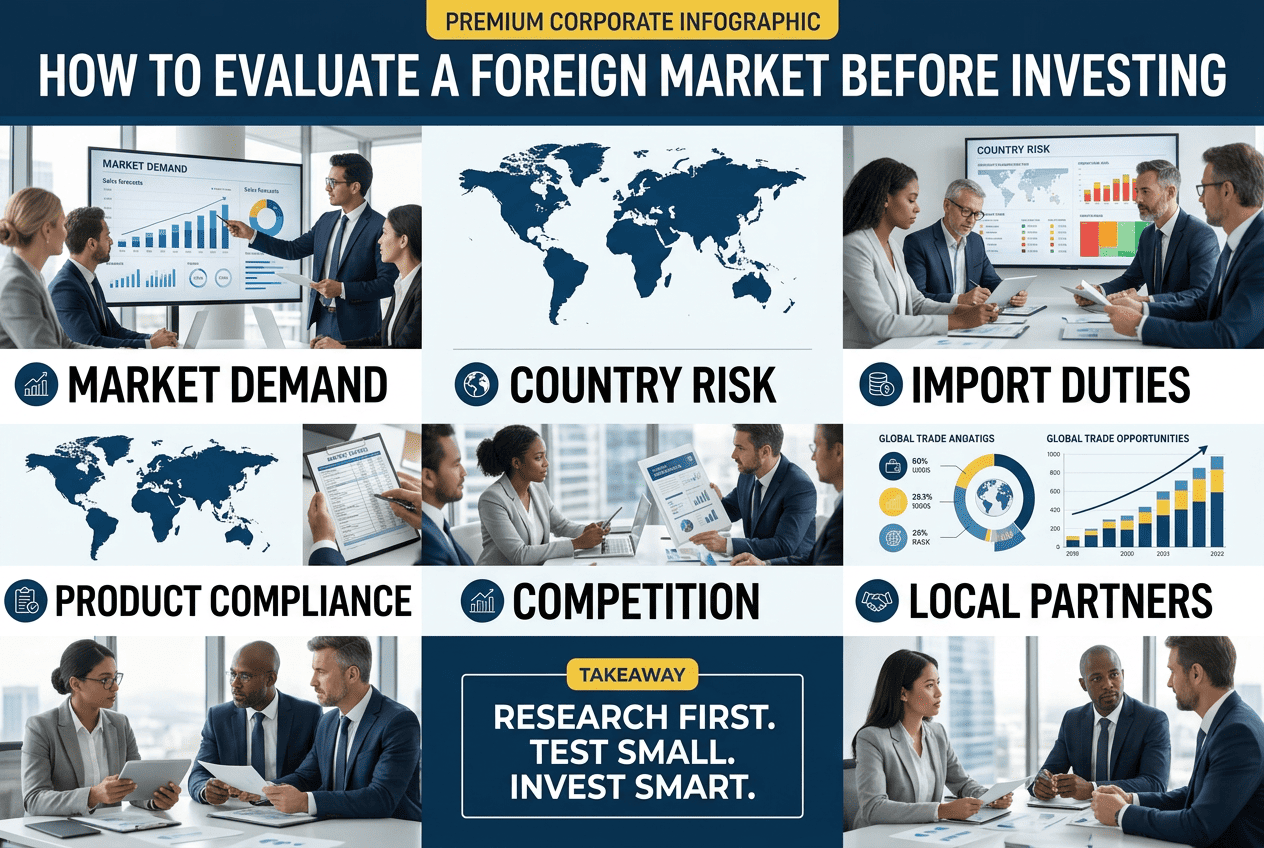
Most failed market entries were not unlucky, they were under-researched. A market that looks large on paper can still be a poor investment once you account for country risk, import duties, certification requirements, entrenched competitors, and the real cost of finding a trustworthy local partner. This guide lays out a practical framework for evaluating a foreign market before you commit capital: how to size realistic demand, how to assess risk, how to test the market cheaply, and where desk research alone stops being enough.
📅 Published October 27, 2026⏱ 14 min read✍️ GTsetu Editorial🔄 Updated October 27, 2026
Entering a foreign market is one of the more expensive and least reversible decisions a growing company makes. Capital goes into legal setup, certifications, inventory, partners, and people long before the first meaningful revenue arrives, and a bad market choice can quietly consume years of that effort. The companies that avoid this tend to do the same thing differently: they treat market evaluation as a structured, staged process with clear go and no-go criteria, rather than a reaction to one promising lead or a neighbouring market that happens to be familiar.
This guide walks through that process: what to measure, in what order, how cheaply you can validate demand before committing, and where the hardest-to-research factor, the reliability of the local people and companies you’ll depend on, requires a different approach than desk research. If you work in industrial or manufacturing sectors, it pairs well with our deeper guide to global market research for manufacturers.
💡 How to read this guide
Section 2 is the core framework, seven steps in the order most companies should run them. Section 3 is a quick-reference table of indicators. Section 5 is worth reading closely if your biggest unknown isn’t the market itself but whether you can find and trust a local partner there.
Section 1
Why Evaluate a Market Before You Invest
The pull toward a market is usually obvious: a large population, a fast-growing economy, an inbound enquiry, or a competitor who already succeeded there. What’s less obvious from the outside are the factors that determine whether you can profitably capture any of it.
Raw market size overstates what you can capture. Total demand for your category is not the same as the share an unknown foreign entrant can realistically win against established local and international competitors.
Country risk can erase margin. Currency volatility, payment delays, policy shifts, and weak contract enforcement can turn an apparently profitable market into a loss-making one.
Access barriers are easy to underestimate. Import duties, product certifications, local standards, and licensing requirements add real cost and delay that don’t show up in a market-size estimate.
Familiar is not the same as best. Smaller companies often default to nearby or culturally similar markets for convenience, even when a more distant market offers meaningfully higher potential return.
The wrong partner is the most expensive mistake. Even in a well-chosen market, committing to an unverified distributor or local operator can undo all the upstream analysis.
📌 The mindset that helps most
Treat the evaluation as a series of gates, not a single research project. Each step in Section 2 should give you enough evidence to either stop, adjust your approach, or move to the next, more expensive stage, so you spend serious money only on markets that have already earned it.
Section 2
The Market Evaluation Framework, Step by Step
From Hypothesis to Go / No-Go Decision
Most companies that evaluate markets well move through some version of the following sequence, getting progressively more specific, and more costly, at each stage.
1
Define Objectives & Screening Criteria
Decide what “good” looks like before you look at a single country
Internal Step
Before researching any market, write down what you’re actually trying to achieve: revenue target, margin threshold, acceptable payback period, and how much capital you’re willing to put at risk. Without these, every market looks attractive in some way and there’s no objective basis for saying no.
What it involves
Minimum revenue, margin, and payback criteria for any new market
Maximum capital at risk before a go/no-go decision point
A shortlist of 3 to 5 candidate countries to screen, not just one
Common mistakes
Starting with a single favoured country and only looking for supporting evidence
Having no walk-away criteria, so every result gets rationalised as “promising”
🎯
Why it matters: Clear criteria turn market evaluation from a persuasion exercise into a genuine decision process.
2
Size the Market & Estimate Realistic Demand
Start with total potential, then adjust for what you can actually reach
Demand
A common starting point is to multiply the number of potential buyers by the average quantity each buys and by the average unit price, giving a theoretical market potential. From there, macro indicators such as GDP per capita, income distribution, urbanisation, and the number of companies in your target sector help refine who your real customers are, and whether the market is growing or shrinking. Regional innovation clusters can also shift a market’s trajectory quickly, as seen in how Maharashtra’s FTI is shaping quantum technology in Pune.
What it involves
Buyers × average quantity × average price as a first-pass estimate
Industry-specific data for B2B categories, such as sector revenue and number of potential customer companies
Growth trend analysis, not just a snapshot of current size
Common mistakes
Treating total market size as if it were your addressable share
Using one year of data without checking whether the market is growing or declining
🎯
Why it matters: If realistic demand is too small to hit your revenue criteria from Step 1, the rest of the analysis is wasted effort.
3
Assess Country Risk & Economic Stability
Political, currency, payment, and enforcement risk
Risk Control
Country risk covers the chance that political instability, economic conditions, corruption, or policy change will hurt returns. Established indicators, such as the OECD country risk classification and Transparency International’s Corruption Perceptions Index, give a general read, while currency movements against your home currency over several years show how much exchange-rate risk you’d carry. How risk gets divided between you and your counterparties in a deal matters just as much, which is covered in more depth in our guide to risk allocation in cross-border deals.
What it involves
Reviewing credit-risk and corruption indicators for each shortlisted country
Analysing multi-year currency volatility against your home currency
Assessing contract enforcement and payment-reliability norms
Common mistakes
Relying on a single risk score instead of looking at the factors driving it
Ignoring currency risk because current exchange rates look favourable
🎯
Why it matters: A large, growing market with weak enforcement or volatile currency can still produce a net loss, regardless of how strong demand looks.
4
Check Market Access, Regulations & Certifications
Duties, standards, and the paperwork that decides whether you can sell at all
Access Barriers
Import duties directly reduce your margin, and local product standards or licensing rules can block or delay entry altogether. Logistics performance and the share of your category already flowing from your home country into the target market give a useful read on how accessible the market really is. Manufacturers in particular should confirm which manufacturing certifications for international trade are required before assuming a market is open to them.
What it involves
Duty rates and total landed cost for your specific product category
Operational resilience standards such as ISO 22301 certification where customers or regulators expect them
Common mistakes
Assuming home-market certifications are recognised abroad
Discovering a mandatory standard only after a distributor or customer asks for it
🎯
Why it matters: Access barriers are the most common reason a market that looked open on paper turns out to be expensive or slow in practice.
5
Analyse Competition & Cultural Fit
Who you’ll be up against, and how buyers there actually behave
Competitive Landscape
A market with moderate potential and intense competition often offers less real opportunity than a smaller, less contested one. Look at how many direct competitors exist, how concentrated market share is, and whether one dominant player controls distribution. Cultural factors, language, buying habits, business etiquette, and trust norms, also shape how easy it is to sell. A market-specific entry guide, such as our walkthrough on expanding an industrial automation business into the Czech Republic, shows how much these details vary by country.
What it involves
Mapping competitors, market share, and any dominant incumbents
Understanding local buying behaviour and relationship norms
Checking how much of your category already comes from your home country
Common mistakes
Assuming what worked in your home market will work with minimal change abroad
Overlooking local competitors because they’re not visible internationally
🎯
Why it matters: Competition intensity is what converts theoretical market size into realistic, winnable revenue.
6
Validate Demand With Low-Commitment Tests
Get real market signals before you spend real money
Validation
Desk research tells you what a market looks like on paper. Low-commitment tests tell you how it behaves. A pilot shipment, a small distributor trial, or structured conversations with several prospective local partners, evaluated against consistent partnership evaluation criteria, produce evidence no report can, including whether the price point works and whether local wholesale distributors actually want your product.
What it involves
Pilot shipments or limited trial orders through a local partner
Conversations with several candidate distributors or customers, not just one
Treating one enthusiastic distributor’s feedback as proof of market demand
Running a pilot with no defined success metrics
🎯
Why it matters: This is the cheapest point at which to discover that demand is weaker, or the price point different, than your research suggested.
7
Model Costs & Returns, Then Decide Go / No-Go
Put everything learned into a single investment case
Decision Gate
Pull the earlier steps into one financial model covering landed cost, certification and setup costs, partner margin, currency exposure, and realistic revenue ramp. If your plan involves acquiring a local business or its assets, rigorous commercial due diligence and a carefully structured asset purchase agreement belong here. For manufacturers, this is also where local production or contract manufacturing options get compared through cross-border manufacturing partnerships.
What it involves
A full landed-cost and margin model by entry option
Downside scenarios for currency movement, delays, and slower ramp-up
A clear go, adjust, or no-go decision against the Step 1 criteria
Common mistakes
Modelling only the best case and ignoring downside scenarios
Letting sunk research costs push a marginal market through the gate
🎯
Why it matters: A disciplined no-go decision here costs far less than discovering the same answer after full market entry.
Section 3
Key Indicators and What They Tell You
The table below summarises the main indicator categories most market evaluations draw on, what each one tells you, and how heavily it typically weighs on the final decision.
Indicator Category
Example Measures
What It Tells You
Typical Weight
Market size & growth
GDP per capita, sector revenue, number of target customers, growth trend
Whether enough realistic demand exists, and whether it’s expanding
The real cost and delay of getting product to customers legally
✓ High
Competitive intensity
Number of competitors, market-share concentration, dominant incumbents
How much of the theoretical market you can realistically win
✓ High
Cultural & language fit
Business etiquette, buying habits, language, consumption preferences
How much adaptation your product, marketing, and sales approach will need
⚠ Medium
Partner & channel availability
Quality of local distributors, verified manufacturers, service providers
Whether you can actually execute in the market, not just analyse it
✓ High, and hardest to research
💡 Pattern to notice
Five of the six indicator categories can be researched from your desk using public data and paid reports. The sixth, whether reliable, verifiable local partners exist and are willing to work with you, usually can’t, and is also where most post-entry failures originate.
Section 4
Contract Protections to Lock In Once You Decide
A go decision doesn’t end the risk, it changes its form. Once you commit to a market, the contracts with your local distributor, partner, or acquisition target decide how much of the risk you analysed actually stays with you. A few terms come up in nearly every cross-border deal, and it’s worth understanding them while you’re still evaluating.
Incoterms 2020 allocate shipping cost and risk between buyer and seller, a direct input into the landed-cost model from Step 7.
FCA (Free Carrier) is among the most widely used Incoterms in cross-border supply agreements and worth understanding specifically for export pricing.
Master Services Agreement (MSA) sets the overarching terms for an ongoing relationship with a local partner or service provider.
Warranty clauses define what you promise about product quality and performance, and for how long, a point foreign buyers will scrutinise closely.
Consequential damages cover indirect losses such as lost profits, and are frequently limited or excluded, worth checking carefully before signing.
Termination for convenience lets a party exit without cause on agreed notice, a vital clause if the market doesn’t perform as hoped.
📌 Why this belongs in market evaluation
If a market only works financially when contracts are enforced the way you expect, you need to know that before committing, not after. Reviewing how these terms typically operate in your target market is part of assessing country risk, not a separate legal exercise that happens later.
Section 5
Desk Research vs. Verified On-the-Ground Partner Intelligence
Reports, public indicators, and trade data answer most of the market-level questions. What they don’t answer is the one that decides whether you can execute: who, specifically, will distribute, manufacture, or represent you there, and can you trust them? Desk research can’t verify a particular company’s legal registration or standing, and cold outreach to unfamiliar firms in an unfamiliar country is slow, signals your plans to the market, and relies on unverified self-reporting.
What you need to know
Desk Research & Paid Reports
Verified Partner Platform
Overall market size, growth, and macro risk
✓ This is what they’re built for
⚠ Not the purpose
Whether specific local companies are legitimately registered
✗ Manual, country-by-country registry checks
✓ Government-sourced verification upfront
Testing partner interest without revealing your market plans
✗ Outreach exposes your intentions early
✓ Anonymous discovery until mutual interest
Sharing pricing and specs with candidates during validation
⚠ Depends on ad hoc NDAs, if used at all
✓ Built-in digital NDA workflow
Comparing partner availability across several candidate countries
✗ Separate searches, separate networks per country
✓ Centralised across 100+ countries
🤝 For Validating a Market Through Verified Partners
GTsetu: Verified Partner Discovery to Test a Market Before You Commit
GTsetu doesn’t replace market research, it answers the question research can’t: are there real, verified companies in this market worth working with? Every company on the platform is verified on 6 government-sourced points before you ever make contact, so you can test partner availability across several candidate countries at once, browse anonymously without signalling your plans, and protect your pricing and specifications with a digital NDA before any real conversation starts.
GTsetu is used by manufacturers, distributors, and raw material suppliers across 100+ countries to find and formally engage verified partners, whether to validate demand through a pilot, structure a longer-term cross-border business partnership, or work with international business development consulting to plan the wider market-entry strategy.
🏛️
6-Point Government-Sourced Verification
Name, Address, Registration Number, Company Status, Company Type, and Date of Incorporation, verified using government tie-ups before any engagement.
🕵️
Anonymous Discovery
Browse verified partner profiles across 100+ countries without revealing which markets you’re evaluating.
📄
Built-In NDA Workflow
Digital NDA with timestamped signatures before any pricing, formulations, or product specs are shared.
🔐
Encrypted Document Workspace
All commercial documents shared through encrypted channels with a full access audit trail, not email attachments.
🌍
100+ Countries
Verified manufacturers, distributors, and raw material suppliers across Asia, the Middle East, Europe, Africa, Australia, and the Americas.
🚫
Zero Commission
No success fee, no broker commission, ever. Your partnership economics remain entirely between you and your partner.
📌 GTsetu complements your market research, it doesn’t replace it
Use desk research and paid reports to decide which markets are worth a closer look, then use verified partner discovery to test whether you can actually execute in them. Combined, they cover both halves of the question: is this market attractive, and can we reliably operate in it?
Section 6
Which Approach Fits Your Situation?
Use this reference to match your next step to where you actually are in the evaluation process.
🎯
You have no clear criteria for a good market yet
Every country looks promising and there’s no objective way to say no.
Start with Step 1
🗺️
You’re comparing several candidate countries
You want to screen quickly and cheaply before going deep on any one market.
Desk research + indicator table
⚠️
A market looks attractive but feels risky
You’re worried about currency, payments, or contract enforcement.
Deepen Step 3 (country risk)
🏭
You’re a manufacturer unsure which certifications apply
You need to know what’s required before assuming the market is open.
Review Step 4 (access)
🔍
Research looks good but you can’t verify any local partners
You have no network in the market and cold outreach feels risky and slow.
GTsetu
🔒
You want to test partner interest without alerting the market
You’re not ready to announce plans or reveal pricing to competitors.
GTsetu (anonymous discovery)
📜
You’ve decided to go and are about to negotiate contracts
You want to understand the key terms before you’re in the room.
Review Section 4
🧭
You want structured help running the whole evaluation
You’d rather bring in outside expertise than build the process in-house.
QHow do you evaluate a foreign market before investing?
Start by defining what a good outcome looks like, then size the realistic demand for your product, assess country risk (political, economic, currency, and regulatory), check market access barriers such as duties and certifications, analyse the competitive landscape, and validate real demand through a low-commitment test, such as a pilot shipment or conversations with local distributors, before committing significant capital.
QHow do you estimate market potential in a new country?
A common approach multiplies the number of potential buyers by the average quantity each buys and by the average price per unit. That figure is then adjusted for market access barriers, competition intensity, cultural fit, and risk factors, because raw market size almost always overstates what a new entrant can realistically capture.
QWhat is country risk and why does it matter for foreign investment?
Country risk is the possibility that political instability, economic conditions, currency volatility, corruption, or regulatory change in a country will hurt returns on an investment there. It matters because a market that looks attractive on size alone can still produce losses if currency swings, payment delays, or sudden policy changes erode margins. How that risk is divided between parties in a deal is covered in our guide to risk allocation in cross-border deals.
QHow long should foreign market research take before investing?
It depends on the size of the commitment. A light desk-research screen of several candidate countries can take a few weeks, while a deeper evaluation involving risk analysis, regulatory review, and local partner conversations for a single target market can take several months. The larger and less reversible the investment, the more thorough the evaluation should be.
QHow can I test a foreign market cheaply before committing?
The cheapest reliable tests are a small pilot shipment, a limited trial with one or two local distributors, or structured conversations with several candidate partners using consistent partnership evaluation criteria. These produce real evidence about price acceptance and partner interest that no desk research can, at a fraction of the cost of full market entry.
QHow do I find reliable local partners to validate a market without an existing network?
Referrals and trade shows work but are slow, and cold outreach makes it hard to confirm whether a prospective partner is who they claim to be. A verified discovery platform such as GTsetu shortens this by confirming each company’s legal registration before you invest time, letting you test interest anonymously across several countries and protect your pricing and specs with a digital NDA. For manufacturers sourcing or producing locally, see also how cross-border manufacturing partnerships are structured.
Ready to Test a New Market With Verified Partners?
GTsetu answers the question desk research can’t, whether reliable, verified local partners exist in your target market. Government-sourced verification, built-in NDA workflows, and zero commission, across 100+ countries.
They represents the product, and research team behind GTsetu, a global B2B collaboration platform built to help companies explore cross-border partnerships with clarity and trust. The team focuses on simplifying early-stage international business discovery by combining structured company profiles, verification-led access, and controlled collaboration workflows.
With a strong emphasis on trust, and disciplined engagement, Team GTsetu shares insights on global trade, partnerships, and cross-border collaboration, helping businesses make informed decisions before entering deeper commercial discussions.