How to Expand Into Multiple Countries Without Opening Offices
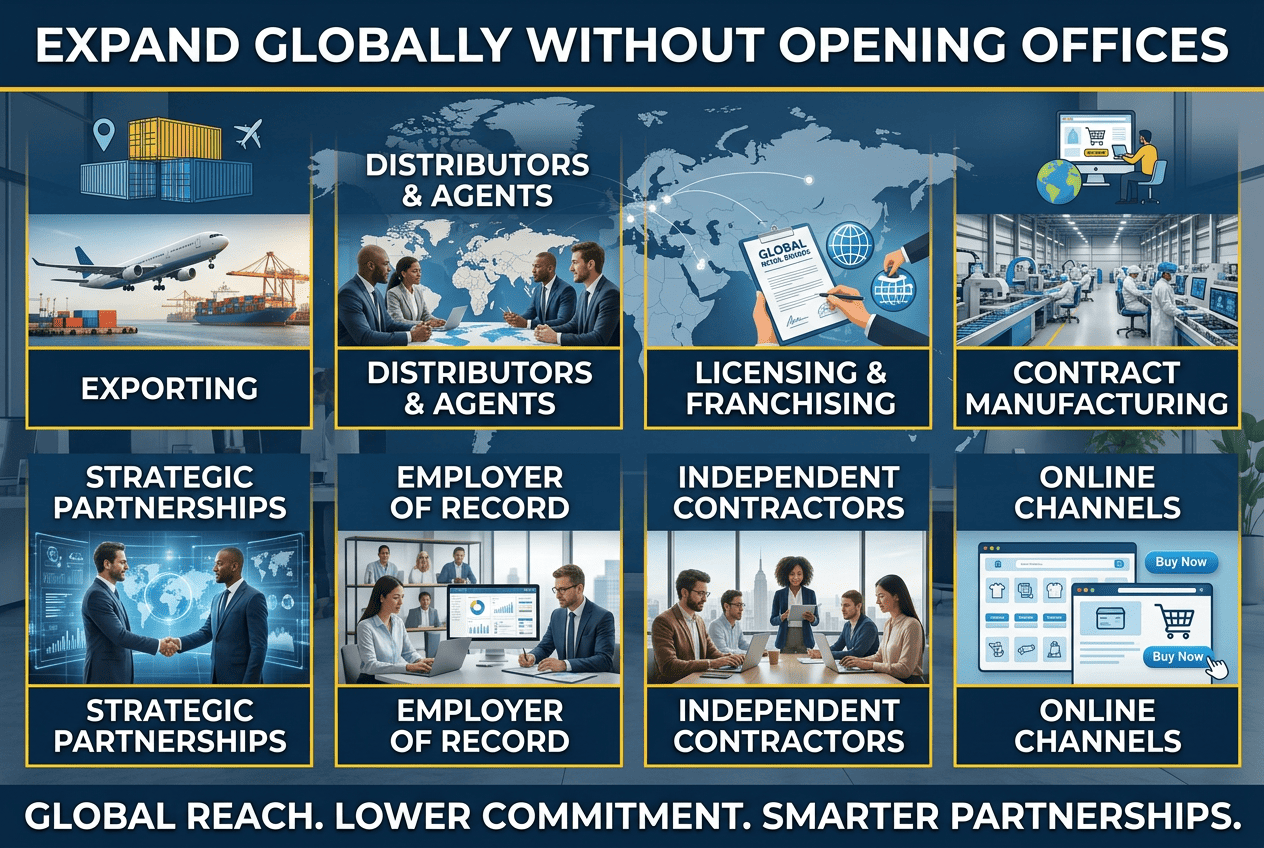
Direct Answer: You can expand into multiple countries without opening offices by using partner-led and asset-light market entry routes: exporting, local distributors and agents, licensing or franchising, contract manufacturing, strategic partnerships or joint ventures, Employer of Record (EOR) arrangements for local staff, independent contractors, and online channels. These routes differ less in cost than in commitment and control: exporting and licensing are easy to reverse, while acquisitions and local entities are not. The right mix depends on whether you need to sell goods, protect intellectual property, trade locally, or simply have people on the ground. Watch for permanent establishment (tax) risk, contractor misclassification, and the point at which local law or scale makes an entity unavoidable. Whatever route you choose, success depends on who you partner with. GTsetu helps you find government‑tie‑up verified distributors, manufacturers and partners across 100+ countries, with built-in NDA workflows and zero broker commission.
📅 Published October 27, 2026🔄 Updated October 27, 2026⏱ 15 min read✍️ GTsetu Editorial Team
8
Asset-Light Entry Routes Compared
$60–120K
Typical Entity Setup Cost Cited by One EOR Provider
100+
Countries on GTsetu
0%
Broker Commission
Global expansion once meant incorporating a subsidiary in every country, renting an office, hiring local staff and learning local compliance the hard way. That model is slow and expensive, and it commits capital before you know whether demand exists. Today, many companies, especially manufacturers and exporters, enter new markets through partners, platforms and flexible employment models, and only build a local presence once the numbers justify it.
Manufacturers and exporters (including Indian companies) looking for new markets, founders planning multi-country launches on a lean budget, business development and sales leaders, and importers or distributors weighing foreign suppliers.
⚖️ Legal, Tax & Compliance Disclaimer
This guide provides general commercial education. It is not legal, tax, employment or immigration advice. Rules on foreign ownership, local partners, permanent establishment, worker classification and licensing differ by country and sector and change over time. Always consult qualified local advisors before entering a market or placing people or agents there.
SECTION 1
1 What Does “Expanding Without Offices” Mean?
🎯 Definition
Expanding without offices means entering and serving foreign markets without setting up your own local entity, premises or full operation. Instead, you reach customers through third parties (distributors, agents, licensees, partners, online platforms) or through flexible structures (an Employer of Record or contractors) that give you presence without incorporation.
The idea is not to avoid commitment forever. It is to prove demand before committing capital. A useful way to think about it: put products, partners or people into a market first, and add structure only when the business demands it.
⚡
Speed
Enter a market in weeks rather than waiting months for incorporation, bank accounts and local registrations.
💰
Lower Upfront Cost
Avoid incorporation, premises and fixed overheads in markets that may not perform.
↩️
Reversibility
Most asset-light routes end with a notice period, not a liquidation, if the market disappoints.
🧭
Local Knowledge
Partners bring customer relationships, regulatory know-how and cultural fluency you cannot buy quickly.
✨ GTsetu Insight
Asset-light does not mean risk-light: you are trusting third parties with your brand, customers and sometimes your intellectual property. Start by assessing them with our partnership evaluation criteria and the commercial due diligence guide.
SECTION 2
2 Eight Entry Routes at a Glance
Each route answers a different need. Here is the full menu in a single view.
Exporting
Sell from home
Produce at home and ship to foreign customers directly or via intermediaries.
📦 Low commitment
Distributors & Agents
Local sales channel
Appoint local firms to import, stock, market and sell your products.
🤝 Local reach
Licensing & Franchising
Rent your IP
Let a local company use your brand, technology or model in exchange for fees or royalties.
🏷 Capital-light
Contract Manufacturing
Make locally via others
Have a local manufacturer produce for you, closer to the market, without owning a plant.
🏭 Local supply
Partnerships & JVs
Shared operation
Ally with an established local company, sometimes required by law in certain sectors.
🧩 Shared control
Employer of Record
People, no entity
A third party legally employs your local staff while you direct their work.
👥 Real presence
Contractors
Flexible talent
Engage independent specialists for sales, support or technical work, with careful classification.
🧑💻 Flexible
Online Channels
Digital storefront
Reach customers through marketplaces, your own site and remote sales and support.
💻 Remote
📌 A Useful Principle
One expansion adviser puts it neatly: the routes differ less on cost than on commitment. Exporting and licensing are reversible; acquisition and incorporation are not. Most companies do best by putting products, partners or people into a market before committing capital to it, then combining routes as the market proves itself.
SECTION 3
3 Exporting, Distributors & Agents
This is the most common route and the natural starting point for manufacturers. You make the product at home and rely on a local intermediary to get it to customers.
1
Direct Exporting
You sell directly to foreign buyers. You keep margin and control, but you handle logistics, customs documentation and the customer relationship from afar.
Best for: B2B and niche products
2
Distributors
A local company buys your product, holds inventory and resells it. You get market access and local service; the distributor earns a margin and often wants territorial exclusivity. Explore international wholesale distributors.
Best for: broad market coverage
3
Sales Agents
An agent finds buyers and earns a commission but does not take title to the goods. Lower capital need, but the agent’s authority must be limited carefully (see permanent establishment, Section 8).
Best for: technical, project sales
4
Trading Houses & Importers
Specialist intermediaries consolidate demand from many buyers and handle import formalities, useful when you lack local contacts.
Best for: first entry
📌 Watch the Hidden Costs
Exporting avoids local set-up costs but brings logistics exposure, tariffs that can quietly erode margin, and slower learning because you are not present. Agree who bears cost and risk at each stage using Incoterms 2020 such as FCA (Free Carrier), and check which standards each market expects; see manufacturing certifications for international trade.
✨ GTsetu Insight
A distributor can make or break a market. Verify legal identity first, then evaluate coverage, track record and conflicts of interest. GTsetu verifies six core credentials through government tie-ups, giving you a trusted starting point before due diligence.
When your advantage is a brand, technology or know-how, or when you want local production without a plant, these routes move capability, not capital.
1
Licensing & Franchising
You grant a local company rights to use your IP, brand or business model, exclusive or non-exclusive, for a territory. Franchising lets others run your model under your brand; private labelling has a local firm sell your product under its name or yours. It is fast and needs little capital, but your IP is the exposure: the agreement must say exactly how it may be used, and cross-border licensing raises legal and tax questions in both countries.
2
Contract Manufacturing & Toll Production
A local manufacturer produces to your specification, cutting freight, lead time and some tariff exposure without a plant of your own. Quality control, IP protection and capacity commitments become the key issues. See cross-border manufacturing partnerships.
3
Strategic Partnerships & Joint Ventures
An alliance with an established local player brings relationships, licences and cultural fluency. In some countries and sectors a local partner is required by law. The price is control: governance, decision rights and exit terms determine whether the partnership succeeds, so analyse a partner as rigorously as you would an acquisition.
4
Acquisitions (the Opposite End of the Spectrum)
Buying a local business gives instant customers, staff and supply chain, but it is expensive, irreversible and carries inherited liabilities. Cross-border deals frequently fail to create value, usually because of integration rather than the transaction itself. If you ever go this way, review what an asset purchase agreement is and insist on thorough commercial due diligence.
✨ GTsetu Insight
Partnerships work best when both sides begin with verified identities and a shared NDA. Our guide to cross-border business partnerships shows how to structure them, and the Czech Republic expansion guide is a worked example of entering a European industrial market.
SECTION 5
5 Putting People in a Market: EOR & Contractors
Sometimes you do need people on the ground, a sales lead, an engineer or a support team, but not a company. Two structures make that possible.
🎯 What Is an Employer of Record?
An Employer of Record (EOR) is a third-party organisation that legally employs your staff in a country where you have no entity. It handles employment contracts, payroll, tax, benefits and local compliance, while you direct the day-to-day work. When you no longer need the arrangement, it typically ends with a notice period rather than a company liquidation.
✅ EOR: Advantages
✅Fast Start: People can begin in days or weeks rather than waiting months for incorporation.
✅Compliance Handled: The EOR carries local employment law, payroll and tax obligations.
✅Flexible Exit: Scale up, convert to an entity later, or exit without a liquidation.
✅Multi-Country Scale: One provider can cover several countries at once.
⚠️ EOR: Limits
⚠️Per-Employee Fees: Cost per head can exceed an entity once headcount grows.
⚠️Not a Trading Entity: It does not let you invoice customers locally or hold local licences.
⚠️Tax Exposure Remains: Staff acting for you may still create tax presence questions.
Independent Contractors
Contractors suit project-based or specialist work and avoid employment overheads. The main risk is misclassification: if a contractor works like an employee (fixed hours, exclusivity, your direction and tools), authorities may treat them as one, with back taxes and penalties. Contractors who negotiate or sign deals for you can also trigger permanent establishment questions. Use clear written agreements and local advice.
📌 Hiring for Manufacturing
If your people will touch product quality or plant operations abroad, be aware that markets expect specific standards. For example, see how food-related sectors are shaped by NSF sanitation certification, and consider continuity planning with ISO 22301 certification when distributed teams or partners run critical processes.
SECTION 6
6 Digital Channels & Remote Presence
Technology lets you appear local without being local. Used well, digital channels can test demand in several countries at minimal cost before you invest in partners or people.
🛒
Marketplaces & B2B Platforms
Sell through established online marketplaces and B2B platforms that already provide traffic, payments and sometimes fulfilment.
🌍
Localised Website & Content
Translate and adapt pages, pricing, currencies and compliance information. Marketing designed at home often lands differently abroad.
📞
Remote Sales & Support
Run inside sales, demos and customer support across time zones with a small, distributed team.
The table summarises how each route typically compares. Actual results vary by country, sector and partner.
Route
Speed
Commitment
Control
Best When
Exporting
Fast
Low
High over product, low over market
You sell goods and need no local presence
Distributors & Agents
Fast to medium
Low to medium
Medium; depends on contract
You need local reach, service and relationships
Licensing & Franchising
Fast
Low to medium
Medium; IP use must be policed
Your brand or IP is the product
Contract Manufacturing
Medium
Medium
Medium; quality oversight needed
You want local production without a plant
Partnerships & JVs
Medium
Medium to high
Shared
Local knowledge or licences are essential
Employer of Record
Days to weeks
Low
High over staff
You need people there, not a company
Contractors
Fast
Low
Limited by classification rules
Specialist or project work
Online Channels
Fast
Low
High over brand, varies by platform
You want to test demand cheaply
Own Entity / Acquisition
Slow
High to very high
Full
You must trade locally or need scale immediately
✨ GTsetu Insight
The best answer is usually a sequence, not a single choice: for example, export to test demand, appoint a distributor, add an EOR-employed sales lead, then consider an entity. Use global market research to decide which countries deserve each step.
SECTION 8
8 When You Do Need an Entity: Triggers & Permanent Establishment
“No office” is a starting point, not a permanent strategy. Eventually, law, tax or scale may require a local presence. Know the triggers in advance.
🏛️
Local Trading Requirements
Invoicing in-country, holding local licences or signing contracts that require a local entity usually means incorporating.
🔒
Legal Mandates
Some countries and sectors restrict foreign ownership or require a local partner or entity by law.
📈
Headcount & Cost Crossover
When per-employee EOR fees and complexity exceed the cost of running your own entity, incorporation may make sense.
🧾
Permanent Establishment
A fixed place of business, or staff or agents who habitually conclude contracts for you, can create taxable presence even without registration.
🎯 Understanding Permanent Establishment (PE)
Permanent establishment is a tax concept that lets a country tax part of a foreign company’s profits when it has sufficient presence there. Triggers commonly discussed include a fixed place of business, a dependent agent who habitually concludes contracts on your behalf, or employees who perform core business activities locally. Rules differ by country and tax treaty, so a structure that looks “entity-free” can still create tax and registration obligations. Get tax advice before placing people or agents abroad.
📌 Cost Reality Check
Some EOR providers cite typical entity set-up costs of around $60,000 to $120,000 before hiring anyone, with registration taking months and sometimes well over a year in slower jurisdictions, plus ongoing legal, accounting and filing obligations. These are vendor estimates and vary widely by country, so treat them as directional and get local quotes.
SECTION 9
9 How to Choose and Sequence Your Entry
Start with what you actually need in each market, not with the structure you assume you must have.
🧭 Quick Guide: Which Route Fits Your Need?
Selling goods, no presence needed?
Export
Test demand
Lowest commitment; start with a few buyers or one distributor.
Need local reach and after-sales service?
Distributor or agent
Channel
Use a verified local partner with a clear contract.
Brand or IP is the product?
License or franchise
IP-led
Invest heavily in the agreement and IP protection.
Need local production?
Contract manufacturer
Local supply
Shorter lead times without owning a plant.
Local licences or relationships mandatory?
Partner or JV
Alliance
Check legal requirements and agree governance early.
Need people, not a company?
Employer of Record
Presence
Decide on an entity later, once demand is proven.
A Five-Step Multi-Country Sequence
1
Shortlist and Rank Markets
Use demand, competition, tariffs, regulation and logistics to rank countries. Do not enter ten at once; pick two or three pilots. See global market research for manufacturers.
2
Check Legal and Regulatory Preconditions
Confirm product standards, import licences, foreign-ownership limits and any local-partner requirements before assuming a route is open.
3
Enter Through the Lightest Route
Start with export, a distributor or an online channel to validate demand with minimal capital.
4
Add Presence Where Demand Is Proven
Layer in an EOR-employed sales lead, a contract manufacturer or a deeper partnership in the markets that perform.
5
Review Structure Annually
Re-assess tax exposure, costs and control. Convert to an entity only when scale, law or economics justify it.
SECTION 10
10 Contracts, Compliance & Risk Across Borders
When you expand through other people, the contract is your office. These provisions matter most in distributor, licence, agency and manufacturing agreements.
Clause 01
Master Services Agreement
A framework for an ongoing relationship with defined services, service levels and reporting. See the MSA guide.
Clause 02
Warranty
Defines product quality promises and who handles claims in-market. See warranty clause.
Sharing designs, formulas or know-how without an NDA and clear licence terms exposes your core asset.
⚠️
Over-Broad Exclusivity
Granting a distributor a whole region without performance targets can lock you out of a market.
⚠️
Unverified Counterparties
Unclear legal identity or standing makes enforcement and recovery difficult.
⚠️
Hidden Tax Exposure
Agents or staff abroad can create permanent establishment and registration obligations.
✨ GTsetu Insight
Decide in advance who carries which risk. Our guide on risk allocation in cross-border deals explains how to allocate responsibility for non-performance, quality issues and policy shocks across borders.
SECTION 11
11 Finding Verified Partners in Every Market
If your expansion runs through partners, the quality of those partners is your expansion. Choosing them well is the single highest-leverage decision in an asset-light strategy.
🎯 The Partner Challenge
Trade fairs, directories and cold outreach are slow, expensive and unverified, and they do not scale across several countries. You need a secure environment where you can discover and evaluate partners with confirmed legal identities in many markets at once, and protect your information while you do it.
🔍
Discover Verified Partners
GTsetu verifies legal name, registered address, registration number, company status, company type and incorporation date using direct government tie-ups.
🕵️
Explore Anonymously
Browse distributor, manufacturer and partner profiles across countries before revealing your identity.
📄
Execute NDAs Securely
Formalise confidentiality before sharing designs, pricing or plans, with a digital audit trail.
🔐
Collaborate Securely
Exchange commercial documents through encrypted channels with access controls and audit trails.
🌍
Scale Across Countries
Build a portfolio of local partners in several markets from one platform, without brokers or agents.
💼
Zero Commission
No broker fees on any partnership formed. Your commercial terms stay between you and your partner.
SECTION 12
12 How GTsetu Helps You Expand Without Opening Offices
🌐 Platform Spotlight, GTsetu
Your Verified Gateway to Local Partners in 100+ Countries
When you expand through partners, trust is your infrastructure. GTsetu connects manufacturers, exporters, importers and distributors with government‑tie‑up verified partners across 100+ countries, with built-in NDA workflows and encrypted collaboration. Every company on GTsetu is verified using direct government tie‑ups across six essential credentials: legal name, registered address, registration number, company status, company type, and date of certificate of incorporation. GTsetu does not verify industry certifications, sales performance, tax status, quality or financial standing; those must be exchanged and validated directly between partners.
✅
Government Tie‑Up Verification
6‑point verification: legal name, registered address, registration number, company status, company type, incorporation date.
📜
Certifications & Performance
GTsetu does not verify these. They must be exchanged directly between partners during due diligence.
🕵️
Anonymous Discovery
Explore verified partner profiles without revealing your identity until mutual interest is confirmed.
📄
Built-In NDA Workflow
Formalise confidentiality before sharing specifications, pricing, or proprietary information, with a full digital audit trail.
🚫
Zero Commission
No broker fees on any deal, whether a distribution agreement, supply contract, or technology partnership.
🔐
Encrypted Collaboration
All documents and communications encrypted in transit and at rest. Cross-border partnerships from first contact.
🌍
100+ Countries
Active verified network of distributors, manufacturers and supply chain partners.
QCan you expand into other countries without opening an office?
Yes. Companies commonly enter foreign markets through exporting, local distributors and agents, licensing or franchising, contract manufacturing, strategic partnerships, Employer of Record arrangements for local staff, independent contractors, and online channels. Which route fits depends on whether you need to sell goods, protect IP, trade locally or simply have people on the ground.
QWhen do you need a legal entity in another country?
Usually when you need to trade locally: invoicing customers in-country, holding local licences, signing contracts that require a local entity, or employing a large team directly. Some sectors and countries also require local incorporation or a local partner by law. Always check the rules for your sector and country.
QWhat is permanent establishment risk?
Permanent establishment is a tax concept. Having a fixed place of business, or certain staff or agents who habitually conclude contracts on your behalf, can give a foreign country the right to tax part of your profits even without a registered entity. Rules vary by country and tax treaty, so take advice from a qualified tax professional before placing people or agents abroad.
QWhat is an Employer of Record?
An Employer of Record is a third-party organisation that legally employs your staff in a country where you have no entity. It handles contracts, payroll, tax, benefits and compliance while you direct the daily work. It is a way to put people in a market without incorporating.
QWhat is the cheapest way to enter a new country?
Exporting through an established distributor or online channel usually needs the least capital. Licensing can also be low-capital. Setting up a local entity is typically the most expensive and slowest route, with registration often taking months and ongoing legal and filing obligations.
QHow do you choose a distributor or partner abroad?
Verify the company’s legal identity and standing, assess market coverage and track record, check references and compliance, sign an NDA before sharing sensitive information, and put the relationship in a clear written agreement covering territory, exclusivity, performance, quality, termination and dispute resolution.
QHow does GTsetu help companies expand without offices?
GTsetu helps manufacturers, exporters, importers and distributors find government-tie-up verified partners across 100+ countries. Verification covers six core credentials (legal name, registered address, registration number, company status, company type, incorporation date). GTsetu also provides built-in NDA workflows, encrypted collaboration and zero broker commission, so you can enter new markets through trusted local partners.
Join 500+ verified manufacturers, exporters, and importers already building cross-border partnerships on GTsetu, with government‑tie‑up verification of six core credentials, built-in NDA workflows, and zero broker fees across 100+ countries. Start entering new markets without opening a single office.
They represents the product, and research team behind GTsetu, a global B2B collaboration platform built to help companies explore cross-border partnerships with clarity and trust. The team focuses on simplifying early-stage international business discovery by combining structured company profiles, verification-led access, and controlled collaboration workflows.
With a strong emphasis on trust, and disciplined engagement, Team GTsetu shares insights on global trade, partnerships, and cross-border collaboration, helping businesses make informed decisions before entering deeper commercial discussions.