How to Expand Your Business Into Southeast Asia: A Practical Guide (2026) | GTsetu
Home ›
Blog ›
How to Expand Your Business Into Southeast Asia
🌏 Global Trade & Expansion
How to Expand Your Business Into Southeast Asia: A Practical Guide
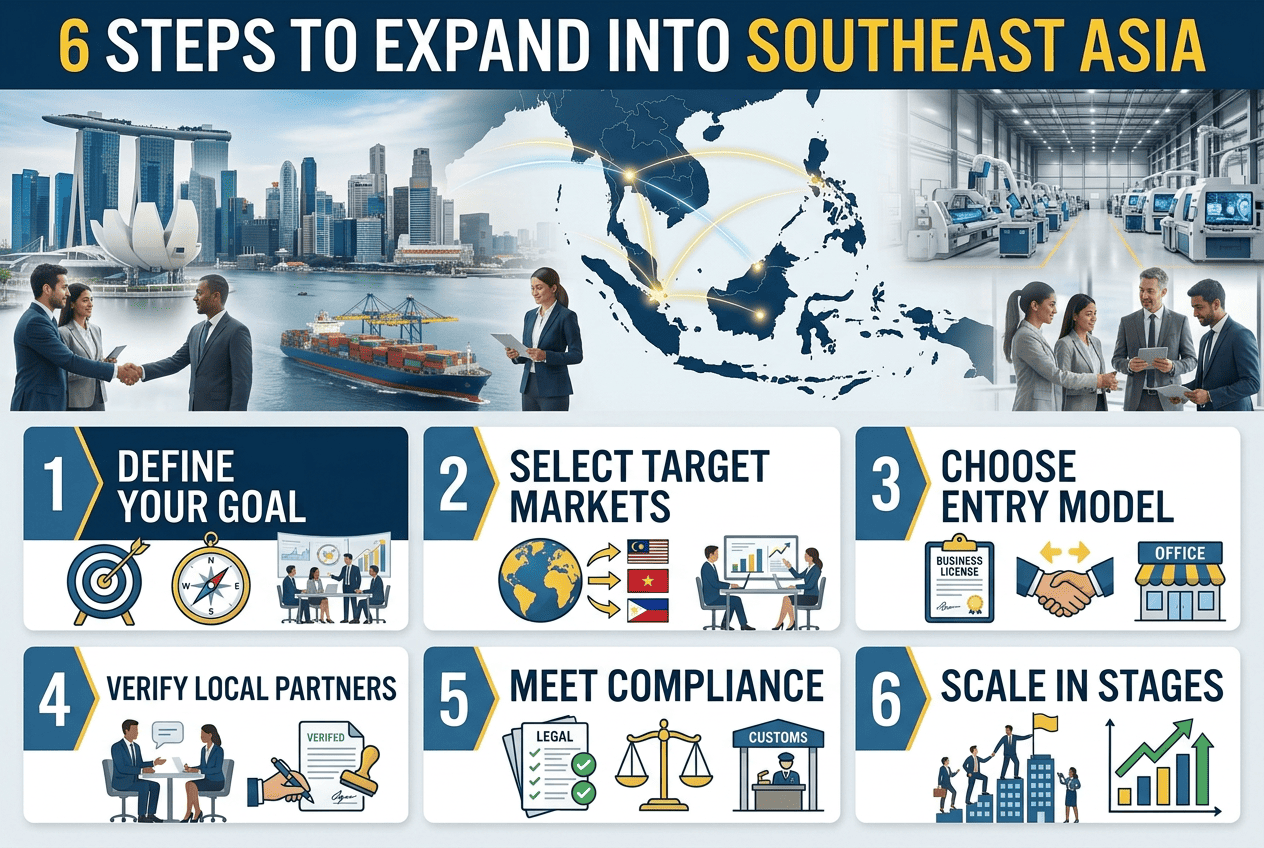
Direct Answer: To expand into Southeast Asia successfully, follow six steps. First, define why you are expanding: new customers, new capabilities or a regional operating base. Second, shortlist one or two markets by scoring demand, competition, regulation, logistics and partner availability, because the region’s ten-plus economies differ widely. Third, pick an entry model: exporting, a local distributor or agent, a joint venture, a regional hub such as Singapore, or your own local entity. Fourth, find and verify local partners before sharing sensitive information. Fifth, handle compliance, certifications, logistics and contracts market by market. Sixth, scale in stages, adding direct presence and local talent as results justify it. Most companies combine partners for fast reach with a small direct team for control. GTsetu helps you find government‑tie‑up verified distributors, manufacturers and partners across 100+ countries, with anonymous discovery, built-in NDA workflows and zero broker commission.
📅 Published October 26, 2026🔄 Updated October 26, 2026⏱ 16 min read✍️ GTsetu Editorial Team
6
Steps to Expand
5
Entry Models Compared
100+
Countries on GTsetu
0%
Broker Commission
Southeast Asia combines a large and young consumer base, fast-growing digital economies, deep manufacturing ecosystems and a position at the centre of Asian trade routes. For manufacturers, exporters and growth-stage companies, it is one of the most attractive regions to expand into, and one of the easiest to get wrong by treating it as a single market.
Manufacturers, exporters, product and service companies, and business development teams planning to sell into, source from or operate in Southeast Asia, including Indian companies looking to build a regional presence.
⚖️ Legal & Compliance Disclaimer
This guide provides general commercial education. It does not constitute legal, tax, immigration or regulatory advice. Company law, foreign ownership rules, licensing, tariffs, incentives and labour rules differ by country and change often. Confirm current requirements with official sources and qualified local advisers before acting.
SECTION 1
1 Why Southeast Asia, and Why Now
🎯 The Opportunity
Southeast Asia is a region of roughly 650 million people across the ASEAN member states, with growing middle-class demand, expanding digital commerce and manufacturing capacity that many global companies use to diversify supply chains. It is also highly diverse: markets differ in size, income, language, regulation and maturity, so a strategy that works in one country rarely transfers unchanged to another.
🛍️
Growing Demand
Rising incomes and urbanisation are expanding demand for industrial, consumer, healthcare and digital products.
🏭
Manufacturing Depth
Several economies offer mature electronics, automotive, food and industrial supply chains and growing industrial parks.
🧭
Supply Chain Diversification
Companies pair or replace single-country production with regional bases to reduce concentration risk.
🌐
Connectivity
Strong regional trade links connect Southeast Asia with India, China, Australia and the wider Asia-Pacific.
SECTION 2
2 Step 1: Define Your Expansion Objective
Before comparing countries, decide what you want the expansion to achieve. The answer shapes the market, the entry model and the budget.
1
Access New Customers
You want revenue growth. Prioritise market size, buyer access, price points and competitive intensity.
Sales-led
2
Build Capabilities
You want talent, technology or production capacity. Prioritise skills, infrastructure and supplier ecosystems.
Capability-led
3
Support Regional Operations
You want a base to coordinate several markets. Prioritise connectivity, legal certainty and tax and talent access.
Hub-led
4
Diversify Supply
You want a second sourcing or production base. Prioritise cost, quality, logistics and supplier reliability.
Resilience-led
Also decide how much speed and flexibility versus long-term depth you want, and which functions you will centralise versus distribute across countries.
SECTION 3
3 Step 2: Choose and Score Your Markets
Do not enter every market at once. Shortlist one or two and score them on the same criteria. Use global market research methods to gather evidence, and treat the table below as a starting hypothesis to test, not a verdict.
Entry models trade off speed, cost, control and risk. Most companies start light and add presence over time.
Export
Direct export
Sell from your home base to local buyers. Lowest commitment, but limited local presence.
Fastest start
Dist.
Distributor / Agent
A local partner sells on your behalf. Fast reach and local relationships, less control.
Fast reach
JV
Joint venture
Share ownership with a local firm. Pools resources and access, but needs strong alignment.
Shared risk
Hub
Regional hub
Anchor HQ and key functions in one base, such as Singapore, and serve the region from it.
Regional control
Entity
Own local entity
Set up a subsidiary or branch in each market. Maximum control and customer ownership, highest cost.
Full control
Dimension
Export / Distributor
JV / Partnership
Hub or Own Entity
Upfront cost
Low
Medium
High
Speed to market
Fast
Medium
Slower
Control
Lower
Shared
Highest
Customer ownership
Often with the partner
Shared
With you
Regulatory exposure
Limited
Shared
Full
Best for
Testing demand and broad reach
Restricted sectors or complex access
Proven markets and strategic accounts
✨ GTsetu Insight
A common pattern is partners for fast reach plus a small direct team for oversight, so you can guide partners and keep strategic accounts. If you are weighing outsourced versus in-house routes, see our guide on international business development consulting.
SECTION 5
5 Using Singapore as a Regional Hub
Many companies base regional headquarters, strategy and IP-sensitive functions in Singapore and serve neighbouring markets from it. Reasons commonly cited include a transparent regulatory framework, fast company incorporation, political stability, strong connectivity and access to skilled talent. Singapore’s Economic Development Board also describes an “SG+ twinning” approach: anchor high-value functions such as HQ, R&D, supply chain management and advanced manufacturing in Singapore, while using nearby locations, for example Johor in Malaysia or the Batam area in Indonesia, for complementary production.
✅ When a Hub Makes Sense
✅ You will serve several markets and need one coordination point.
✅ You hold valuable IP or regional contracts you want under a stable legal system.
✅ You need regional sales leadership, finance or supply chain control.
✅ You plan to split high-value work (design, testing) from lower-cost production nearby.
⚠️ When to Wait
⚠️ You have not yet validated demand in any Southeast Asian market.
⚠️ Your volumes are too small to justify an entity, staff and compliance costs.
⚠️ A hub will not remove local licensing or registration requirements in each country.
⚠️ Local partners can reach your customers more cheaply for now.
📌 A Hub Does Not Replace Local Compliance
A Singapore entity helps with structure and coordination, but products sold in other countries still need to meet those countries’ standards, registrations and import rules. Plan each market’s compliance separately.
SECTION 6
6 Step 4: Find and Verify Local Partners
Partners give you relationships, existing customers and an understanding of local business norms. They are also where most expansion risk sits, so treat selection as a disciplined process.
1
Write a Partner Profile
Define the customers, geography, portfolio fit, sales capacity and financial strength you need before you search.
2
Build a Longlist from Several Channels
Combine trade bodies, chambers, industry associations, trade fairs, competitor analysis, professional networks and verified platforms. See international wholesale distributors.
3
Verify Identity First
Confirm legal name, registered address, registration number and company status against official records before any deeper conversation.
Each market has its own product standards, import procedures, labelling rules and sector licences. Build a country-by-country checklist early, because certification and registration can be the longest items on the critical path.
Confirm HS classification, duties, trade-agreement eligibility and import licences with a customs adviser.
🛡️
IP Protection
Register trademarks and patents locally before launch, since rights are generally territorial.
SECTION 8
8 Contracts and Risk Allocation
Put every relationship in writing, whether a distributor, a contract manufacturer, a service provider or a joint venture. Tailor the contract to local law with local counsel, and cover these areas at minimum.
Area 01
Scope & Territory
Products, markets, channels and any exclusivity, tied to targets and review periods.
Area 02
Pricing & Payment
Currency, payment security, credit terms and consequences of late payment.
Decide up front who carries which risk: currency, delivery, quality, regulatory change and non-payment. Our guide on risk allocation in cross-border deals sets out a practical framework.
SECTION 9
9 Talent, Operations and Culture
Expansion succeeds or fails on people. The region is culturally and economically diverse, so hiring, motivating and managing teams differs from country to country.
Sequence your hires: start with a market lead or business development manager who understands local buyers, then add support roles as revenue grows.
Understand employment frameworks: work-pass rules, hiring routes and employer obligations differ by country. Check official guidance or use an employer-of-record or corporate services provider if you hire before setting up an entity.
Invest in relationships: trust and long-term familiarity often matter more than speed in negotiations, so plan visits, regular calls and clear communication.
Localise carefully: adapt language, packaging, pricing, payment methods and after-sales support for each market.
Keep oversight: combine strong partners with a direct presence so you can guide partners, protect key accounts and learn the market first-hand.
SECTION 10
10 Step 6: A 12-Month Expansion Roadmap
Timelines vary by sector and market, but a staged plan with clear milestones keeps spending proportional to evidence.
1
Months 1–2: Objective, Research and Shortlist
Set the objective, collect market data, score countries and choose one or two priority markets with a target customer profile.
2
Months 2–4: Compliance Mapping and Partner Discovery
Map certifications, registrations and import rules. Build and verify a partner longlist and begin NDA-protected conversations.
3
Months 4–6: Pilot Agreements and First Shipments
Sign pilot contracts with defined targets, complete registrations, agree Incoterms and ship first orders.
4
Months 6–9: Review and Reinforce
Review pipeline, sales, customer feedback and partner performance. Add a market lead or small direct team where results justify it.
5
Months 9–12: Decide on Scale-Up
Choose whether to extend partner territory, open a local entity or hub, enter a second market, or adjust the approach based on evidence.
SECTION 11
11 Common Mistakes to Avoid
⚠️ Frequent Errors
⚠️Treating the region as one market: ignoring differences in regulation, language and buyer behaviour.
⚠️Entering too many countries at once: stretching resources thin.
⚠️Signing the first willing partner: skipping verification and references.
⚠️Granting exclusivity without targets: locking up a market with an inactive partner.
⚠️Neglecting IP registration: leaving trademarks exposed to local squatting.
✅ Better Practice
✅Start narrow: prove one or two markets before expanding.
✅Verify first: check identity, references and capability independently.
✅Pilot, then scale: link rights to results and review dates.
✅Protect IP early: register before you launch and use NDAs.
✅Keep local oversight: pair partners with your own market lead.
12 How GTsetu Helps You Expand Into Southeast Asia
🌐 Platform Spotlight, GTsetu
Your Verified Gateway to Southeast Asian Partners
The hardest part of expansion is often the first step: finding partners who exist as described and sharing sensitive information safely. GTsetu connects businesses with government‑tie‑up verified distributors, manufacturers and partners across 100+ countries, with built-in NDA workflows and encrypted collaboration. Every company on GTsetu is verified through direct government tie‑ups across six credentials: legal name, registered address, registration number, company status, company type, and date of certificate of incorporation. GTsetu does not verify industry certifications, product licences, sales capability, references or financial standing; those must be checked directly between partners during due diligence.
✅
Government Tie‑Up Verification
6‑point verification: legal name, registered address, registration number, company status, company type, incorporation date.
📜
Certifications & Licences
GTsetu does not verify these. Validate them directly with issuers and authorities.
🕵️
Anonymous Discovery
Explore partner profiles without revealing your identity until mutual interest is confirmed.
📄
Built-In NDA Workflow
Formalise confidentiality before sharing pricing, specifications or strategy, with a full digital audit trail.
🚫
Zero Commission
No broker fees on any deal, whether a distribution agreement, supply contract or joint venture.
🔐
Encrypted Collaboration
Documents and communications encrypted in transit and at rest. Secure B2B collaboration from first contact.
🌍
100+ Countries
A verified network of distributors, manufacturers and supply chain partners.
QWhat is the best way to expand into Southeast Asia?
There is no single best way. Most companies start by defining why they are expanding, shortlist one or two priority markets, test demand through a local distributor or partner, and then add a direct presence such as a Singapore regional hub or a local entity as volumes grow. The right sequence depends on your product, budget, regulatory exposure and appetite for control.
QWhich Southeast Asian country should I enter first?
Choose based on your objective rather than market size alone. Singapore suits a regional hub and IP-sensitive functions, while larger consumer markets suit volume sales and manufacturing-oriented markets suit production. Score each country on demand, competition, regulation, logistics, partner availability and cost before deciding.
QWhy do companies use Singapore as a regional hub?
Singapore offers a transparent regulatory framework, quick company incorporation, strong connectivity to regional markets, and a skilled workforce. Many companies base headquarters, strategy and IP-sensitive functions there and serve neighbouring markets from it, sometimes pairing it with lower-cost manufacturing nearby.
QShould I use a distributor or set up my own entity?
A distributor offers faster, lower-cost market access and local relationships but gives you less control. Your own entity offers control and customer ownership but requires more capital, hiring and compliance. Many companies combine both: distributors for broad coverage and a direct team for strategic accounts.
QHow do I protect my business when working with local partners in Southeast Asia?
Verify the partner’s legal identity, check references and financial standing independently, sign an NDA before sharing sensitive information, register your intellectual property locally, and agree territory, performance targets, payment terms, warranties, termination and dispute resolution in a written contract reviewed by local counsel.
QHow long does it take to expand into Southeast Asia?
Timelines vary widely. Research, shortlisting and partner discovery commonly take a few months. Signing a partner, completing registrations and shipping first orders can take several more months. Building a direct presence and a repeatable sales pipeline typically takes a year or more, so plan in stages and set milestones.
QHow does GTsetu help with expanding into Southeast Asia?
GTsetu helps businesses find and verify distributors, manufacturers and partners across 100+ countries. Every company is verified through government tie-ups on six core credentials (legal name, registered address, registration number, company status, company type, incorporation date). GTsetu offers anonymous discovery, built-in NDA workflows, encrypted collaboration and zero broker commission. GTsetu does not verify certifications, financial standing, sales capability or market licences, so those must be checked directly between partners.
Ready to Find Verified Partners in Southeast Asia?
Join 500+ verified manufacturers, exporters and distributors already building cross-border partnerships on GTsetu, with government‑tie‑up verification of six core credentials, built-in NDA workflows and zero broker fees across 100+ countries.
They represents the product, and research team behind GTsetu, a global B2B collaboration platform built to help companies explore cross-border partnerships with clarity and trust. The team focuses on simplifying early-stage international business discovery by combining structured company profiles, verification-led access, and controlled collaboration workflows.
With a strong emphasis on trust, and disciplined engagement, Team GTsetu shares insights on global trade, partnerships, and cross-border collaboration, helping businesses make informed decisions before entering deeper commercial discussions.