How to Find International OEM Customers Online (2026 Guide) | GTsetu
Home ›
Blog ›
How to Find International OEM Customers Online
⚙️ Global Trade & Exporting
How to Find International OEM Customers Online
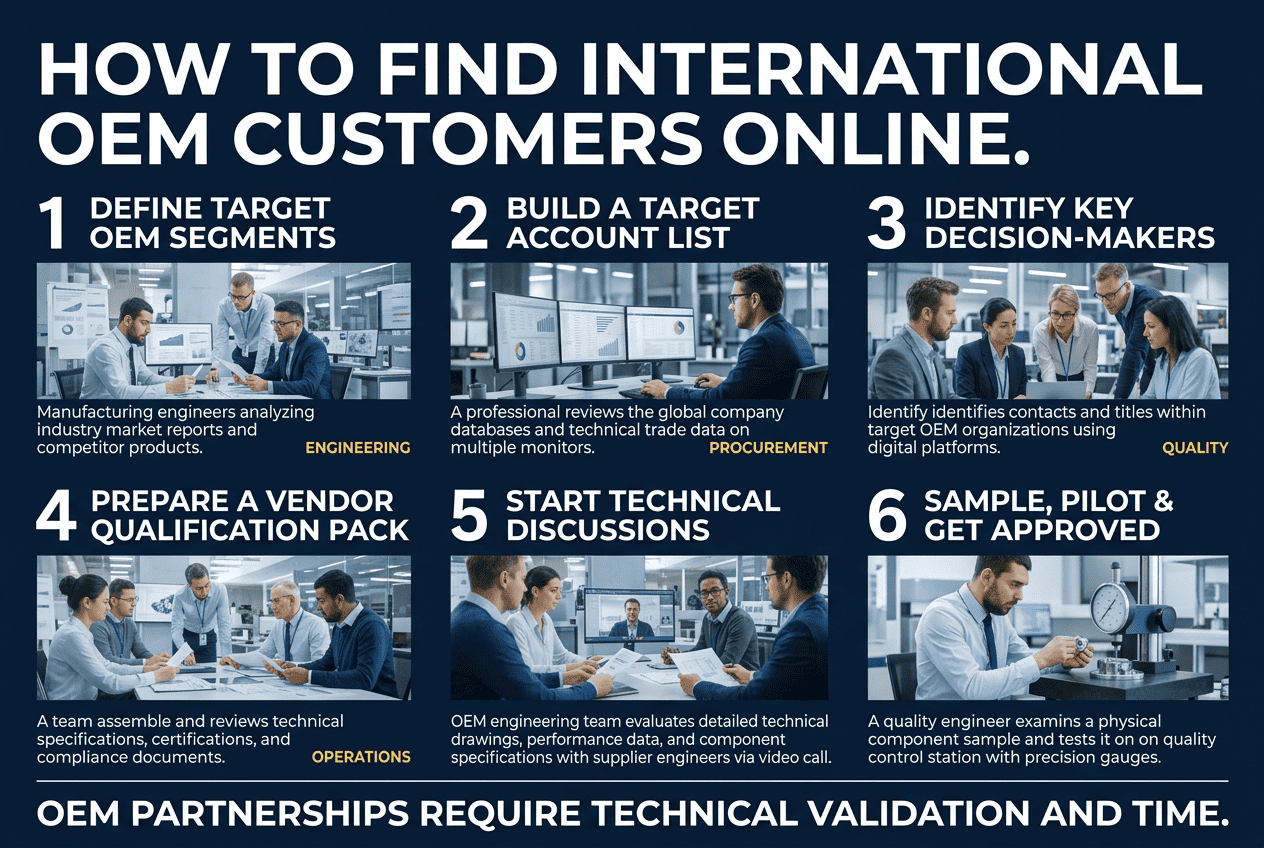
Direct Answer: To find international OEM customers online, treat it as a research-and-qualification process, not a mailing-list exercise. First, define the OEM segments where your product or capability genuinely fits. Second, build a scored target account list from marketplaces, directories, exhibitor lists, trade data and professional networks. Third, map the buying group (engineering, procurement, quality, operations and leadership). Fourth, prepare a vendor qualification pack (company profile, datasheets, certifications, capacity and references). Fifth, approach with application-specific outreach that aims for a technical discussion rather than an instant order. Finally, run samples and a pilot, complete vendor registration and move toward approved-supplier status. OEM cycles often include technical validation and production approval, so expect months, not days. Along the way, verify every prospect’s legal identity. GTsetu helps you find government‑tie‑up verified manufacturers, importers and partners across 100+ countries, with built-in NDA workflows and zero broker commission.
📅 Published October 28, 2026🔄 Updated October 28, 2026⏱ 15 min read✍️ GTsetu Editorial Team
6
Online Channels Compared
6
Steps: Target List to Approved Supplier
100+
Countries on GTsetu
0%
Broker Commission
OEM customers are among the most valuable buyers a manufacturer can win. They order repeatedly, build your product into their own, and often stay for years once you are approved. They are also among the hardest buyers to reach: engineering teams do not respond to mass emails, procurement teams need qualified suppliers, and quality departments want evidence before they say yes.
Component, material and subassembly manufacturers, contract and private-label manufacturers, and engineering or industrial exporters, including Indian manufacturers, who want to supply international OEMs and brands rather than sell only through distributors.
⚖️ Editorial & Compliance Disclaimer
GTsetu is itself a verified partner network, so we have a commercial interest in this topic. We have tried to describe every channel fairly, but platform features and verification practices change often. Several sources we drew on are vendor or consultancy blogs. This guide is general commercial education, not legal, tax or compliance advice. OEM requirements differ by company and industry, so always confirm each target’s specific vendor requirements before investing in documents, samples or customisation.
SECTION 1
1 What Is an OEM Customer?
🎯 Definition
An OEM (original equipment manufacturer) customer is a company that buys components, materials, subassemblies or finished products to build into, or sell under, its own branded products. For a supplier, OEM customers place repeat, specification-driven orders and typically qualify suppliers through technical and quality checks before awarding business.
The term is used in two overlapping ways, so be clear which one you mean before you search.
🔩
Component Supply to OEMs
You make parts, materials or subassemblies that an OEM incorporates into its own equipment, vehicles or machines.
🏷️
OEM / Private-Label Manufacturing
You manufacture a finished product to a brand’s specification, which the brand sells under its own name.
🎨
ODM (Original Design Manufacturing)
You design and build the product, and the brand puts its label on it. More design responsibility, and often more margin.
🔧
Aftermarket & Replacement Parts
A related but different channel: parts sold for replacement rather than first-fit. Qualification and buyers differ from OEM supply.
✨ GTsetu Insight
OEM relationships are long-term partnerships, not transactions. Before you invest in a pursuit, assess whether the buyer is a good partner using our partnership evaluation criteria and the commercial due diligence guide.
SECTION 2
2 Six Online Channels at a Glance
Each channel helps with a different part of the problem. Here is the full menu in a single view.
B2B Marketplaces
Inbound visibility
List your capabilities and let buyers find you, or respond to buyer requests for quotation.
🛒 Visibility
Industrial Directories
Regional focus
Searchable databases of manufacturers and buyers by region and industry.
🗂 Focus
Trade Data
Proof of buying
Shipment records revealing companies that already import your category, and from whom.
📊 Targeting
Professional Networks
Decision-makers
Find and approach engineers, buyers and quality leads directly with relevant messages.
📨 Access
Official & Trade Fair Services
Credibility
Government partner searches, exhibitor lists and missions that add vetting and introductions.
🏛 Official
Verified Partner Networks
Identity first
Discover companies whose legal identities are confirmed, then collaborate under NDA.
✅ Trust
SECTION 3
3 Step 1: Define Segments & Build a Target Account List
Start with research, not outreach. OEMs are not one market, and a broad manufacturer list wastes time. Group prospects by end industry, such as automotive and EVs, industrial machinery, electronics, energy equipment, medical devices, aerospace, process equipment and infrastructure manufacturing, then test where your product has a real application fit.
1
Define Application Fit
State exactly what problem your product solves for an OEM: performance, cost, weight, durability, compliance or supply-chain risk. Market size alone does not establish fit; a high-volume segment can be a poor match for a specialist product with a long qualification cycle. See global market research for manufacturers.
Draw from industry associations, exhibitor lists, supplier directories, trade publications, annual reports, import and export data, cluster databases and professional networks. Record plants, product lines, processes, likely bought-in components, visible suppliers, expansion news and key contacts.
4
Score and Prioritise
Rank accounts on buying readiness, not contact volume, using a simple scorecard like the one below.
Scoring Criterion
What to Ask
Example Score (out of 5)
Application Fit
Does our product match what this OEM builds?
5 = direct fit, 1 = tenuous
Decision-Maker Access
Can we identify and reach engineering, sourcing and quality contacts?
5 = named contacts, 1 = generic inbox
Qualification Path
Are the vendor requirements realistic for us?
5 = already meet them, 1 = major gaps
Commercial Potential
Do realistic volume, value and margin justify the effort?
5 = high and recurring, 1 = marginal
Timing Signals
Is there a new plant, product launch or supplier change creating an opening?
5 = clear trigger, 1 = none
Illustrative scorecard adapted from common OEM account-planning practice. Adjust the criteria and weighting to your product and industry.
✨ GTsetu Insight
A 25-point scorecard turns a long list into a short, defensible pursuit plan: for example, call accounts scoring 20 and above first, nurture the middle band and monitor the rest. India’s industrial and technology clusters illustrate how regional ecosystems concentrate OEM demand; see Maharashtra’s FTI and the future of quantum technology in Pune.
SECTION 4
4 Step 2: B2B Marketplaces & Directories
Marketplaces and directories help buyers find you and give you a searchable presence. They work best for catalogue and made-to-specification products, and less well for highly engineered, long-cycle components, where direct outreach matters more.
Platform
Typically Strongest In
How It Helps OEM Prospecting
Watch Points
Alibaba
Global, Asia-heavy
Millions of buyers; sellers can list products and earn a verified status
Crowded; many inquiries are price-driven
Global Sources
Electronics and consumer goods
Buyers seeking suppliers, often for private-label and OEM products
Concentrated on certain categories
Tradewheel
Global wholesale
RFQ pages let you see buyer requirements and tune your listings
Emerging platform; vet each lead
ThomasNet
North America, industrial
Industrial directory used by North American buyers for supplier discovery
Regional focus
Europages
Europe
Company profiles with certifications and export capabilities; useful for manufacturing and machinery
Europe-focused
IndiaMART
India
Reaches Indian buyers and wholesalers; relevant for Indian OEM supply
Mostly domestic-driven demand
EC21
Industrial, electronics, machinery
Membership tiers include verified exporter status
Quality of leads varies
Summarised from a Global Trade Magazine roundup and other public descriptions. We have omitted the roundup’s numerical ratings because their basis is not stated. Features change, so check each platform’s current terms.
Make Your Listing OEM-Ready
📐
Specifications, Not Slogans
Show materials, tolerances, standards, capacity and typical applications. Engineers search for specifications, not adjectives.
Photos, process descriptions, test equipment and capacity data build credibility with quality teams.
⚡
Fast, Technical Replies
Respond to inquiries quickly with a named engineer or sales contact and concrete next steps.
SECTION 5
5 Step 3: Trade Data, Professional Networks & Official Services
1
Trade Data Platforms
Platforms such as Volza and others compile shipment records so you can search buyers, suppliers and shipment histories by product, country and volume. They show who already imports your category and from whom, a strong signal of buying intent. Records show activity, not suitability.
Best for: finding active importers
2
Professional Networks & Company Research
Use professional networks, company websites, annual reports and exhibitor lists to find named engineers, buyers and quality leads, rather than a generic inbox. Contact several functions at each account.
Best for: reaching decision-makers
3
Government & Trade Body Services
Export promotion agencies offer partner searches, company background reports and matchmaking. For example, the U.S. Commercial Service runs a partner-search service, a Gold Key matching service and a company profile report, and many countries have equivalents.
Best for: credible introductions
4
Trade Fairs & Exhibitor Lists
Even if you cannot attend, exhibitor and visitor lists reveal which OEMs and suppliers are active in your segment. Attending lets you meet engineers and procurement leads face to face.
Best for: relationships
📌 Outsourcing the Legwork
Some companies bring in specialists to research accounts, run outreach and support local sales. If you consider this, evaluate the provider’s independence, track record and fees. See our overview of international business development consulting.
SECTION 6
6 Step 4: Map the OEM Buying Group
OEM purchasing decisions are rarely owned by one person. Technical approval, supplier qualification and commercial sign-off often follow separate paths, so identify each stakeholder early and speak to what each cares about.
📐
Engineering / Design
Evaluates application fit, performance, drawings, specifications and validation. Often the champion. Lead with technical relevance and test data.
🧾
Sourcing / Procurement
Runs supplier discovery, RFQs, commercial comparison and onboarding. Show supplier readiness, pricing structure and delivery terms.
✅
Quality
Reviews quality systems, inspection methods, certifications and corrective-action capability. Provide process-control evidence and audit readiness.
🏭
Plant / Operations
Assesses manufacturability, delivery reliability, installation, service and production impact. Show responsiveness and continuity planning.
💼
Finance / Leadership
May approve strategic suppliers, capital purchases or localisation decisions. Frame the business case, risk reduction and total cost.
✨ GTsetu Insight
OEMs increasingly ask suppliers about resilience as well as price. Business continuity credentials such as ISO 22301 certification can reassure operations and quality teams that you will keep delivering when disruption hits.
SECTION 7
7 Step 5: Prepare for Vendor Qualification
Outreach only works if you can pass the checks that follow first contact. Prepare a standard qualification pack before you start, then confirm what each target actually requires. Requirements differ by OEM, so treat the list below as a planning checklist, not a universal rule.
1
Company & Commercial Documents
Legal entity details, tax and banking information, company profile, ownership structure and compliance declarations as requested.
Identity & legitimacy
2
Technical Documents
Datasheets, application notes, drawings, test reports and material specifications relevant to the OEM’s use.
Technical proof
3
Quality Evidence
Certifications, inspection methods, quality manuals, test capability and corrective-action procedures. For example, food-contact or sanitary equipment may require NSF sanitation certification.
Process control
4
Capacity & Supply History
Manufacturing capability and capacity summary, permitted reference projects and supply history, so the OEM can assess delivery risk.
Delivery confidence
5
Local Readiness (for Foreign Suppliers)
Define response times, sample availability, import handling, warranty obligations, service support and payment terms. Local credibility is shown by responsiveness, not just an address.
Execution capability
6
Typical Vendor Registration Flow
Screening, document review, possibly a plant audit and sample or trial-part evaluation, then vendor-code creation and permission to receive RFQs. Timelines vary by OEM.
Approval path
SECTION 8
8 Step 6: Outreach, Samples & Trials
The goal of first contact is a technical conversation, not a purchase order. Reference a specific application, production constraint or expansion initiative so the message is clearly relevant.
1
Send a Concise, Relevant Message
Name the OEM’s product line or application, state in one line what problem you can solve, and propose a short technical discussion. Avoid generic brochures and long attachments.
2
Hold a Technical Discovery Call
Understand their specification, volumes, qualification requirements, approval timeline and current suppliers. Ask who else must approve.
3
Agree Samples and a Pilot Plan
Define success criteria upfront: performance, quality, compatibility, cost impact, cycle time and delivery reliability. Name the evaluation owners and a review date. Agree delivery terms for samples using Incoterms 2020, for example FCA (Free Carrier).
4
Support the Trial and Respond to the RFQ
Offer engineering support during evaluation, record technical concerns and decision criteria, then submit a clear, complete quotation.
5
Complete Onboarding and Approval
Finish vendor registration, negotiate commercial terms and move toward approved-supplier status, then develop the account with regular reviews.
📌 Do You Need a Distributor?
For strategic OEM accounts that need technical selling and close engineering contact, direct sales often works best. For smaller orders, wider geographic coverage, local inventory or service support, a distributor can help. Read about international wholesale distributors to choose the right route per account.
SECTION 9
9 Comparing Channels & Choosing Your Mix
Channel
Best For
Verification
Effort
Main Limitation
B2B Marketplaces
Catalogue and made-to-spec products
Varies by tier
Low to medium
Crowded; price-driven inquiries
Industrial Directories
Regional, industry-specific discovery
Some badges check business details
Low
Narrow regional coverage
Trade Data
Finding active importers
Shipment history, not trustworthiness
Medium
Records show activity, not fit
Professional Networks
Reaching named decision-makers
None automatically
High
Time-intensive, needs good messaging
Official & Trade Fair Services
Credible introductions
Often vetted by officials
Medium to high
Periodic; cost and travel
Verified Partner Networks
Trusted, confidential first contact
Legal identity (GTsetu: six government-sourced credentials)
Low to medium
Does not verify capability or credit
🧭 Quick Guide: Which Channel Should You Start With?
Catalogue or private-label product?
Marketplaces + RFQs
Volume
Respond fast to buyer requests and optimise listings.
Highly engineered component?
Target list + direct outreach
Precision
Use research and technical messaging with named contacts.
Know your category but not the buyers?
Trade data
Targeting
Find companies already importing your product code.
Need credibility in a new country?
Official services + fairs
Credibility
Use partner searches, exhibitor lists and missions.
Worried about fraud or IP exposure?
Verified network + NDA
Protection
Confirm legal identity and sign confidentiality first.
Limited team capacity?
Focus on top-scoring accounts
Focus
Pursue ten great accounts rather than a hundred weak ones.
SECTION 10
10 Verifying Genuine OEM Customers & Red Flags
Not every inquiry labelled “OEM” is genuine. Before you share drawings, ship samples or quote tooling, run these checks.
1
Confirm Legal Existence
Match company name, registration number and registered address to the official registry of its country, and confirm the status is active.
Registry check
2
Check That the Business Makes Sense
Does the company really build products that would use yours? Check its website history, product range, plants and trade records for consistency.
Plausibility
3
Speak to Named Contacts
Hold video calls with named engineering or procurement contacts and confirm their roles through independent sources.
Human verification
4
Ask for References and Reports
Request trade references and consider a credit or background report before large commitments. Start with samples or a pilot order on secure payment terms.
Third-party proof
🚩
Upfront Fees to “Qualify”
A buyer asking you to pay registration, sample or inspection fees before any order is a classic fraud signal.
🚩
Requests for Designs Without an NDA
Pressure to send drawings or process details before confidentiality is in place can mean IP harvesting.
🚩
Vague Specifications
No clear application, volumes or timeline suggests a fishing exercise rather than a real programme.
🚩
Free Samples as the Only Goal
Repeated sample requests with no movement toward trials, RFQs or vendor registration deserve scrutiny.
SECTION 11
11 OEM Contracts & Terms That Protect You
OEM relationships involve specifications, tooling, intellectual property and long-term volumes. A clear agreement turns a promising trial into protected supply.
Clause 01
Master Services Agreement
A framework for ongoing supply, specifications, forecasting and service levels. See the MSA guide.
Clause 02
Warranty
Defines quality commitments, duration and remedies for non-conforming parts. See warranty clause.
Who owns designs, moulds and tooling, and what happens if the relationship ends?
⚠️
Exclusivity & Non-Compete
Limits on selling similar products to others should be narrow, time-bound and priced accordingly.
⚠️
Forecasts & Minimums
Non-binding forecasts can leave you with unused capacity; agree minimums or compensation for stranded stock.
⚠️
Quality Agreements & Change Control
Specify acceptance criteria, audit rights and how engineering or process changes are approved.
✨ GTsetu Insight
Settle who bears which risk before production begins. Our guide on risk allocation in cross-border deals explains how to allocate responsibility for delays, defects and policy shocks across borders.
SECTION 12
12 How GTsetu Helps You Find OEM Partners
🌐 Platform Spotlight, GTsetu
Your Verified Gateway to OEM Customers and Partners
OEM relationships run on trust. GTsetu connects manufacturers, exporters, importers and distributors with government‑tie‑up verified partners across 100+ countries, with built-in NDA workflows and encrypted collaboration. Every company on GTsetu is verified using direct government tie‑ups across six essential credentials: legal name, registered address, registration number, company status, company type, and date of certificate of incorporation. GTsetu does not verify industry certifications, production capacity, product quality or financial standing; those must be exchanged and validated directly between partners.
✅
Government Tie‑Up Verification
6‑point verification: legal name, registered address, registration number, company status, company type, incorporation date.
📜
Certifications & Capacity
GTsetu does not verify these. They must be exchanged directly between partners during due diligence.
🕵️
Anonymous Discovery
Explore verified manufacturer and buyer profiles without revealing your identity until mutual interest is confirmed.
📄
Built-In NDA Workflow
Formalise confidentiality before sharing drawings, specifications, pricing, or proprietary information, with a full digital audit trail.
🚫
Zero Commission
No broker fees on any deal, whether a supply contract, distribution agreement, or technology partnership.
🔐
Encrypted Collaboration
All documents and communications encrypted in transit and at rest. Cross-border partnerships from first contact.
🌍
100+ Countries
Active verified network of manufacturers, importers and supply chain partners.
An OEM (original equipment manufacturer) customer is a company that buys components, materials, subassemblies or finished products to build into, or sell under, its own branded products. For a supplier, OEM customers are manufacturers who place repeat, specification-driven orders rather than one-off purchases.
QHow do I find international OEM customers online?
Define the OEM segments where your product fits, build a scored target account list from directories, exhibitor lists, trade data and professional networks, map the engineering, procurement and quality contacts at each account, prepare a vendor qualification pack, and approach with application-specific outreach that leads to a technical discussion, samples and a trial.
QWho makes buying decisions at an OEM?
Decisions are usually shared. Engineering or design evaluates technical fit, procurement runs RFQs and commercial terms, quality approves the supplier and its processes, operations assesses delivery and production impact, and finance or senior leaders may approve strategic suppliers. The exact group depends on the product and the value at stake.
QWhat is OEM vendor qualification?
Vendor qualification is the OEM’s process of screening and approving a new supplier. It typically asks for company, tax and banking details, quality documentation and certifications, capacity information, supply history and compliance declarations, and may include a plant audit, sample evaluation and vendor-code creation before the supplier can receive RFQs. Requirements and timelines vary by OEM.
QHow long does it take to win an OEM customer?
OEM sales cycles are often longer than ordinary B2B sales because they can include technical validation, supplier onboarding, commercial negotiation and production approval. Timelines depend on the product, industry and the OEM’s own requirements, so plan for months rather than weeks and agree milestones in advance.
QHow can I tell if an OEM buyer is genuine?
Verify the company’s legal registration and address in official registries, check that its website, product line and trade history are consistent, speak with named engineering or procurement contacts, ask for references, and be wary of requests for upfront fees or pressure to skip due diligence. Start with samples or a pilot order on protected terms.
QHow does GTsetu help find international OEM customers?
GTsetu connects manufacturers, exporters, importers and distributors with government-tie-up verified partners across 100+ countries. Verification covers six core credentials (legal name, registered address, registration number, company status, company type, incorporation date). GTsetu also offers anonymous discovery, built-in NDA workflows, encrypted collaboration and zero broker commission.
Ready to Find Verified OEM Customers and Partners?
Join 500+ verified manufacturers, exporters, and importers already building cross-border partnerships on GTsetu, with government‑tie‑up verification of six core credentials, built-in NDA workflows, and zero broker fees across 100+ countries. Start building your OEM pipeline today.
They represents the product, and research team behind GTsetu, a global B2B collaboration platform built to help companies explore cross-border partnerships with clarity and trust. The team focuses on simplifying early-stage international business discovery by combining structured company profiles, verification-led access, and controlled collaboration workflows.
With a strong emphasis on trust, and disciplined engagement, Team GTsetu shares insights on global trade, partnerships, and cross-border collaboration, helping businesses make informed decisions before entering deeper commercial discussions.