How to Find Trustworthy Manufacturers Overseas: A Step-by-Step Vetting Guide (2026) | GTsetu
Home ›
Blog ›
Find Trustworthy Manufacturers Overseas
🏭 Manufacturing & Sourcing
How to Find Trustworthy Manufacturers Overseas: A Step-by-Step Vetting Guide
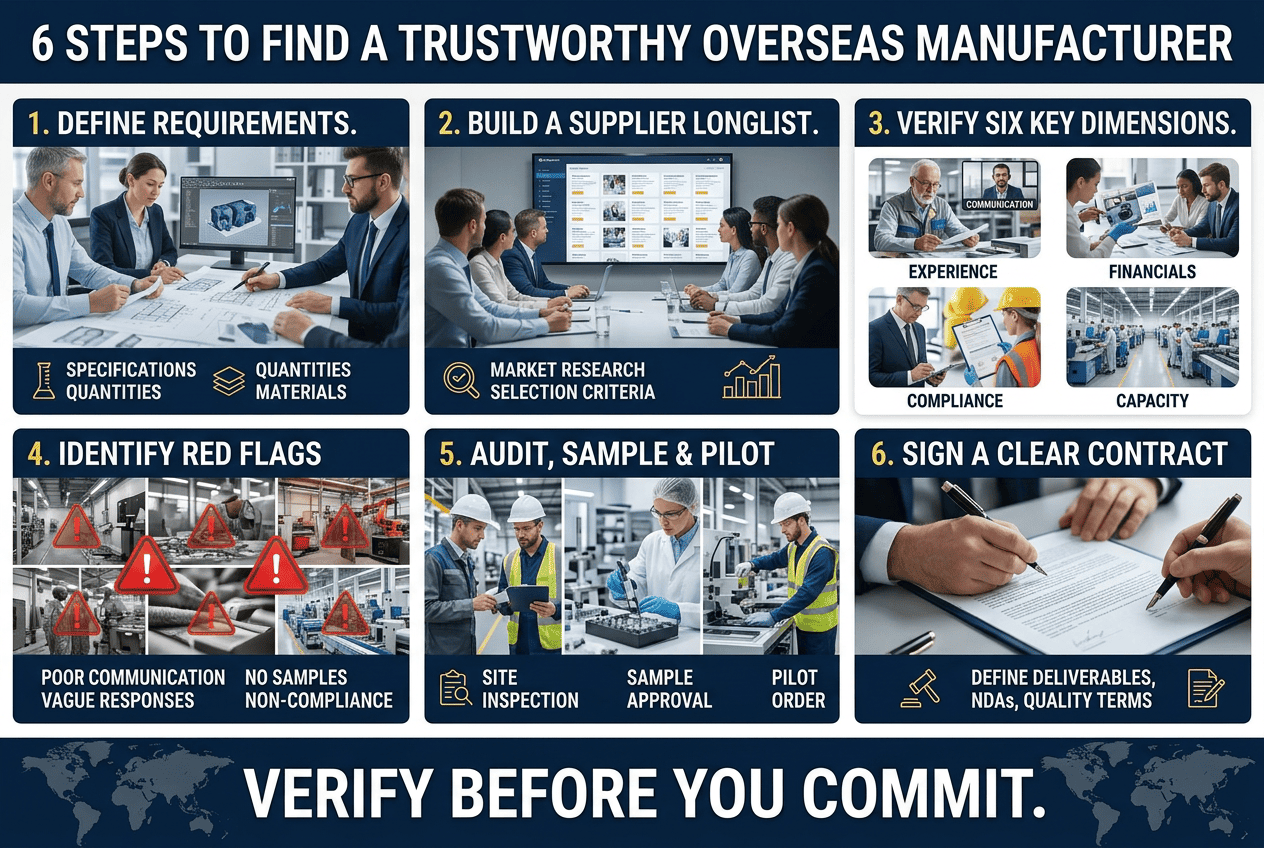
Direct Answer: To find a trustworthy overseas manufacturer, follow six steps. First, write a clear requirements pack (specifications, volumes, tolerances, standards and target landed cost). Second, build a longlist from several channels such as verified platforms, trade fairs, associations, government bodies and referrals. Third, vet each candidate on six dimensions: experience, communication, quality systems, financial standing, compliance and capacity, and verify claims independently. Fourth, watch for red flags like prices far below market or refusal of audits. Fifth, audit, sample and pilot before committing. Sixth, sign a written contract covering quality, delivery, Incoterms, warranty, IP and termination. GTsetu helps you find government‑tie‑up verified manufacturers and partners across 100+ countries, with anonymous discovery, built-in NDA workflows and zero broker commission.
📅 Published October 28, 2026🔄 Updated October 28, 2026⏱ 16 min read✍️ GTsetu Editorial Team
6
Vetting Dimensions
4–8
Weeks for Thorough Vetting
100+
Countries on GTsetu
0%
Broker Commission
Moving production overseas can cut costs and open capacity, but one bad supplier can erase a year of profit. A polished website says nothing about whether a factory can make your part, at your quality, on time. Trust has to be built from evidence: verified identity, proven capability, transparent communication and a contract that protects you if things go wrong.
Founders and product companies outsourcing production, procurement and sourcing managers adding a second source, and manufacturers looking for contract-manufacturing or component partners in another country.
⚖️ Disclaimer
This guide provides general commercial education and is not legal, tax or regulatory advice. Timelines, costs and requirements vary by product, country and supplier. Contract, IP, customs and tariff rules differ by jurisdiction and change often, so take advice from qualified professionals before you sign.
SECTION 1
1 Why Finding a Trustworthy Manufacturer Is Hard
🎯 Definition
A trustworthy overseas manufacturer is one that is who it says it is, can make your product to specification at scale, communicates honestly when problems arise, and is financially and legally stable enough to honour its commitments.
Most failures come from a handful of causes. Supplier claims go unverified. Specifications are misunderstood across language and time-zone gaps. Quality is checked only after goods are shipped. Contracts leave remedies vague. And buyers choose on unit price alone instead of total landed cost.
🎭
Unverified Claims
Directories and websites show what a supplier says about itself. They do not prove it can produce your part at scale.
🗣️
Communication Gaps
A misunderstood tolerance can delay a launch. Precise specifications and regular updates matter as much as price.
📉
Quality Escapes
Your customers blame you, not the factory, if products fail. Quality systems must exist before the first order.
⚖️
Compliance & Logistics Risk
Tariffs, classification mistakes, port disruption and regional politics can strand inventory and trigger penalties.
SECTION 2
2 Step 1: Define Your Requirements Pack
You cannot judge a manufacturer against criteria you have not written down. Prepare a requirements pack before you contact anyone. It speeds up quotes, makes candidates comparable and shows suppliers you are serious.
1
Product Specification
Drawings or CAD, materials, tolerances, finishes, packaging and labelling, plus what is critical to quality.
Unambiguous & versioned
2
Volumes & Timeline
Prototype, pilot and production quantities, required lead times and how demand may grow. For process fit, see our guide to manufacturing process selection.
Now and in 24 months
3
Standards & Certifications
Quality systems, product certifications and regulatory approvals required in your market.
Non-negotiables first
4
Target Landed Cost
Work back from your selling price to the maximum landed cost, including freight, duty and inspection.
Not just unit price
5
IP & Confidentiality Needs
What is proprietary, what you will share and what must stay in-house or be split across suppliers.
Share only what is needed
6
Partner Profile
Size, location, language, existing customers and willingness to scale alongside you.
Fit, not just capability
SECTION 3
3 Step 2: Where to Find Overseas Manufacturers
No single channel is enough. Combine several to build a longlist of 10 to 20 candidates, then verify each one independently.
1
Verified Partner Platforms
Platforms such as GTsetu let you discover companies whose legal identity has been checked against government sources, so you spend your time on capability and fit instead of basic existence checks.
2
Trade Fairs & Industry Associations
Exhibitor lists and member directories help you meet many suppliers quickly and compare their equipment, samples and customers face to face.
3
Government Trade Bodies & Chambers
Export promotion agencies, embassies and chambers of commerce can introduce suppliers and explain local rules. Treat them as one input, not a substitute for due diligence.
4
B2B Marketplaces & Professional Networks
Useful for volume of options, but quality varies widely. Verify every profile and ask for references you can call yourself.
5
Referrals & Competitor Mapping
Ask peers and existing suppliers who they trust, and study who makes comparable products. Our guide on how to research competitors in a foreign market shows how to map supply and distribution.
6
Sourcing Agents & Consultants
Help can speed things up and bridge language and distance, but check their fees, incentives and independence. Compare options in our guide to international business development consulting.
✨ GTsetu Insight
If you also need a sales channel in the same country, read about international wholesale distributors. Many companies find a manufacturing partner and a distribution partner in the same market, with different qualification criteria for each.
SECTION 4
4 Step 3: The Six-Dimension Vetting Framework
🎯 The Rule
Judge candidates on evidence, not promises. Score every candidate against the same six dimensions, and match the depth of due diligence to the money and risk involved. For a structured approach, see our guides on commercial due diligence and partnership evaluation criteria.
🏭
1. Proven Industry Experience
A history of making products like yours. Ask for case studies, engineering samples and historical defect rates.
💬
2. Transparent Communication
Prompt, honest updates, including bad news. Test responsiveness and technical English or a shared working language early.
✅
3. Robust Quality Assurance
Documented processes, incoming-material checks, in-line inspection, calibration and corrective-action records.
🏦
4. Financial Stability & Scale
Cash flow and equipment to grow with you. Struggling suppliers may cut corners on materials or labour.
Spare capacity, willingness to prioritise you, and compatibility with your growth plans and values.
📌 Sector-Specific Checks
Some sectors need extra evidence. A supplier of food-contact or hospitality equipment may need to show sanitation standards (see how to get NSF sanitation certification), and a supplier that holds your stock or tooling should be able to show continuity planning (see how to get ISO 22301 certification). Ask for certificates and verify them with the issuer.
SECTION 5
5 The Verification Checklist
Use this table to turn each claim into something you can check. If a supplier will not support a check, treat that as information.
What to Verify
How to Verify
Legal identity
Legal name, registered address, registration number, company status and incorporation date against official registries or a verified platform
Real facility
Site visit, third-party audit or live video walkthrough; match address and equipment to what was claimed
Production capability
Samples, machine lists, process capability data and similar parts already produced
Customer references
Call at least two existing customers in a comparable category; ask about defects, delays and how problems were handled
Certifications
Confirm validity, scope and expiry directly with the issuing body, not from a PDF alone
Financial health
Trade references, financial statements or credit reports, proportionate to your exposure
Compliance record
Environmental, labour and export compliance; public enforcement records where available
SECTION 6
6 Step 4: Red Flags to Recognise Early
None of these is automatically fatal, but each deserves a direct answer before you proceed.
🚩
Prices Far Below the Market
A quote much lower than comparable suppliers often means thinner materials, skipped processes or hidden charges later.
🚩
Resistance to Audits or References
Reluctance to let you visit, use an inspector or speak with customers.
🚩
Inconsistent Company Details
Different names, addresses or registration numbers across documents, or an operating entity that differs from the registered one.
🚩
“We Can Make Anything”
Claims of expertise in every category. Real factories specialise, and a textile maker rarely pivots to metal assemblies.
🚩
Pressure for Large Upfront Payments
Big deposits before samples, audits or a signed contract leave you with little leverage.
🚩
Evasive Communication
Slow, vague or contradictory answers during sales will not improve during production.
✨ GTsetu Insight
Inconsistent company details and unclear ownership are exactly what identity verification is designed to catch early. See our guide on why trust breaks in global deals for the failure patterns behind most partnership disputes.
SECTION 7
7 Step 5: Audit, Sample and Pilot
Do not wait until goods are on a container ship to find out about quality. Use milestones so you can stop or correct early.
1
Facility Audit
Inspect equipment, cleanliness, process controls, storage, calibration and worker conditions yourself or through a qualified third-party auditor.
2
Paid Samples
Order samples against your specification and test them. Pay for them, so that the supplier treats them as real work.
3
Pilot Order
Start with a small production run to test quality consistency, packaging, lead time and communication before scaling.
4
In-Line and Pre-Shipment Inspection
Check during production and before shipment against agreed acceptance criteria, ideally through an independent inspector.
5
Scale With Review Points
Increase volumes in steps, and keep a second qualified source for critical parts where you can.
SECTION 8
8 Total Landed Cost and Incoterms
The cheapest quote is rarely the cheapest outcome. Compare suppliers on total landed cost: unit price plus tooling, freight, insurance, duties and taxes, inspection, rework risk and the cost of delay.
Cost Element
What to Include
Practical Tip
Unit price
Ex-works or delivered price, tooling amortisation, packaging
Confirm what is and is not included in every quote
Freight & insurance
Transport, cargo insurance, handling
Name the rule and version, such as Incoterms 2020, and the named place
Handover point
Where risk passes from supplier to you
FCA (Free Carrier) gives a clear handover for many containerised exports
Duties & taxes
Tariffs, VAT or GST, brokerage, classification
Check classification and current rates with a customs adviser; they change quickly
Quality cost
Inspection, rework, returns, warranty claims
Cheap and defective is expensive
Delay risk
Stockouts, expedited freight, lost sales
Value reliability, not only price
SECTION 9
9 Step 6: Contracts, Quality Terms and IP Protection
A good contract does not replace trust, but it defines what happens when trust is tested. Take local legal advice, and do not rely on a generic template.
✅ Protect Yourself
✅NDA first: sign confidentiality terms before sharing designs, pricing or specifications.
✅Protect IP: register in the manufacturing country where possible, define who owns tooling and improvements, and share only what each supplier needs.
✅Specify quality: acceptance criteria, inspection methods, sampling and consequences of non-conformance.
✅Define warranty: scope, duration and claims process. See the warranty clause.
Do not assume your home courts are the best forum. Many international contracts use arbitration for neutrality and cross-border enforceability. Choose governing law, seat, rules and language with legal advice.
SECTION 10
10 Managing the Relationship After Signing
Treat your manufacturer as a long-term partner, not a transactional vendor. Suppliers tend to treat a product the way they are treated.
Name one owner on each side and agree a regular review rhythm covering quality, delivery, cost and improvement ideas.
Share forecasts so the supplier can plan materials and capacity.
Track a few KPIs such as defect rate, on-time delivery and response time, and discuss them openly.
Visit or audit periodically instead of only at the start.
Have a backup. Qualify a second source for critical items to reduce dependency and disruption risk.
Thorough vetting commonly takes about four to eight weeks, longer for complex products. Rushing is one of the most reliable ways to pick the wrong supplier.
Timing
Activity
Output
Week 1
Requirements pack and channel research
Specification, target landed cost, longlist
Weeks 2–3
RFQs, identity checks, reference calls, NDA
Shortlist of three to five
Weeks 3–5
Facility audits and paid samples
Scored comparison and sample test results
Weeks 5–7
Commercial and contract negotiation
Agreed price, terms, IP and quality clauses
Weeks 7–8+
Pilot order and inspection
Go or no-go for full production
PLATFORM
12 How GTsetu Helps You Find Manufacturers
🌐 Platform Spotlight, GTsetu
Your Verified Gateway to Manufacturers & Partners
The riskiest step in overseas sourcing is the first: finding a manufacturer that exists as described and sharing sensitive designs safely. GTsetu connects manufacturers and buyers with government‑tie‑up verified distributors and partners across 100+ countries, with built-in NDA workflows and encrypted collaboration. Every company on GTsetu is verified through direct government tie‑ups across six credentials: legal name, registered address, registration number, company status, company type, and date of certificate of incorporation. GTsetu does not verify industry certifications, financial standing, sales capability or references; those must be checked directly between partners during due diligence.
✅
Government Tie‑Up Verification
6‑point verification: legal name, registered address, registration number, company status, company type, incorporation date.
📜
Certifications & Financials
GTsetu does not verify these. Exchange and validate them directly between partners.
🕵️
Anonymous Discovery
Explore partner profiles without revealing your identity until mutual interest is confirmed.
📄
Built-In NDA Workflow
Formalise confidentiality before sharing drawings, CAD files or pricing, with a full digital audit trail.
🚫
Zero Commission
No broker fees on any deal, whether a supply contract, distribution agreement or manufacturing partnership.
🔐
Encrypted Collaboration
Documents and communications encrypted in transit and at rest. Secure B2B collaboration from first contact.
🌍
100+ Countries
A verified network of distributors, importers and supply chain partners.
QHow do I find a trustworthy manufacturer overseas?
Define your product requirements first, build a longlist from several channels (verified platforms, trade fairs, industry associations, government trade bodies, referrals and sourcing professionals), then vet each candidate on experience, communication, quality systems, financial standing, compliance and capacity. Verify claims independently, audit the facility, order samples and put quality, delivery and IP terms in a written contract.
QHow can I verify that an overseas manufacturer is real?
Check the company’s legal name, registered address, registration number and status against official registries, confirm that the site and address match, speak to existing customers, and inspect the facility in person or through a qualified third-party auditor. A polished website alone does not prove production capability.
QWhat are the red flags of an unreliable overseas manufacturer?
Warning signs include prices far below the market, reluctance to allow audits or share references, vague or inconsistent company details, claims to make everything, pressure to pay large deposits upfront, slow or evasive communication and resistance to written quality specifications and NDAs.
QDo I need to visit an overseas factory before ordering?
An in-person visit is the strongest way to verify capability and build trust, but it is not always practical. A qualified third-party inspector, a trusted local representative or a detailed video audit can substitute, especially for early-stage orders. The more money and risk at stake, the stronger the case for an on-site audit.
QHow long does it take to vet an overseas manufacturer?
Thorough vetting commonly takes about four to eight weeks, covering research, supplier screening, audits, sample production and contract negotiation, though complex products can take longer. Rushing the process raises the risk of choosing an unsuitable supplier.
QHow do I protect my intellectual property when manufacturing abroad?
Register your IP in the manufacturing country where possible, sign an NDA and an enforceable manufacturing agreement before sharing designs, define who owns tooling and improvements, share only the information each supplier needs, and choose governing law and dispute resolution deliberately with legal advice.
QHow does GTsetu help with finding overseas manufacturers?
GTsetu helps manufacturers and buyers find and verify distributors and partners across 100+ countries. Every company is verified through government tie-ups on six core credentials (legal name, registered address, registration number, company status, company type, incorporation date). GTsetu offers anonymous discovery, built-in NDA workflows, encrypted collaboration and zero broker commission. GTsetu does not verify certifications, financial standing or sales capability, so those must be checked directly between partners.
Ready to Find a Verified Overseas Manufacturer?
Join 500+ verified manufacturers, exporters and distributors already building cross-border partnerships on GTsetu, with government‑tie‑up verification of six core credentials, built-in NDA workflows and zero broker fees across 100+ countries.
They represents the product, and research team behind GTsetu, a global B2B collaboration platform built to help companies explore cross-border partnerships with clarity and trust. The team focuses on simplifying early-stage international business discovery by combining structured company profiles, verification-led access, and controlled collaboration workflows.
With a strong emphasis on trust, and disciplined engagement, Team GTsetu shares insights on global trade, partnerships, and cross-border collaboration, helping businesses make informed decisions before entering deeper commercial discussions.