How to Find Verified OEM Partners in Foreign Countries (2026) | GTsetu
Home › Blog › How to Find Verified OEM Partners in Foreign Countries
🏭 Global Trade & Manufacturing
How to Find Verified OEM Partners in Foreign Countries
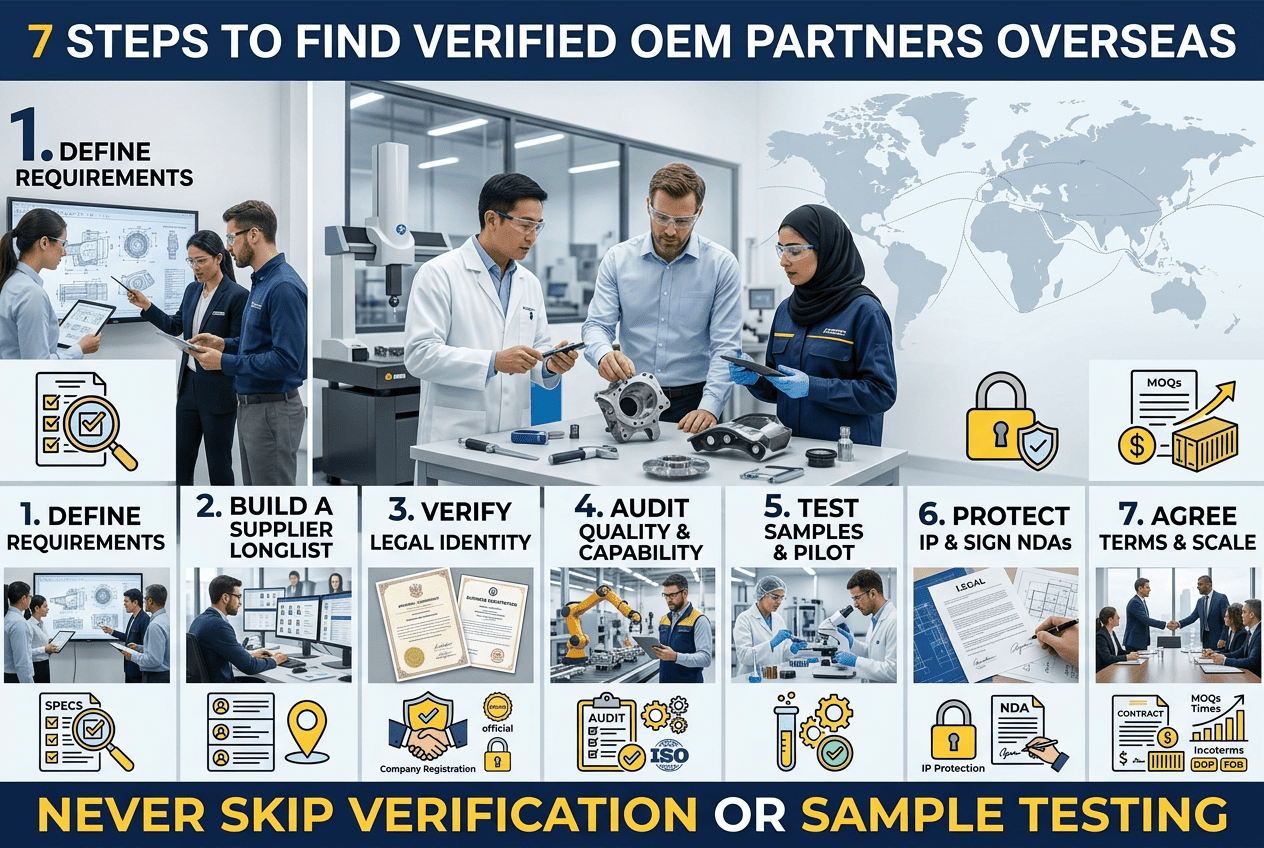
Direct Answer: To find verified OEM partners in foreign countries, follow a disciplined seven-step process. Define your specifications and requirements first; build a longlist through verified B2B platforms, trade bodies, trade shows and referrals; verify each company’s legal identity; vet capability and quality through certifications, references and audits; test with samples and a pilot run; protect your intellectual property with NDAs and clear contracts; and agree commercial terms such as MOQs, lead times and Incoterms before scaling. Never skip identity verification or sample testing, however attractive the quote. GTsetu helps by connecting buyers with government‑tie‑up verified manufacturers across 100+ countries, with built-in NDA workflows and zero broker commission.
📅 Published October 19, 2026🔄 Updated October 19, 2026⏱ 14 min read✍️ GTsetu Editorial Team
7
Steps to Find an OEM Partner
8
Vetting Checks
100+
Countries on GTsetu
0%
Broker Commission
Finding the right overseas manufacturer can lower your costs, widen your capabilities and speed up product launches. Choosing the wrong one can mean defective batches, leaked designs, missed deadlines and money you cannot recover across borders.
Brand owners, startups, importers, procurement and sourcing managers, and product companies looking for contract manufacturers or OEM suppliers outside their home country.
⚖️ Disclaimer
This guide provides general commercial education, not legal, tax or intellectual property advice. Requirements vary by country and product. Consult qualified professionals before signing contracts or sharing designs.
SECTION 1
1 What Is an OEM Partner?
🎯 Definition
An OEM (original equipment manufacturer) partner produces goods to your specifications, often under your brand. You control the design and requirements; the manufacturer controls production. A verified OEM partner is one whose legal identity, capability and track record you have independently confirmed, rather than accepted on trust.
OEM
Original Equipment Manufacturer
You provide the design; the factory builds to spec. More control, more upfront work.
📐 Your Design
ODM
Original Design Manufacturer
The factory supplies an existing or custom design that you brand. Faster, cheaper to launch.
⚡ Their Design
CM
Contract Manufacturer
A third party that manufactures on contract; the term often overlaps with OEM.
🤝 Build-to-Order
SECTION 2
2 The 7-Step Process
1
Define Specifications
Write down materials, tolerances, quality targets, volumes, budget and timelines.
2
Build a Longlist
Source candidates from verified platforms, trade bodies, shows and referrals.
3
Verify Identity
Confirm each company legally exists and is in good standing.
4
Vet Capability & Quality
Check certifications, capacity, quality systems, references and financial health.
5
Test Samples & Pilot
Evaluate samples, then a small pilot run, before committing volume.
6
Protect Your IP
Sign an NDA and set ownership and confidentiality terms before sharing designs.
7
Contract & Trade Terms
Agree pricing, MOQs, warranty, shipping terms and exit rights in writing.
SECTION 3
3 Step 1: Define Your Specifications
Good manufacturers cannot quote accurately on vague requests, and vague specs invite disputes later. Prepare a clear brief before you contact anyone.
📐
Technical Drawings
Dimensions, materials, tolerances, finishes and bill of materials.
🎯
Quality Standards
Acceptance criteria, testing methods and defect thresholds.
📊
Volumes & Budget
Target quantities, order cadence and target unit cost.
Before assessing quality, confirm the company exists, is registered and is active. Check legal name, registered address, registration number, company status, company type and incorporation date against official registries. Trading companies and shell entities regularly present themselves as factories.
Ask for the registration documents, compare them with public records, and match the name on quotes, contracts and bank accounts. A mismatch is a serious warning sign. This is the core of commercial due diligence.
SECTION 6
6 Step 4: Vet Capability & Quality
Certs
Certifications
Ask for current certificates relevant to your industry and confirm them with the issuing body.
📜 Evidence
Capacity
Equipment & Scale
Can they make your volume with their machinery, staff and shifts?
⚙️ Capability
QC
Quality Control
Inspection stages, testing equipment, defect tracking and corrective actions.
🔬 Process
Refs
References
Speak to existing customers, ideally in your sector or market.
🗣️ Track Record
Finance
Financial Health
Stability matters; a supplier that fails mid-order leaves you stranded.
GTsetu connects manufacturers, exporters, distributors and buyers across 100+ countries. Every company is verified through direct government tie‑ups across six credentials: legal name, registered address, registration number, company status, company type, and date of certificate of incorporation. This covers Step 3 of the process above. GTsetu does not verify industry certifications, product quality, factory capability or financial standing; these must be validated directly between partners.
✅
Government Tie‑Up Verification6‑point identity verification.
🕵️
Anonymous DiscoveryExplore manufacturer profiles without revealing your identity.
📄
Built-In NDA WorkflowFormalise confidentiality before sharing designs or specifications.
🚫
Zero CommissionNo broker fees on any deal.
🔐
Encrypted CollaborationDocuments and messages encrypted in transit and at rest.
An original equipment manufacturer (OEM) partner produces goods to your specifications, often under your brand. You typically own or control the design, while the manufacturer handles production.
QWhat is the difference between OEM and ODM?
With OEM, you supply the design and the manufacturer builds to your specification. With ODM (original design manufacturer), the manufacturer supplies an existing or custom-developed design that you rebrand or adapt. OEM gives more control; ODM can be faster and cheaper to launch.
QHow do I find verified OEM partners overseas?
Define clear specifications, build a longlist through verified B2B platforms, trade bodies, trade shows and referrals, verify each company’s legal identity, review certifications and references, audit or inspect where possible, order samples, and start with a pilot run before scaling.
QWhat should I check when vetting an OEM manufacturer?
Legal registration and company status, relevant certifications, production capacity, quality control processes, financial stability, references, communication responsiveness, minimum order quantities, lead times and willingness to sign NDAs and clear contracts.
QHow do I protect my intellectual property with an overseas OEM?
Register IP in relevant jurisdictions where possible, sign an NDA before sharing designs, use contract clauses on ownership, confidentiality and non-compete, limit what is shared at each stage, and take advice from an IP lawyer familiar with the manufacturer’s country.
QHow does GTsetu help find verified OEM partners?
GTsetu helps buyers discover and engage government-tie-up verified manufacturers and partners across 100+ countries, verifying six core credentials, with built-in NDA workflows, encrypted collaboration and zero broker commission.
Join 500+ verified manufacturers, exporters and importers building cross-border partnerships on GTsetu, with government‑tie‑up verification of six core credentials, built-in NDA workflows and zero broker fees across 100+ countries.
They represents the product, and research team behind GTsetu, a global B2B collaboration platform built to help companies explore cross-border partnerships with clarity and trust. The team focuses on simplifying early-stage international business discovery by combining structured company profiles, verification-led access, and controlled collaboration workflows.
With a strong emphasis on trust, and disciplined engagement, Team GTsetu shares insights on global trade, partnerships, and cross-border collaboration, helping businesses make informed decisions before entering deeper commercial discussions.