How to Find Verified Overseas Suppliers Without Trade Shows (2026) | GTsetu
Home ›
Blog ›
How to Find Verified Overseas Suppliers Without Trade Shows
🌍 Global Trade & Compliance
How to Find Verified Overseas Suppliers Without Trade Shows
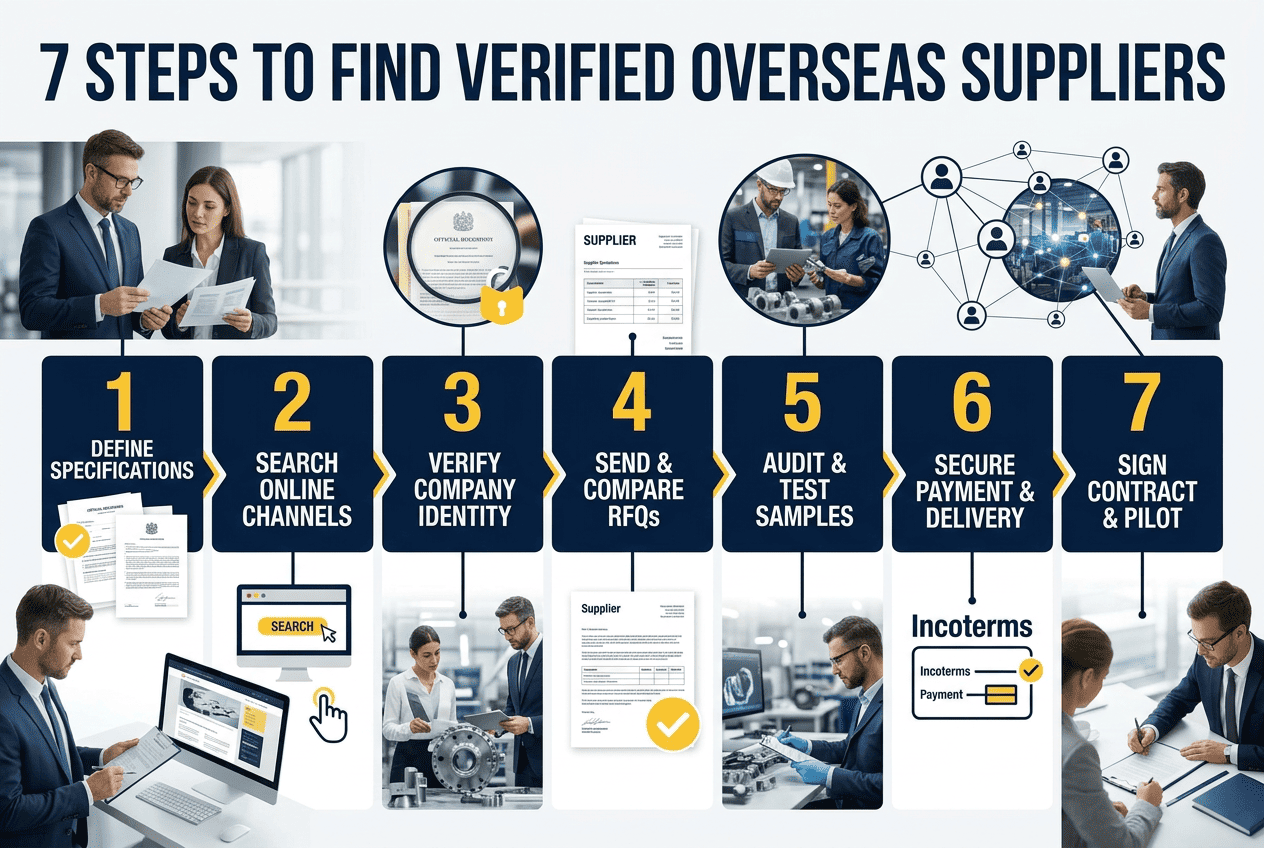
Direct Answer: To find verified overseas suppliers without trade shows, follow seven steps. First, define your specifications so you know exactly what you need. Second, search online channels: verification-first networks, B2B marketplaces, trade data, associations, government trade offices and referrals. Third, verify identity against official records before investing time. Fourth, send a structured RFQ to three to five suppliers and compare answers. Fifth, run a virtual audit, test samples and consider a third-party inspection. Sixth, protect payments and delivery with staged terms and clear Incoterms. Seventh, lock everything into a contract and start with a pilot order. GTsetu helps with the early steps by connecting you with government‑tie‑up verified companies across 100+ countries, with built-in NDA workflows and zero broker commission.
📅 Published October 28, 2026🔄 Updated October 28, 2026⏱ 14 min read✍️ GTsetu Editorial Team
7
Steps to Source Online
3–5
Suppliers per RFQ
100+
Countries on GTsetu
0%
Broker Commission
Trade shows remain valuable, but they are expensive, seasonal and not always possible. Travel budgets, small teams and tight launch timelines push many buyers to source entirely online. That can work well, provided you replace the in-person handshake with evidence: verified identity, comparable quotes, samples, audits and safe payment terms.
Importers, brand owners, manufacturers, procurement teams, startups and small businesses that need to source components, materials or finished goods from overseas suppliers without relying on exhibitions or travel.
⚖️ Legal & Compliance Disclaimer
This guide provides general commercial education on supplier sourcing. It does not constitute legal, financial, customs or regulatory advice. Import rules, product standards and registry access vary by country and change often. Always confirm current requirements with official sources and qualified advisers.
SECTION 1
1 Why Source Without Trade Shows
🎯 Definition
Online supplier sourcing is the process of finding, vetting and contracting overseas suppliers without attending exhibitions. It combines digital search channels, identity and capability verification, structured quotation and sampling, and payment and contract safeguards that substitute for face-to-face assurance.
Benefits and Trade-Offs
💰
Lower Cost
No stand fees, flights or hotels. Budget goes to samples, audits and inspections instead.
🌍
Wider Reach
Search across many countries and suppliers, not only those exhibiting at one event.
⏱️
Year-Round Speed
Start sourcing any day of the year rather than waiting for the next fair.
🔎
Easier Comparison
Side-by-side RFQs make price, lead time and quality easier to compare fairly.
Relationships take more deliberate video calls and follow-up. Plan for it.
SECTION 2
2 The 7-Step Process at a Glance
Do the inexpensive desk work first. Spend on samples, audits and inspections only for suppliers who pass each earlier filter.
1
Specify
Write clear specifications, volumes, standards and target landed cost.
📑 Requirements
2
Search
Use several online channels to build a long list.
🔎 Discovery
3
Verify
Confirm legal identity and status against official sources.
🪪 Trust
4
Quote
Send identical RFQs and compare price, lead time and responsiveness.
📨 Comparison
5
Audit
Check capability by live video, samples and third-party inspection.
🏭 Capability
6–7
Pay & Contract
Protect payments, sign clear terms and begin with a pilot.
📝 Protection
✨ GTsetu Insight
Steps 2 and 3 are where online buyers lose the most time and take the most risk. Starting with companies already checked against government sources shortens both. Assess finalists with our partnership evaluation criteria.
SECTION 3
3 Step 1: Define Your Specifications
Vague requests attract vague, unreliable answers. A precise specification lets good suppliers self-select and makes quotes comparable.
1
Describe the Product Precisely
Include materials, dimensions, tolerances, finish, packaging, labelling and drawings or reference samples where possible.
2
State Volumes, Timing and Budget
Give trial and annual quantities, required lead time and a target landed cost so suppliers can judge fit.
Before negotiating, confirm the supplier is a real, active, legally registered company. This simple desk check removes a large share of fraud and impersonation.
✅ What to Confirm
✅ Legal name and registered address match official records.
✅ Registration number and company status (active, not dissolved).
✅ Business scope covers the product you want.
✅ Email domain, website and bank details name the same entity.
🚩 Red Flags
⚠️ Refuses to share registration details.
⚠️ Asks for payment to a personal or third-party account.
⚠️ Prices far below every other quote.
⚠️ Stock photos or factory images used by other companies.
📌 Go Deeper When Stakes Are High
For larger or longer-term supply relationships, extend identity checks into reputation, financial health and track record. See commercial due diligence.
SECTION 6
6 Step 4: Run a Structured RFQ
Send the same request to three to five verified suppliers and compare answers on more than price.
Compare
What to Look For
Price & Terms
Unit price, tooling or setup costs, minimum order quantity, payment terms, stated Incoterm
Lead Time & Capacity
Production time, realistic capacity for your volumes, peak-season constraints
Quality Approach
In-process checks, testing, defect handling and certifications held
Responsiveness
Speed and clarity of replies, quality of technical questions asked
Flexibility
Willingness to customise, accept audits and agree to a pilot
✨ GTsetu Insight
Sign a mutual NDA before sharing drawings or detailed specifications. GTsetu’s built-in NDA workflow creates a digital audit trail. For help structuring sourcing strategy, explore international business development consulting.
SECTION 7
7 Step 5: Audit Virtually & Test Samples
Without a site visit, you must prove capability another way. Match the depth of checks to order value and risk.
📹
Live Video Walkthrough
Ask for unscripted video of production lines, quality checks and your product category in progress.
🧪
Production Samples
Order samples made on the actual line and test them against your specification.
🔍
Third-Party Inspection
Hire an independent inspector for factory audits and pre-shipment checks when stakes are high.
Payment terms are your strongest protection when you cannot meet in person.
🎯 Payment Safety Rules
• Pay only to a corporate bank account in the verified company’s registered name.
• Treat last-minute bank detail changes as suspicious until confirmed through a known contact.
• Use staged payments or a letter of credit for larger orders; pay balances after inspection.
• Account for currency conversion and bank fees when comparing quotes across countries.
• Fix responsibility and risk transfer with Incoterms 2020 and FCA (Free Carrier).
SECTION 9
9 Step 7: Contract & Pilot Order
A written agreement converts what you verified into enforceable commitments. Start small to confirm the supplier performs as promised.
1
Agree Specifications and Acceptance Criteria
Attach drawings, tolerances and inspection standards so quality disputes can be resolved objectively.
Test quality, communication and delivery on a small order before scaling. If you plan to acquire a supplier’s operations later, read what an asset purchase agreement is.
11 How GTsetu Helps You Find Verified Overseas Suppliers
🌐 Platform Spotlight, GTsetu
Start Sourcing From Verified Companies, Not Guesswork
GTsetu connects manufacturers, exporters, importers and distributors across 100+ countries. Every company is verified using direct government tie‑ups across six essential credentials: legal name, registered address, registration number, company status, company type, and date of certificate of incorporation. GTsetu does not verify industry certifications, product quality, or financial standing; those must be exchanged and validated directly between partners using the steps in this guide.
✅
Government Tie‑Up Verification6‑point verification: legal name, registered address, registration number, company status, company type, incorporation date.
📜
Certifications & QualityNot verified by GTsetu. Validate directly with suppliers during due diligence.
🕵️
Anonymous DiscoveryBrowse verified supplier profiles without revealing your identity until mutual interest is confirmed.
📄
Built-In NDA WorkflowFormalise confidentiality before sharing drawings or specifications, with a full digital audit trail.
🚫
Zero CommissionNo broker fees on any supply, distribution or partnership deal.
🔐
Encrypted CollaborationDocuments and messages encrypted in transit and at rest from first contact.
🌍
100+ CountriesA growing verified network for sourcing across regions.
QHow can I find overseas suppliers without going to trade shows?
Use a mix of online channels: verification-first B2B networks, B2B marketplaces, trade and customs data, industry associations, government trade offices and chambers of commerce, professional networks, and referrals from peers. Define your specifications first, build a shortlist, verify identity, request quotes and samples, and audit virtually or through a third party.
QHow do I verify an overseas supplier online?
Confirm legal name, registered address, registration number and company status against official sources, check that the business scope covers your product, request references and certifications and validate them with issuers, hold a live video walkthrough of the facility, and consider a third-party inspection.
QCan I trust a supplier I only meet online?
Trust should be built from evidence, not impressions. Verify identity, test samples, use staged payments, run a pre-shipment inspection and start with a small pilot order before committing to larger volumes.
QWhat is an RFQ and why does it matter?
A request for quotation (RFQ) is a structured request sent to several shortlisted suppliers with the same specifications, quantities and terms. It lets you compare price, lead time, quality and responsiveness fairly and shows which suppliers understand your requirements.
QHow do I pay overseas suppliers safely?
Pay only to a corporate bank account in the verified company’s registered name, use staged payments tied to milestones or an irrevocable letter of credit for larger orders, confirm any bank detail change through a known contact, and agree clear Incoterms so responsibilities and risk are defined.
QHow does GTsetu help find verified overseas suppliers?
GTsetu connects manufacturers, exporters, importers and distributors across 100+ countries. Companies are verified through government tie-ups on six credentials (legal name, registered address, registration number, company status, company type, incorporation date), with anonymous discovery, built-in NDA workflows, encrypted collaboration and zero broker commission. GTsetu does not verify certifications, product quality or financial standing; those are validated directly between partners.
Ready to Source From Verified Overseas Suppliers?
Join 500+ verified manufacturers, exporters, and importers already building cross-border partnerships on GTsetu, with government‑tie‑up verification of six core credentials, built-in NDA workflows, and zero broker fees across 100+ countries.
They represents the product, and research team behind GTsetu, a global B2B collaboration platform built to help companies explore cross-border partnerships with clarity and trust. The team focuses on simplifying early-stage international business discovery by combining structured company profiles, verification-led access, and controlled collaboration workflows.
With a strong emphasis on trust, and disciplined engagement, Team GTsetu shares insights on global trade, partnerships, and cross-border collaboration, helping businesses make informed decisions before entering deeper commercial discussions.